

As expected by last week's financial markets and the prediction betting markets, the US and Israel struck Iran over the weekend. Plenty of uncertainty right now in the Middle East as the world awaits the Iranian leadership's response. For now the Strait of Hormuz appears negatively affected as shippers avoid the waterway due to fear for their safety or threats from their insurance companies. A few weeks of crude oil supply at sea and in storage will help minimize the immediate price impact. But if the conflict extends into April, crude oil prices could potentially reach triple digits.
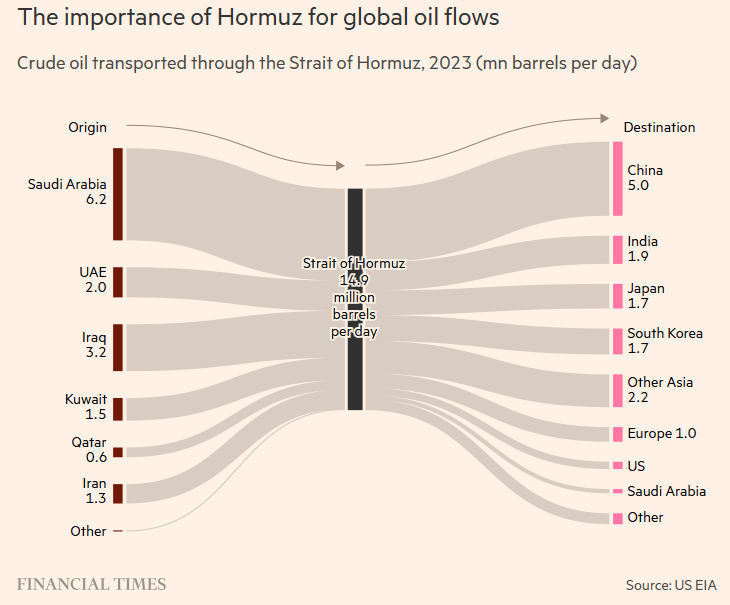
Higher energy prices have many impacts around the globe. Here in the US, higher gasoline prices will be a headwind for consumer spending, thus braking GDP growth. For Europe, a pause in Qatar's LNG production (20% of global exports) has caused a jump in natural gas prices when storage levels are near seasonal lows. With one-half of the Strait of Hormuz oil flowing to China and India, any long term freeze in deliveries will pressure those governments to find another solution. Other regions may attempt to increase their energy output, but it won't offset what might be shut in or undeliverable.
It is difficult to say if the weekend's events will create a risk-off buying opportunity. As of Monday, the largest equity declines appeared in cruise ships, airlines, hotels/casinos, luxury goods and homebuilders. International equity markets heavily dependent on imported energy also took a hit. But given the administration's comments that this conflict could last another five weeks and that the next surge would be larger and could include ground forces, investors might not rush to hit the buy button just yet. A war extending into April could easily pause the business momentum accumulated over the last 9 months. Expect IPO bankers and corporate syndicate desks to slow their pace of activities until more clarity emerges. And be reminded that the marketing for the financing of the largest buyout ever, Electronic Arts, begins this week with one of its major private equity buyers headquartered in the Middle East.
Away from Iran, Nvidia, the largest company in the world reported last week. The results exceeded expectations, and most analysts raised their earnings forecasts and price targets. But even with Jensen saying all the right things, stockholders were left unrewarded. This shows you exactly where we stand in the current market. Mag-7 and AI are being questioned, while asset-intensive businesses are being rewarded. Equity investors continued to move toward International, Value and Smaller-cap companies last week. Note the international index ETFs below, which recorded their 14th straight weekly gain. Unreal. A 15th consecutive weekly gain is unlikely as rising energy costs hit many European and Asian stock indexes.
For the week ahead, the US economy will report its normal monthly run of job data points: ADP Employment, Challenger Job Cuts, Nonfarm Payrolls, Unemployment Rate, and Average Hourly Earnings. As a result of the February storms, job growth in snow shoveling may have drawn workers from all other industries. Elsewhere, the remaining news and data coverage will center on the Middle East and disruptions to global energy markets. Let's all hope that this conflict ends soon.
Maybe the most important chart in the US for the next few weeks…
@peark.es: Attacking Iran looks like it will cost US consumers about 40 cents/gallon.
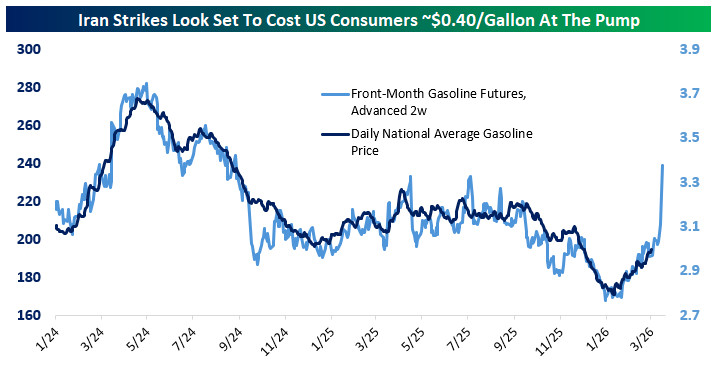
But as painful as a 40 cent bump to gasoline prices might be to Americans, several other major nations could be looking at much larger increases…
China is a major buyer of Gulf oil, meaning its economy would be damaged by a serious disruption to traffic. Some 84 per cent of the crude oil and condensate, and 83 per cent of the liquefied natural gas, that went through the Strait in 2024 was destined for Asian markets, according to the US Energy Information Administration. China, India, Japan and South Korea were key destinations, it added.
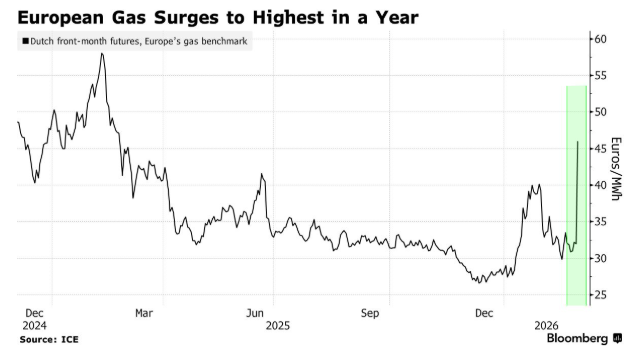
The big impact to Europe will be felt in the form of natural gas prices…
Qatar shut LNG production at the world’s largest export facility after it was targeted in an Iranian drone attack, sending European gas prices surging as much as 54%.
QatarEnergy’s Ras Laffan plant covers about a fifth of global liquefied natural gas supply, and the unprecedented halt now threatens energy security and rattled global markets.
Europe’s benchmark gas futures jumped by the most since the 2022 crisis caused by Russia’s invasion of Ukraine.
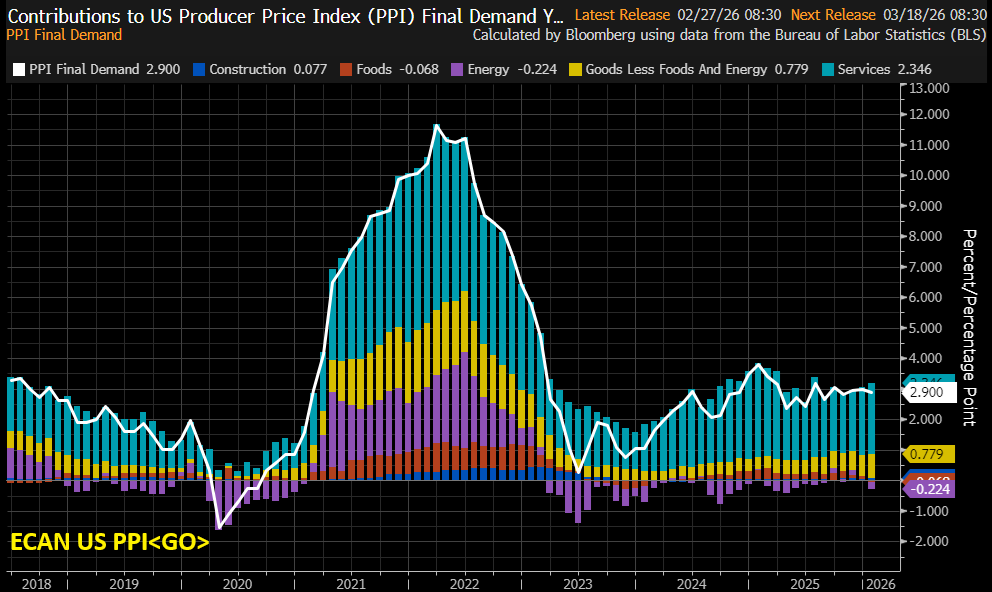
Given the surprise pop in last week's PPI release, an increase in gasoline prices would be an unwelcome event for a Federal Reserve official wanting to lower interest rates…
@M_McDonough: The January PPI print arrived well above consensus, as core pressures intensify. While headline figures benefited from a reprieve in energy and food, the underlying data suggests a much stickier environment for producers.
Key Data Points:
PPI Final Demand (MoM): +0.5% vs. +0.3% Est. (Prev. +0.4%)
Core PPI (Ex-Food/Energy): +0.8% vs. +0.3% Est. — a significant upside surprise.
Year-over-Year: Headline PPI cooled slightly to 2.9%, but Core PPI accelerated to 3.6% (from 3.3%).
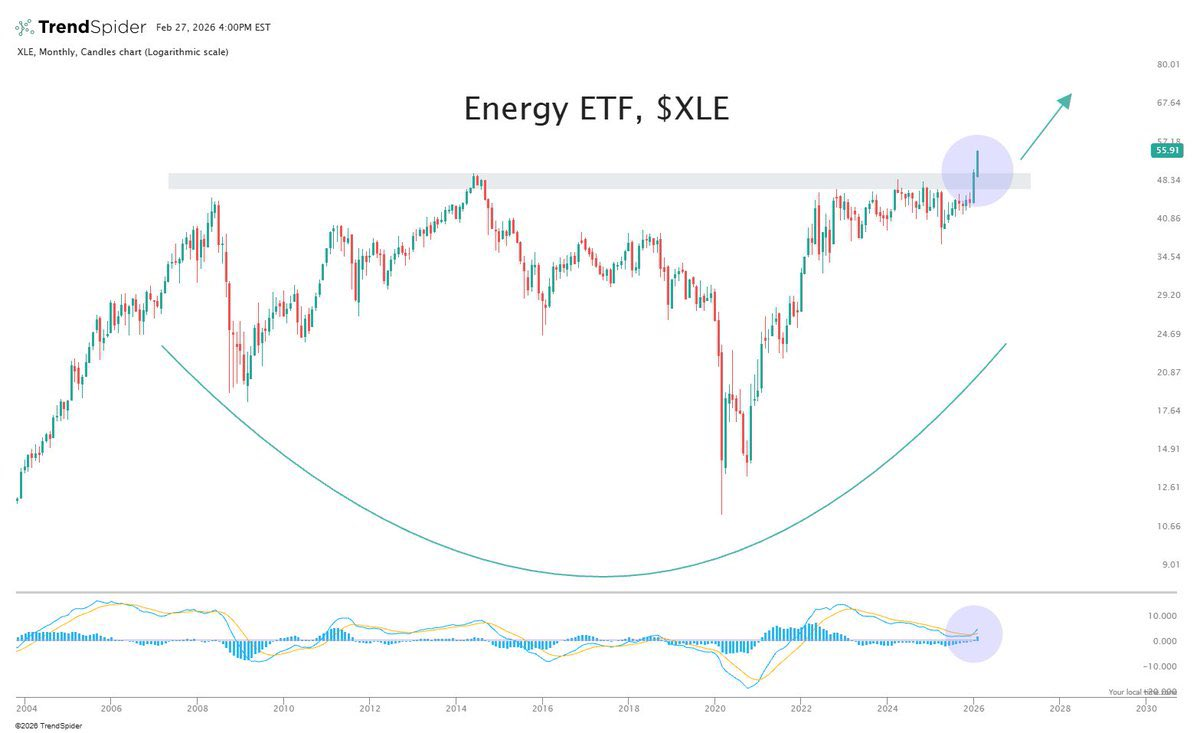
Unrest in the Middle East will likely push Energy stocks further out of their 18-year base breakout…
@TheChartReport: The Energy sector is completing a massive 18-year base while triggering a fresh bullish crossover on the monthly PPO.
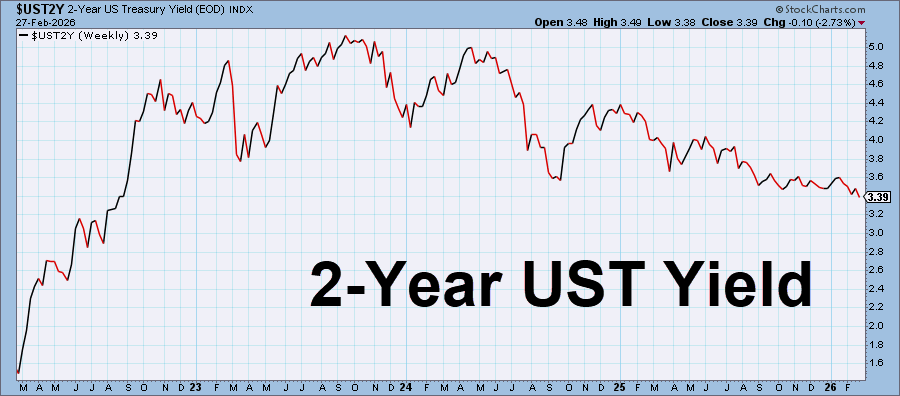
Two-year US Treasury yields broke to a 2022 low on Friday…
This was partially due to continued falling housing costs and energy prices. Also likely some movement from the corporate credit markets to the risk-free markets as worries over Blue Owl, BDCs and the UK's mortgage lender MFS grew.
StockCharts
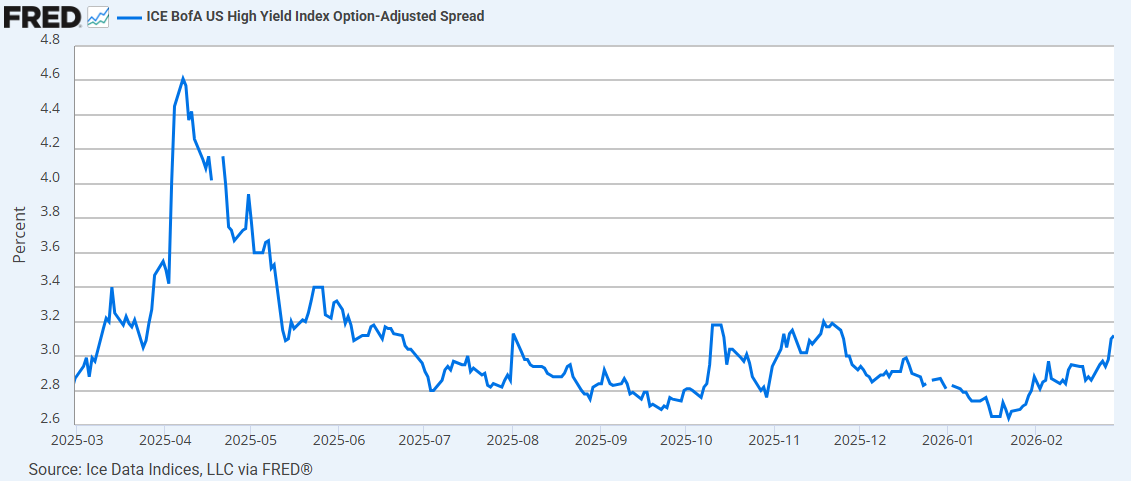
A look at the High Yield Index shows spreads widening off of its near all-time low base…
A move toward 400 bps would be an unfortunate turn of events and likely put a lid on the equity markets.
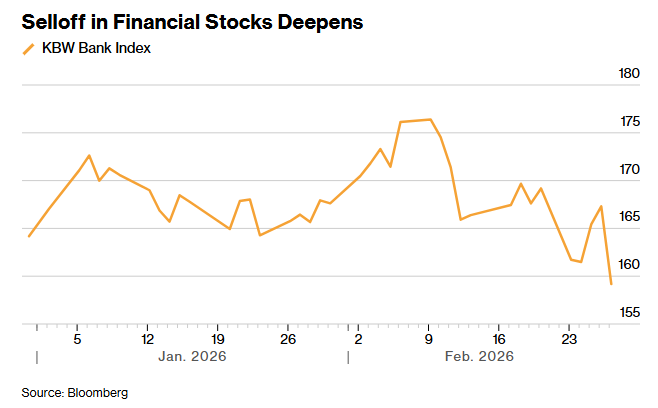
Falling risk free yields combined with increased worries about AI and some new credit items continue to weigh on bank stocks…
Financial stocks ended January as one of the GOATs of US stock sectors. Now they acts like another Mag-7 name. Let's see if buyers will come and take advantage of the new discounted prices.
Financial firms ended February where they spent much of the month: enduring another dizzying blow from the threat of artificial intelligence and grappling with signs those cockroaches Jamie Dimon warned about in the world of private credit are starting to scurry.
The combination delivered another bruising selloff in shares of banks and asset managers Friday. The KBW Bank Index slumped 4.9%, dragging the group to levels last seen in early December. It’s worst session since April’s trade turmoil. All 23 members slid at least 1.9%, with Western Alliance Bancorp, Goldman Sachs Group Inc. and Zions Bancorp NA among the worst performers.
Lenders, payments providers and asset managers have suffered a rolling barrage of blows this month, most prominently from new AI applications and private credit woes. Credit spreads have also started widening, and a Wall Street-backed UK mortgage lender collapsed, adding to fear that banks could face rising defaults in the opaque world of private lending.
Investment-grade bond markets, which had emerged as a safe haven during recent AI-driven swings in equities, are now showing some signs of strain. Globally, premiums on comparable debt have already widened by nearly 4 basis points this week, the largest move since early November, according to a Bloomberg index.
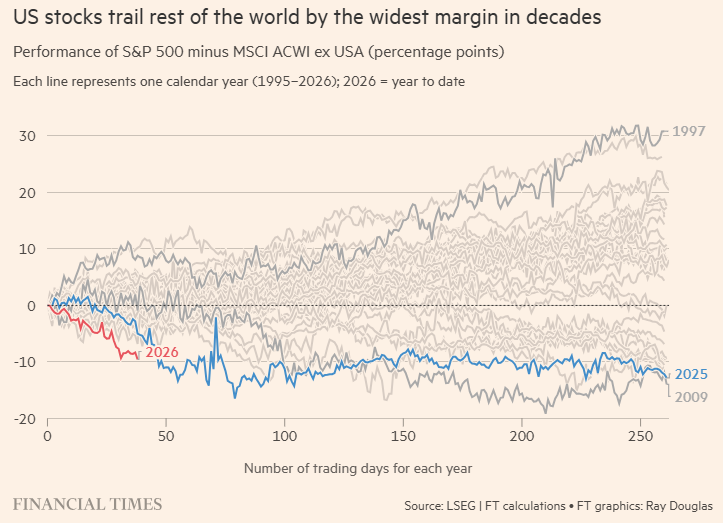
Through Friday, the US equity market was putting up its worst relative performance in thirty years…
The US’s benchmark S&P 500 index is now slightly negative on the year, bobbing tediously higher and lower in an unusually tight range since late December. Normally, this would reflect a global outbreak of nerves. This time, however, it’s focused squarely on the US, due to stress in its prized tech sector and policy dysfunction. European and Asian markets are mostly doing just fine.
Global stocks, measured in the widely tracked MSCI World Index and skewed heavily towards the US, are up by 2 per cent so far in 2026. That’s decent. But if you strip out the US, you’re up a much rosier 9 per cent. The fact is, it has paid to give US markets a swerve right now. So far this year, they are a dud.
This is shaping up to be the worst year for US stocks compared with the rest of the world since at least 1995. It is not yet clear how meaningful the recent pullback in AI-related stocks will turn out to be, but the wave of nausea over the impact of AI on the wider tech sector is certainly helping to tilt the balance further from the US, and towards Europe.
Michael Hartnett at BofA Global claims the new world order is own International…
The Biggest Picture: long view... new world order = new world bull; we say international stocks outperform US H2'2020s; RoW 38% share of $97tn global stock market cap (vs US 62% – Chart 2) to rise further on fiscal excess, populism, end of deflation... plus AI disruption more labor market (see Block) and/or corporate revenue negative to services-heavy US GDP & SPX index than manufacturing/resource-heavy EAFE/EM macro & equity indices.
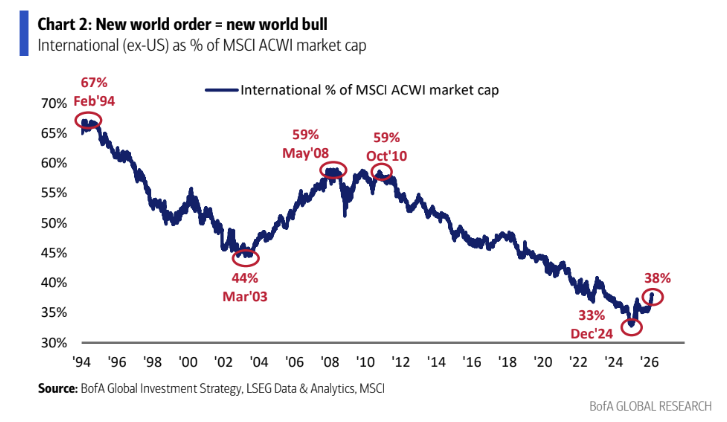
BofA Global
Here is the 14-week positive streak for these international index ETFs…
Do not hold your breath for a 15th week.
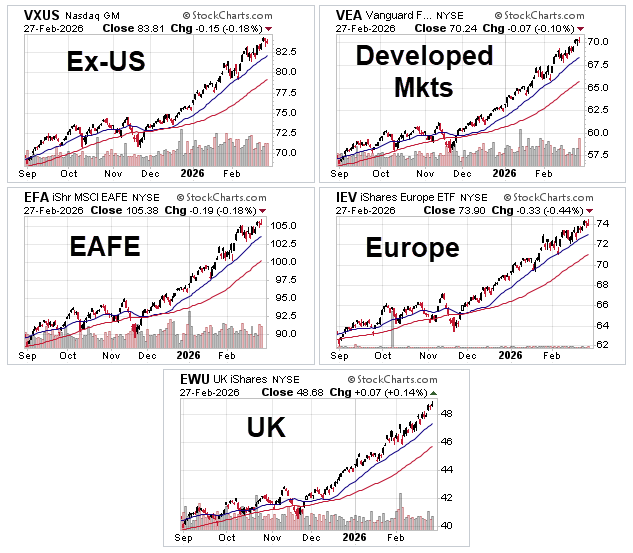
StockCharts
And while the S&P 500 battles with being flat for 2026, only a handful of red index ETFs around the world…
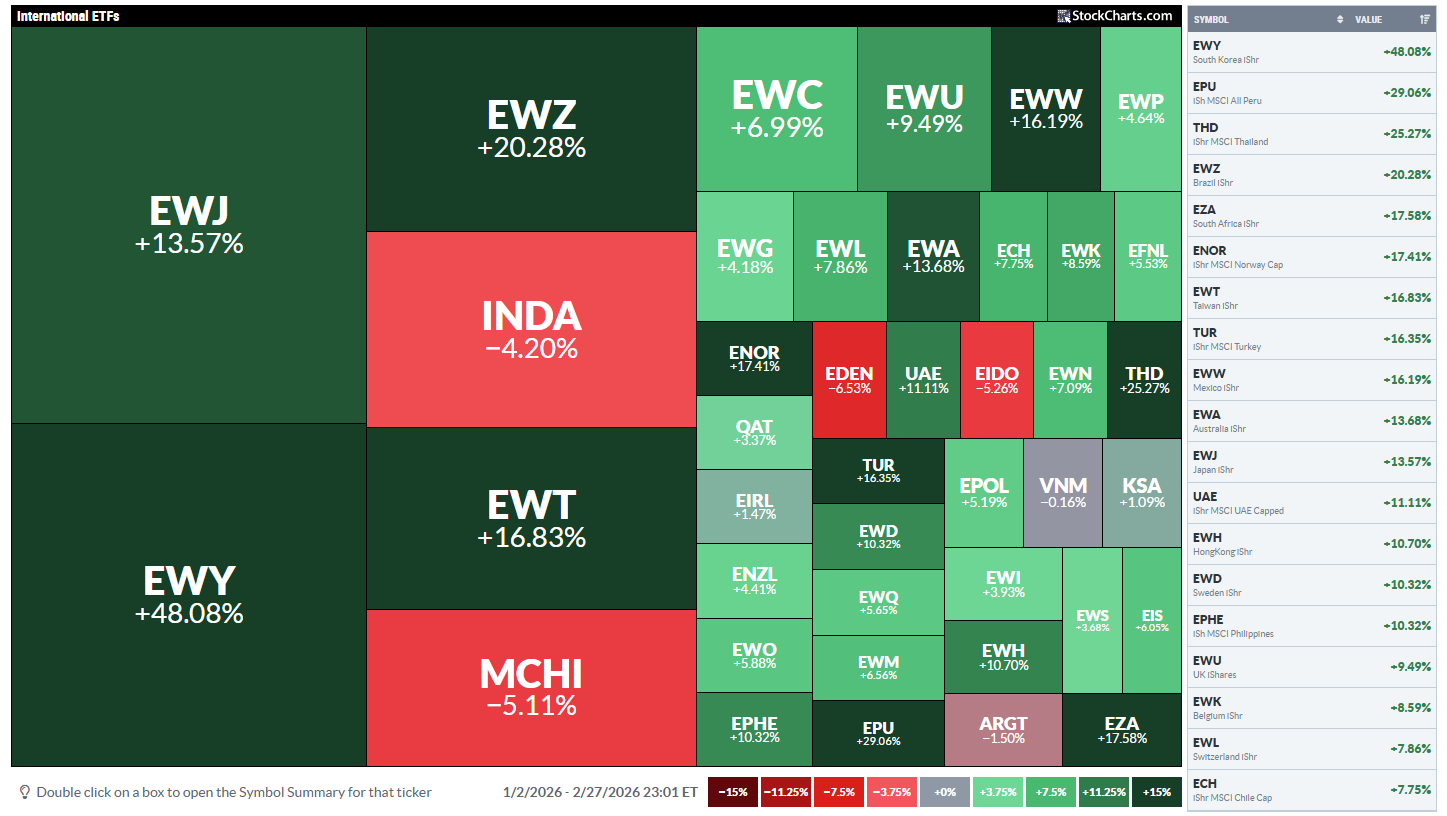
StockCharts
The most widely discussed company this week in corporate meetings, across company email, and over Slack channels will be Block…
"A significantly smaller team, using the tools we're building, can do more and do it better." — Jack Dorsey, Feb 2026.
Block (formerly Square) is a growing company, but it became a thick company as it grew through COVID and after acquiring the 1,300 employees of Afterpay in 2022. On Friday, Jack tweeted that the company would be shrinking its employee base by 40%. The news is being sold as AI eliminating the need for 4,000 team members. This might be partially true, but to be fair, Block has way too many employees. But other fintech executives will have read the news and seen the +20% increase in the stock price and begin to wonder, "What if?".
With earnings, Block announced that it would be reducing its headcount by more than 40% or by ~4,000 employees. Although a reduction was expected considering intra-qtr news reports, the magnitude is very surprising. The company was clear to say that these changes are being made from a position of strength and aren’t primarily motivated by cost savings, both being points that we agree with. Rather, Dorsey and team highlighted how a step function improvement in AI tools is allowing smaller teams to get more done with less, and Block is proactively restructuring its organization to adapt to the impending world of work.
While we appreciate management’s bold commitment to modernizing its org structure, we also acknowledge that Block’s headcount has expanded almost 3x since 2019, and this reduction would take XYZ’s headcount back toward 2020-2021 levels, giving some credence to the argument that this move is partially motivated by improving talent density, a move we welcome. That said, if we assume Block headcount ends the year at ~6K employees, it would be earning ~$2M in gross profit per employee, which by our math is ~2x higher than Visa’s rev-per, ~3x higher than Shopify’s GP-per and ~8x higher than Toast’s GP-per, indicating a level of AI-enabled efficiency that would be a standout among peers.
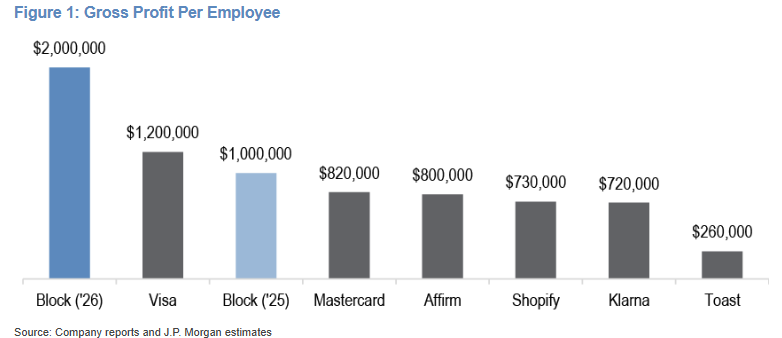
J.P. Morgan
Good timing for a new piece from Howard Marks…
“Nothing has ever taken hold at the pace AI has. It’s able to change the world at a speed that approaches instantaneous, outpacing the ability of most observers to anticipate or even comprehend. In the past, infrastructure was built for a new technology, and it often took years for that infrastructure to be fully utilized. In the case of AI inference, however, demand already exists and is growing rapidly, and I’m told AI is supply constrained.”
Even the Fed has uncertainty surrounding AI adoption on the US job market…
“The thing with AI is it’s coming at us so fast….that it’s easy to start seeing jobs that may go away before you see the new jobs that are going to be created… I either think that you’ll see some return to job growth coming in this next year, or we’re in a period of economic activity I’ve never seen in my life:” Fed Gov. Chris Waller
@lisaabramowicz1
Legacy software players say that they will not become obsolete. Now they just have to prove it…
WorkDay CEO at the start of the earnings call: "I've been working in the HR & ERP space for over 30 years...That kind of complexity [HR & ERP systems] is very hard to replicate. No amount of vibe coding is going to produce an HR or an ERP system."
@TheTranscript_
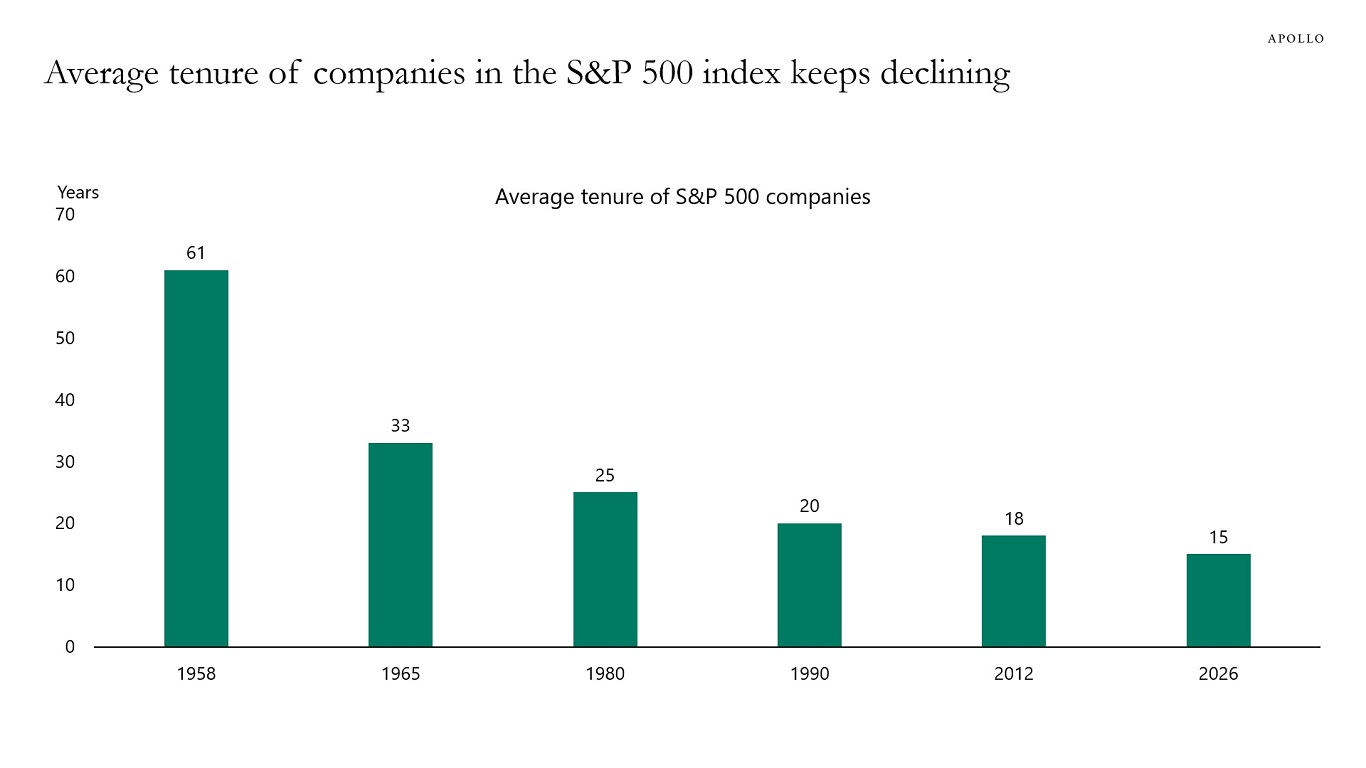
AI should decelerate the average tenure of S&P 500 companies even further…
The average number of years a company remains in the S&P 500 index keeps declining.
Several factors are driving the faster churn in the index:
- Creative destruction operates more rapidly, shortening the typical time a company remains large and competitive enough to stay in the S&P 500.
- Technological innovation (IT, internet, AI, cloud, mobile) creates new business models that scale quickly and displace incumbents before they can adapt.
- M&A and private equity activity more regularly remove large firms from public markets via buyouts or mergers.
The bottom line is that companies in the S&P 500 stay successful for shorter and shorter periods.
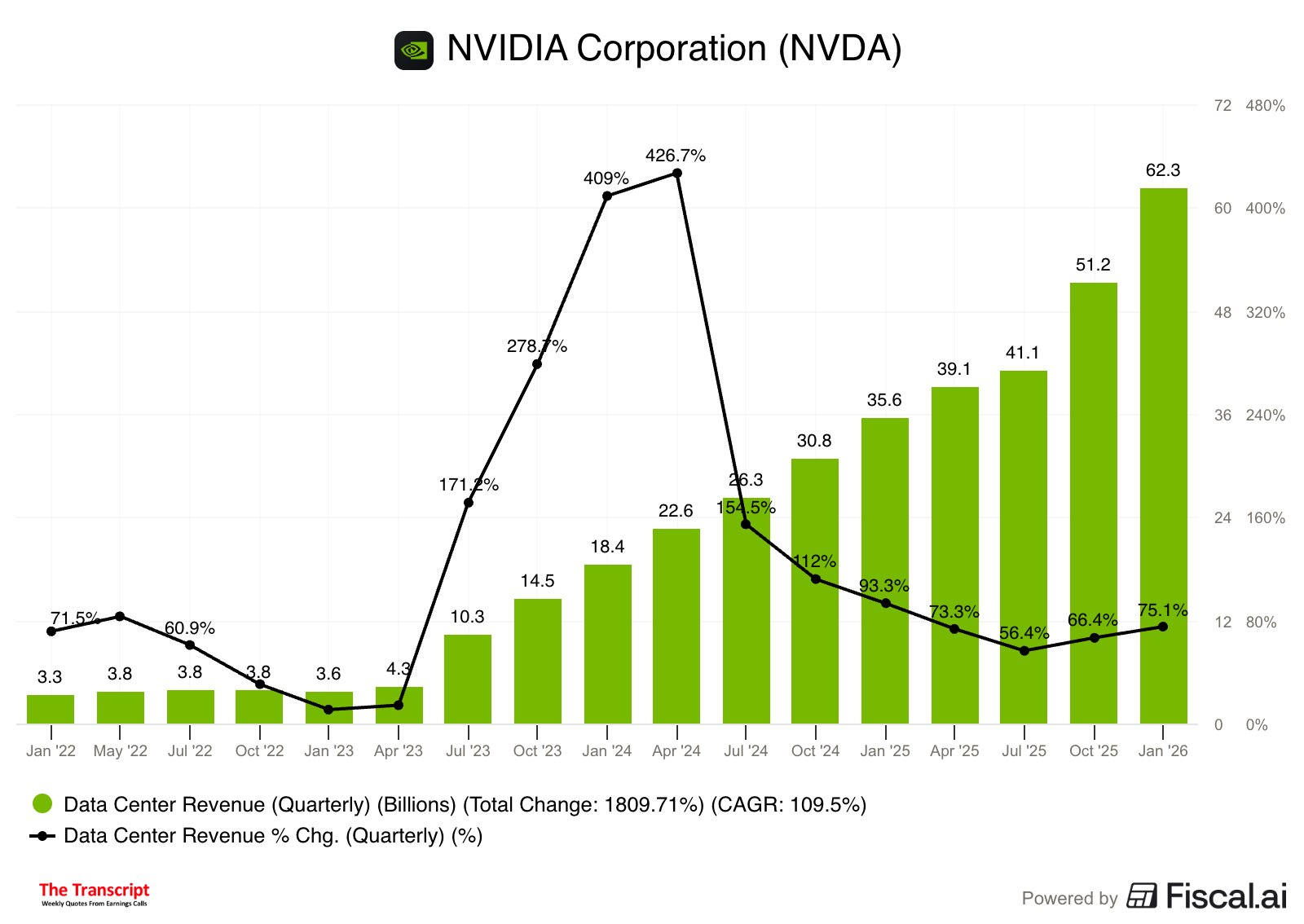
Nvidia data center revenue growth continues to accelerate, stock price targets get raised, and the market could care less…
$NVDA CFO: "Analysts' expectations for 2026 CapEx across the top 5 cloud providers and hyperscalers, who collectively account for little over 50% of our data center revenue, are up nearly $120B since the start of the year and approaching $700B."
$NVDA CFO: "Q4 data center revenue of 62B increased 75% Y/Y & 22% Q/Q, driven primarily by sustained strength in Blackwell & the Blackwell Ultra ramp. With Nvidia infra in high demand, even Hopper & much of the six year old Ampere based products are sold out in the cloud."
@TheTranscript_
Another busy week in the M&A markets…
Excluding the Paramount win over Netflix for Warner Brothers Discovery ($70 billion market cap), there was another $70 billion of M&A hitting the global markets including a big one in Japan.
- Elliott Investment Management has agreed to a sweetened bid for Toyota Industries that values the company at almost $40 billion, paving the way for the Japanese forklift maker to be taken private. Toyota Fudosan, the group’s real-estate arm, said Monday that it planned to increase its tender offer price for Toyota Industries to 20,600 yen a share, equivalent to $132, from its previous offer of ¥18,800. The new offer valued Toyota Industries at about $39.66 billion. Toyota Fudosan is privately held by Toyota (6201.jp) group companies, with Toyota Motor Chairman Akio Toyoda also serving as its chairman. Shares of Toyota Industries closed 1.5% higher at ¥20,535 on Monday. They were below ¥13,000 in mid-April, before the company said it received various proposals, including one to take the business private.
- BlackRock Inc.’s Global Infrastructure Partners LP and EQT AB agreed to buy AES Corp. (AES) for about $10.7 billion in cash as the market heats up for power plant developers that can provide electricity for energy-hungry AI data centers. GIP and EQT will pay $15 per share for AES representing a 40% premium to the 30-day volume-weighted average share price before July 8 last year, the last full day of trading prior to the first media report of a potential acquisition. The enterprise value of the deal is about $33.4 billion.
- Victory Capital (VCTR) went public with its $8.6 billion offer for Janus Henderson (JHG) ratcheting up pressure on the asset manager that previously agreed to a $7.4 billion buyout by Nelson Peltz's Trian and General Catalyst. Victory offered $30 in cash and 0.350 of its shares for each share of Janus for a value of $57.04 per share that would create a money manager with more than $800 billion in assets. The Trian-led December proposal valued Janus' shares at $49 each. The offer is a 37% premium to JHG unaffected share price as of October 24, 2025 and ~16% premium to Trian deal.
- Brink’s Company (BCO) plans to acquire NCR Atleos (NATL) for about $4 billion in cash and stock, a deal that combines two major players in the ATM business. The companies said the deal includes 13.3 million shares of Brink’s common stock and $2.2 billion in cash, plus the assumption of about $2.6 billion of NCR Atleos’ debt.
- Equinix (EQIX) to acquire with CPP Investments Nordic data center company atNorth for $4B - Canada Pension Plan Investment Board (CPP Investments) and Equinix announced they have entered into a joint agreement to purchase atNorth—a leading Nordic high-density colocation and built-to-suit data center provider—from Partners Group, one of the largest firms in the global private markets industry.
- CECO Environmental Corp (CECO) to merge with Thermon Group Holdings (THR) in $2.2B stock and cash deal. The filtration company looks to enter the thermal solutions market amid booming demand from data centers. Thermon offers industrial process heating, temperature maintenance, environmental monitoring, and temporary power distribution solutions.
- Magellan Financial Group Ltd. agreed to buy Barrenjoey Capital Partners in a deal valued at about A$1.62 billion ($1.1 billion), delivering a windfall for the ex-UBS Group AG bankers who set up the Australian investment bank just five years ago. Since opening in 2020, Sydney-based Barrenjoey has expanded to more than 400 employees and now spans corporate and strategic advisory work, capital markets underwriting and research.
- GSK (GSK.uk) has agreed to pay $950 million in cash for Canadian biotech 35Pharma marking the second major deal new CEO Luke Miels has struck to accelerate development of new medicines at the British drugmaker. The latest acquisition of 35Pharma's experimental pulmonary hypertension drug, HS235, will bolster GSK's future pipeline of respiratory medicines.
Various News Sources
Speaking of showtime, let's raise the curtain for Paramount and Netflix…
Paramount will be levered 6-7x which puts them immediately between a rock and a hard place to find $6 billion in cost cuts while also attempting to produce the best content in the world. Pray there is no economic slowdown or a new advertising revenue shift. Netflix doesn't gain a studio but gets a competitor who will need to provide them with content along with that big fat check. Grab an extra-large bucket of popcorn for this main event.
Netflix will walk away about $2.8 billion richer thanks to the termination fee outlined in their agreement with Warner. And it has run up the price on what will be a larger competitor, once Paramount Skydance and Warner Discovery get their merger over the necessary regulatory hurdles. One risk to losing the deal had been that a combined Paramount-Warner entity could pull popular content off Netflix to use for their own streaming offerings. But the merged company will now need all the cash flow it can muster to service a substantial debt load, so it is unlikely to fully turn away from the biggest payer in town.
That debt load—which Bernstein analyst Laurent Yoon estimates will total close to $100 billion—raises fresh questions about how combining two major studios will affect Hollywood, which has already been battered by shrinking TV and movie production. Substantial layoffs seem certain, but cost cutting alone won’t make the operation into the sort of entertainment powerhouse that can better compete with the likes of Netflix and Disney. Compelling shows and movies will still be needed, and the costs of producing quality content are only going up.
In a report Friday, Robert Fishman of MoffettNathanson said content spending by Paramount-Warner will need to rank “atop its media peers.” But the company will also need to pay down a lot of debt to get back to an investment-grade credit rating, which Paramount Chief Strategy Officer Andy Gordon said the company was “absolutely committed to” in an earnings call on Wednesday.
Learn more about the Hamilton Lane Strategies
DISCLOSURES
The author has current equity ownership in: Nvidia Corp. and Netflix Inc.
The information presented here is for informational purposes only, and this document is not to be construed as an offer to sell, or the solicitation of an offer to buy, securities. Some investments are not suitable for all investors, and there can be no assurance that any investment strategy will be successful. The hyperlinks included in this message provide direct access to other Internet resources, including Web sites. While we believe this information to be from reliable sources, Hamilton Lane is not responsible for the accuracy or content of information contained in these sites. Although we make every effort to ensure these links are accurate, up to date and relevant, we cannot take responsibility for pages maintained by external providers. The views expressed by these external providers on their own Web pages or on external sites they link to are not necessarily those of Hamilton Lane.