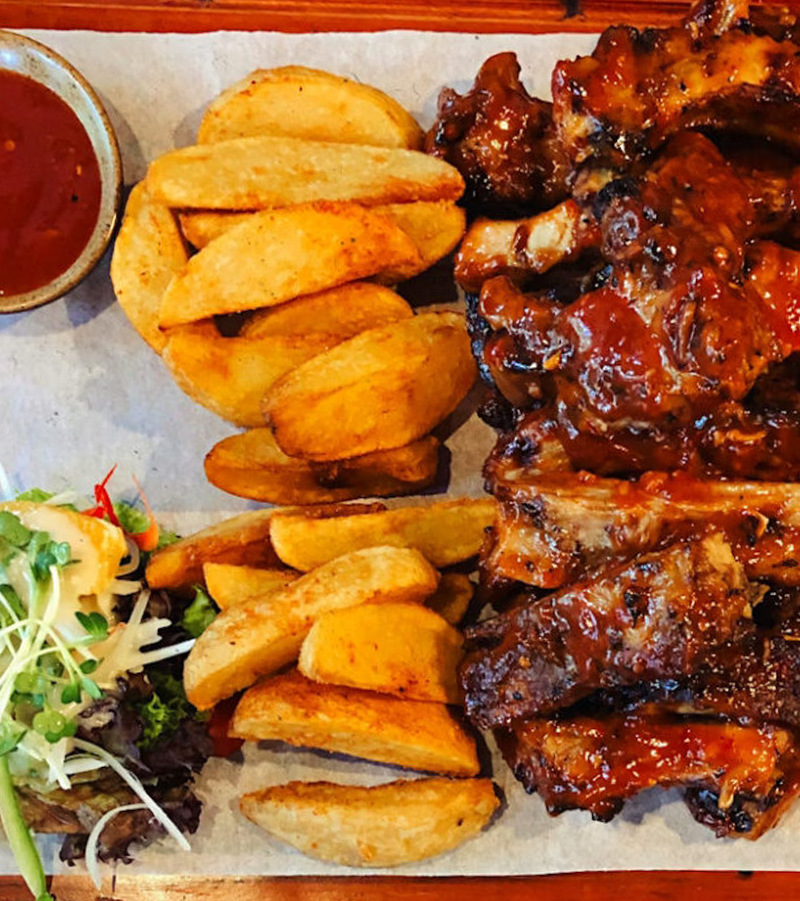
Weekly Research Briefing: Finger Licking Good

The Venn diagram between hands on barbecue eaters and active investors is colliding this week and both groups are reaching for more napkins. While the grills are firing up and the sauce is being prepared, equity stock correlations are moving to historic lows. This means macro investing strategies should move to the back burner while the active company investment specialists take over.
The vast scattering of daily stock moves combined with a widening range of stock returns and valuations has led to many good investments being discarded while portfolios rush to chase any company with near-term earnings and price momentum. For investors focused on the short term, this is a perfectly fine way to generate investment returns. But if you have a multi-billion dollar portfolio focused on the long term, now is the time to harvest gains at premium valuations while planting the winners of 2030 which are discounted today.
Your watchlist of attractive opportunities should be growing nicely right now. For public companies, many are experiencing large drawdowns even as the market reaches new highs. Just looking at the broader Russell 3000 (large, mid, and small-cap US companies), I count that one-third of the stocks are now trading more than 30% off their 52-week highs. Look through the listings and note all the Healthcare, Software and Consumer stocks with charts that resemble waterfalls. Many great companies with strong cash flow characteristics are included here. Even some companies that could accelerate as AI adoption rolls through their enterprise.
Expect M&A transaction volumes to continue strengthening as long as these market discrepancies persist. Strategic corporate takeovers or private equity investment acquisitions will buy good companies with low valuations, provided the financing markets are open and accommodating. So now is the time to dig some holes and plant some big seeds in either the public or private equity markets.
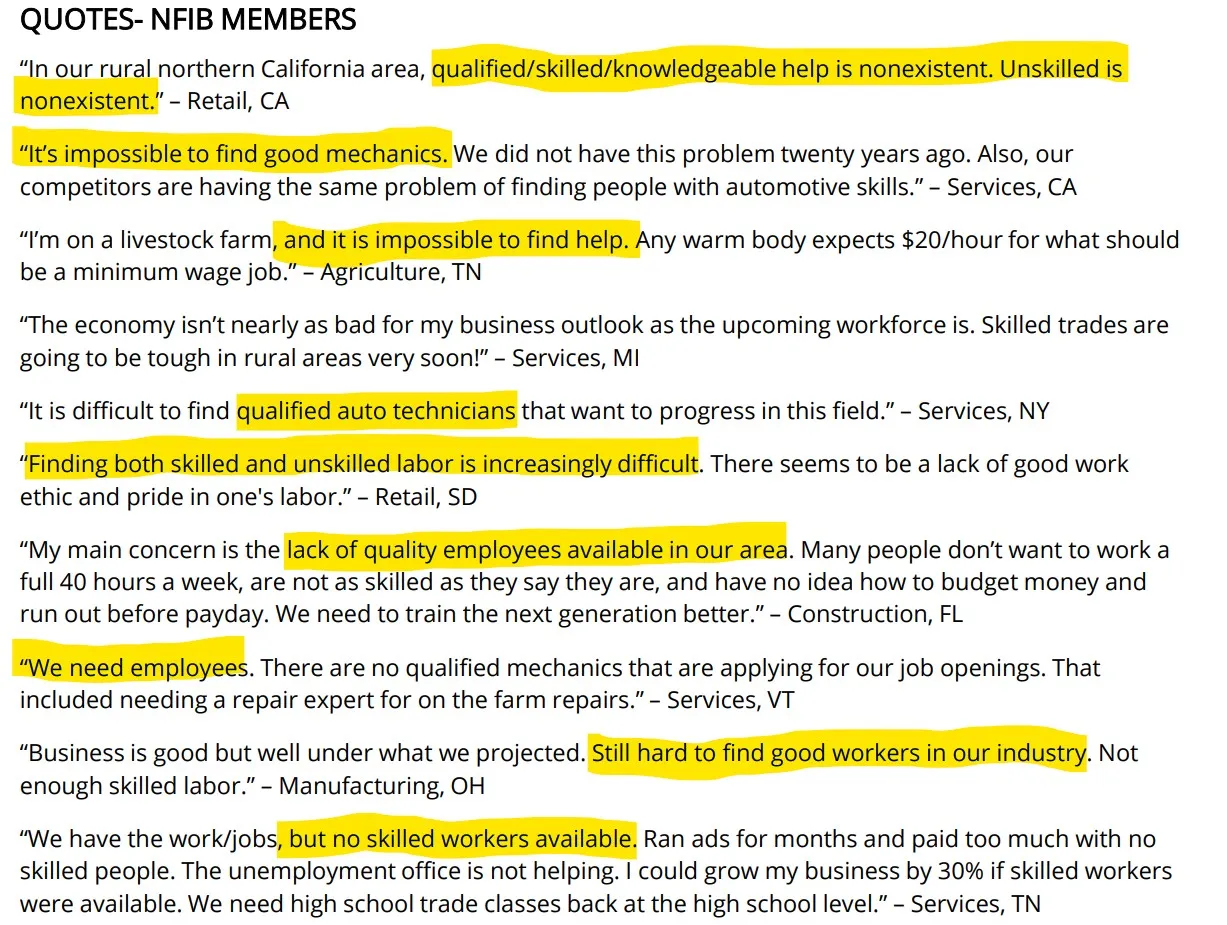
Some interesting data points emerged in the markets last week. Inflation came in hot as energy prices accelerate throughout the economy. Consumers continued to spend at retail even though price inflation accounted for most of the increase. Small businesses are having a very difficult time finding qualified workers. Stock prices continued to follow higher forward earnings estimate gains. And surprisingly little news emerged from either the China summit or the conflict in the Middle East. This week focuses on Nvidia and the major retailer earnings before the market winds down for the big Memorial Day weekend.
Have a great start to the summer and we will be back in June.
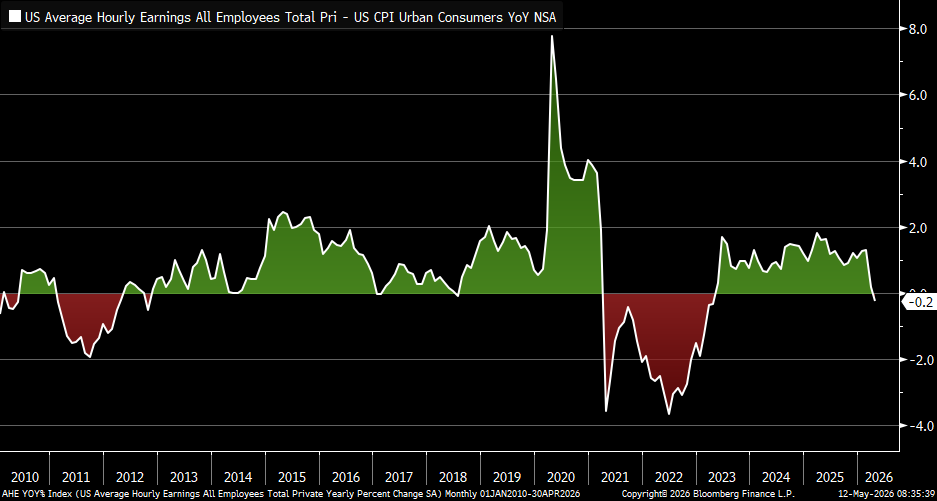
Last week's jump in the CPI means that wages are no longer beating inflation…
@KevRGordon: With headline inflation coming it at +3.8% y/y in April, that means real average hourly earnings growth (adjusted for CPI) slipped into negative territory for the first time since April 2023
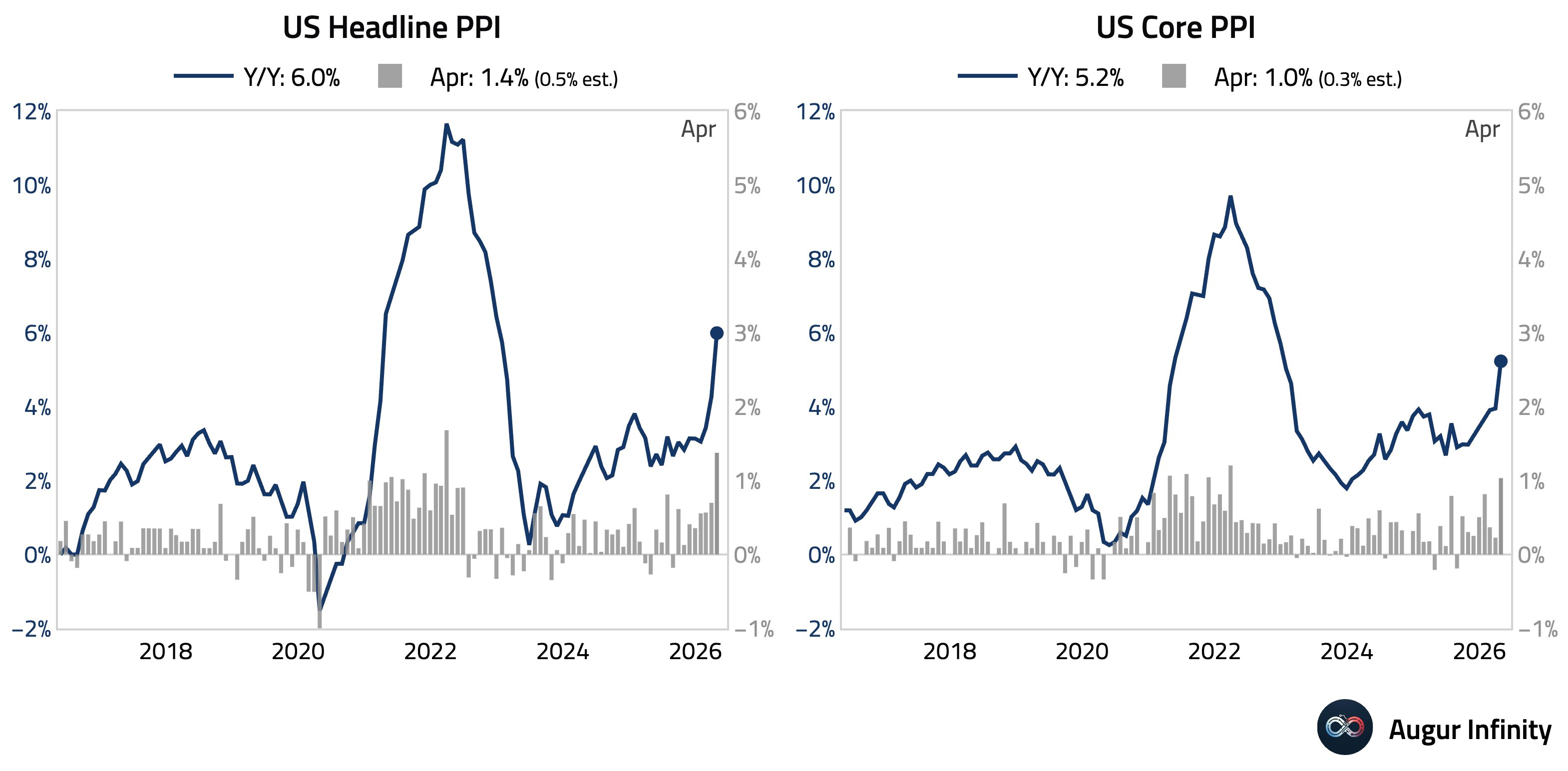
Higher energy prices had a bigger impact on Producer Prices last month…
@AugurInfinity: Producer prices unexpectedly surged in April, well above consensus estimates.
Consumers are buying more goods as measured in dollars, but the volume of goods purchased is not increasing…
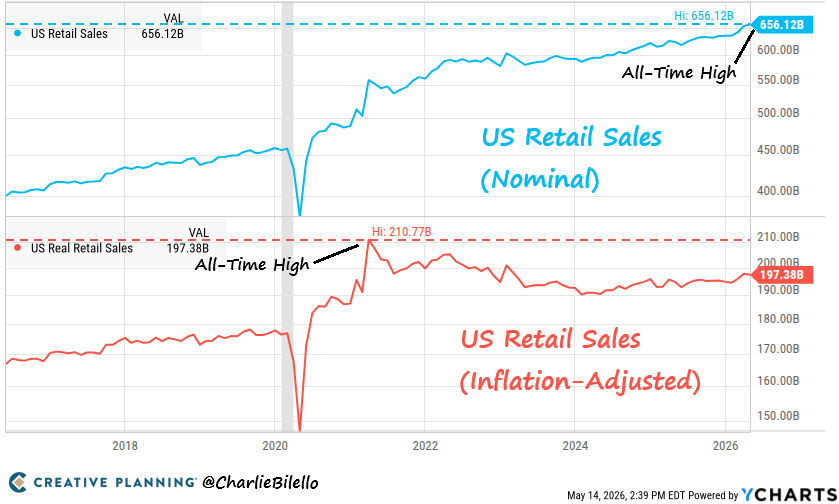
@charliebilello
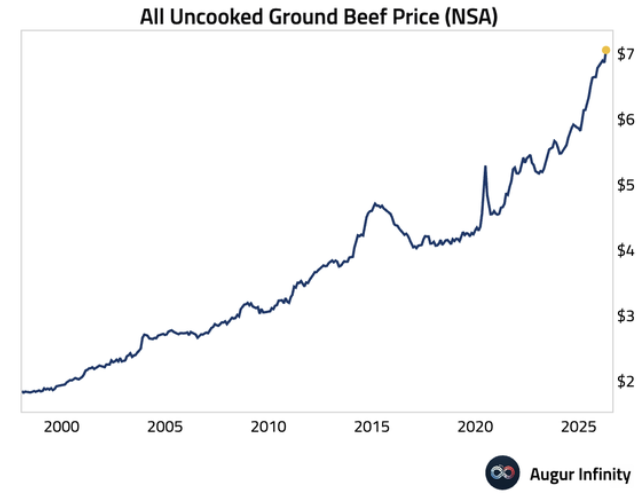
Just in time for the big weekend, your burger price just hit a new all-time high…
Ground beef broke $7 per pound for the first time ever. If you thought the restaurants were complaining this quarter about meat prices, just wait.
Good observations by Joe Weisenthal on the state of the small business owner…
Now this is just a partial screengrab. The actual section is longer and not all of the respondents are complaining about hiring. Also, we don’t know the degree to which the quotes that NFIB spotlighted are perfectly representative of the world of small businesses. Nonetheless, it’s remarkable that this is what’s surfacing up now, and not, say, complaints about interest rates or taxes or regulations or whatever.
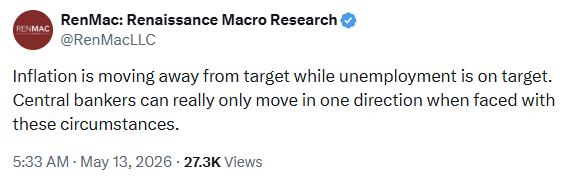
So just to zoom back out for a second, you have the inflation data and it’s warm, if not straight up hot. And the labor market is, at a minimum, not falling apart.
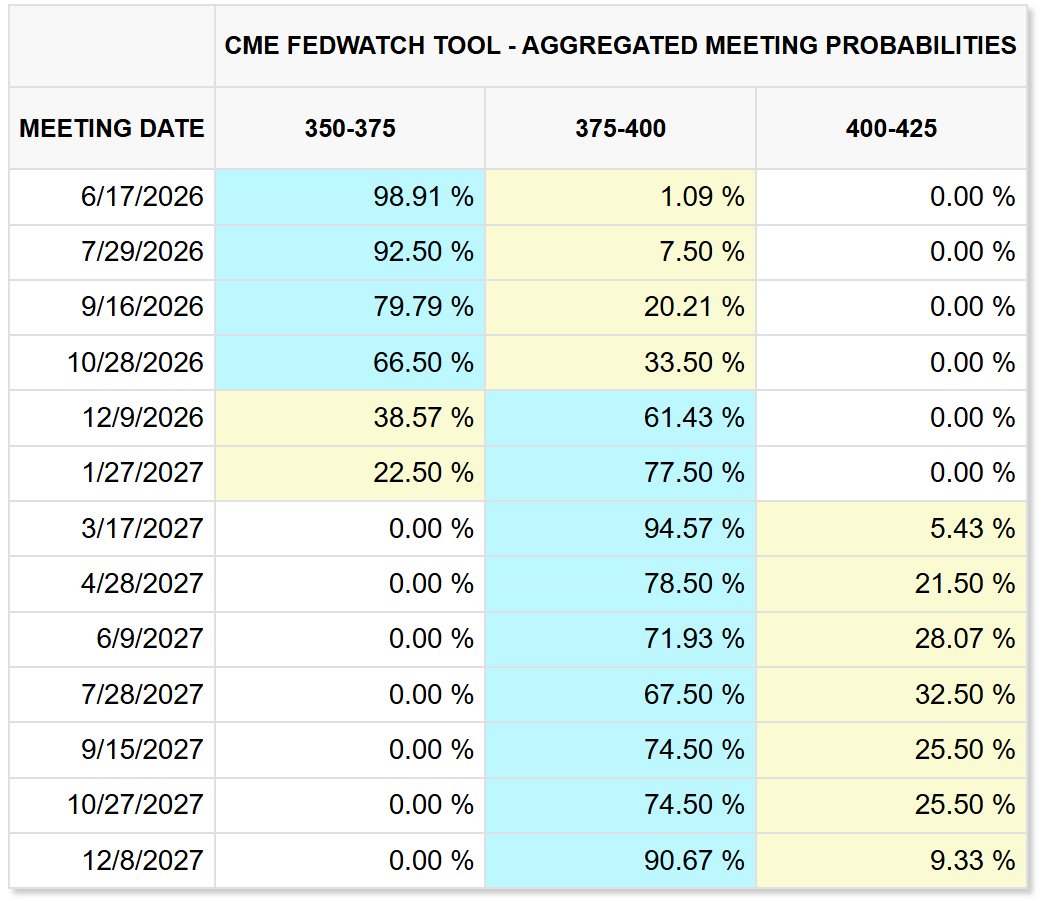
And so to this note, not only is the market not looking at rate cuts anytime soon, the direction of travel increasingly looks like higher rates. 2 year yields are higher than 3M yields, and the spread is at its widest since November 2022, when we were still in the throes of the worst inflation. Increasingly the market is looking at the possibility of hikes coming down the pike.
Employment tightening while inflation increasing can mean only one thing…
Even the President has now given up on getting lower Fed Funds rates until the War with Iran ends…
The market now sees two rate hikes as possible going into 2027.
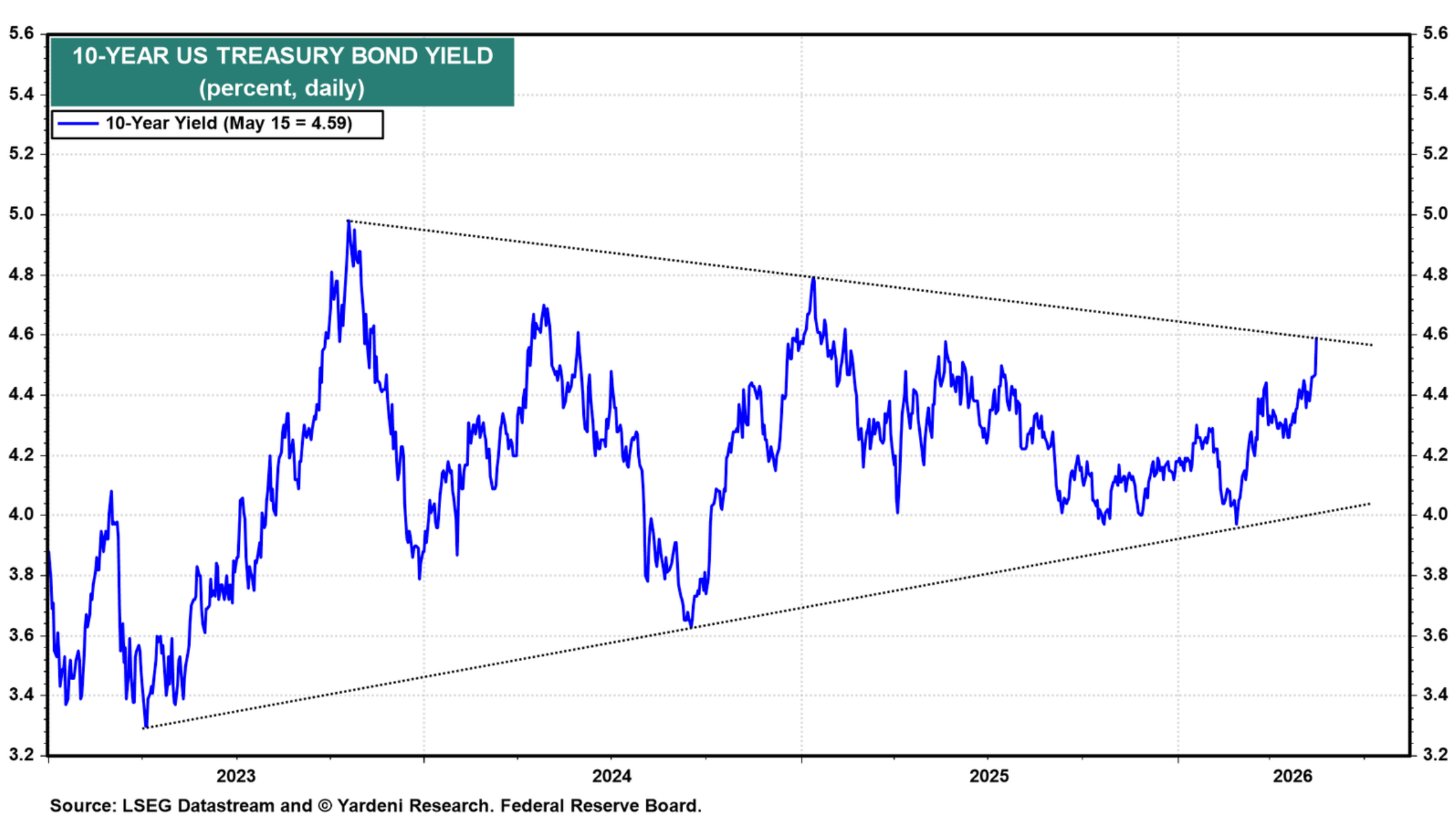
10-year Treasury yields now on the verge of breaking out…
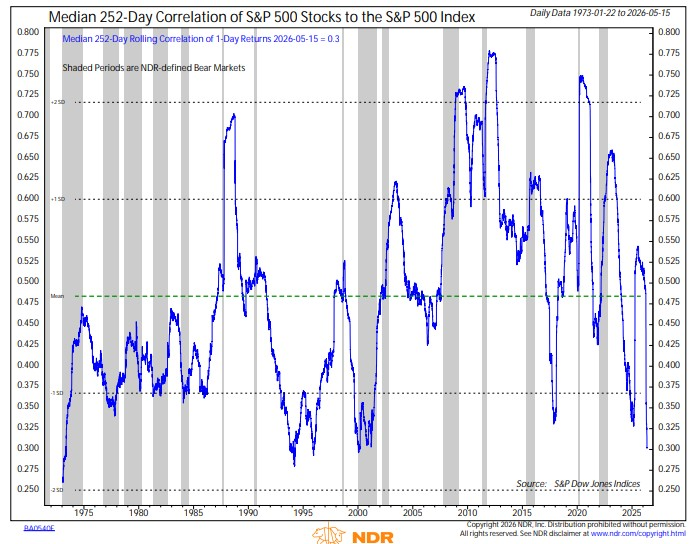
As we highlighted in the introduction, stock prices have become wildly uncorrelated…
@edclissold: Fun stat. The one-year correlation among S&P 500 stocks is at its lowest level since March 2000. It's a stock market more than a market of stocks.
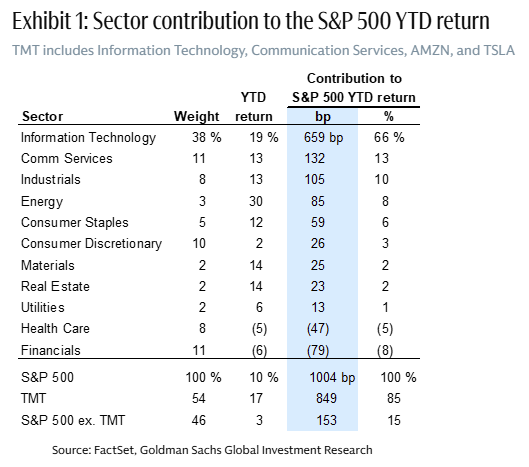
Digging down into the sector returns shows the bulk of the returns happening across Tech, Media and Telecom…
Through Thursday, the S&P 500 had returned 10% YTD in 2026, with TMT (the Information Technology and Communication Services sectors plus AMZN and TSLA) accounting for 85% of the return. The S&P 500 excluding TMT has returned just 3% YTD. NVDA, which accounts for 9% of S&P 500 market cap weight, has contributed 20% of the aggregate S&P 500 YTD return.
Goldman Sachs
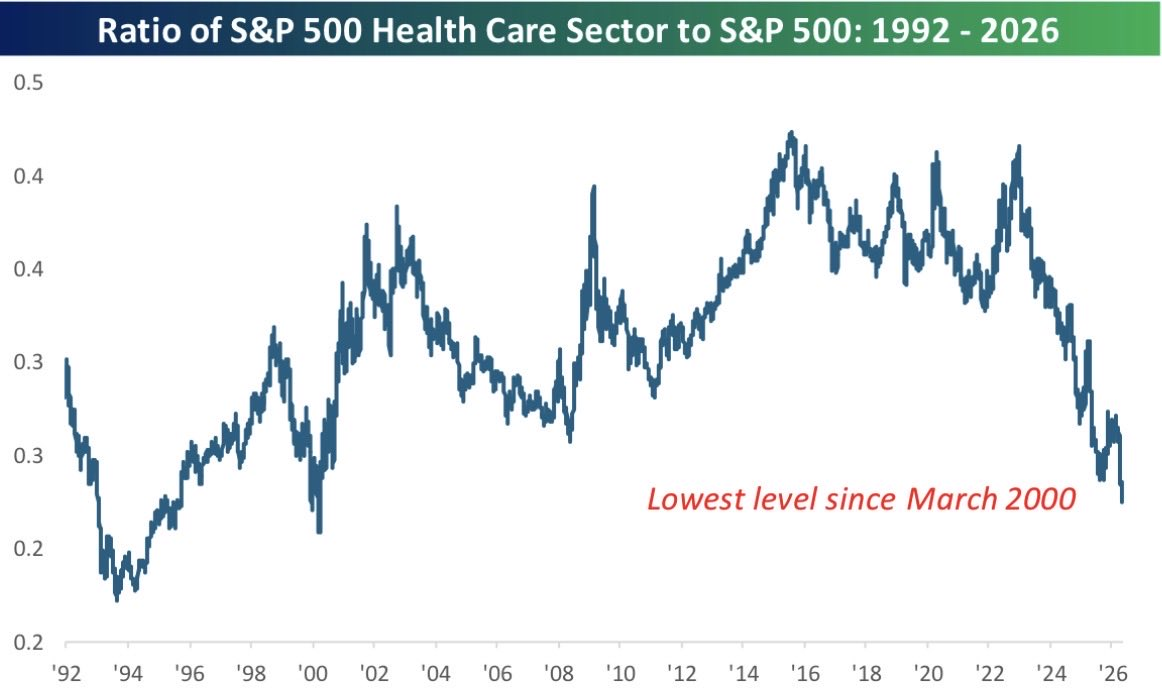
And in terms of relative importance, the Healthcare sector is now at a 26-year low…
@bespokeinvest: The ratio of the Health Care sector $XLV to the S&P 500 $SPY has fallen to its lowest level since March 2000.
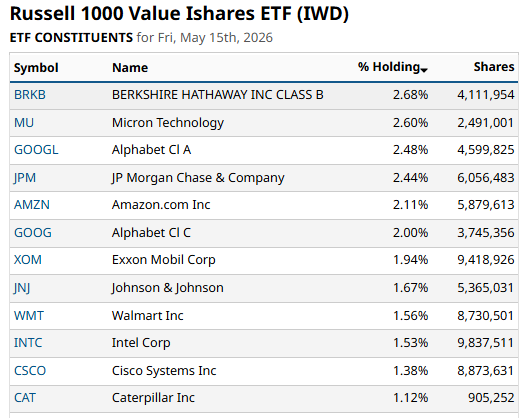
How well do you know your Large Cap Value portfolio?
I bet that some of you are surprised to see TMT names make up half of the top holdings.
Barchart
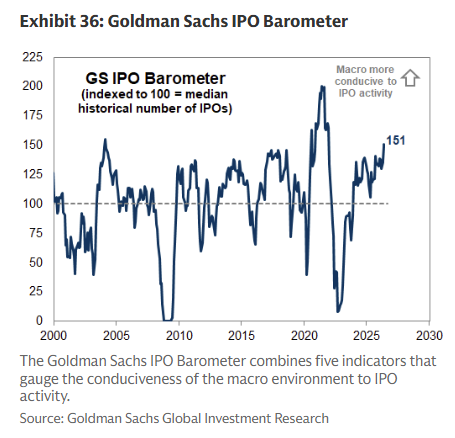
Now here is a headline to fire up the appetites of IPO investors…

Front Page Headline on Friday's Wall Street Journal
Last week was a good week for IPO launches…
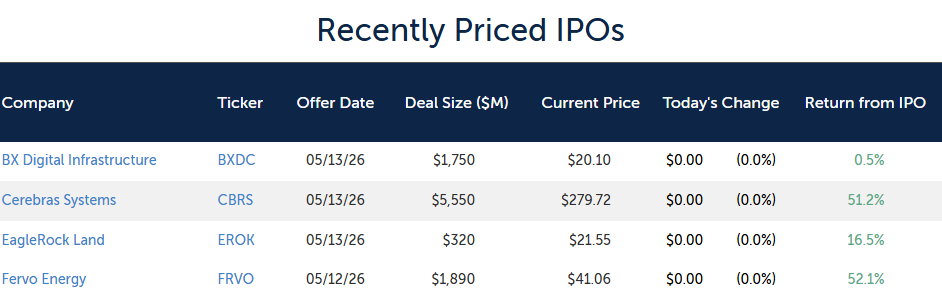
Fervo Energy and Cerebras hit the market perfectly…
The appetite of the market looks ready for many more IPOs as soon as everyone returns from their barbecues.
Speaking of IPO's, 'Disclosure Day' takes on a whole different meaning now...
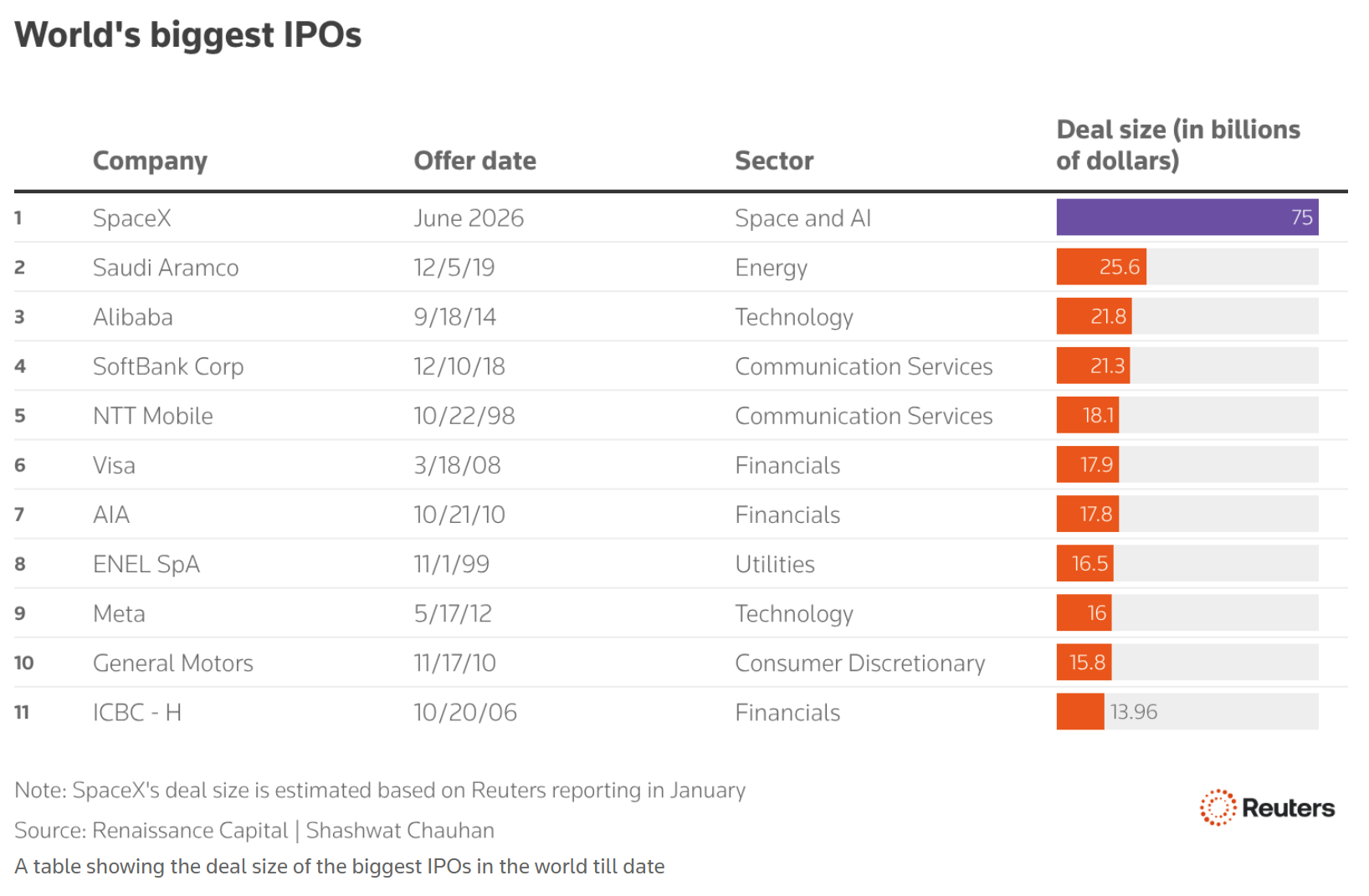
Steven Spielberg thought that he would have the whole day to himself and his new epic movie. But now Elon, Merrill Lynch, Citigroup, Goldman Sachs, JPMorgan, and Morgan Stanley have crashed the party. SpaceX has picked it's pricing date (6/11) with first trade to happen on (6/12). $75b raised in the offering and a targeted $2t market cap valuation will both trigger Guinness world records. Wall Street syndicate desk vacations postponed until the end of June.
SpaceX is targeting a valuation of roughly $1.75 trillion in its upcoming initial public offering, in what could be the biggest-ever stock market debut by a U.S. company on Wall Street.
The listing of Elon Musk-led SpaceX could easily dwarf many of the biggest U.S. IPOs on record, including those of Alibaba , Visa and Facebook, now Meta Platforms which analysts say reflects high growth expectations from the rocket and satellite company that it may struggle to meet.
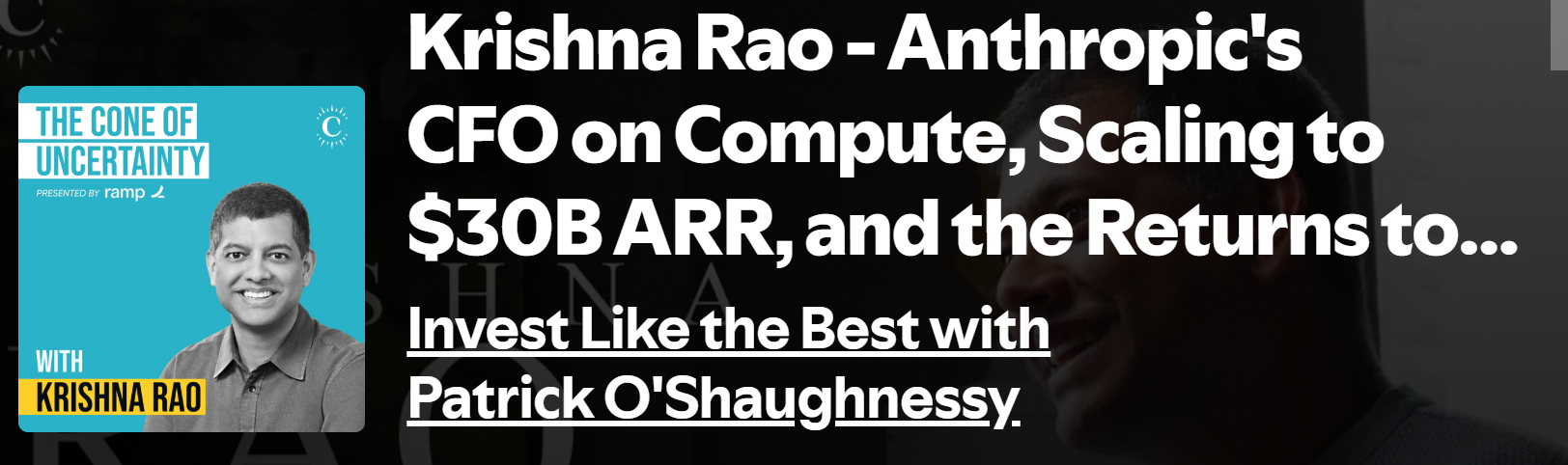
Speaking of AI, this is a very insightful interview with the CFO of Anthropic covering the leading topics of the day. I strongly recommend it for any investor in the AI space…
“The compute that we procure is the lifeblood of our business. It is the most important thing in the company. It’s the canvas on which everything else gets built. The decisions we make on how much compute to buy are some of the most consequential and hardest decisions to make in the entire company. Think of it this way — if you buy too much compute, you go out of business. If you buy too little compute, you can’t serve your customers.” - Anthropic CFO Krishna Rao
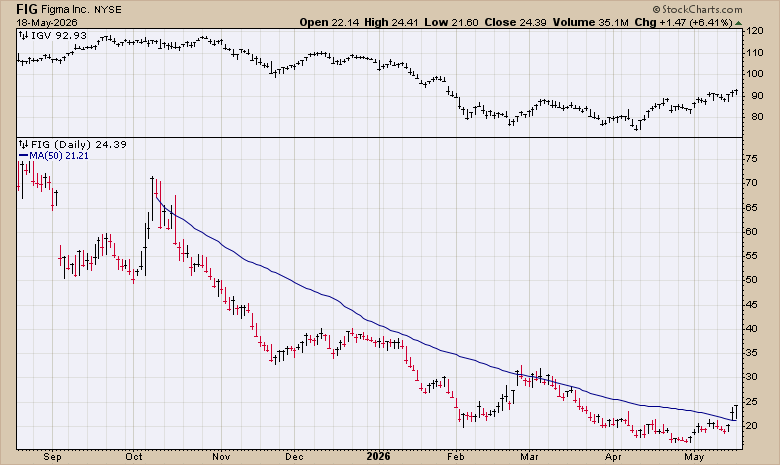
If you thought AI would kill all software companies, Figma would like a word…
@knowledge_vital: "When code is a commodity, design is the competitive edge—the craft, point of view, and human judgment that make a great product rise above the rest" (Figma Inc. conference call)
StockCharts
The tails of AI are very long. They are even helping hotel demand in the Bay Area…
@TheTranscript_: $HST Host Hotels CEO: AI demand is benefiting both downtown San Francisco and airport-adjacent lodging assets: "Leasing activity and net absorption improved in early '26 driven by AI-related companies. And that is benefiting not only our properties in city center, but also the Hyatt Burlingame, which is out by the airport and the Santa Clara Marriott. So we couldn't be happier with what's happening in that market and look forward to continued growth going forward."
Step 1: Pivot to Batteries. Step 2: Sell to Data Centers. Step 3: Attach Wheels to Batteries…
Ford aligns with the global leader in battery science and production, and its stock price posts its biggest 2-day non-GFC/COVID move in 24 years.
Shares in Detroit carmaker Ford surged more than a fifth over two days, the sharpest jump since 2020, on investor hopes that its new energy unit will profit from the US data centre boom.
Ford launched its new subsidiary, Ford Energy, on Monday as part of a pivot away from electric vehicles and towards providing battery storage capacity for Big Tech giants building AI data centres, deploying technology licensed from Chinese battery giant CATL.
The company’s stock jumped 13 per cent on Wednesday after Morgan Stanley analysts said its relationship with CATL gave Ford an “under-appreciated strategic competitive advantage for its energy storage business”, estimating it could generate a gross margin of 25 per cent and grow to be worth $10bn…
“When we come calling to large grid suppliers, energy companies, they’re really excited about Ford being in this business,” he said. “We’re a trusted company. They’ve been buying our vehicles for a long time, and we’ve done our homework on this business.”
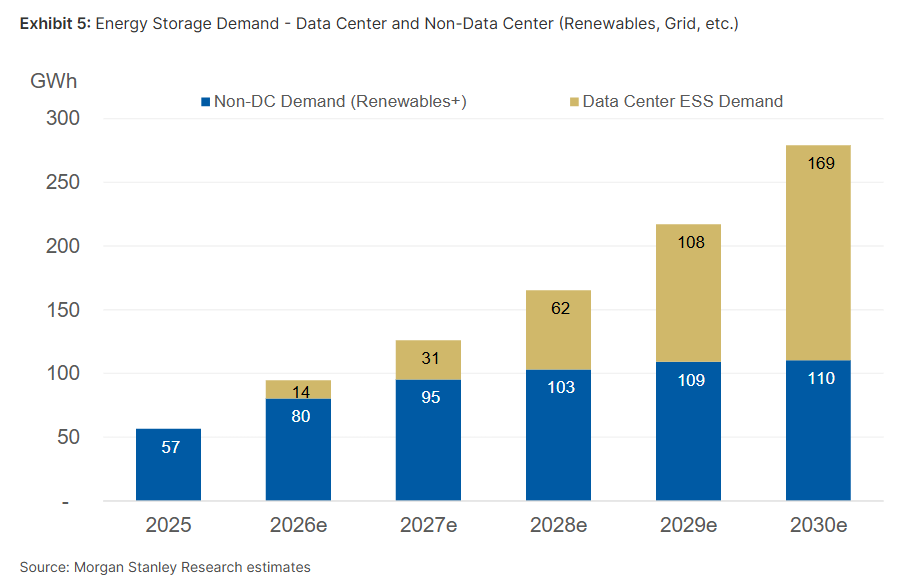
Speaking of Energy Storage Systems, Morgan Stanley has some strong thoughts on future battery demand for data centers. And note that Ford is only planning on supplying 20 GWh of the mustard yellow bar below…
We forecast meaningful growth in ESS (demand over the next five years, driven by three structural forces:
- The rapid growth of AI inference workloads is making power demand more volatile and peak heavy, increasing the need for ESS to perform peak-shaving and smooth sudden load spikes.
- ESS is increasingly being deployed as a practical mitigation to traditional power capacity constraints, including limited availability of gas turbines, grid congestion, and long interconnection timelines.
- Growing penetration of renewables which require storage to balance intermittency.
Putting these together, we forecast a 38% CAGR for US ESS deployments, reaching 279 GWh by 2030. This is supported by a 14% CAGR within traditional grid-linked, utility-scale storage, increasing to 110 GWh by 2030 (vs. 57 GWh in 2025), while the data center market has the potential to support another 169 GWh of annual deployments by 2030.
Morgan Stanley
Big M&A today in the power markets as a top player in renewables gets access to Virginia's data center customer base…
“Scale matters more than ever—not for the sake of size, but because scale translates into capital and operating efficiencies.” NextEra CEO John Ketchum
NextEra Energy has agreed to combine with rival Dominion Energy to create a $420bn power behemoth, in a deal that comes at a time of booming demand for electricity to power AI data centres.
The deal, the fourth largest of all time according to LSEG, would create a US utility giant with a customer base of more than 10mn homes and businesses stretching from Florida to Virginia.
NextEra said on Monday that it will pay the equivalent of almost $76 a share for Dominion as part of an all-stock deal that values the group’s equity at roughly $67bn, a 23 per cent premium to Friday’s closing price. That implies an enterprise value of almost $124bn, including $56.7bn in debt…
The tie-up will help NextEra extend its dominance from its home base of Florida, where its Florida Power & Light division serves roughly 6mn customers, into the Carolinas and Virginia, where Dominion has around 3.6mn customers.
Dominion is the main power supplier for “data centre alley” in northern Virginia, the heartland of the US AI infrastructure build-out that handles roughly two-thirds of global internet traffic.
The deal will redraw the US power grid just as technology giants like Microsoft, Amazon and Google owner Alphabet race to build data centre capacity to meet AI demand — and power suppliers spend tens of billions of dollars in a rush to boost capacity.
And another undervalued British listed company receives a notice from a suitor across the pond…
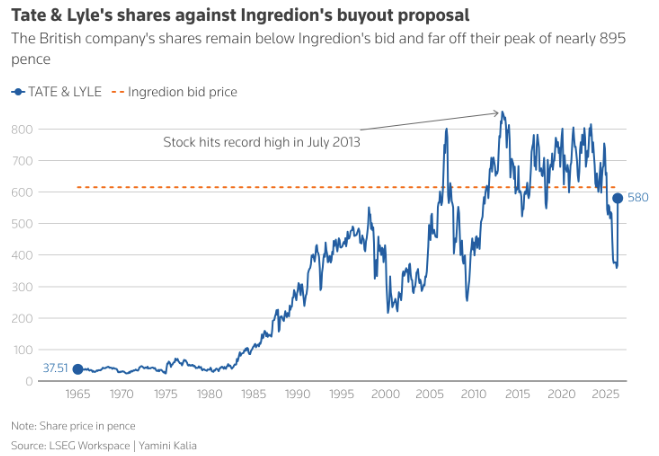
U.S. food ingredients maker Ingredion (INGR) is in talks with British rival Tate & Lyle (TATE) over a possible takeover of the London-listed firm in a 2.74 billion pound ($3.7 billion) deal, the British company said on Thursday, sending its shares 55% higher.
A deal between Tate & Lyle, known for its artificial sweeteners used in Coca-Cola drinks, and Ingredion, could create a food and beverage ingredients giant worth more than $10 billion, at a time when consumers are increasingly opting for low-calorie drinks and diets…
Tate & Lyle has faced declining revenue and profit amid weak U.S. bakery demand, lower European pricing and rising costs, while Ingredion has seen softer demand for its legacy starches and sweeteners as consumers shift toward healthier and plant-based options.
As we have written about previously, the demographic curves are coming for higher-ed…
A big drop in enrollment at the University of Vermont is causing financial concerns, with undergraduate enrollment down 7% and the incoming first-year students for next fall projected to come up 15% short of last year…
“UVM experienced a significant enrollment decline this fall,” UVM President Marlene Tromp told state lawmakers Wednesday. “It is becoming -- because of the caliber of school that we compete with -- it’s becoming more difficult for us to compete.”
She points to the nationwide trend of declining demographics and, due to new federal policies, fewer international students. And since there are fewer, the ones applying to UVM are now getting accepted into schools they wouldn’t get into before. “So, they’re reaching for students that would ordinarily come to us,” Tromp said. She says the decline comes as they are accepting more students. “We made a significantly greater percentage of offers.”
Medical professionals have seen enough of the data and are strongly encouraging an acceleration of autonomous vehicle rollouts…
An Open Letter from the Medical Community on America’s Road Deaths
Jonathan Slotkin, MD and Eric Topol, MD
May 14, 2026
We are surgeons, emergency physicians, nurses, PAs, rehabilitation specialists, intensivists, researchers, and more. We treat, study, and prevent motor vehicle injuries. Many of us hold the wounded in our hands. We are writing because the evidence now says that much of this suffering is preventable.
More than 100 Americans die in car crashes every day. Cyclists killed by red-light runners. Pedestrians killed by drunk drivers. Families killed by someone confusing the accelerator and the brake. In 2024, more than 39,000 people died on American roads. Crashes are the leading cause of death for Americans aged 16 to 24, accounting for nearly half of all fatalities in that age group. 5.1 million crash injuries required medical attention in 2023 alone. The combined economic and quality-of-life toll exceeds $1 trillion annually. That is larger than the entire Medicare budget.
No other cause of death at this scale would be met with this little urgency. As clinicians, we no longer accept it.
Safer infrastructure, better speed enforcement, impaired driving prevention, and public transit all save lives and deserve continued investment. Autonomous vehicles are not a replacement for those efforts, but their safety data has reached a threshold we cannot responsibly ignore.
A 2025 peer-reviewed study examined 56.7 million fully driverless miles on public roads and found an 85% reduction in serious-injury-or-worse crashes compared with human drivers on the same streets. Waymo’s most recent data release, covering more than 170 million miles, shows the results strengthening: a 92% reduction in serious-injury-or-worse crashes, with pedestrian injury crashes down 92% and cyclist crashes 85%, respectively. Intersection crashes, among the deadliest we see, fell 96%. If these results hold as deployment scales, the population-level effect could rival seatbelts or the decline of smoking. In medical research, when an intervention demonstrates this magnitude of benefit, we work to change the standard of care…
Learn more about the Hamilton Lane Strategies
DISCLOSURES
The author has current equity ownership in: Nvidia Corp.
The information presented here is for informational purposes only, and this document is not to be construed as an offer to sell, or the solicitation of an offer to buy, securities. Some investments are not suitable for all investors, and there can be no assurance that any investment strategy will be successful. The hyperlinks included in this message provide direct access to other Internet resources, including Web sites. While we believe this information to be from reliable sources, Hamilton Lane is not responsible for the accuracy or content of information contained in these sites. Although we make every effort to ensure these links are accurate, up to date and relevant, we cannot take responsibility for pages maintained by external providers. The views expressed by these external providers on their own Web pages or on external sites they link to are not necessarily those of Hamilton Lane.