
Weekly Research Briefing: A Most Important Handoff

By this time next week, the roar of the crowd might be deafening. Surely the World Cup's biggest fans will be cheering for their teams as they take the field. But the bigger screams might come from investors clamoring for shares in the SpaceX IPO from their brokers and bankers. Retail and active institutional investors interested in the space industry or AI data centers will be joined by passive index fund investors, who can buy in earlier than previously possible. Profit-seeking traders will also fight for the stock, looking to front-run those large index fund investors who will scramble to secure their necessary fills. This will be the largest IPO of all-time and the largest transfer from private to public investors. A major payday awaits those early investors or employees whose shares have been locked up and held for years.
The timing for the SpaceX IPO could not be better. Equity markets are at all-time highs and credit spreads are near all-time lows. Investors are hungry not just for equities, but also for new stocks that offer direct exposure to Space and AI. And Elon Musk even wants to put AI data centers into space so with this one company, they can get both. The nearly $2 trillion valuation is a very large number that historic fundamentals do not justify. However, nearly everyone in the US will be exposed to SpaceX because it will become one of the world's largest public companies and a major component of nearly every passive equity portfolio. So in your best Buzz Lightyear voice, "To infinity and beyond!".
While SpaceX employees and private equity investors count their profits next week, investment bankers and other founders of AI-exposed companies will watch the launch of this mega-cap equity into the markets. If all goes well, expect a line to form at the stock exchange as other companies ready themselves for sale. There is likely another $2-3 trillion in market cap sitting on the bench just waiting to enter the game. Why now? Two main reasons explain the surge in big IPOs. First, the market wants some new names emerging in the fastest-growing part of the economy which is currently AI. The ducks are quacking loudly, time to feed them. Second, many of these companies have used private equity and credit markets to raise capital in the past. Now that their financing needs are growing exponentially, they are looking at more favorable terms and valuations by tapping the public equity and debt markets. So a lower cost of capital for them, which makes it a win, win, win? Well we will see where the SPCX ticker closes at the end of its first trading day.
While the world awaits next week's biggest IPO and the World Cup, this week the US markets will receive May jobs data, some important earnings figures and several company conference presentations to consider. I was amazed last week by some of the earnings and conference meeting moves. It has been a while since I saw 20%+ jumps in so many large cap company stock prices. Even this afternoon I see Hewlett Packard Enterprises (a $60B market cap) up 36% after reporting its figures. These days, just having "AI" in your earnings release seems to be worth a double digit upward move. Enjoy this market while it lasts. Have a great week.
SpaceX is about to become the largest baton hand-off in the global financial markets and the major passive index funds are lining up their BUY orders…
To the index overlords who steer trillions of dollars in flows through the eligibility rules they set, adding a company like SpaceX is simply a matter of reflecting the market as it really is. Nasdaq Inc. changed its rules so SpaceX can join the Nasdaq 100 Index, a cohort of the largest non-financial companies listed on its exchange, in just 15 trading days, down from a three-month minimum. FTSE Russell adopted a similar approach, shortening the waiting time to five trading days, and S&P Dow Jones Indices is expected to decide soon following its own consultation on the subject, potentially opening the S&P 500 Index itself to welcome instant mega-caps like SpaceX…
Fast-track timelines vary by index, but if S&P follows its competitors, the resulting passive demand for SpaceX from funds tracking indexes would be nearly $20 billion, according to Bloomberg Intelligence analysts James Seyffart and Rob Du Boff’s estimates. With a $75 billion raise, that would be roughly a quarter of SpaceX’s offering.
SpaceX is planning an early release schedule for insiders whose shares are subject to so-called lock-up agreements preventing them from selling immediately, and if S&P’s proposal is adopted, at least 90% would be unlocked by the time SpaceX could enter the S&P 500, Seyffart and Du Boff wrote in a note. The shares sold by employees and early investors, likely giving them windfall profits, could be snapped up by index-tracking funds.
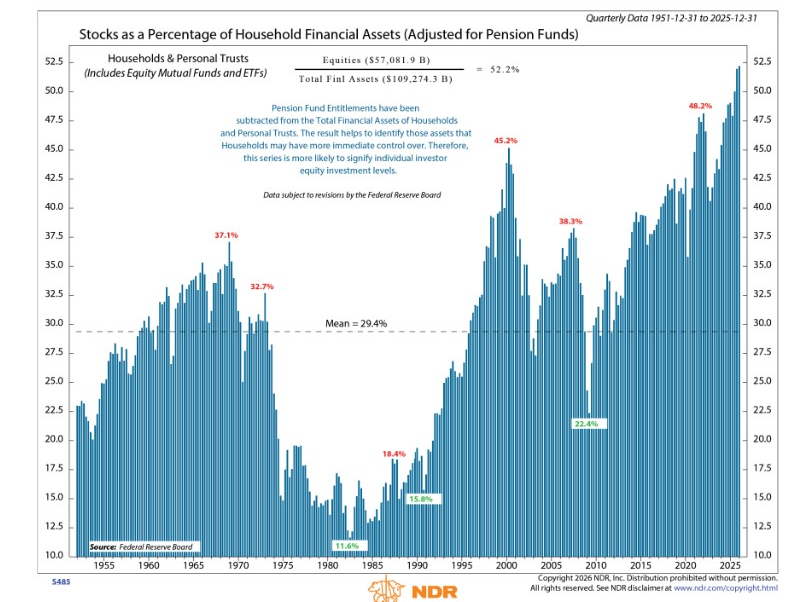
Households own more public equity than ever and are ready to take a position in SPCX whether they like it or not…
It will be difficult to avoid owning a 1-2% slice of SpaceX if you have any passive equity asset exposure. Now who wants to be an astronaut for Halloween?
@edclissold
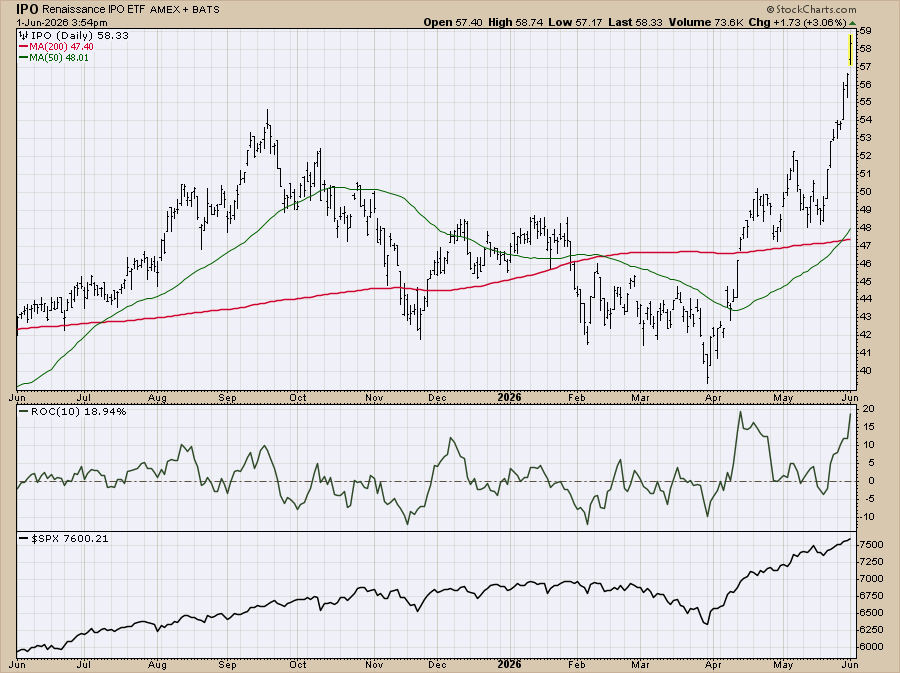
Even investors in previous IPOs are excited as the IPO ETF chart shows…
Up 20% in two weeks and up almost 50% in two months.
StockCharts
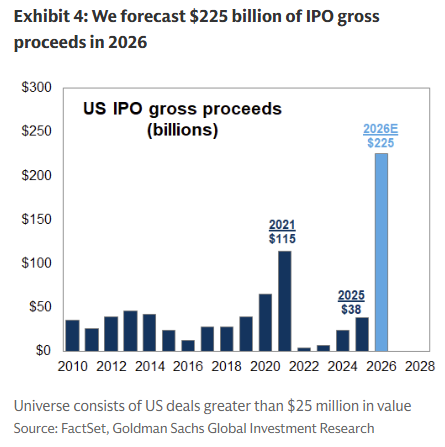
Raise your IPO forecasts for 2026 and make sure the tri-state luxury car dealers have maximum inventories…
GOLDMAN DESK: “.. US IPO gross proceeds will total a record $225 billion in 2026. Our previous forecast was for $160 billion of IPO issuance. Our new estimates reflect a continued healthy macro .. and recent changes to the outlook for potential launches by some of the largest private companies.”
@carlquintanilla.bsky.social
The S&P indexes might be the last to the SpaceX party which could mean higher prices for their passive investors if the SPCX launch is a success…
And then the S&P 500 impact is the biggest, just because it is the most-used index, with “about $11.8 trillion of passive equity funds tied to the S&P 500.” It is also float-weighted, but it is slow: SpaceX won’t be eligible for the S&P for at least six months, by which point a lot of SpaceX’s stock will probably no longer be locked up. If SpaceX’s float is $1 trillion in six months — if it has a $2 trillion market capitalization, and half of its stock is unrestricted — then it will be about 1.5% of the S&P 500, and S&P 500 funds might have to buy about $175 billion of its stock. So much more than the IPO raise, though much less than the float at that point.
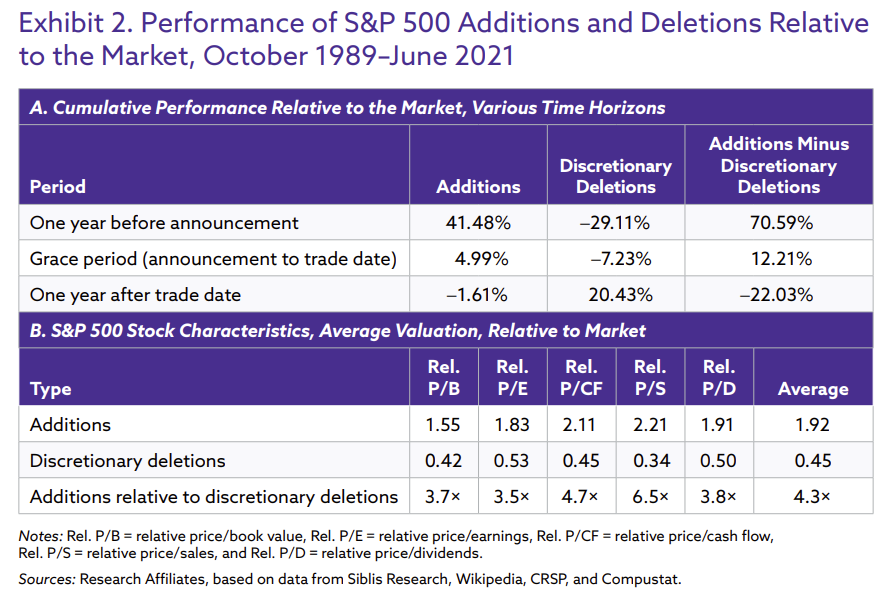
If you are looking for the historical price performances of stocks added to the S&P 500, here you go…
Multiple studies, including Lynch and Mendenhall (1997) and Chen et al. (2004), have documented the tendency for stocks added to major indexes to experience significant price appreciation between the announcement date and the effective date of inclusion, with deletions declining correspondingly. Expanding on earlier work, Arnott, Brightman, Kalesnik, and Wu (2023) analyzed S&P 500 reconstitutions from October 1989 through June 2021 and found that index additions outperformed the broad market by an average of 499 bps during the grace period between announcement and implementation. They also showed that discretionary deletions lagged the market by 723 bps over the same window. These sizable performance gaps, as summarized in Exhibit 2, highlight the enduring market impact of rebalancing flows triggered by index changes.
The on-deck circle looks equally stocked and could unlock another $2+ trillion in value for their employees and private equity owners…
SpaceX isn’t alone in its ambition to raise a whopping sum to help it win the AI race. OpenAI is preparing to file confidentially for an IPO in the coming weeks, people familiar with the matter have said. Bloomberg News reported that Anthropic PBC was considering its own public debut as soon as October of this year. And while they continue to scale up in the private sector, most of these AI-forward companies are landing eye-watering appraisals. OpenAI raised funds at an $852 billion valuation back in March. After Anthropic achieved a $380 billion mark earlier this year, it’s now in talks for a round at a more than $900 billion valuation. Both would likely exceed their private valuations in an IPO.
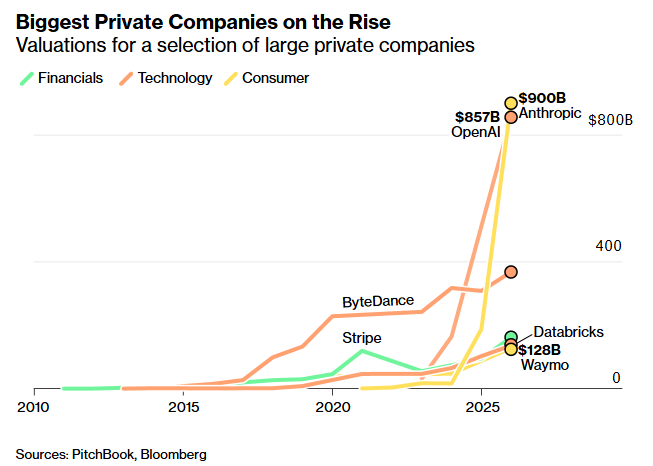
This new wave of private to public deals is very different from the previous internet wave…
Companies are not supposed to show up on exchanges already the world’s most valuable businesses. New ventures raise money privately when they’re small and speculative, but established businesses have almost always turned to public markets when they needed sizable capital for growth. Everyone wins: Venture investors offload their shares to cash in on their early support, and new investors participate in potentially even bigger gains ahead. That’s the story of practically every public company trading today, including tech behemoths Microsoft Corp., Amazon.com Inc. and Nvidia Corp.
That model has been upended by private markets awash with capital and capable of feeding practically unlimited cash to the most sought-after businesses. The result is companies staying private longer and coming to market with ever higher valuations. Nvidia was valued at roughly $600 million when it went public in 1999. Five years later, Alphabet Inc. raised the stakes with a $23 billion valuation at IPO. Meta Platforms Inc. raised the bar again to $104 billion in 2012, which seemed like a fortune at the time. That’s loose change compared with this year’s blockbuster IPOs.
I don’t blame companies for sidestepping the rigors of public markets when private money is readily available, but it’s a disservice to public market investors. By debuting at valuations comparable to Big Tech, much of the value of SpaceX, OpenAI and Anthropic’s future growth will be captured by private investors at IPO, at the expense of public shareholders. And that’s best case. If expected growth doesn’t materialize, these IPOs will be a massive wealth transfer from ordinary investors to private equity — and a major blow to the appeal of public markets.
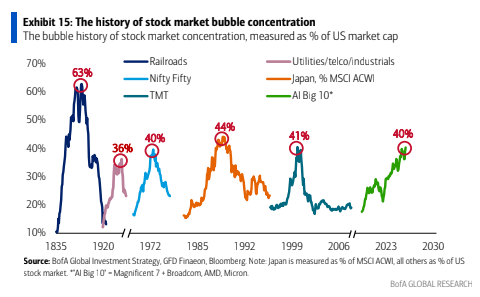
We are witnessing a unique time in the financial markets…
The “AI Big 10” stocks currently make up 40% of the S&P 500 market cap, a figure that could rise toward 50% as the newer AI companies move into the indexes.
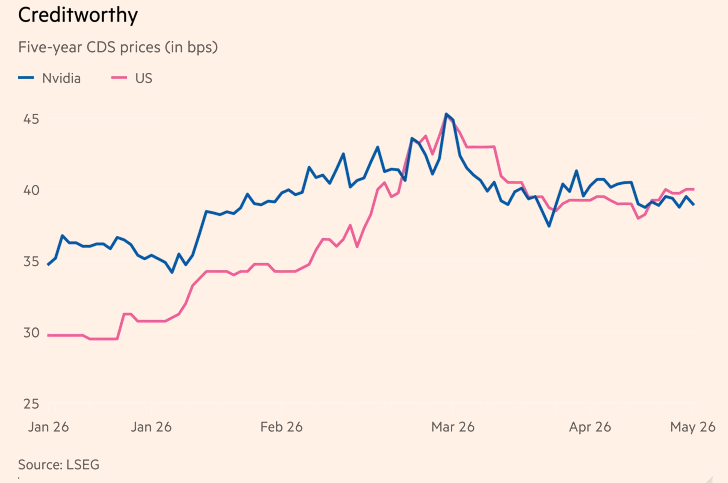
Another unique sign is that Nvidia has a better credit quality view than the US government…
Nor should anyone really worry too much about the health of Nvidia — at least in terms of its survival. It has total debts of $8.5bn, cash of $10.6bn, and generated free cash flow of almost $100bn in the year to end-January, according to LSEG data. Its profits could plunge 90 per cent and it would still rank as one of the 100 most profitable companies in the world.
There’s a reason why five-year credit default swaps on Nvidia are trading at under 40 basis points, roughly the same price as it costs to insure against the US government defaulting (although that’s probably not the yardstick of unimpeachable creditworthiness that it once was).
Before SpaceX, the market will get to ride on another rocket ship as Honeywell's quantum computer company goes public this week…
Honeywell International Inc.-backed quantum computing company Quantinuum Inc. boosted the size of its initial public offering to as much as $1.46 billion, raising the number of shares offered and the price range.
The company is offering 26.5 million shares for $53 to $55 each, according to a filing Monday with the US Securities and Exchange Commission confirming an earlier Bloomberg News report. Quantinuum had previously offered about 21 million shares for $45 to $50 each.
At the top of the new range, the company would have a market value of $14.3 billion based on the outstanding shares listed in its filing.
The quantum computing firm’s IPO drew orders for a double-digit multiple of the number of shares available, people familiar with the matter said Friday. The company is on track to price after the market closes in New York on Wednesday and start trading the next day.
Quantinuum makes powerful quantum computers that are capable of solving complex tasks beyond the abilities of traditional processors that could make exponential leaps in computing.
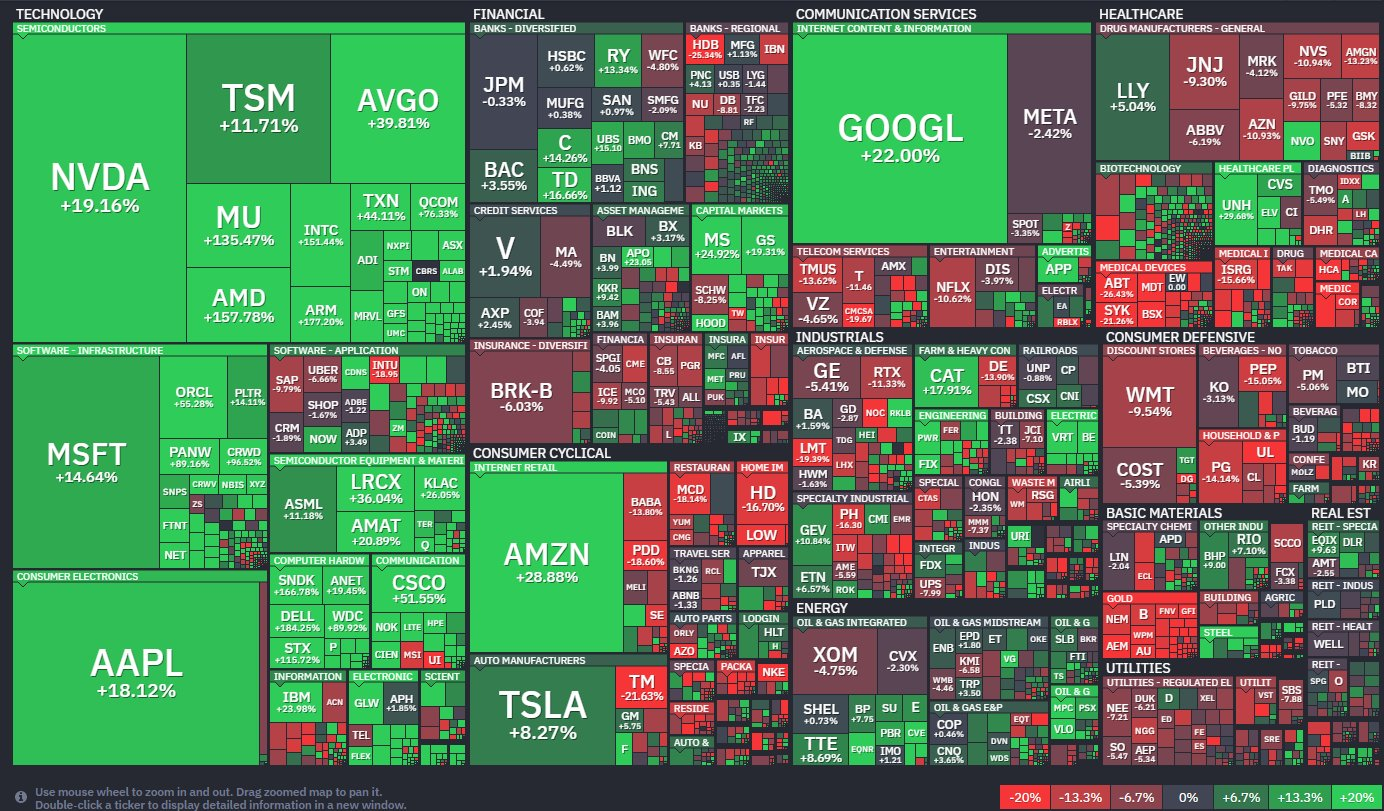
The war with Iran began three months ago so here is a good visual to the performance of the US listed stocks and ADRs over that time frame…
Most obvious are the tech hardware and chips moves. Maybe more surprising are some of the big moves in Software companies. Or maybe the non-moves in the energy names.
@MikeZaccardi
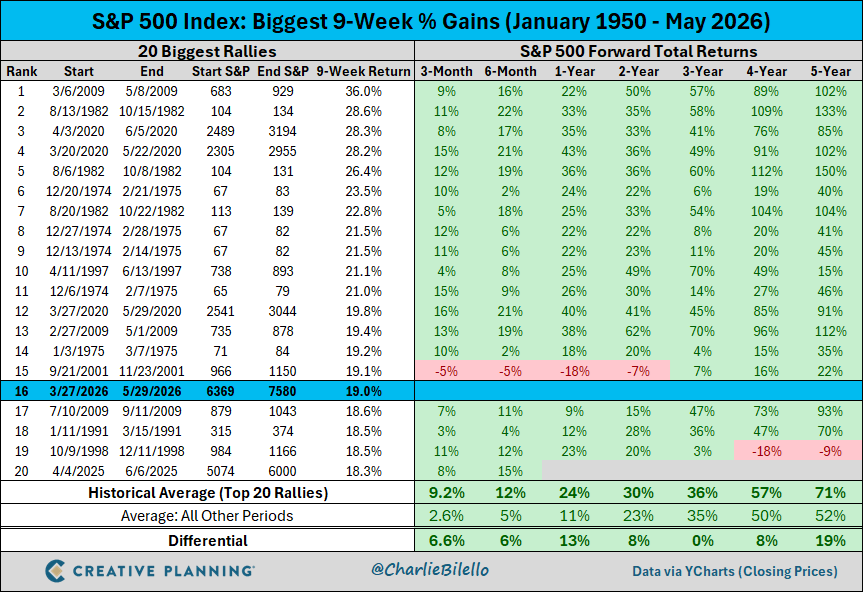
If the current unusual strength in the S&P 500 is similar to the past, then prepare for higher prices…
The 19% gain in the S&P 500 over the last 9 weeks is the 16th biggest 9-week gain for the index since 1950. What tends to follow the biggest short-term advances? More upside and above-average returns. Strength begets strength.
@charliebilello
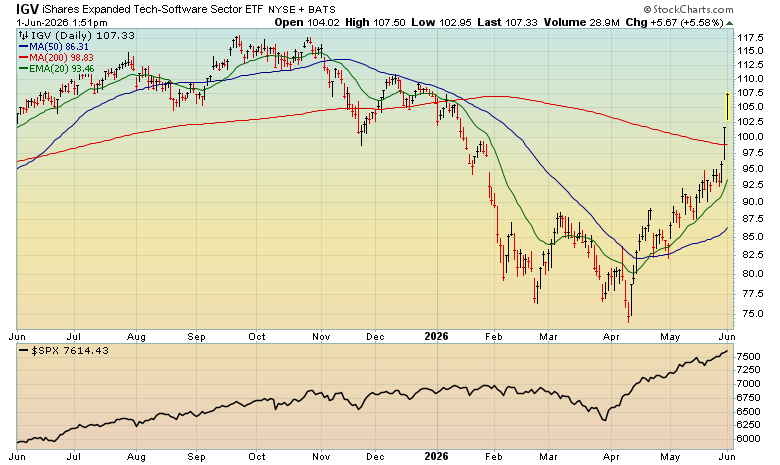
Remember when they said that Software was dead?
The major Software ETF just had its best month in 25 years (+21.15%) and is now in a +44% bounce from its April low. I lift a Red Bull to all those who were buying this spring.
StockCharts
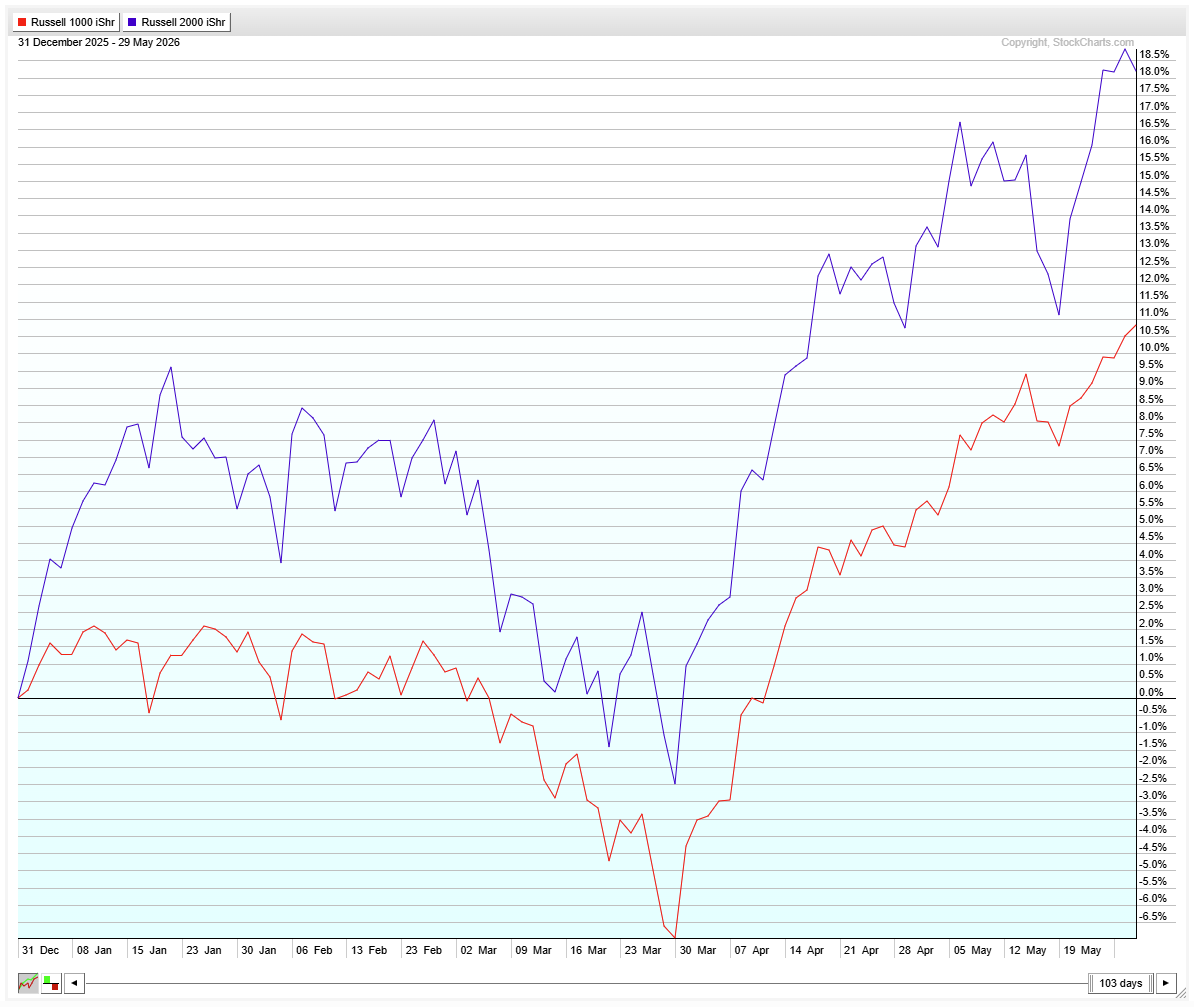
With all the focus on AI & tech, have you noticed that Small Caps beating Large Caps by over 700bps YTD…
StockCharts
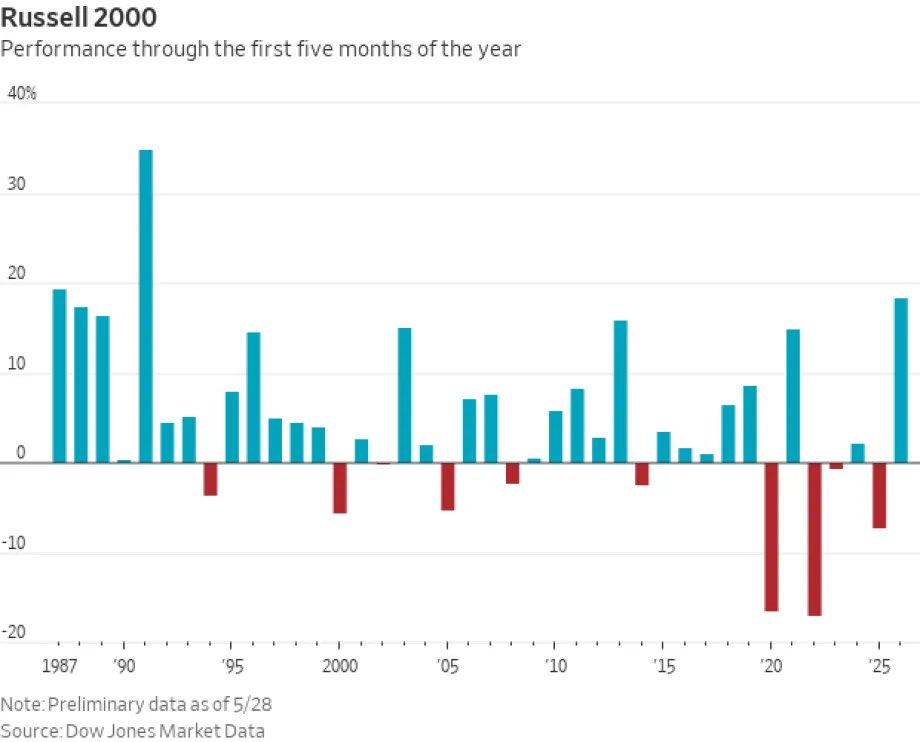
In fact, Small Caps are lining up for their best YTD in 34 years…
@TheChartReport: The Russell 2000 $IWM is on track for its strongest start to a year since 1991.
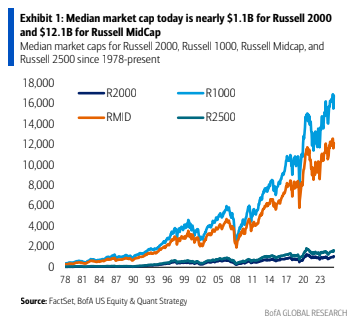
A refresher on Small Caps. They have been left in the dust by the Bigs and Mids…
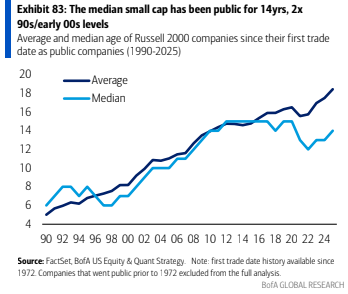
The median market cap of the Russell 2000 index today is $1.1B, almost double what it was a decade ago, with the top end of the index at last June’s rebalancing at $10B vs. just $4B a decade ago. Mid caps have also grown in size, with the median Russell MidCap stock $12B today vs. just $6B a decade ago.
BofA Global
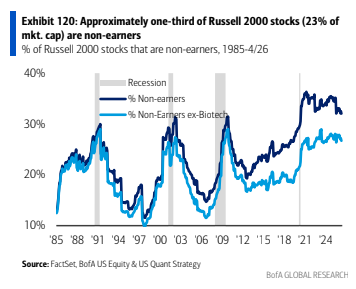
And a huge chunk of them lose money (even excluding all of the biotechs)…
BofA Global
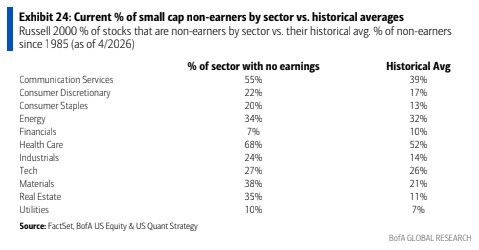
Only the Financial sector has an increase in profitable names versus the historical averages…
BofA Global
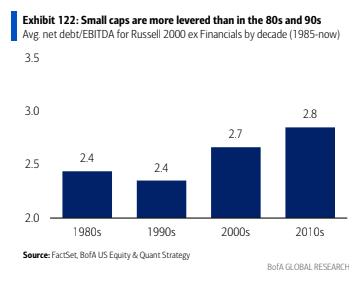
Rising leverage is partly to blame for the decline in profitability…
BofA Global
Also, the index is looking stale and old with good companies moving up or going private…
BofA Global
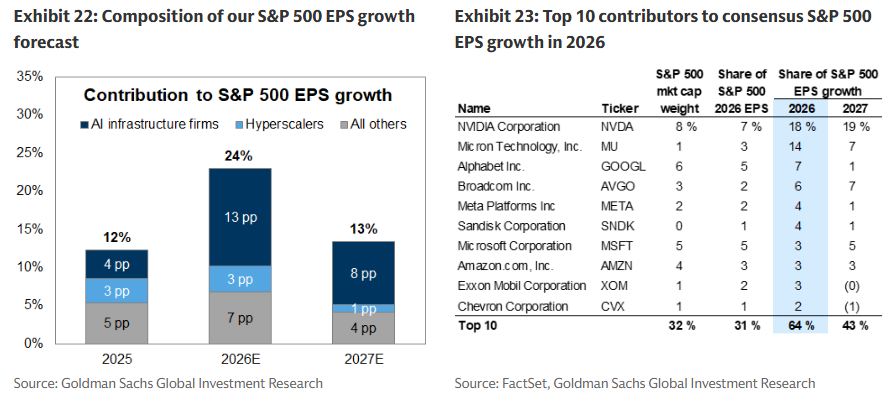
It remains an AI earnings driven market…
We expect the beneficiaries of AI infrastructure investment will account for roughly half of S&P 500 EPS growth in 2026 and 2027. Semiconductors are the primary direct earnings beneficiaries of the AI investment boom, and consensus estimates show NVDA and MU together accounting for a third of S&P 500 EPS growth this year. A number of tech hardware, industrials, and utilities companies are also receiving large earnings boosts from the AI build out. Growing hyperscaler depreciation expense will partially offset the boost to S&P 500 earnings, with a larger impact in 2027 than in 2026.
Goldman Sachs
More, more, and more…
“Each one of these [AI factories], at the one-gigawatt level, started at $20 to $30 billion. It’s now at $50 to $60 billion. And soon, it will be $80 to $100 billion per gigawatt. $100 billion into an AI factory. It must work the first time, and it must work right away. The cost of capital is incredible. The complexity is incredible.” - Nvidia CEO Jensen Huang
Even more…
ASML CEO: Demand on AI is coming so strongly that we will be in a supply-limited market for quite a while; Sees global semiconductor market "tense" due to tight supply for the foreseeable future.
AMAT management said AI and “agentic” demand now give it “8 plus quarters” of visibility and support “continued strong growth” in WFE spend into 2027 and 2028.; says the better 2026 systems outlook is “not fundamentally a pull-in from 27 into 26”; instead, growth is being driven by a pipeline of greenfield projects that are now coming online.
TradeTheNews
Even the most commodity portion of the semiconductor market saw an ETF created for it. And demand went through the roof!
An exchange traded fund investing in a narrow group of AI chipmakers has surged through $10bn in assets just 50 calendar days after its launch, in a further sign of investor excitement over the rapid build-out of huge data centres by tech hyperscalers.
The Roundhill Memory ETF, which has the stock market ticker DRAM, hit the figure on Friday after surging 87 per cent since launch on April 2 and after $8.6bn of inflows, in the quickest rise to a $10bn valuation for any ETF on record, according to data from Morningstar.
DRAM hit the milestone in less than one-tenth of the time taken by the iShares AI Innovation and Tech Active ETF, known as BAI, which reached $10bn in assets last month, 556 days after its launch — at the time, the quickest rise to that value for any thematic ETF.
“DRAM is a textbook case of an ETF issuer catching lightning in a bottle, pairing a perfect ticker symbol with impeccable timing and an investment thesis tailor-made for the current market,” said Nate Geraci, president of NovaDius Wealth Management…
“I would just caution folks. Three stocks make up most of the fund and they are all related. It’s not like they are different parts of the AI supply chain,” Rosenbluth said.
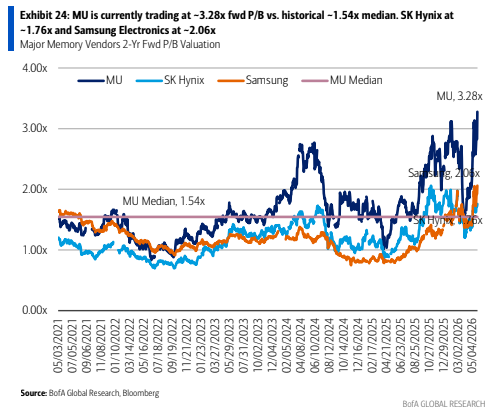
Now for those new to the semiconductor memory space, keep in mind that when demand slows, the environment gets ugly…
In the past when the bottom fell out (2022, 2019, and 2016) Micron traded down to 1x book value. Memory chip manufacturing is a very capital intensive business with three major competitors (Hynix, Samsung and Micron) who are all now trading at $1T+ valuations. Will high bandwidth memory chips (HBM) make this cycle more sustainable? Stay tuned and alert for the answer.
BofA Global
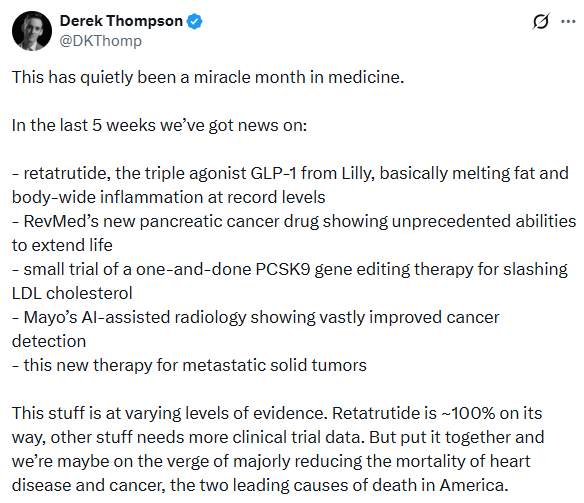
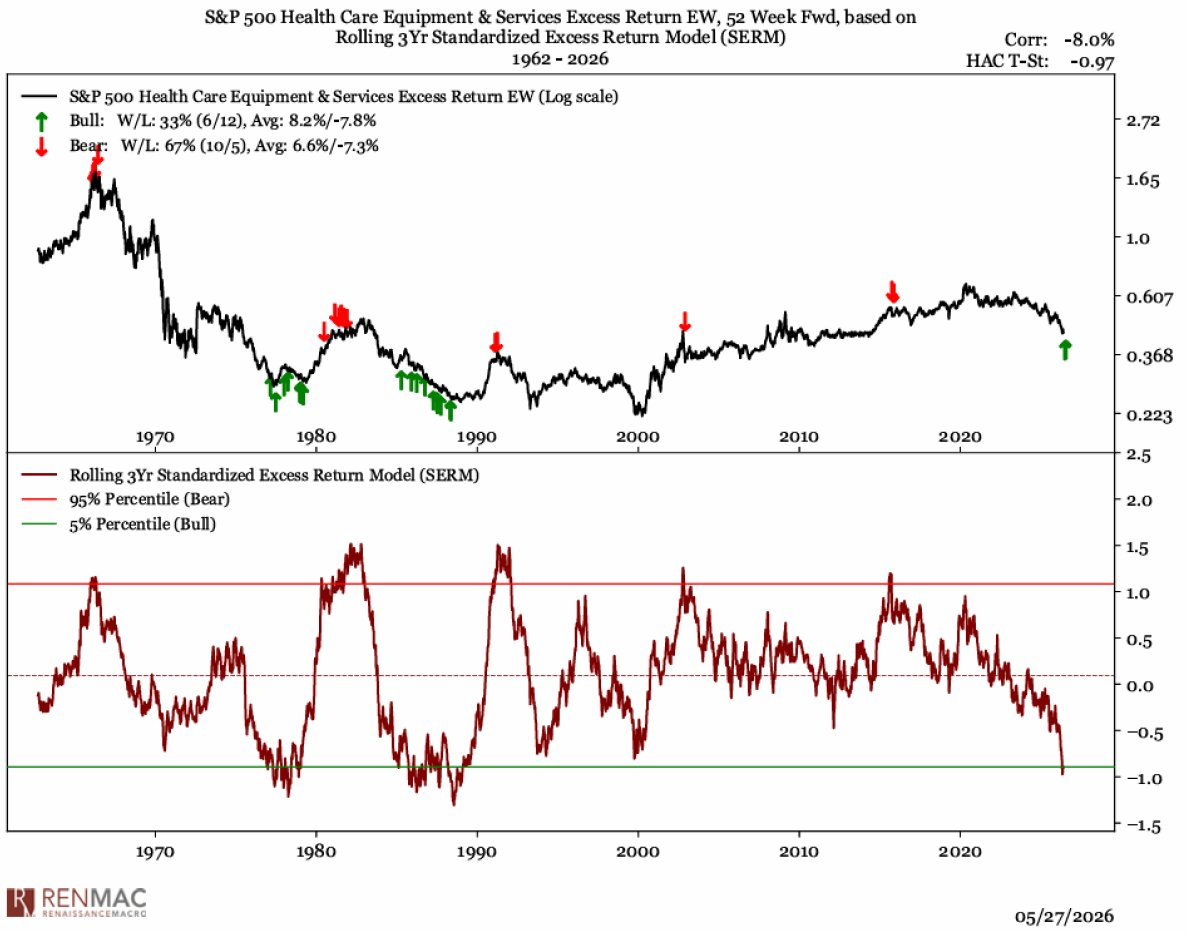
On the other side of the valuation spectrum, maybe your healthcare positioning is too small?
Did you see this weekend at ASCO there was a standing ovation after the release of the full Daraxonrasib results (for pancreatic cancer). There are some major advances being made and we have yet to turn on the full AI firehose onto medical research.
Couldn't agree more…
@RenMacLLC: Healthcare Equipment hasn't been this abandoned since the late 1980s. Our 64-year SERM model is in the 5th percentile bullish zone - a set-up that suggests it's time to start turning over rocks.
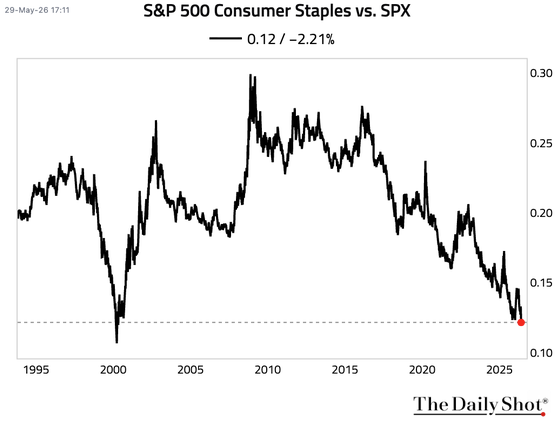
Staples is another massively underperforming sector right now…
This oil company presentation raised many eyebrows last week…
Exxon Mobil warned Thursday that oil inventories will fall to record low levels in coming weeks, forcing prices to spike and curbing demand.
“We’re approaching unheard of inventory levels,” said Exxon Senior Vice President Neil Chapman at a conference hosted by Bernstein in New York.
“I mean really, really low levels,” Chapman warned. “You can debate whether that’s going to hit, those really low levels, in two weeks or three weeks. Once you get to that point, then you’ll see price shoot up.”
The price of physical Brent oil cargoes will spike to $150 to $160 per barrel when inventories hit all-time lows in coming weeks, the executive said. “When the price gets to a certain level, demand destruction brings it back into balance,” he said…
Iran’s closure of the strait has cost the market more than a billion barrels so far, the largest oil supply disruption in history, according to the International Energy Agency. Oil stockpiles have mitigated the impact so far, but that “can’t last forever,” Chapman said…
Oil industry executives have warned for two months that the crude futures market is not reflecting the scale of the disruption triggered by the war in the Middle East.
“I don’t know, whether it’s two to three weeks or three to four weeks,” Chapman said. “What I’m really saying is, once you get to the minimum inventory levels and all-time low inventory levels, there’s only one way to go. That’s the situation.”
In the world of M&A, Berkshire Hathaway brings its fortress balance sheet to play in the homebuilder's sand box…
Now Taylor Morrison can grow faster beyond the 21 markets in 12 states that it is currently in. And in addition to having the Gecko greet every new homeowner when they arrive to the front door, Berkshire has a portfolio of homebuilding inputs including Johns Manville insulation, Shaw carpets, Acme bricks, Benjamin Moore paints and MiTek truss hardware. All that is missing is Whirlpool appliances, but maybe that will come next.
Berkshire Hathaway agreed on Sunday to buy home builder Taylor Morrison Home Corp. for $6.8 billion in cash…
Berkshire has long been involved in the housing industry, owning a large residential real-estate broker, and holding stakes in home builders in recent years.
Berkshire will pay $72.50 per share for the Scottsdale, Ariz.-based home developer, a 24% premium to Taylor Morrison’s closing stock price of $58.50 on Friday.
“This is an exciting transaction for Berkshire and reinforces our long-standing commitment to U.S. housing. Homeownership remains central to the American dream, and this investment expands our ability to serve that market,” Abel said in a statement.
And a mega merger of equals hits the multi-family housing industry…
A near perfect overlap of markets that will merge over 180,000 rental apartments, so plenty of cost synergies on deck to justify the $52b equity value combination. A very large 'A' rated balance sheet will give them a financing advantage against the rest of the industry. And no regulator is going to get in the way of a $4b+ and 10,000 unit development portfolio. The only question should be, "When can they make another public or private acquisition?".
Equity Residential (EQR) and AvalonBay Communities (AVB) have agreed to an all-stock merger to form a housing rental company with an enterprise value of $69 billion, the firms said on Thursday, strengthening their presence in key U.S. markets.
The deal, which would create the largest publicly traded U.S. apartment real estate investment trust by market value, will also strengthen the capacity to invest in AI technology.
The companies said they have a 95% overlap in markets where they own rental properties, a concentration expected to improve margins by enabling neighborhood-based operations, centralized services and lower cost-to-serve.
The transaction is expected to generate $175 million in gross synergies by the end of 18 months after completion, driven by reduced corporate overhead costs and property management expenses, the companies said.
“AI was able to do here what lots of excellent human researchers tried and failed to do.” — Noga Alon, professor, Princeton University
This is just the start of major advances in mathematics. Now many researchers will be turning to AI to assist in other unsolved problems. Then onto every other science discipline. What a great time to be alive.
“If you are a mathematician,” one of the world’s leading mathematicians recently wrote, “you may want to make sure you are sitting down before reading further.”
And you’ll definitely need to sit down if you’re not a mathematician.
Because a famous math problem that stumped humans for the better part of a century has finally been toppled—by AI.
Not long ago, the most advanced AI models couldn’t do basic math. By last year, they were performing at gold-medal levels at the International Mathematical Olympiad. Now they are solving classic problems in combinatorial geometry using algebraic number theory. In no time at all, artificial intelligence has gone from stupid to frighteningly smart.
But even mathematicians were astonished when OpenAI announced that one of its models resolved a puzzle known as the unit distance problem without the help of any humans scribbling a bunch of equations on chalkboards.
The full problem and solution can be found here…
Learn more about the Hamilton Lane Strategies
DISCLOSURES
The author has current equity ownership in: Nvidia Corp. and Berkshire Hathaway Corp.
The information presented here is for informational purposes only, and this document is not to be construed as an offer to sell, or the solicitation of an offer to buy, securities. Some investments are not suitable for all investors, and there can be no assurance that any investment strategy will be successful. The hyperlinks included in this message provide direct access to other Internet resources, including Web sites. While we believe this information to be from reliable sources, Hamilton Lane is not responsible for the accuracy or content of information contained in these sites. Although we make every effort to ensure these links are accurate, up to date and relevant, we cannot take responsibility for pages maintained by external providers. The views expressed by these external providers on their own Web pages or on external sites they link to are not necessarily those of Hamilton Lane.