
Weekly Research Briefing: Feeling a Bit Squishy

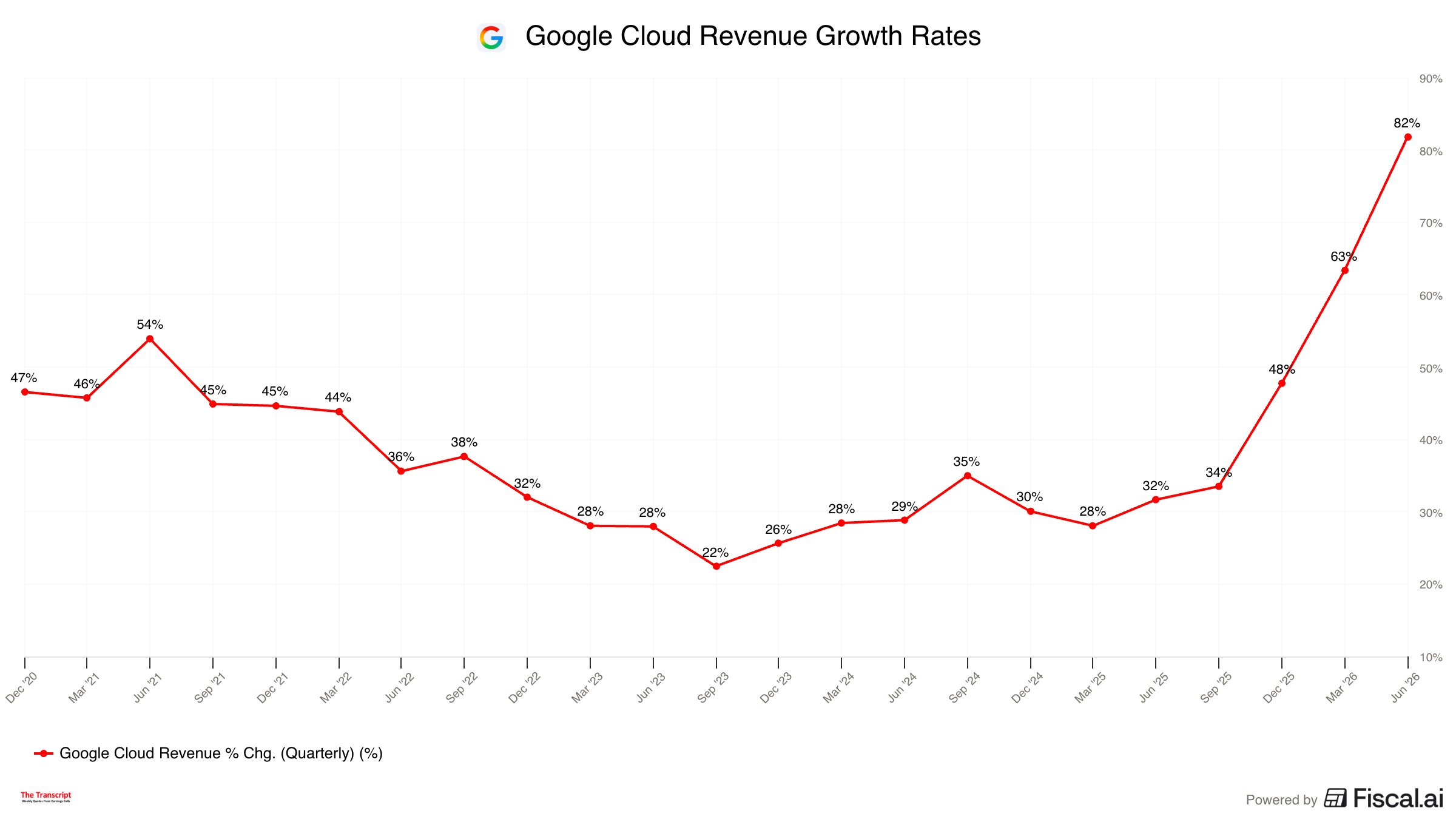
The stock market faced its biggest test last week when Alphabet reported its highly anticipated earnings. They posted great growth (+82% y/y) and solid margins (35.6%) from their Google Cloud business, but investors paused due to compute capacity shortages and increased capex plans. If a hyperscaler AI cloud data center can earn high teens returns on capital and the company can invest hundreds of billions of dollars over the next few years, shouldn't they spend as fast as possible? Even if it means two years of slightly negative free cash flows? A long term investor would say 'YES'. But last week, Alphabet traders and shorter term investors had the final say of 'NO'.
This week, we will have three more big hyperscaler tests for the investing world as Microsoft, Meta and Amazon report their earnings and update us on their AI business model plans. Maybe AI investors will be in a better mood after the others report, but for now, it sure feels like the market has a softer appetite for increasing cloud exposures. In the meantime, public equity investors continue to find other places to deploy winning bets as the financial sector, value, high dividend, small cap and many international indexes reach all-time highs.
Broader equity market gains are occurring even as the war with Iran accelerated last week before decelerating over the weekend. Global energy prices have remained highly volatile as the Strait of Hormuz remains closed and traffic in the Bab al-Mandab Strait is reduced. It is anyone's guess whether the average gasoline price will have a $3 handle or a $5 one. Also, the White House has reactivated global tariffs again. Some countries will see 10% tariffs, while Canada gets 50%.
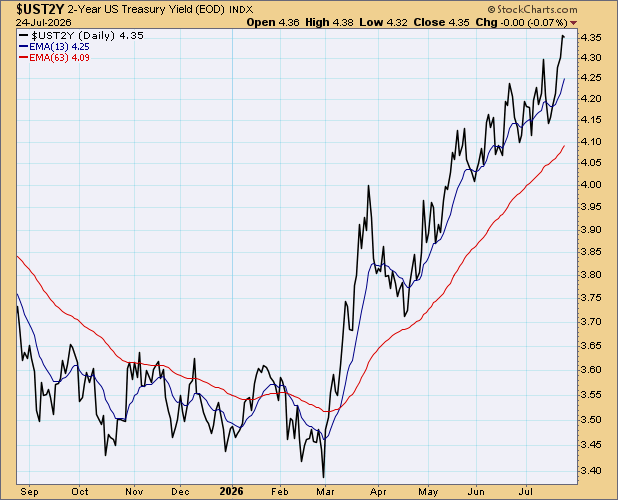
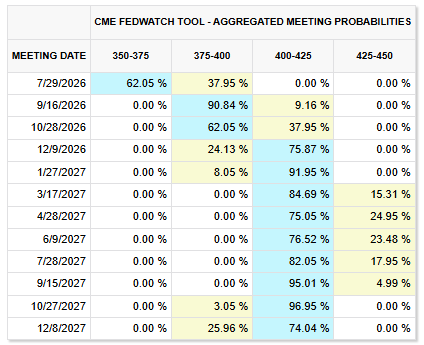
With the 2-year US Treasury yield at 4.3% and Fed Funds at 3.5-3.75%, the Fed has the justification to raise rates this week. If not, it should make the September meeting a lock for an increase. The Fed should just raise rates now; otherwise, the Jackson Hole symposium will feature only one line of thinking and questioning. Away from the FOMC and one-third of the S&P 500 reporting earnings, there is not much else to focus on besides your final August vacation travel planning. Enjoy the week.
The most important earnings item of the week was Google Cloud's accelerating revenue growth rate…
CEO comment: "Q2 was an amazing quarter, with Alphabet revenues growing 24% year-over-year and Google Cloud revenues accelerating to 82% growth, driven by demand for AI infrastructure and AI solutions"
@TheTranscript_
Unfortunately, their Cloud revenue growth rate did little to help the stock as investors instead became more cautious on future capex spending and their shortage in compute capacity…
- “We are updating our full year 2026 CapEx guidance range to $195 billion to $205 billion, up from our previous estimate of $180 billion to $190 billion. The increase in the range is primarily due to an acceleration in the delivery of capacity to meet growing demand. As we previously shared, we continue to expect our CapEx to increase significantly in 2027, and we’ll provide more details at a later date.”
- “And given the supply-constrained environment, we plan to expand the use of third-party capacity in Q3 as a bridging strategy while we build up more internal capacity. This strategy allows us to keep growing our customer base and capture greater overall value. However, it will create modest margin pressure in the near term as we utilize this capacity.”
- “We had negative free cash flow of $5.9 billion in the second quarter driven by our investments in CapEx. Free cash flow was $53.3 billion for the trailing 12 months. We ended the quarter with $242.5 billion in cash and marketable securities, which includes $87.1 billion of marketable equity securities. Long-term debt was $98.2 billion.”
Regardless of the stock price reaction, Sundar is even more excited about the future…
“So I would say from an ROIC standpoint, I think we are taking a full stack approach. We are seeing momentum across consumers and enterprises and developers and so on. So it feels like, if anything, over the past year, we’ve gotten more bullish on the opportunities ahead.” - Alphabet CEO Sundar Pichai
Further clouding investor's heads is a potential half billion dollar circular financing deal…
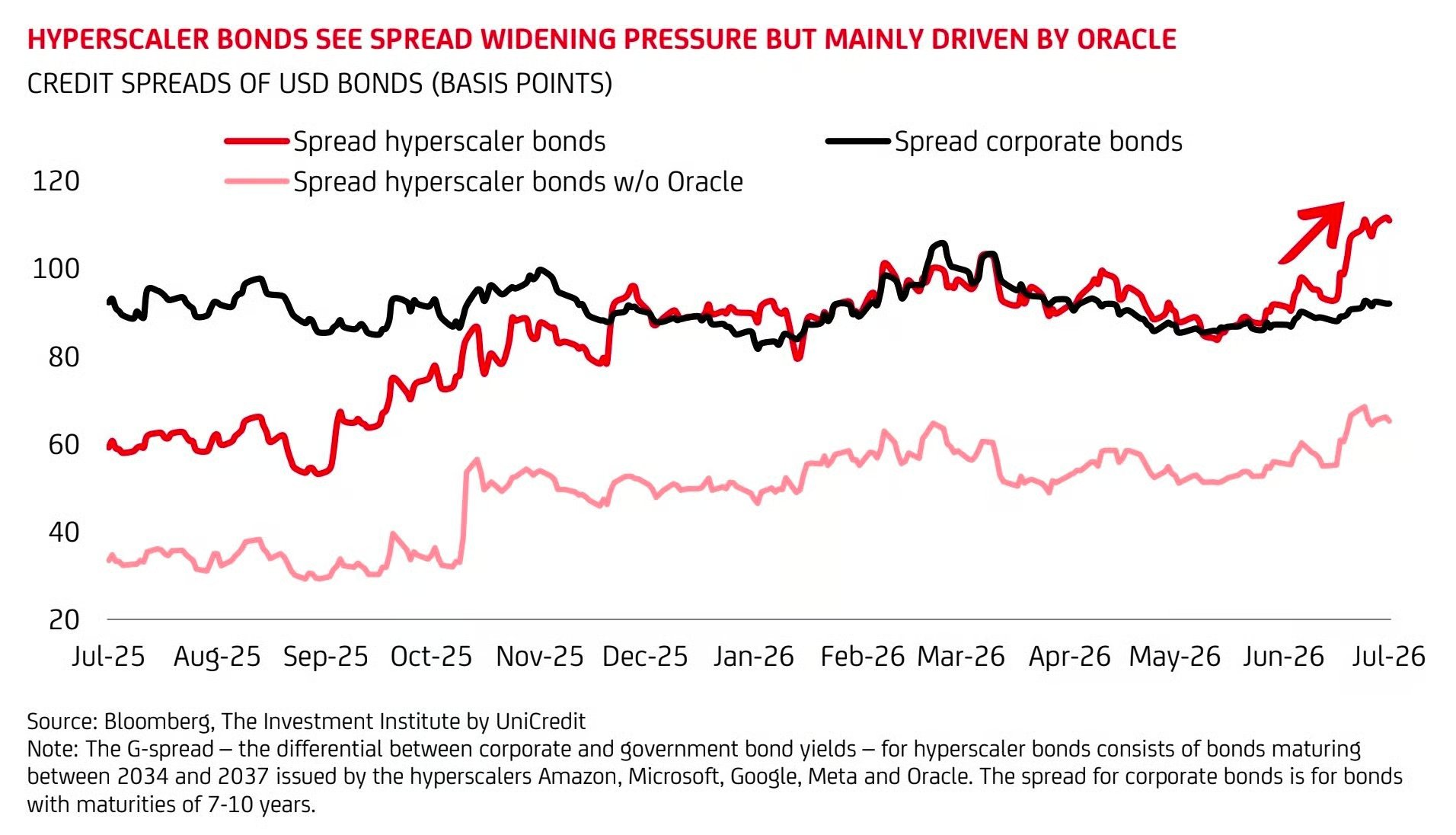
If hyperscaler debt spreads were tightening, builders would not have to run to Nvidia for a signature.
“Nvidia is in talks to provide a roughly $250 billion backstop for OpenAI as part of a massive data-center project, one of the most ambitious financial transactions yet in America’s artificial-intelligence boom.
The guarantees from Nvidia would help the ChatGPT maker lease a 10-gigawatt project that SoftBank’s energy subsidiary is developing in southern Ohio, people familiar with the matter said. In total, the project could cost more than $500 billion, including the chips that would go inside the data centers. It would be the largest data-center project announced to date.”…
Nvidia’s backing would allow the data-center developer, which is owned by Japanese billionaire Masayoshi Son’s investment firm SoftBank, to raise debt at more favorable terms than it could if OpenAI had no financial backer, since OpenAI has no investment-grade credit rating as an unprofitable private company…
The $250 billion guarantee would cover the data-center lease and debt needed to fund its build-out, but not the Nvidia chips that would go inside it. Nvidia, which has invested $30 billion in OpenAI, is also discussing a deal to finance the chip purchase for OpenAI, which could total $350 billion, people familiar with those discussions said. Such circular funding arrangements have caused concerns that the industry is vulnerable if investor sentiment shifts or growth slows for AI companies.
The campus would require roughly 10 gigawatts of electricity, or enough to power several million homes, and take many years to complete. The first phase of the project is expected to be finished in 2028, with around 800 megawatts of power, according to people familiar with the deal.
Meanwhile, Nvidia is going to finance one more major AI competitor to expand its bets (and help future semiconductor orders)…
Nvidia has agreed a $5bn investment in Safe Superintelligence, the secretive artificial intelligence start-up led by OpenAI co-founder Ilya Sutskever, deepening the chipmaker’s ties with one of Silicon Valley’s most closely watched AI companies.
The Silicon Valley group and SSI announced the deal on Monday as part of a “long-term partnership” that will see the start-up use Nvidia’s latest Vera Rubin hardware.
The $4.75tn chipmaker has agreed to invest around $5bn, according to people briefed on the terms of the deal. Such large commitments are typically contingent on the start-up hitting certain milestones.
The credit markets will likely fund the $5 trillion in AI capex planned through 2030. Those debt financing costs are rising…
UniCredit: "The recent widening in credit spreads of hyperscaler bonds has reignited investor debate about the viability of their business models, especially in light of their abundant capex."
@dailychartbook
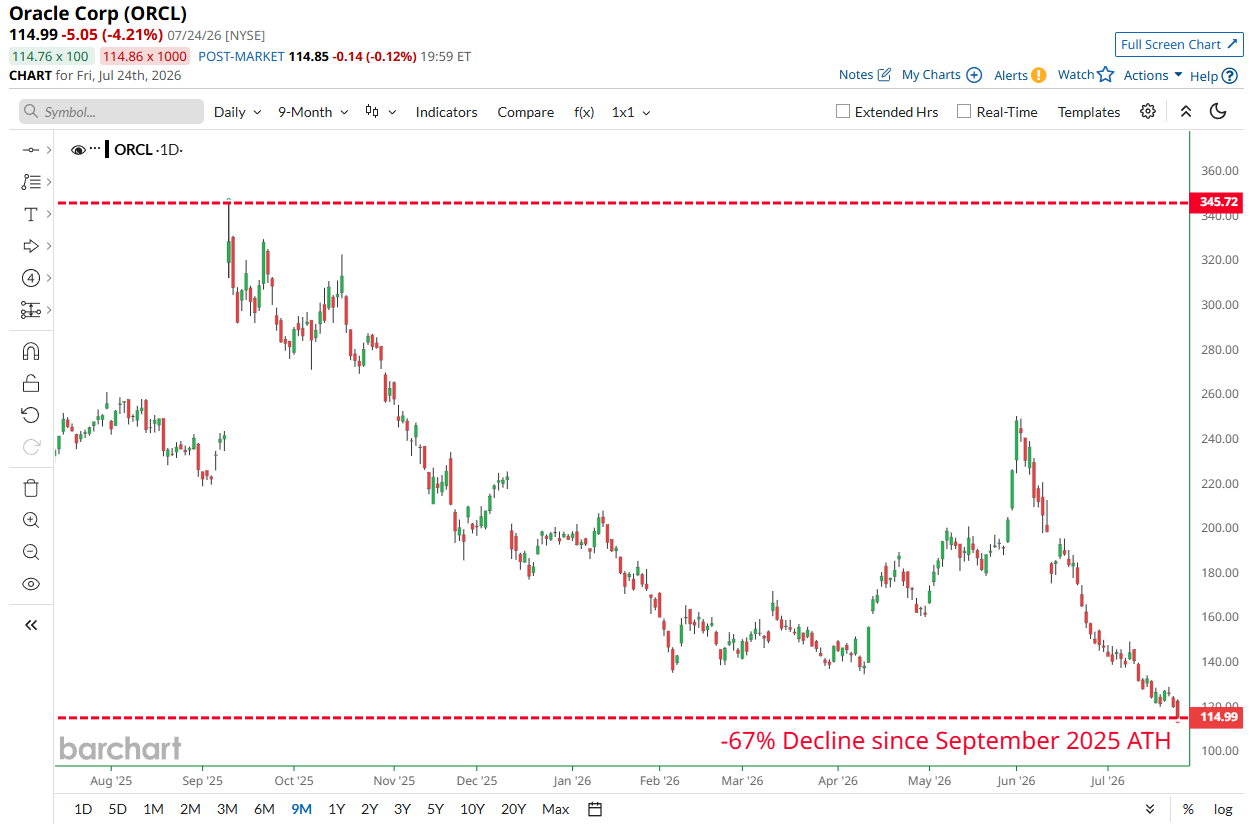
Not only are Oracle debt spreads widening, but their equity value also continues to fall…
Many questions on how this should resolve itself. Sell projects, pay down debt and buyback stock? Find a big balance sheet BFF to lower your financing cost in exchange for a pound of flesh? Or just keep your head down and bet that your customers execute and pay their bills.
@Barchart
MLB decides not to help AI growth rates…
Fresh off last week’s All-Star break, Major League Baseball took aim at artificial intelligence. As the season resumed, clubs were barred from using AI assistants in the dugout.
It wasn’t a preemptive move — the technology is already here. Last week, reports emerged that the New York Mets spent hundreds of thousands of dollars on a custom AI assistant to steer pitch selection and other in-game decisions. The result? Another losing record. But according to The Athletic, the hapless Mets aren’t alone. As many as one-third of the league’s clubs are trying for an in-game AI edge.
Nobody wants a chatbot managing a baseball game. At least, they shouldn’t. But baseball has seen versions of this story before. For decades, the game has rewarded teams that use information better than their opponents. AI is simply the latest tool in that evolution. MLB shouldn't overreact and treat it as a threat to the game’s existence.
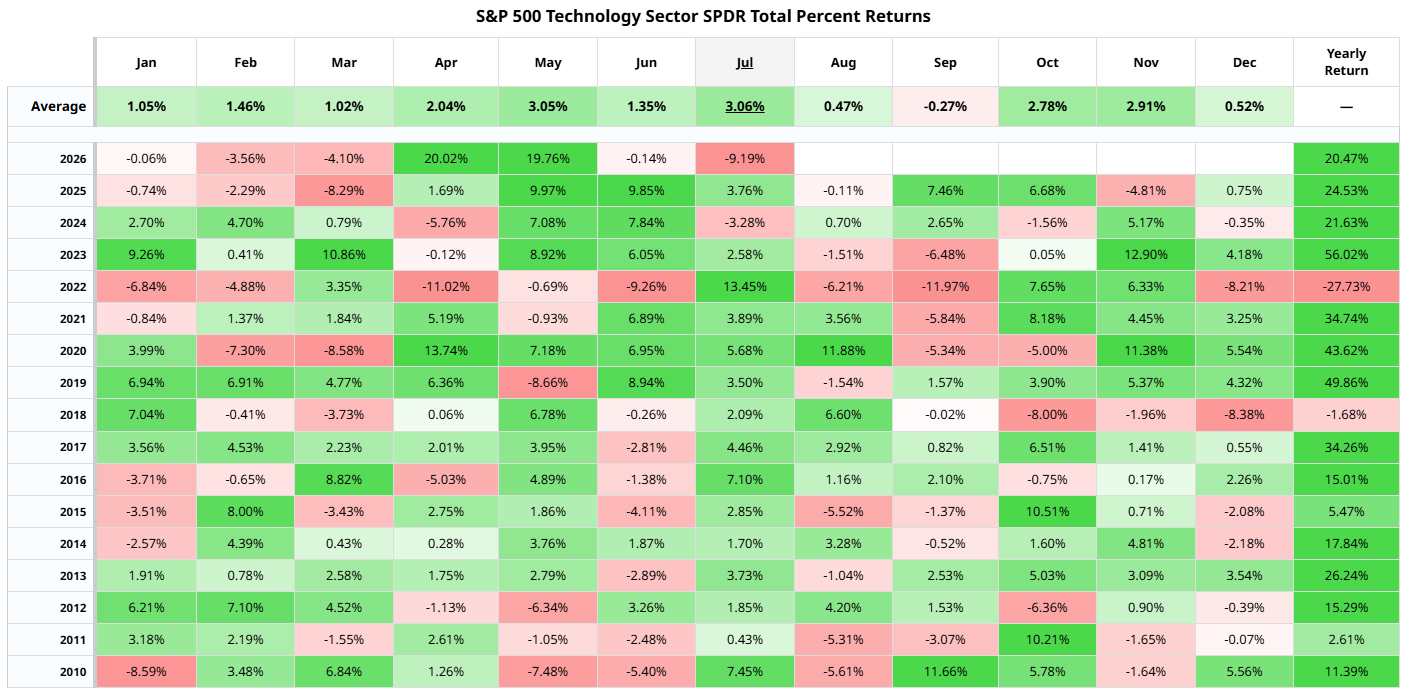
As AI hits a bump, the Technology Sector is on track for its worst month since 2022…
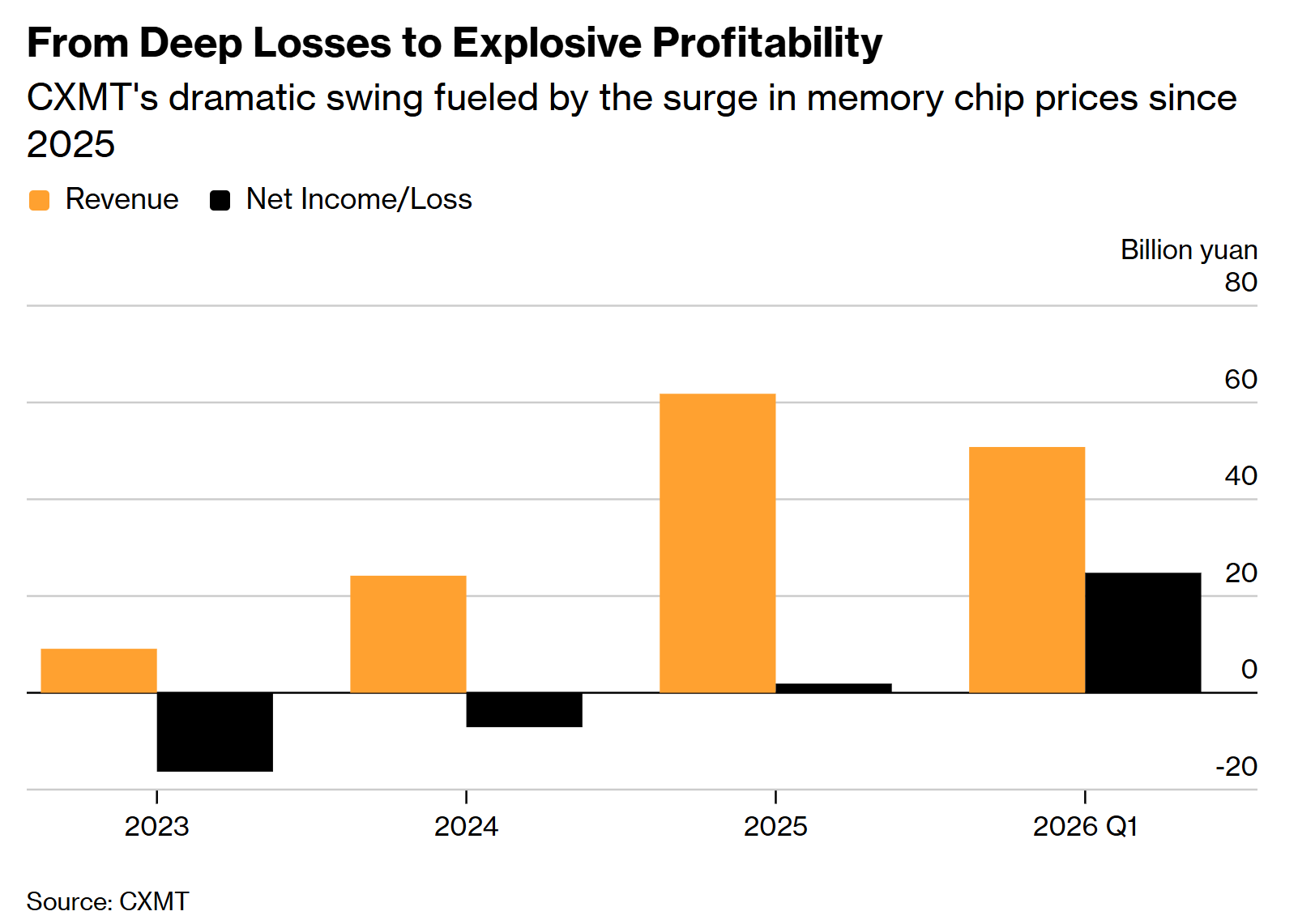
But all is not soft as the world's fourth largest DRAM maker just went public at a 1/2 trillion US$...
Great timing to monetize the spike in memory prices. Now, like other memory companies, the question is how long will high memory prices stick around?
CXMT Corp. surged 466% in its Shanghai trading debut to become China’s largest onshore-listed company, as investors piled into one of the country’s biggest artificial-intelligence champions.
At its closing price of 49 yuan on Monday, the maker of dynamic random-access memory chips is valued at about 3.3 trillion yuan ($488 billion), surpassing all other A-share companies.
The blockbuster debut of the second-largest initial public offering in China’s history — raising as much as 66.6 billion yuan — underscores investors’ voracious appetite for a company viewed as central to Beijing’s ambitions to build a self-sufficient semiconductor industry. CXMT has emerged as the nation’s best hope of challenging foreign suppliers in DRAM chips, a critical component used in everything from smartphones to AI servers.
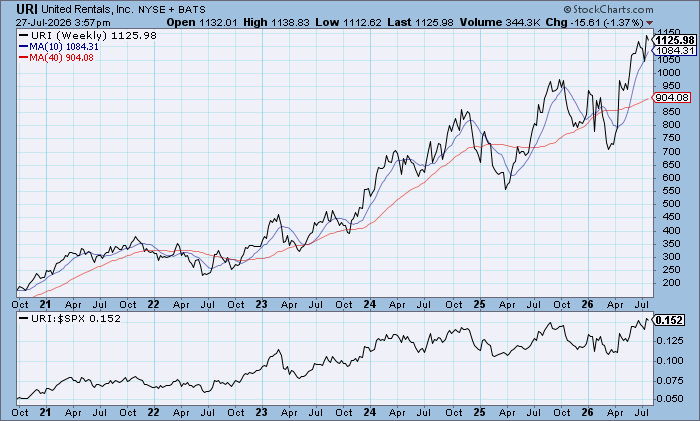
And the largest rental equipment company in North America also saw a pickup in their Q2 no doubt helped by some big AI projects…
United Rental is now targeting +10% revenue growth for 2026 up from +7% on strong non-residential and infrastructure activity. The stock hit new all-time highs on an absolute and relative basis which should be a good tailwind for your cyclical exposures.
- “As evidenced in our record second-quarter results across EPS, adjusted EBITDA and revenue, 2026 is on track to be a great year for United Rentals. Our growth accelerated in the quarter, customers remain optimistic, particularly around large projects, and we continue to demonstrate strong cost discipline.”
- “Looking ahead, I am very pleased that we are again raising our guidance for the year, supported by the tailwinds we see across large projects, customer backlogs, and the momentum witnessed year-to-date.”
@wallstreetengine
@stockcharts
In other earnings, the Transportation sector is seeing momentum in industrial demand…
“And so yes, if you look at it broadly, if you look at the car orders, and I’m talking across the board, there is some slight uptick that’s there. You’re also seeing that in the momentum that we talked about on the industrial side, that’s largely a lot of our carload business where we’ve had record average revenue per car and, candidly, record revenue that’s there. So that’s encouraging to us as we move and turn into the second half.” - Union Pacific EVP of Marketing and Sales Kenny Rocker
“So the truckload freight market has rapidly progressed over the past few months, with spot rates trading well ahead of normal seasonality, tender rejection rates reaching levels not seen since 2021, and contractual bid activity growing increasingly supportive. This has continued to be largely supply-driven, though signs of improving demand are starting to emerge” - Knight-Swift Transportation CEO Adam Miller
“What started as a narrow supply-driven improvement in market conditions broadened through the spring, resulting in strong volume growth across the business. Customers are increasingly turning to rail for their supply chain needs and we are focused on earning their business through competitive service offerings and reliable execution.” - CSX CCO Maryclare Kenney
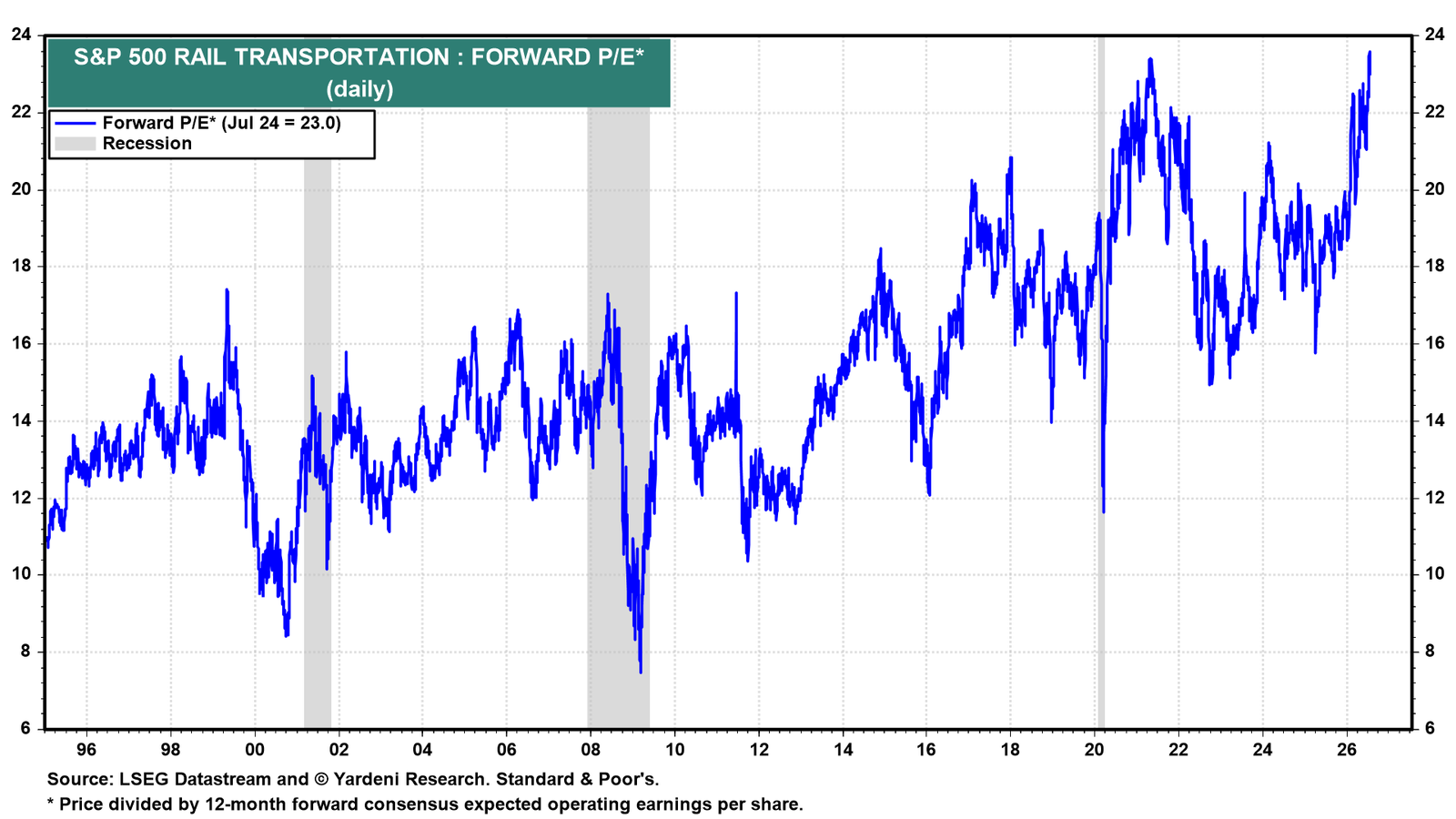
And Railroad stock multiples have taken notice rising to their highest level in 30 years…
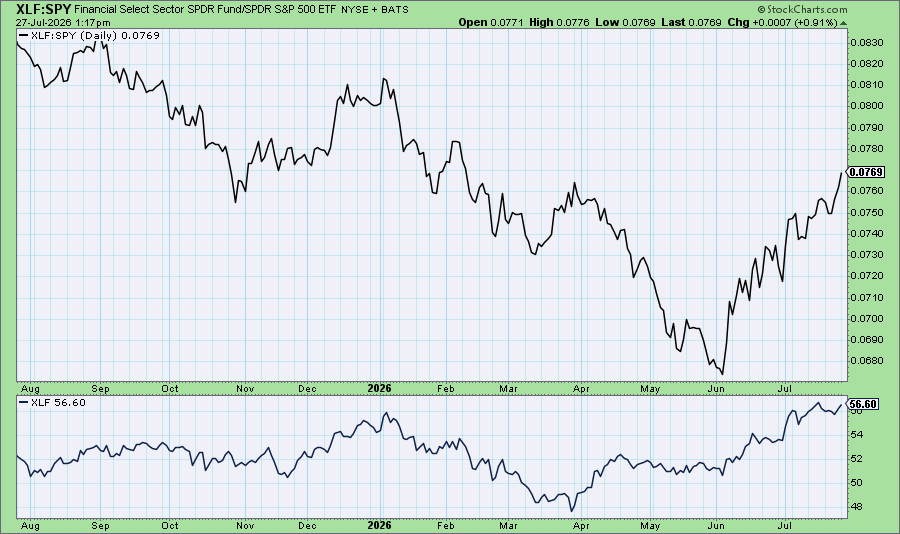
The Financial Sector is now working on its 9th weekly gain in a row…
A beneficiary of AI due to all of the syndicated debt financing as well as this year's IPOs. But the biggest benefit from AI might be to their companies use of the technology to increase productivity.
StockCharts
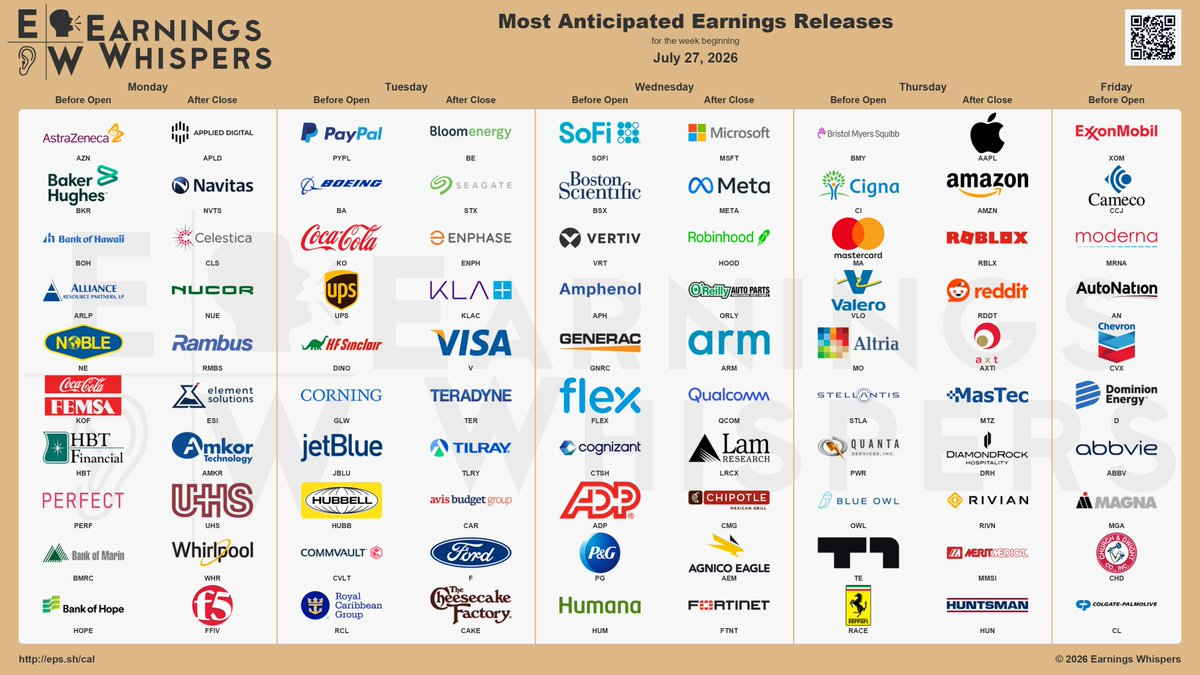
The biggest week of the season for the S&P 500 earnings reports as over 1/3 of the index will report…
@eWhispers
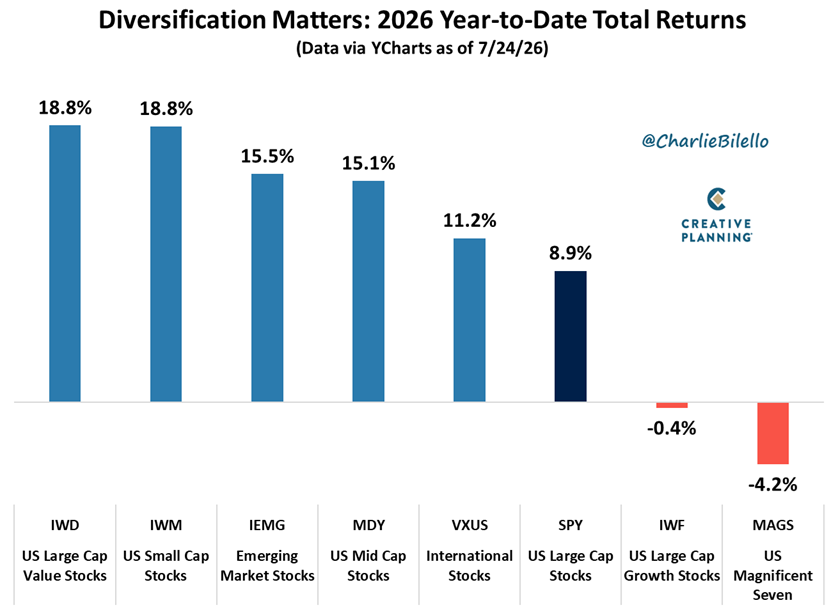
A glance at where public equity are beating the S&P 500 this year…
@charliebilello
Companies continue to wrestle with input price increases by increasing their own output prices…
Packaging Corp is raising containerboard prices by double their typical increase. Qualcomm is raising semi prices 10%+. Taiwan Semi is raising wafer prices 5-10%. And a comment from Honeywell's earnings call:
“So essentially, we’re able to cover inflation with price, but inflation is stubborn. We see a lot of inflation in electronics, memory, obviously, copper, and we also see inflation in labor. So I think this is the environment we’re in. We’ll continue to price at that level and continue to manage things with our customers.” - Honeywell International CFO Mike Stepniak
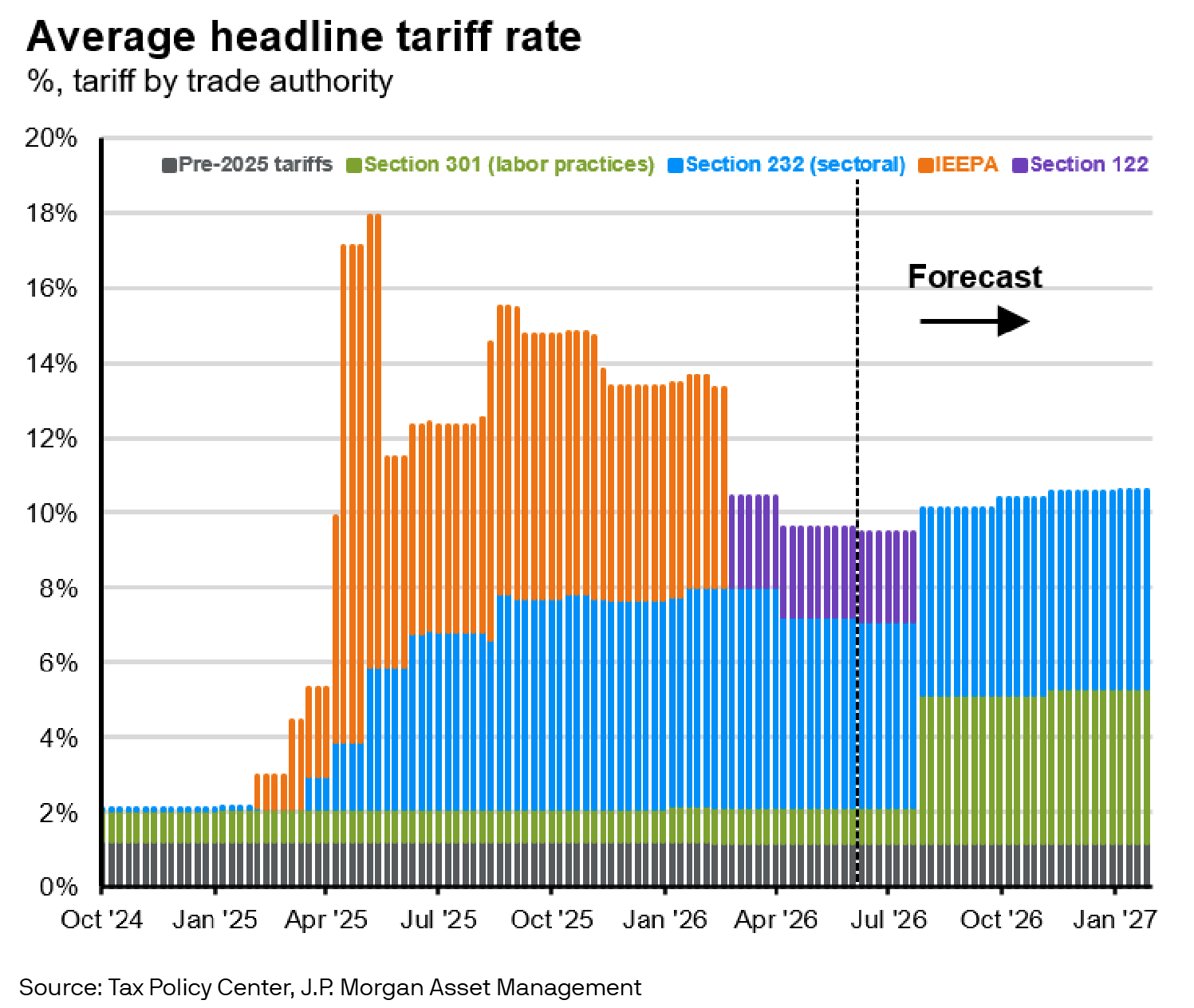
The White House wants to keep the tariff rate that you pay on foreign goods at 10%...
Tough news for those with foreign inputs or love of international products. Troubling news for Republican incumbents up for re-election in November.
War, tariffs and a strengthening US economy has pushed 2-year yields up almost 100 bps this year…
Three-Eights odds that the FOMC hikes rates this week…
And for the first time, there are now measurable odds of a 3rd hike in 2027.
Across the entire credit spectrum, some positive comments last week…
High yield spreads remain tight
“...we’re watching high-yield spreads. Our original assumption for the year was that they were going to widen modestly into H2 of the year. They’re actually still very tight by historical averages. Our speculative-grade default rate outlook continues to decline. That tells me there may be some support for tighter spreads further into the year, which may provide greater support for leveraged finance issuance than we’ve been forecasting. Right? We’ll see.” - Moody’s CEO Robert Fauber
Private credit redemption pressure eased
“I would say as much as anything, it’s the level of noise has come down. I think a lot of people were calling for this massive calamity, and when the calamity did not occur, I think sort of the press, what you see on TV or Twitter or in newspapers, that has calmed. Before, obviously, was getting clients understandably nervous. They would pick up the newspaper and say private credit faces this massive problem, and they would call their financial advisor, and that did create a dynamic. I think the key here is what happens in the fullness of time.” - Blackstone COO Jon Gray
Is it beginning to feel like this is now a typical summer vacation photo?
@newseye.bsky.social: One of the great photos of our time.
Captured by Maximilien Lamy for AFP.

Learn more about the Hamilton Lane Strategies
DISCLOSURES
The author has current equity ownership in: Nvidia Corp. and Alphabet Inc.
The information presented here is for informational purposes only, and this document is not to be construed as an offer to sell, or the solicitation of an offer to buy, securities. Some investments are not suitable for all investors, and there can be no assurance that any investment strategy will be successful. The hyperlinks included in this message provide direct access to other Internet resources, including Web sites. While we believe this information to be from reliable sources, Hamilton Lane is not responsible for the accuracy or content of information contained in these sites. Although we make every effort to ensure these links are accurate, up to date and relevant, we cannot take responsibility for pages maintained by external providers. The views expressed by these external providers on their own Web pages or on external sites they link to are not necessarily those of Hamilton Lane.