
Weekly Research Briefing: Another Bird Streak

Congrats to the local team on grabbing Super Bowl LX. This follows last year's Eagles to give birds their second streak after the 2013 Ravens and 2014 Seahawks did. Time for the Cardinals, Falcons or Ravens to step it up and fly the streak to three?
While the Osprey might have a strict pescatarian and rookie quarterback diet, last week's financial markets dug their talons into anything related to technology or software. Anthropic got the blame, but investors have been spooked about AI's impact on work processes for over a year. It was as if the entire investing world woke up on Tuesday the 3rd, screamed 'Uncle' simultaneously, and hit the sell button. But as the week wore on and defenses were made, it was tough to believe that all software companies were going out of business. And while new AI processes might alter work flows, it will be a cold day in Miami before someone tries to take away my Excel and Slack. But at the end of the day, for the software worries to evaporate and investors to feel comfortable owning the stocks and credit, the companies will need to keep delivering on sales and margins.
As we watched last week's volatility across stocks, indexes and market factors, by Monday the VIX fell back to the high teens, the Dow Industrials held 50,000 and Oracle even bounced 20 points. Money doesn't appear to have left the total equity market, but the AI freakout only continued the shift from growth into cyclicals, large caps into small caps and US into international equities. Big momentum money has these trends locked and loaded.
The bulk of the largest companies have now reported, and it is time for smaller caps to release their results. 1,800 companies will hit the tape this week making it the second busiest of the season. So far the earnings season remains positive with improved revenue growth (highest since the Q3 of 2022) and record-high profit margins across the blended averages. In addition to stacks of company reports, we will also get an extra serving of economic data as the January jobs data will be released on Wednesday. Kevin Hassert of the NEC seemed to have dampened expectations for this release in a Monday AM interview so perhaps non-farm payrolls will come in at less than 50,000. Retail Sales, Existing Home Sales and the CPI will also be closely watched for this week.
Before we get to the US markets, there was a notable once in a generation mandate to govern Japan handed over to PM Takaichi over the weekend…
The equity markets and economy should like the extra fiscal stimulus, but we will all have to wait to see more details.
Her majority allows her to overcome not only legislative gridlock, but also bureaucratic inertia. For better or worse, what gets done will be what she wants. Veteran Japan analyst Jesper Koll of the Monex Group puts it as follows:
Takaichi now has the LDP and the technocrats exactly where she always wanted them: the LDP is now beholden to her; and the elite technocrats now know she’ll be in power for at least two or three more years…so they have no choice but to invest their career in her success.
Where will Takaichi take her country? She is prepared to boost fiscal spending to help Corporate Japan reclaim some global influence, and she is aided by corporate governance reforms that have finally catalyzed quite a renaissance for old-line Japanese manufacturing companies. But she is hindered by skepticism in bond and currency markets, and by a recurrence of inflation.
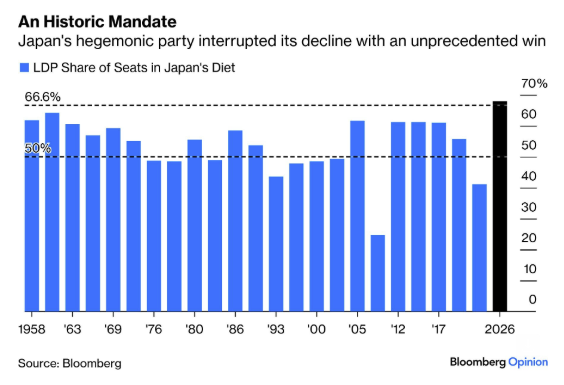
Long time Japanese investors will tell you how big a deal this political victory is…
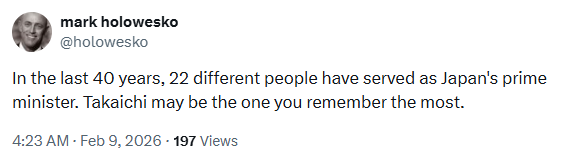
Investors wasted no time in applauding the mandate through higher Japanese equity prices on Monday…
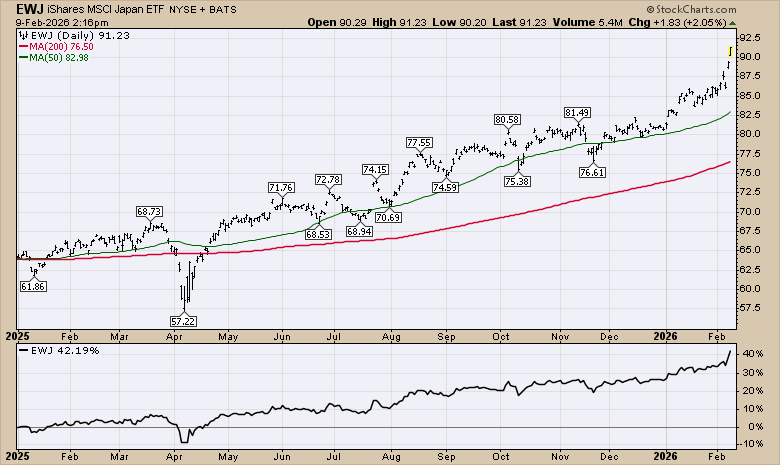
StockCharts
Speaking of int'l stocks, ex-US equities are now working on their 12th consecutive weekly gain and are +46% since the beginning of 2025…
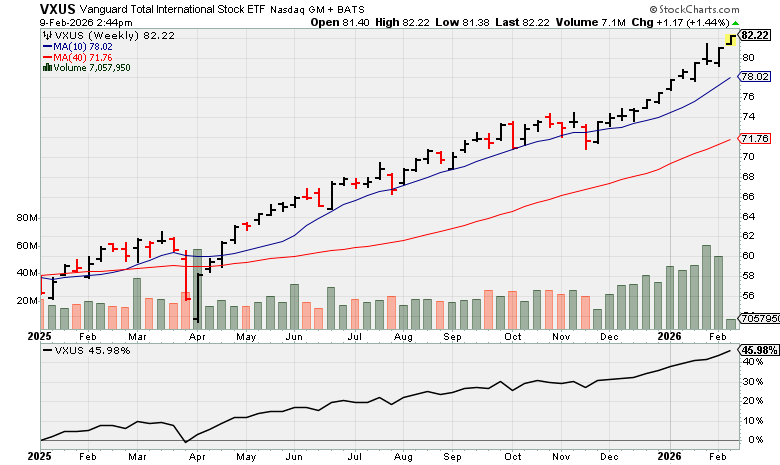
StockCharts
And yes Walter, Europe looks increasingly ready to outperform the US…
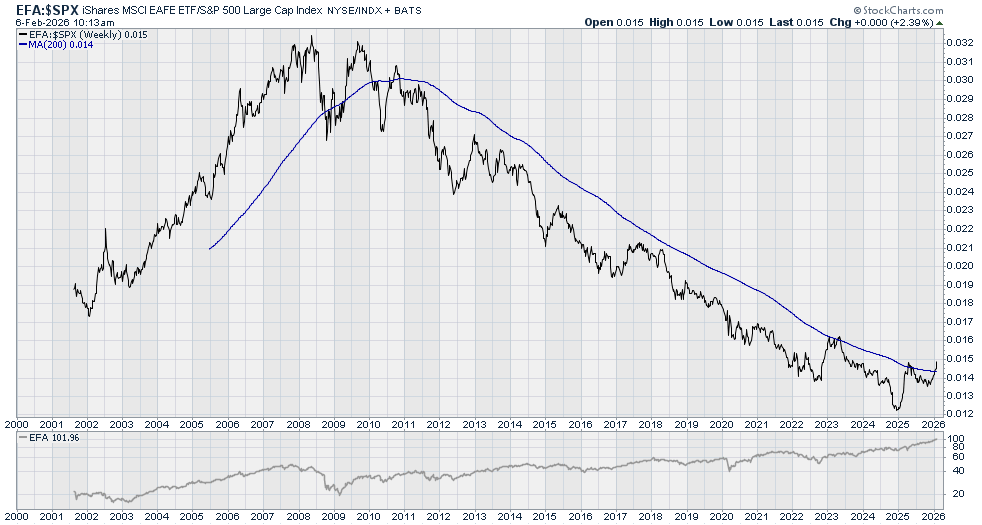
@WalterDeemer
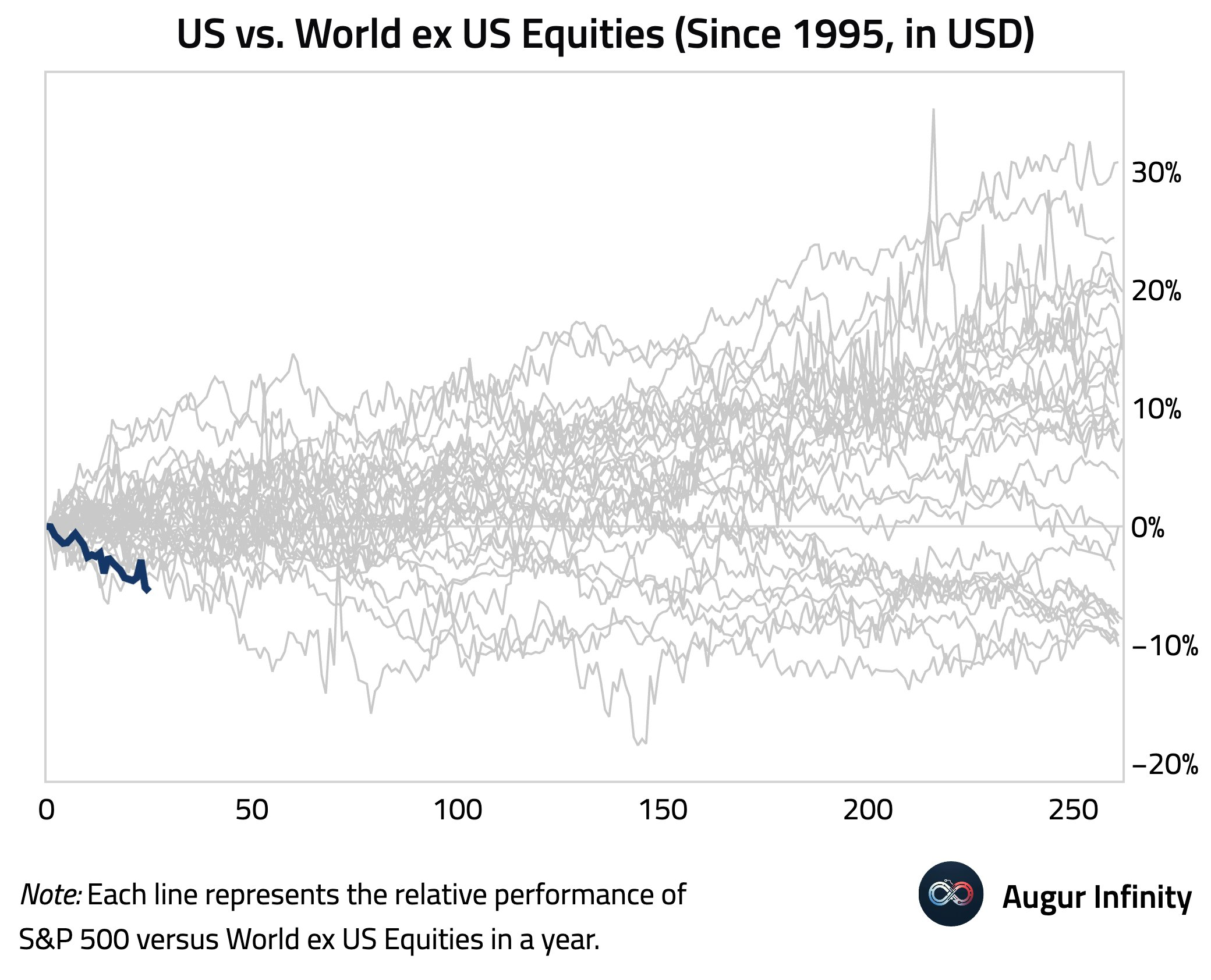
US equities are now underperforming ex-US equities by the most in 30 years…
@AugurInfinity: The year-to-date underperformance of US equities relative to the rest of the world is the worst since at least 1995.
In the event that you have some favorite Canadian assets in mind, this chart should help your decision making…
The Canadian dollar is quietly breaking higher vs the US dollar as a 15-year downtrend looks to be ending.
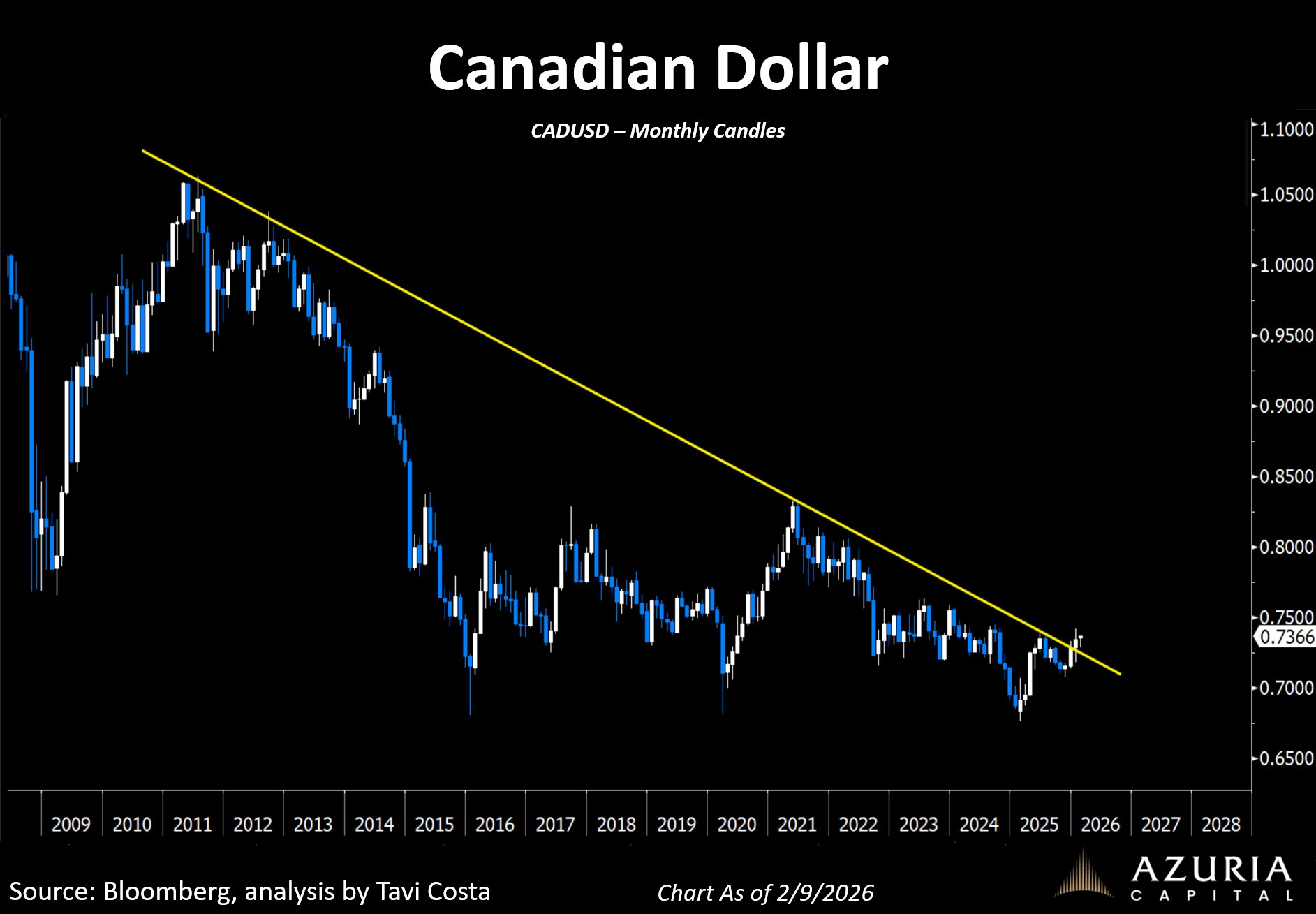
@TaviCosta
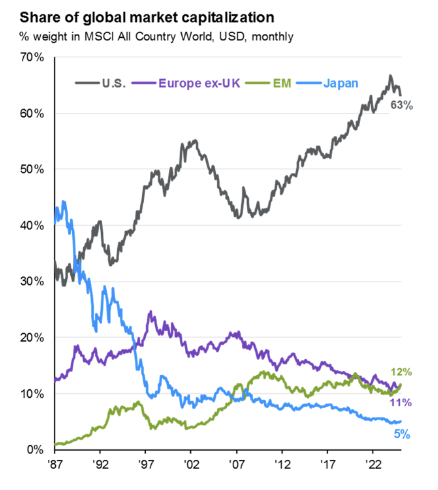
Future underperformance by the US could run for years if foreign regions move to regain some of their market capitalization…
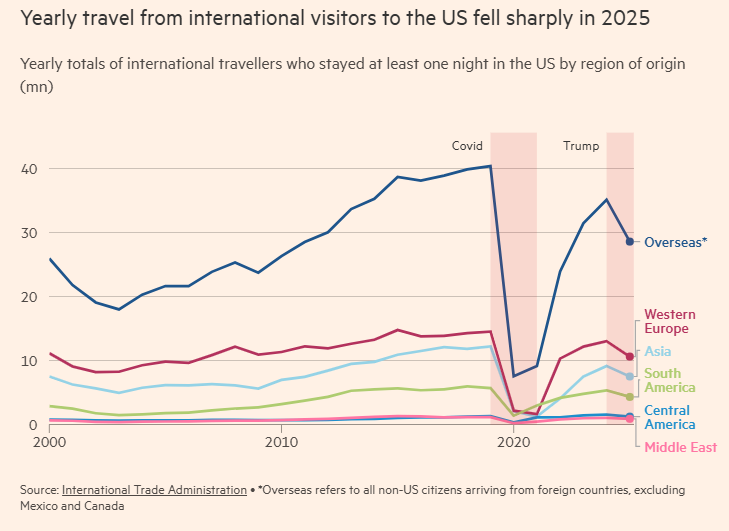
And not just are US stocks underperforming, but so is US destination travel…
International travel to the US has plunged in the first year of Donald Trump’s second term, as the president has overseen a dramatic expansion of immigration enforcement, mounting scrutiny at the border and global tariffs.
The number of foreign visitors who travelled to the US in 2025 fell 4.2 per cent — the first annual decline since the Covid-19 pandemic — according to data from the International Trade Administration.
In contrast, worldwide international travel increased 4 per cent in 2025, according to the UN’s tourism arm.
“The US is the only major destination in the world that is tracking a decline in international visitor spending,” said Erik Hansen, a senior vice-president at the US Travel Association.
“It’s a tremendous impact,” he said, citing a decline of about 11mn international visitors, which amounts to $50bn in lost spending. “Even a single percentage point that we lose means billions of dollars, it means hundreds of thousands of jobs.”
The assault on Software companies bordered on extreme last week. Or as the J.P. Morgan Software analyst put it:
“We are now in an environment where the sector isn’t just guilty until proven innocent but is now being sentenced before trial.”
@wallstengine
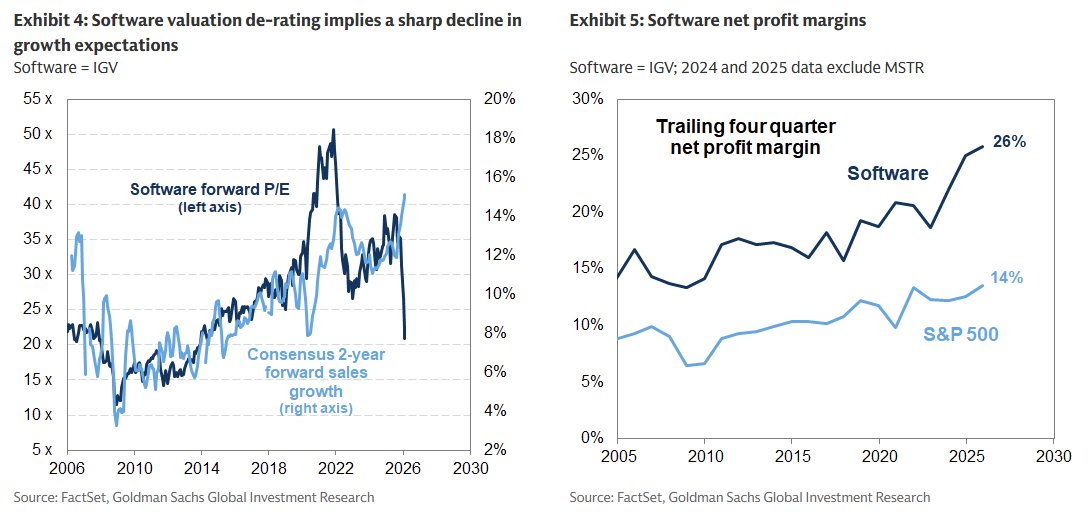
Software valuations went from a correction to a slaughter even as current sales growth and margin outlooks remain solid…
The collapse in Software share prices implicitly reflects downside risk to record high profit margins and growth estimates. Coming into this year, consensus estimates pointed to two-year forward Software revenue growth of 15%, more than 2x the 6% revenue growth modeled for the median S&P 500 stock and the highest expected growth in at least 20 years.
Goldman Sachs
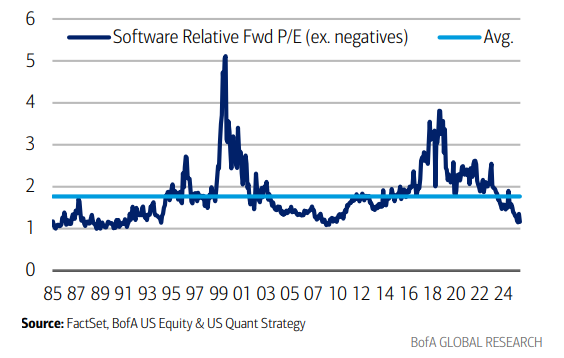
Even Small Cap Software stocks were hit back to relative P/E lows…
BofA: Small-cap Software trades at its lowest levels since ’09 on relative forward P/E (ex-nonearners)
@MikeZaccardi
The keeper of AI chips had a timely microphone to offer a rational voice to the week's chaos…
Jensen on software: “Remember what software is. Software is a tool. There is a notion that software is in decline and will be replaced by AI. It is the most illogical thing in the world and time will prove itself... Suppose we are the ultimate AI, artificial general robotics – the ultimate version of AI that can solve any problem. If you are a human or robot would you use a screwdriver, or invent a new one? I'd just use one. Would you use a chainsaw or invent a new chainsaw. You would use one. If you are artificial general robotics you will obviously use tools. Now do the digital version of that… if you are AGI would you use the digital tools like SAP and ServiceNow and Cadence and Synopsis, or would you reinvent them? Of course you’d use them. That’s why the latest breakthroughs in AI are… what… tool use... because the tools are designed to be explicit. There are many problems in our world where F = MA. You don’t need approximately, statistically, you need exact. So I think we want AGI to use tools.”
Jensen Huang at the Cisco AI Summit
Many others also took to the airwaves and keyboards to defend the companies that we all use on a daily basis in our workplaces…
Spooked by a wave of new AI tools for professional workflows in financial, legal, accounting and compliance sectors, investors have been offloading shares in information services companies including S&P Global, Moody’s, Verisk, FactSet, Thomson Reuters, Relx, Wolters Kluwer and Gartner. In the past month, such stocks have fallen between 15 per cent and 36 per cent, with the slide accelerating last week. The fear is that AI will disintermediate B2B information providers. But this is profoundly wrong. The market misunderstands what makes these businesses valuable.
Users of B2B data operate under high stakes: a pharmaceutical compliance officer relying on regulatory guidance for marketing a new drug; a credit analyst allocating capital to a bond issue; an auditor deploying new accounting methodologies. These professionals require high-quality data, from validated sources, embedded within domain-specific analytical and workflow tools. And they are happy to pay for it. Indeed, B2B info providers often charge regular price increases far in excess of inflation, with some maintaining annual customer retention rates well above 90 per cent…
AI represents a new and perhaps historically large step-function in B2B productivity. The combination of data, software and AI will enable firms to run more audits, process more legal contracts, underwrite more financings and solve more compliance issues while maintaining their exacting standards of quality.
Now onto the demand for AI, last week's earnings comments leads me to believe that backlogs continue to grow massively…
“Google Cloud’s backlog increased 55% sequentially and more than doubled year-over-year, reaching $240 billion at the end of the fourth quarter. The increase in backlog was driven by strong demand for our cloud products, led by our enterprise AI offerings from multiple customers.” – Alphabet CFO Anat Ashkenazi
“Data center construction backlog is now up to 11 years at the 2025 build rates, and the U.S. backlog stands at 206 gigawatts.” – CEO Paulo Sternadt
“...backlog is $244 billion. That’s up 40% year-over-year. I think it’s up 22% quarter-over-quarter. We have -- and we have a lot of deals that are in the pipeline. There’s just -- as I mentioned earlier, there is a lot of demand for AWS right now. in the AI space and also in the core AWS space” - Amazon CEO Andy Jassy
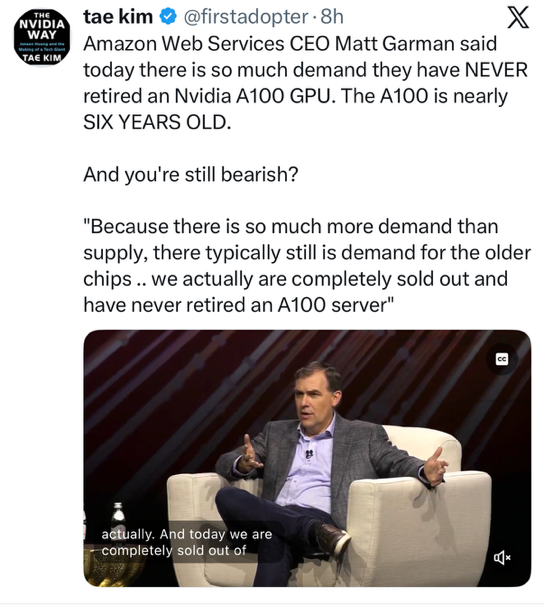
If AI demand backlogs weren't growing, the cloud providers would not be using 6-year old chips…
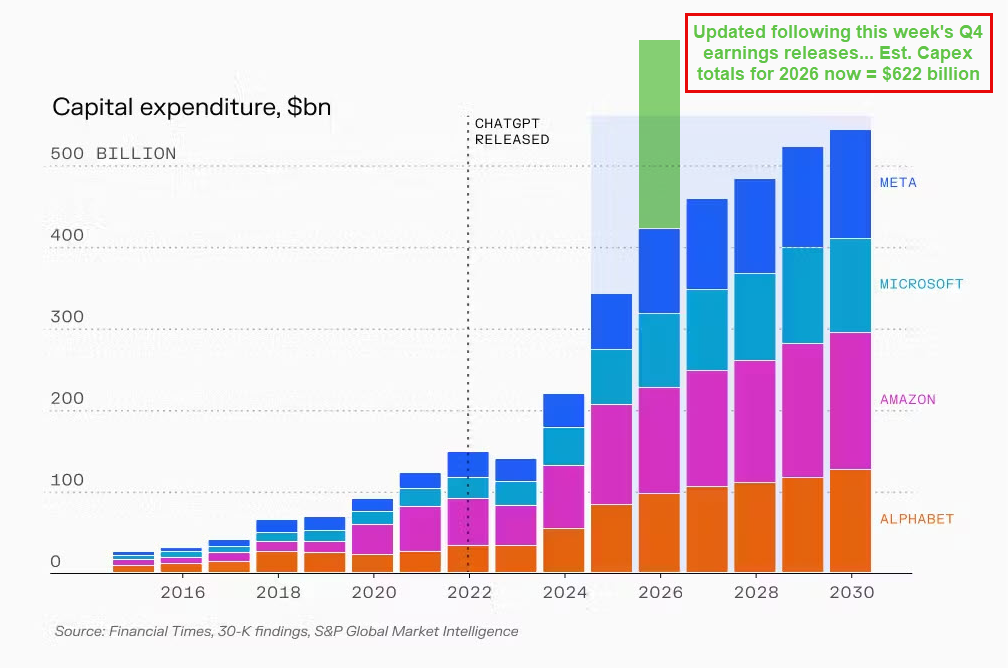
This is how fast the AI infrastructure wave is moving…
Contrary Research just released its 2026 Tech Trends report last week and as the hyperscalers reported their figures, the forecast became already horribly outdated. I updated the 2026 figures in green below. I'll let you update 2027-2030.
How lucky did the US economy get to have AI data centers fall into 2023 and beyond?
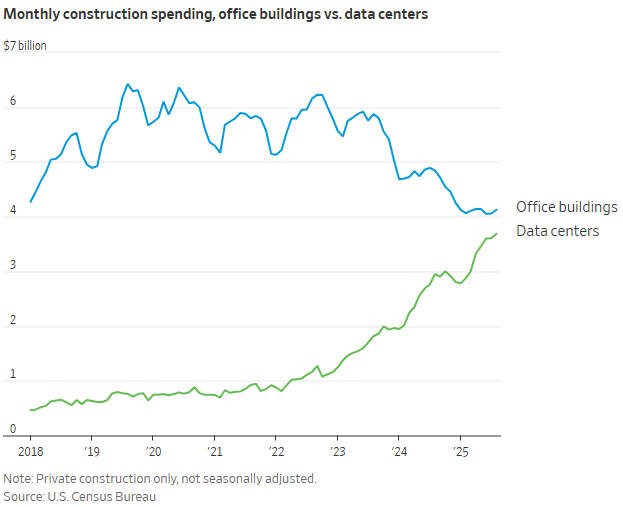
@PeterMallouk
The Alphabet CEO was asked what keeps them awake at night currently as he attempts to deploy $3 billion in capex per week…
"I think specifically at this moment, maybe the top question is definitely around compute capacity, all the constraints. Be it power, land, supply chain constraints, how do you ramp up to meet this extraordinary demand for this moment, get our investments right for the long term, and do it all in a way that we are driving efficiencies and doing it in a world-class way"
@TheTranscript_
Unlike other hyperscalers, access to capital was not one of Alphabet's concerns…
Alphabet Inc. has attracted more than $100 billion of orders for a bond sale that’s expected to be about $15 billion, according to people with direct knowledge of the matter.
The demand is among the strongest ever seen for a corporate bond offering, showing investor hunger to buy debt tied to the artificial-intelligence boom.
Just last week, Oracle Corp. raised $25 billion from a bond that drew a record $129 billion of demand.
ISM Services comments for January have some notable mentions about data center buildouts…
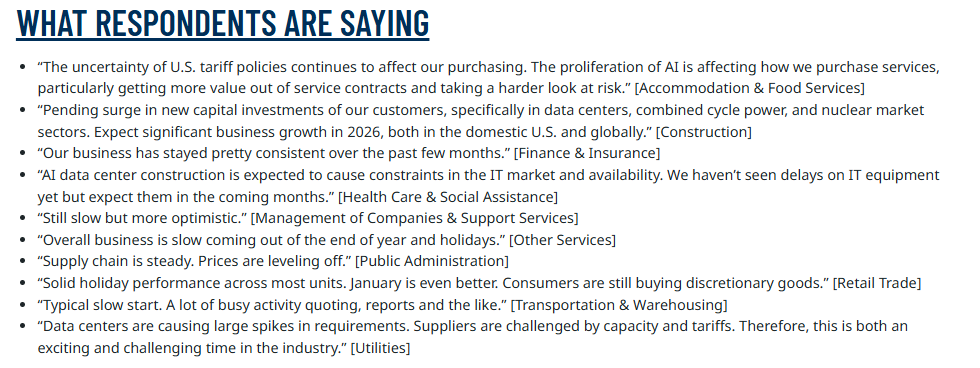
@KevRGordon
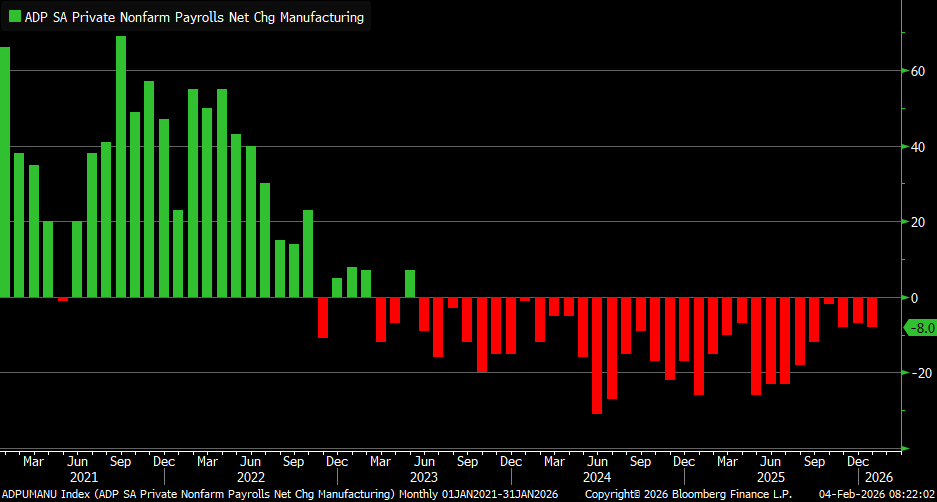
The rise in AI data center buildouts is having little positive impact on US manufacturing jobs…
@KevRGordon: Per ADP payroll data, manufacturing payrolls have contracted for 32 straight months
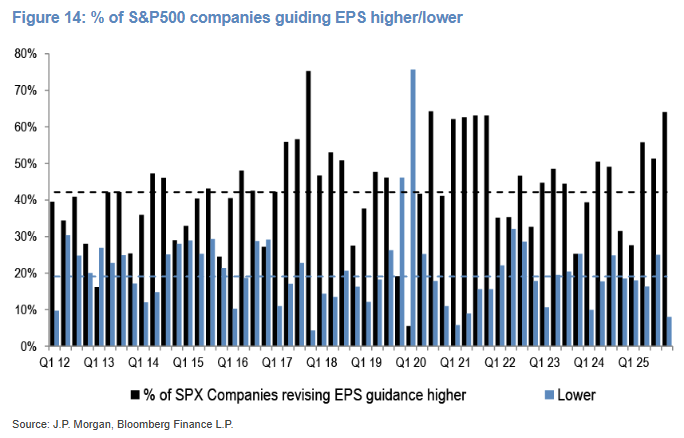
J.P. Morgan notes that S&P 500 companies are currently upward revising earnings estimates at the highest rate since 2021…
J.P. Morgan
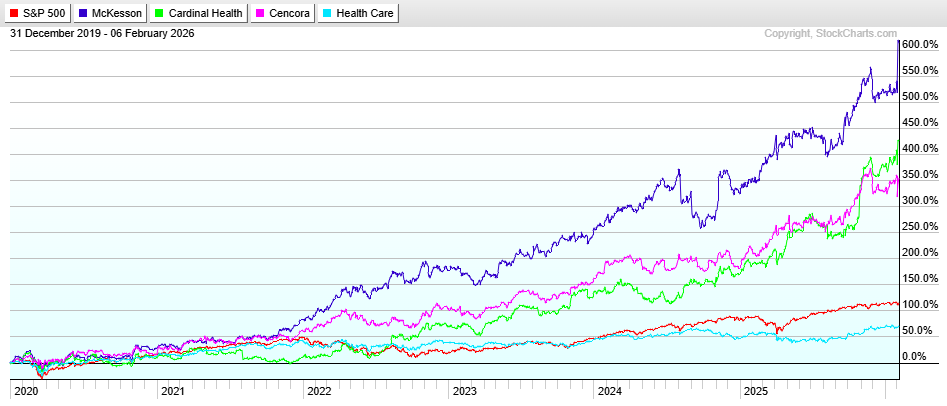
One of the easier jobs this decade would have been just to own the drug distributors…
Two of the three giants (McKesson, Cardinal Health and Cencora/the old AmerisourceBergen) reported above and beyond numbers again. Congrats to all that over own the stocks relative to their Healthcare and Large Cap benchmarks.
MCK: Revs +11%, core EPS +16%, guidance raised, analyst target prices raised
CAH: Revs +19%, EPS +20%, guidance raised, analyst target prices raised
StockCharts
One good earnings read: Major industrial gas supplier says that China’s industrial demand appears to be bottoming…
“In my assessment, the China markets that we supply and work with closely are largely bottoming out...We talked about China earlier on. China manufacturing, as you know, a lot of that is underwritten by large-scale exports to markets, which may or may not be welcoming those exports, but it has provided a little bit of momentum. And within that, there are clear green shoots in manufacturing, the EV piece — when I was with BYD, one of our customers in China, the chairman was complaining that he wasn’t seeing as much growth as he was expecting and he was unhappy that he was only growing 28%.” – Linde CEO Sanjiv Lamba
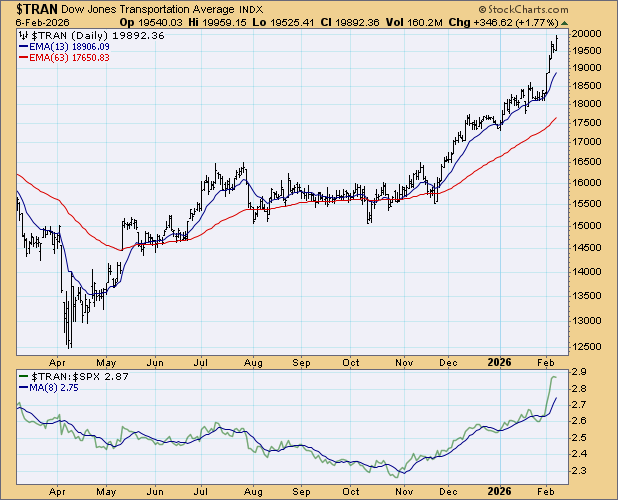
Money may have left software stocks, but it found a home in transportation companies…
StockCharts
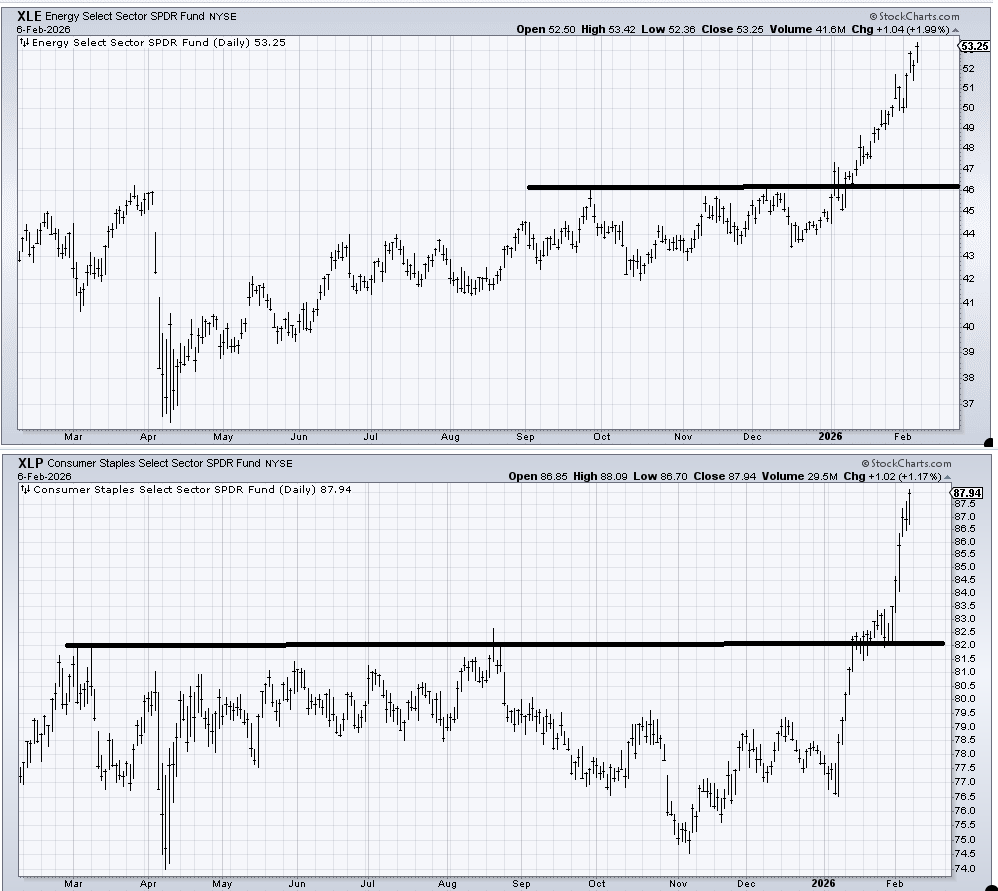
And also in Energy and Consumer Staples stocks which also made new all-time highs…
@hmeisler.bsky.social
So true...
If you are into very long term base pattern breakouts, then you are going to love John Roque's chart of the XLE…
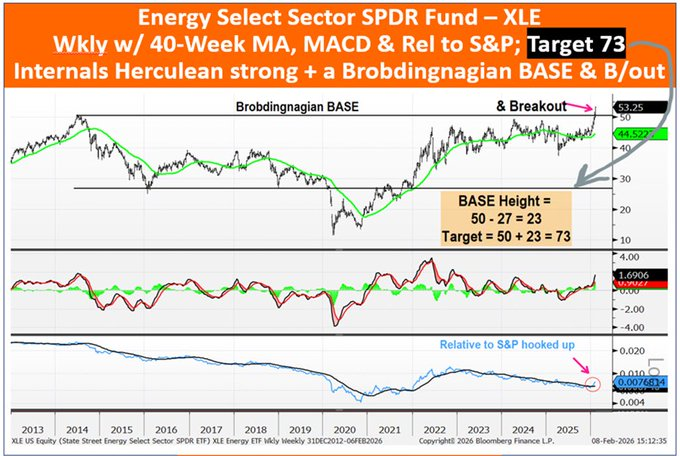
@daChartLife
Michael Hartnett at BofA Global says it is time to be long Main Street…
Stay long Detroit, short Davos: long Main St plays, e.g. EM, small cap, banks, REITs, assets punished H1 2020s by big bond bear market; 2026 inflation surprises downside as AI chills labor market, politicians address voter concerns over affordability; why Trump aggressive intervention to reduce price of energy, healthcare, credit, housing, electricity via Big Oil, Big Pharma, Big Banks, Big Tech means small & mid-cap best play for "boom" on Main St in run-up to US midterms; plus flip from asset-light to asset-heavy business model suggests major threat to 2020s market leadership of Big Tech/Magnificent 7... AI hyperspend 2026 capex = $670bn (96% of cash) vs $150bn (40% of cash) in ’23... no longer the best balance sheets, no longer the biggest stock buybacks.
BofA Global
A big part of Main Street is small company stocks, both of which are breaking to new all-time highs…
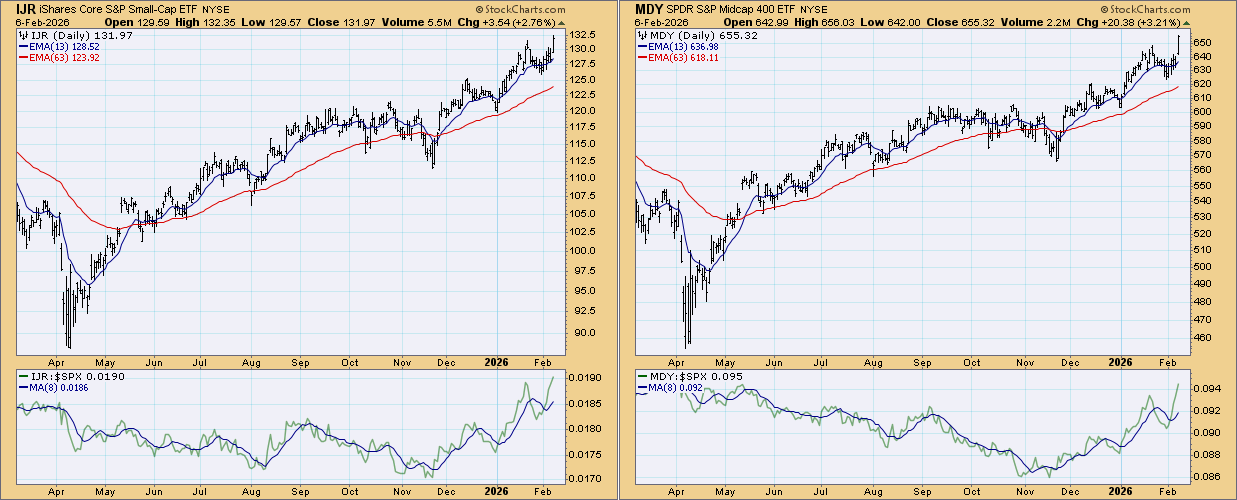
StockCharts
Speaking of super all-time highs, the Denver Broncos were only one game away from making it to the biggest game…
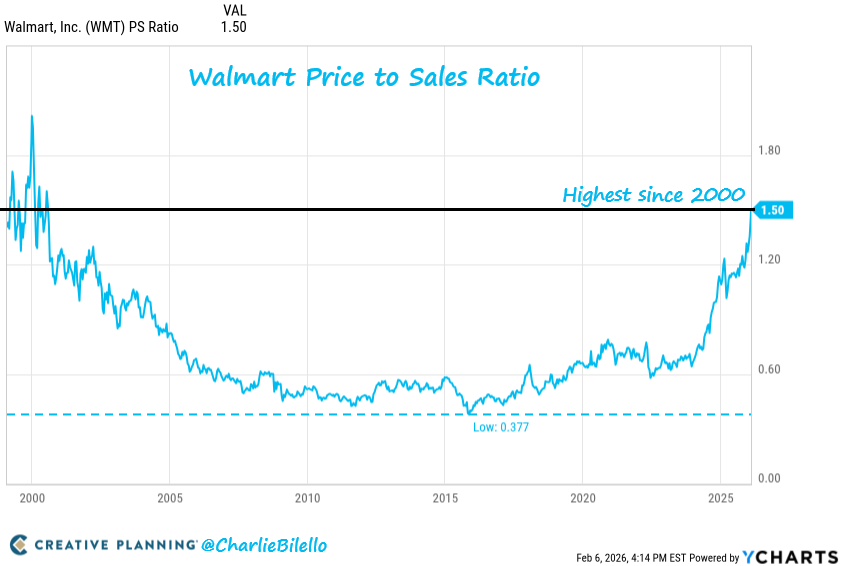
But with the owner's piggy bank trading at a 25-year high P/S valuation, they should be able to afford to get there soon enough.
@charliebilello: Walmart is now trading at 1.5x Sales, its highest valuation since 2000.
M&A in the markets continues at a healthy pace with many deals last week that will result in even fewer small cap companies on the exchanges and in private equity portfolios…
- Banco Santander (SAN) is buying Webster Financial (WBS) in a cash-and-stock deal valued at $12.3 billion, marking an escalation in the Spanish banking giant’s push to expand its presence in the U.S. The deal would put Santander in contention with big regional U.S. banks. Santander called it “strategically significant” for its U.S. business and said it would make it a top bank in the Northeast. With more than $80 billion in assets, Stamford, Conn.-based Webster has dozens of branches throughout Connecticut, Massachusetts, Rhode Island and the New York metro area.
- A KKR (KKR) triangle-led consortium has agreed to acquire a Singapore data-center company valued at $10.9 billion, marking the U.S. firm’s largest Asia-Pacific infrastructure investment yet as the AI frenzy fuels demand for tech assets. The group of investors, which includes Singapore telecommunications company Singtel (Z74.sg), will buy the rest of ST Telemedia Global Data Centres not already owned from its parent. The KKR-led group already owns a minority stake in STT GDC that it acquired from parent ST Telemedia for $1.3 billion in 2024.
- A consortium led by private-equity firm Advent International and FedEx (FDX) has agreed to buy Polish parcel-locker provider InPost (INPST.nl) for more than $9 billion, in a deal that bolsters the American delivery company’s business in Europe. InPost has grown rapidly in recent years and now has more than 61,000 automated parcel lockers across Europe that allow consumers to collect and send packages, as well as thousands of pickup and drop-off locations. The consortium said it would pay 7.8 billion euros for InPost, which is based in Poland and listed in Amsterdam. The €15.6 a share offer represents a 50% premium to InPost’s share price on Jan. 2, the day before news of a potential deal was disclosed, but is below the company’s 2021 IPO price of €16.
- Texas Instruments Inc. (TXN) has reached an agreement to buy the US chip firm Silicon Laboratories Inc. (SLAB) for about $7.5 billion, deepening its exposure to several long-standing markets for chips including the home appliance, power, industrial and medical-device sectors. Silicon Labs investors will receive $231 in cash for each share of the company’s common stock which is a 70% premium to its market price.
- Deep-water oil rig owner Transocean Ltd. (RIG) agreed to acquire rival Valaris Ltd. (VAL) in an all-stock deal valued at $5.8 billion as offshore drilling activity heats up. The deal will create the world’s largest offshore rig contractor by market value, with a fleet of 73 offshore rigs, including 33 ultra-deepwater drillships, nine semisubmersibles and 31 jackup vessels. Valaris investors will receive 15.2 shares of Transocean stock for each share they own — a roughly 32% premium based on the Feb. 6 closing price.
- U.K. lender NatWest (NWG.uk) is set to buy wealth manager Evelyn Partners for 2.7 billion pounds ($3.67 billion) including debt to boost its savings and investment offerings. The bank reached an agreement with private equity firms Permira and Warburg Pincus to take over Evelyn Partners. Under Permira’s ownership since 2014, the group that was later rebranded Evelyn Partners has gone from overseeing around 5 billion pounds in client assets to 69 billion pounds at exit through organic growth and acquisitions.
- Analog chipmaker SiTime Corp. (SITM) has agreed to acquire Renesas Electronics Corp.’s timing unit in a cash-and-stock transaction valued at about $2.9 billion. The Renesas division makes the clocks that synchronize signals in wireless infrastructure. Shares of Renesas have gained 27% in the past year in Tokyo, for a market capitalization of about ¥4.8 trillion ($31 billion). Shares of SiTime have surged 62% during the same period, giving it a market value of about $9.1 billion.
- DSM-Firmenich (DSFIR.nl) said it agreed to sell a majority stake in its animal nutrition and health business to private-equity group CVC Capital Partners in a deal valued at 2.2 billion euros ($2.60 billion), including debt. The Dutch ingredients supplier said Monday that the sale marks the final step in its yearslong effort to become a company fully focused on human nutrition, health and beauty.
- Eli Lilly (LLY) will buy Orna Therapeutics for up to $2.4 billion in cash, gaining access to a technology that allows patients' own cells to generate therapies inside the body, without the need to extract them. Orna is developing therapies that use a form of RNA called circular RNA, along with novel lipid nanoparticles. Its lead drug candidate, ORN-252, is in early stages of development.
- KKR (KKR) agreed to acquire Arctos Partners, an investor in professional sports franchise stakes, in a deal initially valued at $1.4 billion. The initial consideration KKR will pay includes $300 million in cash, $900 million of equity to existing Arctos shareholders and $200 million of additional equity to be allocated by 2028 and subject to vesting through 2033. The deal also includes an additional $550 million in future equity tied to both KKR share price and business-specific performance targets and vesting through 2031.
Various News Sources
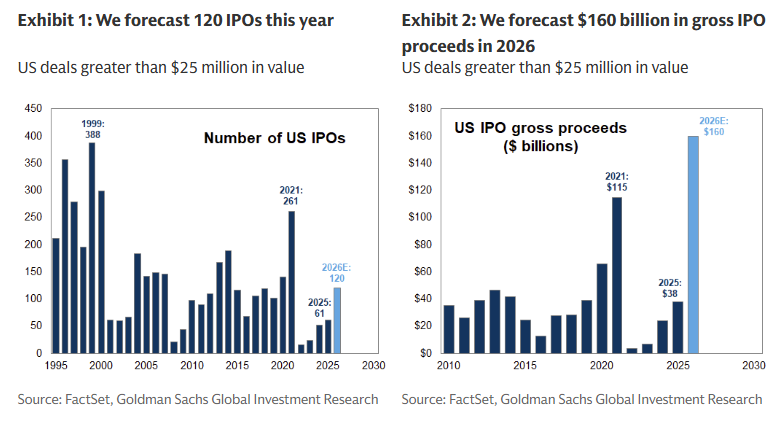
Goldman Sachs expects a flood of IPOs in 2026…
Our base case forecast is that roughly 120 IPOs will bring $160 billion to the public equity market this year. These estimates imply a nearly 100% year/year increase in the number of IPOs and a 320% increase in gross proceeds. In our base case outlook, IPO activity should benefit from a combination of a supportive macro backdrop and the potential for public launches from some very large private companies.
Goldman Sachs
The first trillion dollar IPO is looking to have the passive buyers lined up at the stock exchange post on day one…
This would be a break in tradition. Good news for the employees, VCs and private equity owners who are looking for a successful IPO.
Advisers for the company, which recently merged with xAI, have reached out to major index providers, including Nasdaq, to discuss how SpaceX and this year’s other hot startups might join key indexes sooner than normal, according to people familiar with the matter.
Companies typically must wait several months or a year after their public debut before gaining inclusion in a major index such as the S&P 500 or the Nasdaq-100. Inclusion unlocks access to retail and institutional capital from funds, particularly those mimicking the performance of indexes that have to hold the companies in the index.
The traditional waiting period is intended to give the companies time to demonstrate that they are stable and liquid enough to handle extensive buying from index funds.
SpaceX hopes to skirt traditional rules in an effort to bring liquidity to its shareholders sooner as part of its planned IPO. SpaceX advisers have sought index policy changes that would fast-track its entry into major indexes for the company and benefit other highly-valued private companies, the people said.
Genius move by the NFL to expand the size of their tent…
Does Roger Goodell have the best job in the world?
@JoePompliano: Many people believe the NFL is making a political statement by picking Bad Bunny to perform at the Super Bowl, but I really think it's as simple as...
- He's the world's most popular artist
- Having him perform advances the NFL’s long-stated goal of international expansion
- Picking someone with little overlap with the average NFL fan will help the league set a new viewership record — Americans will watch no matter what, and Bad Bunny pulls in new viewers who might not have tuned in otherwise.
Music aside, it makes a lot of business sense.
A great pen by Peggy Noonan on the importance of journalism as we lose one of our giants…
Why is the end of a great newspaper not good for democracy? Let’s journey back to Thomas Jefferson, in Paris in 1787, as American minister to France. Back home they were debating the U.S. Constitution. In a letter dated Jan. 16 to his friend Edward Carrington, a member of the Continental Congress, his thoughts: “Were it left to me to decide whether we should have a government without newspapers, or newspapers without a government, I should not hesitate a moment to prefer the latter.” He wasn’t being flip. He understood journalism was a defense against tyranny.
Government by its nature always wants to accumulate power and use it. A watchful press slows this process, sometimes stops it, by exposing its abuses.
If citizens are informed, they can self-govern from a rough baseline of realism. “The good sense of the people,” Jefferson wrote, is always “the best army.” True, they can be “led astray,” but their mistakes will be limited and can be corrected through information that can “penetrate the whole mass of the people.” When the public is uninformed, those running government “shall all become wolves.”
He absolutely knew those who report could produce work that was partisan, inaccurate, sensationalistic. He himself became quite the mischievous manipulator of the press. But again, the process could self-correct, especially if a nation had a big, burgeoning information culture, with everyone keeping an eye on everyone else.
In any case he was certain a free press was safer for the republic than what would otherwise become government censorship and propaganda.
Learn more about the Hamilton Lane Strategies
DISCLOSURES
The author has current equity ownership in: Alphabet Inc. and Nvidia Corp.
The information presented here is for informational purposes only, and this document is not to be construed as an offer to sell, or the solicitation of an offer to buy, securities. Some investments are not suitable for all investors, and there can be no assurance that any investment strategy will be successful. The hyperlinks included in this message provide direct access to other Internet resources, including Web sites. While we believe this information to be from reliable sources, Hamilton Lane is not responsible for the accuracy or content of information contained in these sites. Although we make every effort to ensure these links are accurate, up to date and relevant, we cannot take responsibility for pages maintained by external providers. The views expressed by these external providers on their own Web pages or on external sites they link to are not necessarily those of Hamilton Lane.