
Weekly Research Briefing: Winter Keeps Coming

My Times Square webcam has seen more days of snow this year than any of my Western US ski trails. It is not fair to watch our best winter equipment gather dust and cobwebs while Manhattanites build snowmen in front of Pele soccer. Oh well, maybe next year. Hey Google, replay the Olympic downhill and giant slalom finals again while I write about tariffs.
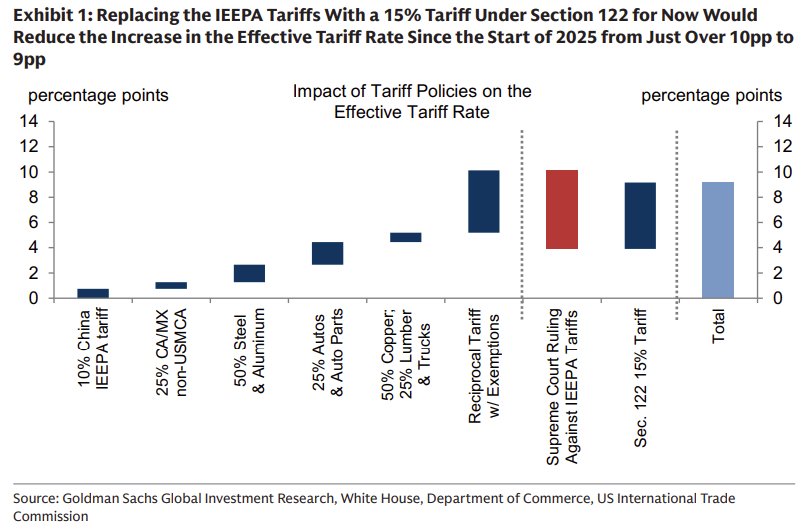
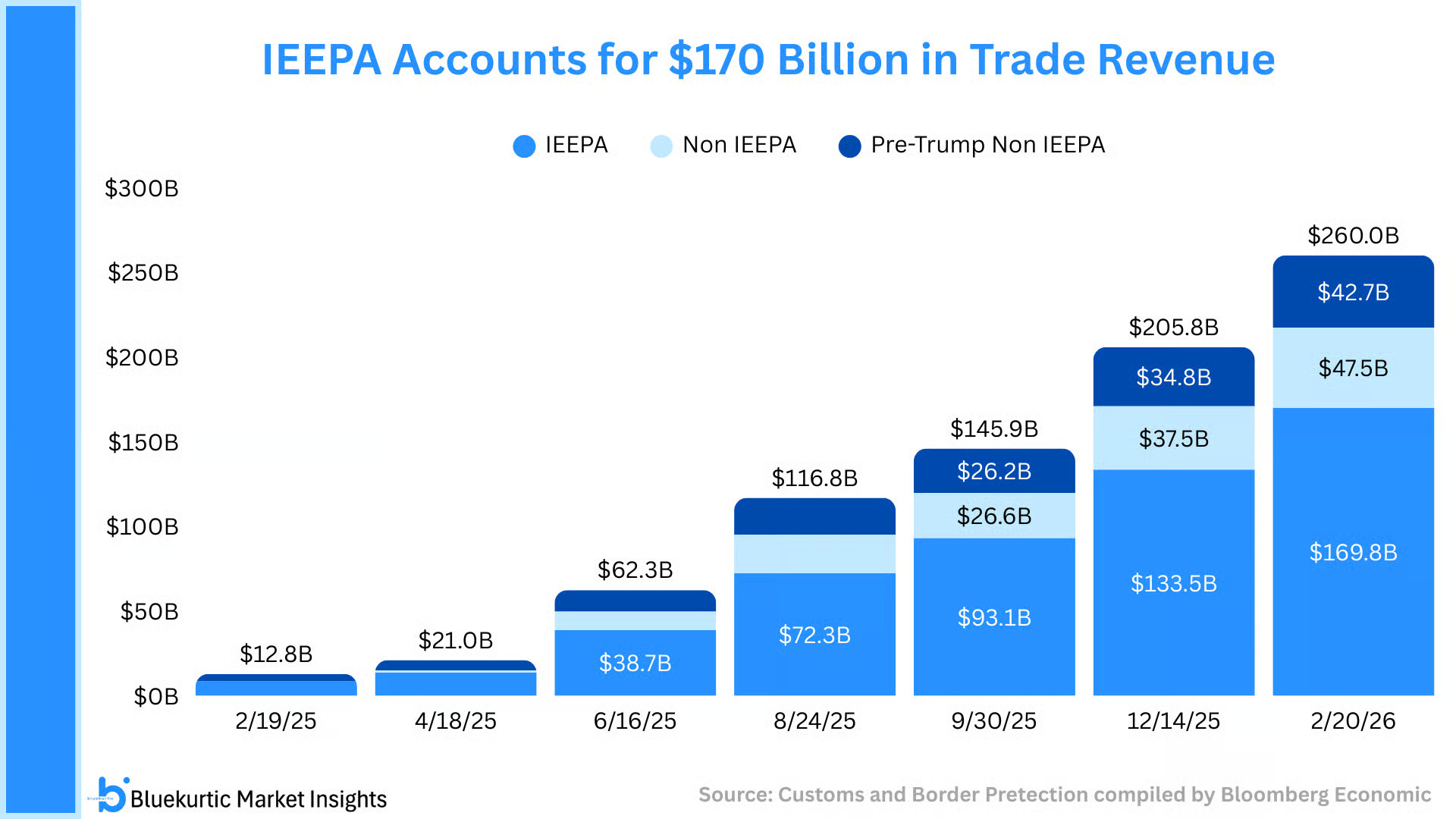
As expected, the Supreme Court reaffirmed under the US Constitution that implementing broad tariffs resides with Congress, not with the President. Instead of taking an economic victory lap, ending his broad tariff campaign, and returning $170 billion in illegally gained tariffs to the US-based companies who paid them, the White House decided to keep fighting. With the IEEPA tariffs now dead and buried, the President tweeted that he will add a new 15% layer of Section 122 tariffs. These tariffs could also face a legal challenge since they were created to protect the US dollar and to keep gold from leaving Ft. Knox back when our currency was on the gold standard. If the White House implements the new tariffs, they will only last 150 days until Congress votes on them. And with the Congressional mid-terms coming up in November, no member of Congress will tell their constituents that they voted for a tax increase on US voters and businesses.
To make matters even more confusing, foreign countries looking at the new trade tax boards are learning that those countries who struck a deal with the US (U.K., Japan, U.A.E., Australia) are now worse off, while those who didn't strike a deal (China, Brazil, India, Indonesia) are now better off. Look for foreign nations to either renegotiate or tear up their unsigned trade agreement deals. The increased uncertainty and confusion over tariffs will certainly slow all US trade until the dust settles. There is no reason for a foreign airline company to place an order or take delivery of a Boeing jet if they can save tens of millions of dollars by waiting six months. Expect even fewer US manufacturing jobs to be created this year. And expect foreign nations to continue to align and sign free trade deals that don't include the US.
While the financial markets cheered the SCOTUS decision on Friday, they did not like the POTUS reaction on Friday, Saturday, Sunday and Monday. The market wants free trade, lower prices, increased sales, production and jobs. The Supreme Court has chosen a side. Now it is Congress' turn to decide. And in November, it will be the voters' turn to decide. In addition to the bitter reaction on tariffs, the uncertainty of war with Iran, and the bulls' desire to stay home and make snow angels with the kids, the market was also digesting another round of interchange destruction. Monday's piece was written by Citrini Research and follows on the heels of the blog post by Matt Shumer last week. While both pieces offer interesting perspectives on where AI could lead us in the future, it will still be a cold day in hell before anyone tries to take Microsoft Excel out of my life. (MSFT -3% on Monday). And I bet that you aren't ready to give up your Visa/Amex/Mastercard any time soon, but even those three stocks were down 4-7% on Monday. AI fears continue to create a 'shoot now, ask questions later' environment for all asset-light businesses right now. The only way out of it will be for the asset-light businesses to continue putting up numbers and making their shareholders happy.
While the public stock market remains fixated on AI, the corporate M&A market remains in a Valentine's Day love shack. You will see the full details of the transactions near the end of this note, but over the last two weeks I count:
- 27 deals totaling over $100b (sized $1b+)
- 18 US targets, 9 international targets
- 13 public company tickers disappearing
- 7 private companies being acquired
- 14 private companies buying assets
And with only one deal over $10 billion, this should highlight how many small and mid-sized companies are being currently transacted. It is also nice to see the broadening of international buyers and sellers. And as long as credit spreads remain near historically tight levels, the corporate romances should continue. Volumes could even pick up if certain asset-light company valuations continue to downtrend as PayPal found new admirers today.
The markets have some data to look at through the holiday weekend. The January retail sales came in weaker, while January nonfarm payrolls and the unemployment rate came in stronger. CPI was weaker, but the PCE was stronger. And the FOMC moved to push out rate cut expectations while also pointing toward the importance of future data releases. This week's big event will be on Wednesday when Nvidia reports earnings. No pressure, but expectations are high and the weight of the tech investing world is on their shoulders. Politically and geopolitically, the State of the Union address is on Tuesday and a move/no-move on Iran can happen at any time. Have a great week and enjoy the snow you lucky East Coasters.
Goldman Sachs shows how the Supreme Court struck down the red IEEPA tariff bar and how the President added a new Sec. 122 tariff bar to settle at near where we started…
Goldman Sachs
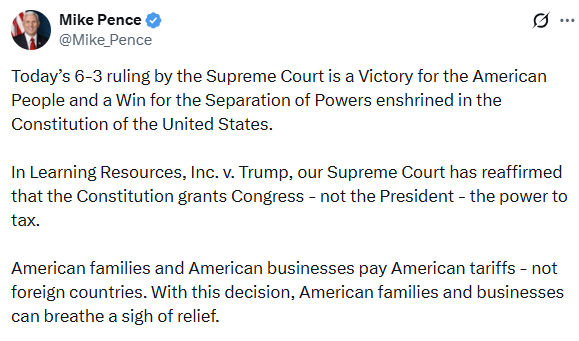
The former Vice President celebrates the SCOTUS ruling and is not a fan of tariffs…
The clock is ticking on the tariff refunds: In addition to the $170 billion that the US Government needs to repay US businesses, there will be a penalty at a 6% interest rate calculated from the entry date of the imported goods…
"With the Supreme Court ruling the IEEPA tariffs imposed by President Trump illegal, the administration now faces up to $170B in potential tariff refunds. Over 1,500 companies have already filed trade court claims to secure their place in line." - Bluekurtic
@dailychartbook.bsky.social
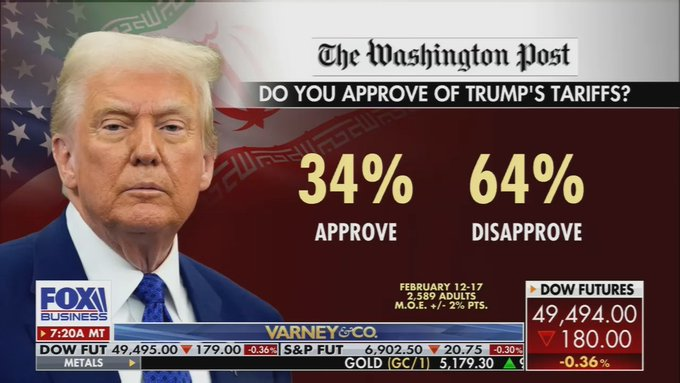
Just no getting around the fact that voters do not like taxes…
No Republican seat in Congress is safe in the rapidly approaching November elections. Even races in Texas and Florida look to be up for grabs.
Fox Business News
Did the Supreme Court just make the President a lame duck?
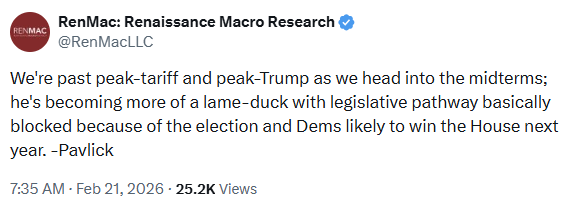
@RenMacLLC
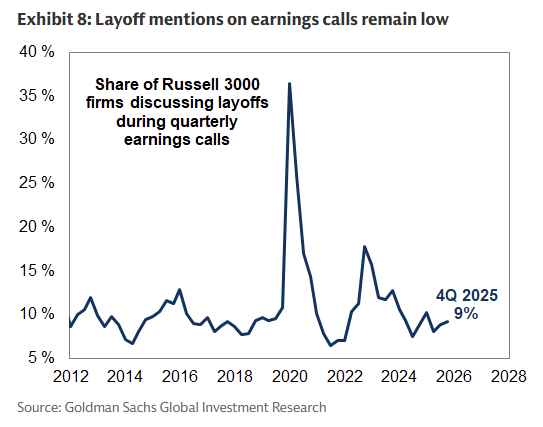
One big positive economic read from the Q1 earnings calls is the lack of layoff mentions…
With little apparent pressure from wages, corporate discussions of layoffs have remained minimal. A low share of companies discussing layoffs on earnings calls is consistent with both recent weekly jobless claims data and this week's solid January jobs report.
Goldman Sachs
As you would expect, the biggest earnings gains are coming out of the suppliers to data centers…
Vertiv (VRT) makes the physical power/cooling equipment for data centers.
Orders of $8.35B more than doubly cleared (!!) the bogey of >$4B, with that figure translating to +252% y/y, bringing B2B close to 3.0x and backlog increasing +109% y/y to +15.0B. This is WELL ahead what anyone on sellside or buyside was thinking was feasible in terms of order strength to close out 2025, and commentary in the release suggests that 2026 will be even more robust (“We had an extremely strong year in orders, and we expect to further grow in 2026.”)
J.P. Morgan
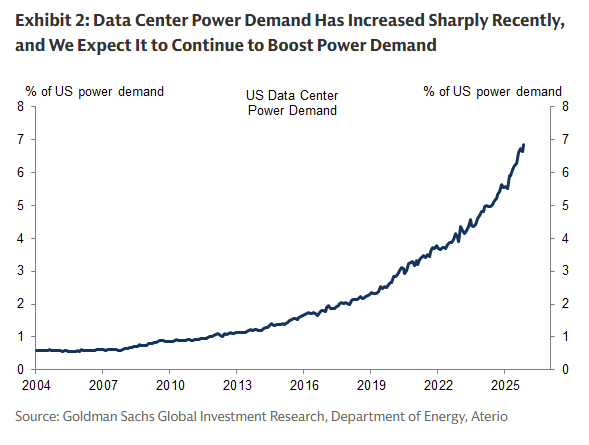
Power demand to data centers continues to rise exponentially…
Data centers still account for a relatively small share of US power demand, at about 7%, but that share has grown sharply in recent years. Going forward, our equity analysts expect strong data center-related demand to boost overall power demand by 1.2pp on average in 2026-2030, accounting for nearly half of overall demand growth of 2.6% annualized.
Goldman Sachs
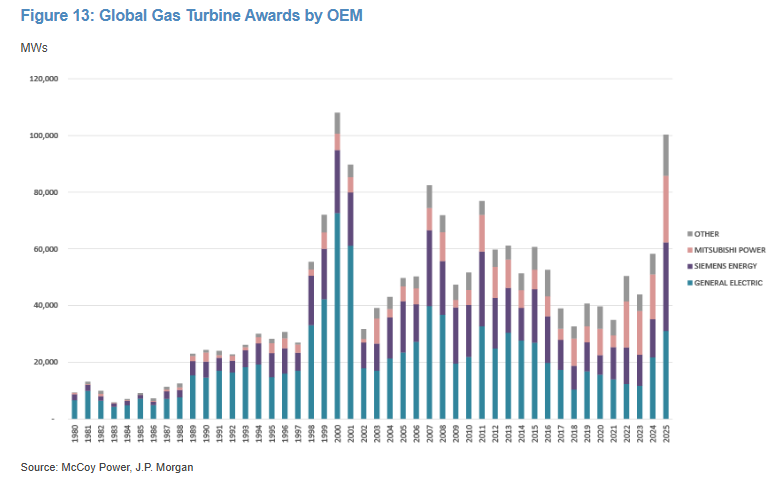
For those who need to bring their own power to a data center, here is a chart showing that rising demand…
- 2nd Largest Year of Gas Turbine Orders in History: 2025 global gas turbine orders were ~100GW, a sizeable jump from ~58GW in 2024 and ~44GW in 2023. Most major regions and countries saw order growth in 2025, but North America was the most notable, with ~44GW of orders (up ~160% y/y).
- 3rd Largest Quarter of Gas Turbine Orders in History: Global gas turbine orders were 34.1GW in 4Q25 (+134% y/y, +48% q/q), the third largest quarter in history behind 3Q/4Q of 2000 (35.9/35.0GW).
- Gas Turbine Stocks Significantly Outperformed YTD. A basket of gas turbine-related stocks has increased 31% YTD, on average, significantly outperforming the S&P 500 (+1%). The biggest outperformer was Siemens Energy (+37%), while the worst performer was GE Vernova (+25%).
J.P. Morgan
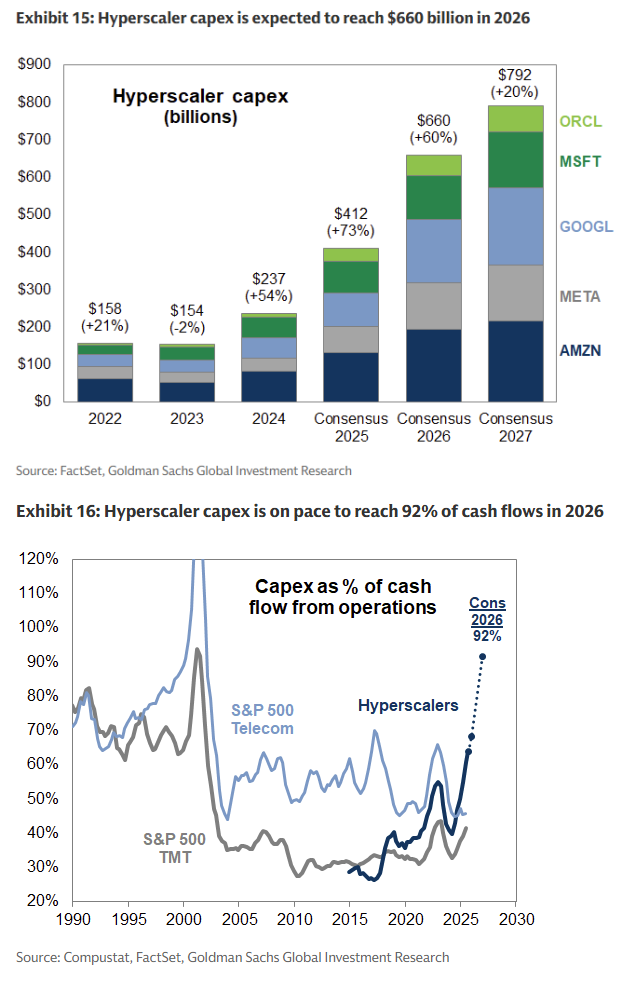
Hyperscaler capex updated shows companies spending all of their cash flow on the next big thing…
Following updated guidance in 4Q earnings reports, analysts now expect the hyperscalers to spend a combined $660 billion on capex in 2026, $120 billion (22%) above estimates at the start of the earnings season. As a result, the hyperscalers' capex spending is now on track to account for 92% of cash flows from operations this year. If realized, this level of capex spending relative to cash flows would exceed the intensity of investment from S&P 500 technology companies during the late 1990s, explaining the recent turn of the US tech mega-caps to debt markets.
Institutional Investors are a bit less excited about spending all that cash flow…
...CIOs telling CEOs to improve balance sheets (35% from 26%) vs. increase capex (20% from 34%) as FMS investors saying corps “overinvesting” at new record high (Chart 1).
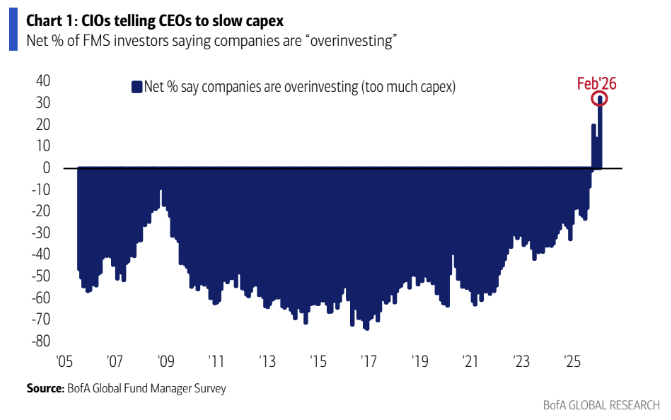
BofA Global
And as investors worry about tech spending on AI and potential business model disruptions, they are moving many chips toward companies who won't be threatened by AI…
To underscore just how far the value rally has run, the valuation gap between high-quality bellwethers and commodity stocks has nearly vanished. Microsoft, the poster child for quality growth, now trades at 22.6x forward earnings, almost indistinguishable from Exxon Mobil at 22.5x. This convergence is a striking signal that the value trade is stretched. Within Technology, the rotation has been pronounced. Semiconductors, seen as direct AI beneficiaries, have attracted strong inflows, while the software sector has experienced its largest non-recessionary drawdown in over 30 years. AI disruption fears and aggressive de-risking have triggered broad-based selling and a ~$2 trillion reduction in market cap, with indiscriminate selling across both quality and speculative software names.
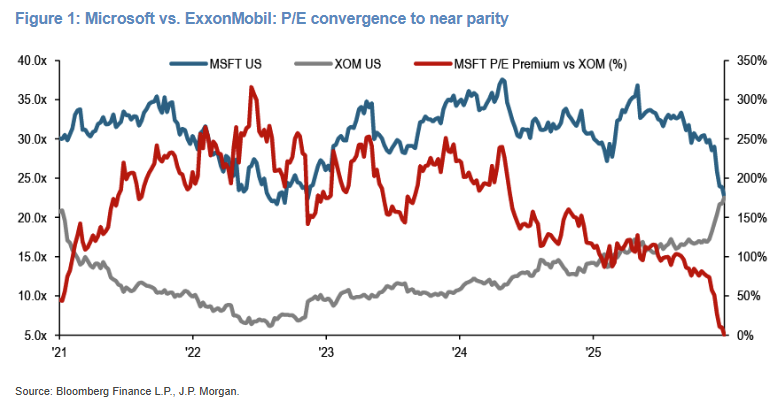
J.P. Morgan
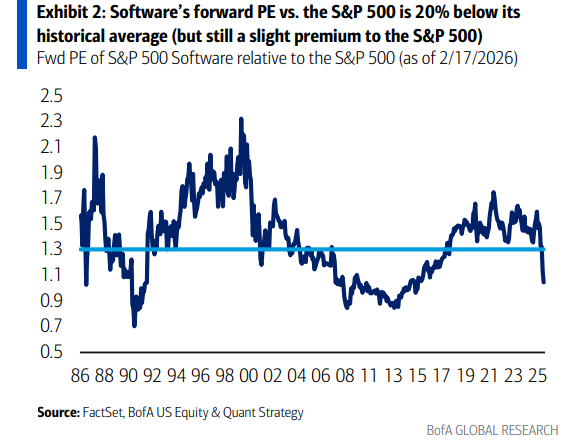
And even as Software industry earnings have not been hit, their valuations have lost over 1/3 of their value…
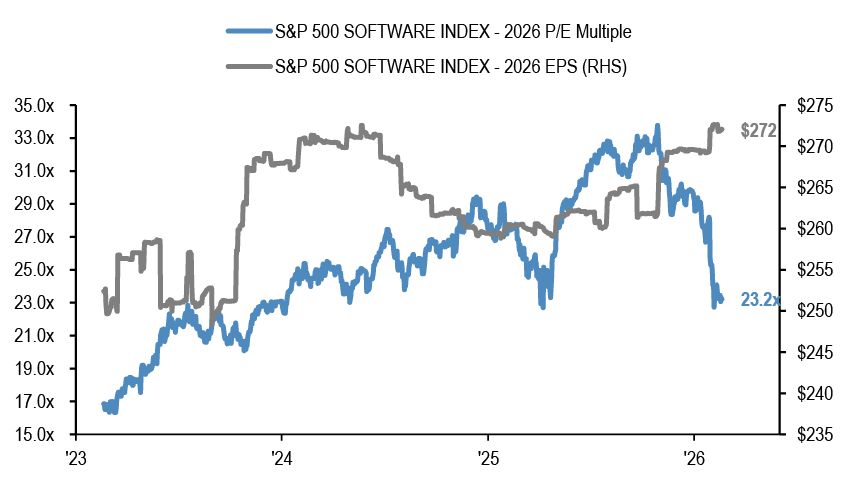
J.P. Morgan
Over the long-term, Software relative P/E premium has been eliminated…
BofA Global
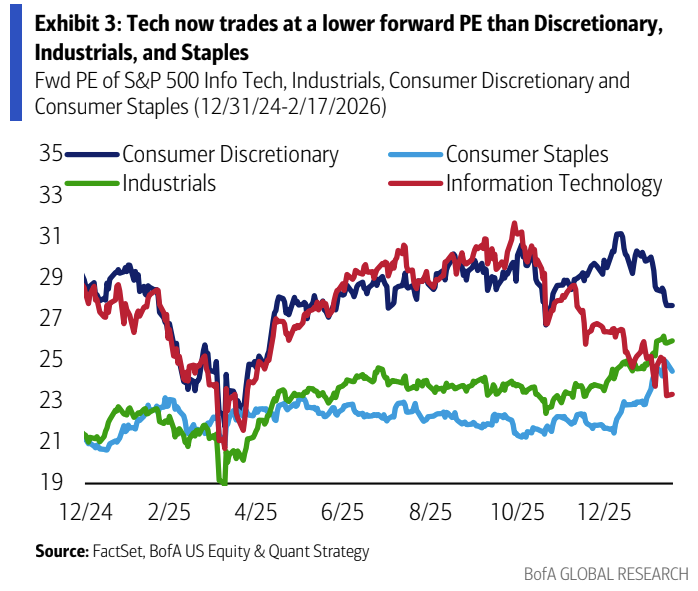
And more broadly, even Consumer Staples and Industrials now trade for higher multiples than Technology…
BofA Global
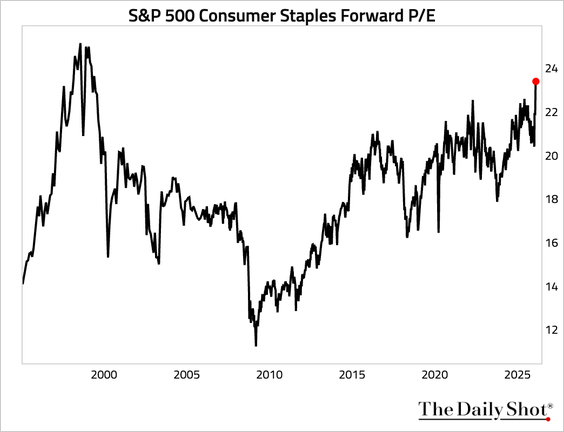
On an absolute basis, Consumer Staples hasn't traded this rich since the GFC…
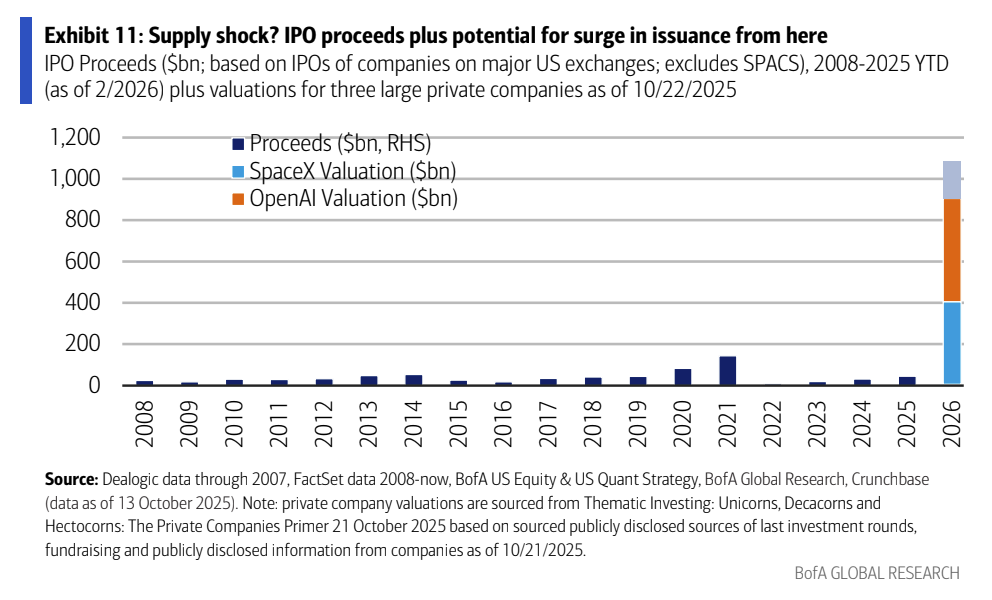
But maybe Technology and Software investors are also making room for the flood of future AI IPOs…
BofA Global
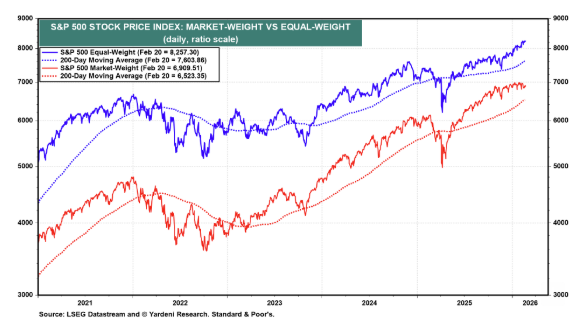
The gains of asset heavy business models has broadened the market out helping the equal-weight indexes…
The equal-weight S&P 500 has been rising to record highs since the beginning of the year, while the market-weight S&P 500 has been literally loopy just below 7000 over the same period (chart). This has been mostly attributable to the stock market's rotation in the type of outperforming stocks, from high-tech to low-tech industries. Previously, the former were supercharged by expectations that companies involved in AI were sure winners, while the latter lagged because investors figured it would take a while before AI benefited them. However, once the hyperscalers began massively increasing their spending on AI infrastructure, investors feared that the investments might not pay off. This mounting uncertainty triggered a rotation from high-tech industries that had gained much market-cap share in the S&P 500 to low-tech industries with much smaller market-cap share.
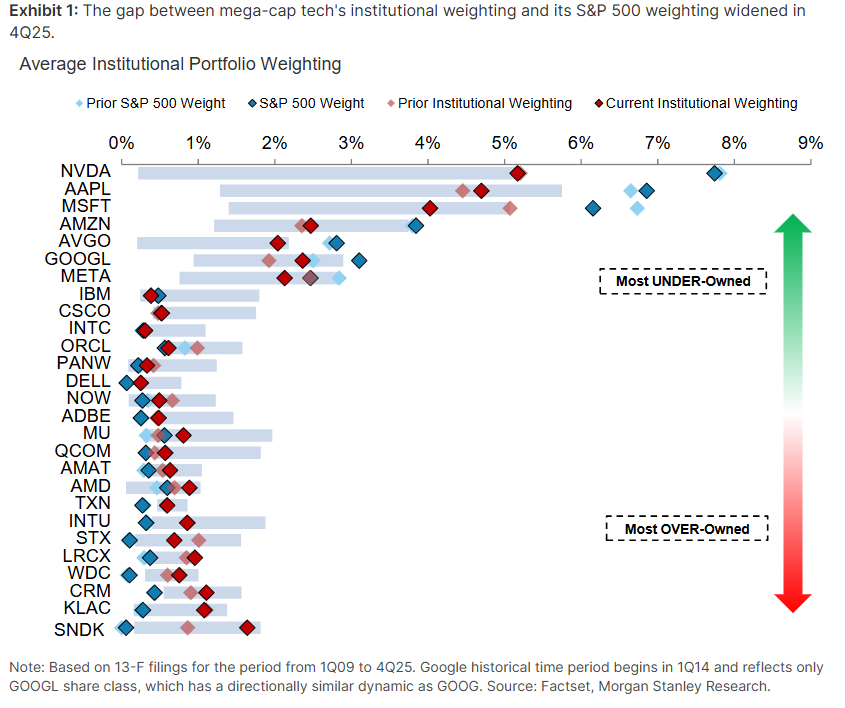
Mega cap tech names are now very under-owned by institutional investors…
Mega-cap Tech stocks are more under-owned vs. the S&P 500 exiting 4Q25 than at any point in the last 17 years; NVDA remains the most "under-owned" large-cap tech stock, while SNDK is the most "over-owned".
Morgan Stanley
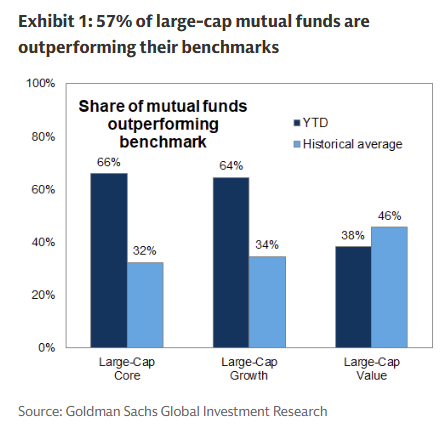
This has helped mutual fund portfolio managers to outperform their benchmarks in 2026…
57% of large-cap mutual funds have outperformed their benchmarks YTD, exceeding the long-term average of 37%. If maintained, this would match 2022 as the strongest year for mutual fund performance since 2007. Large-cap core funds have fared best, with 66% of funds outperforming the benchmark.
Goldman Sachs
Over-owning anything internationally has also helped US portfolio managers…
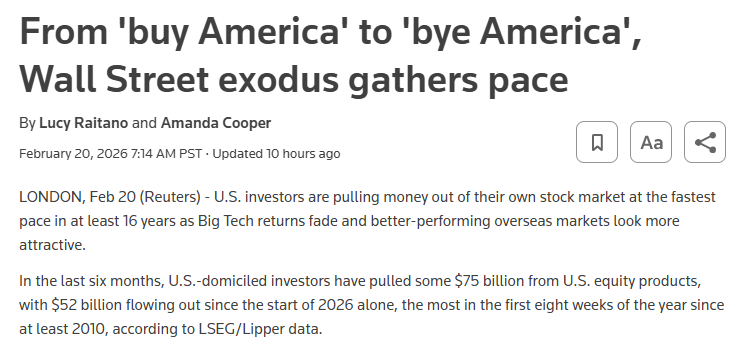
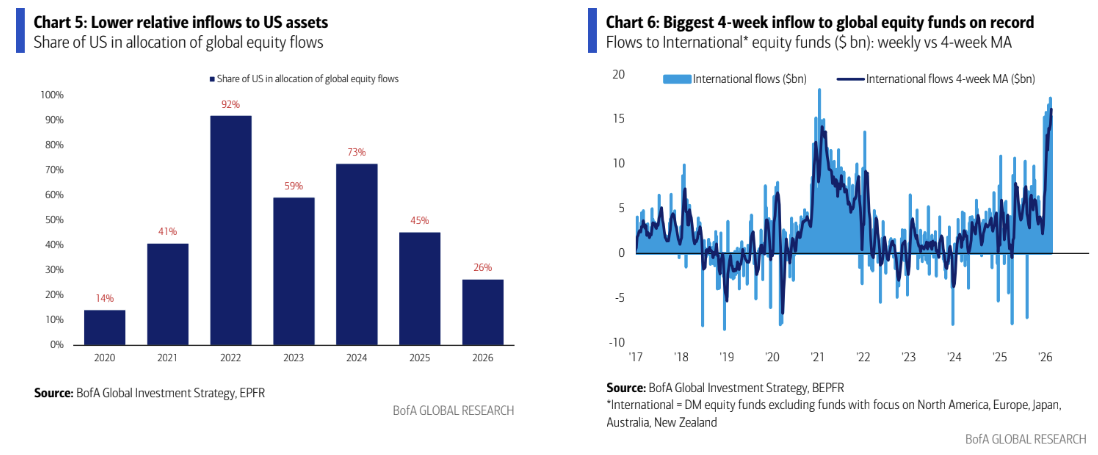
Fund flows shows an increasing amount of investment to head into the non-US$ buckets…
BofA Global
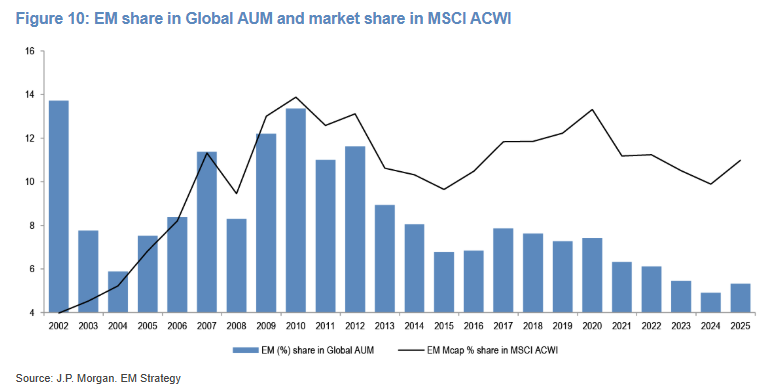
Despite strong inflows, EM equity allocations remain well below benchmark weights. EM is still significantly under owned in the average portfolio…
J.P. Morgan
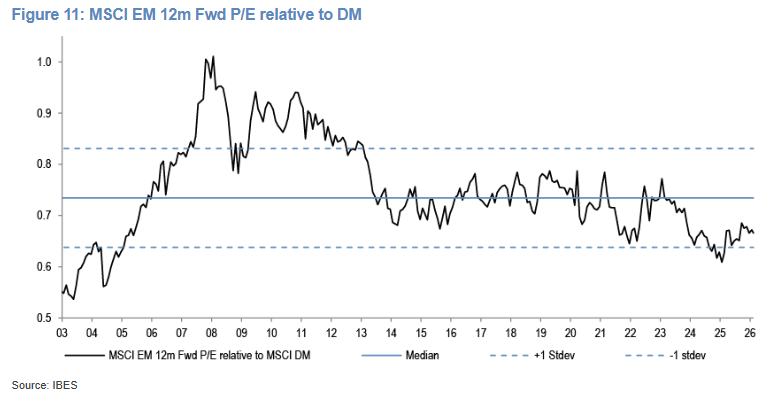
At 13x 12m Fwd P/E, EM equities are trading at a 33% discount relative to DM, much bigger than the typical…
J.P. Morgan
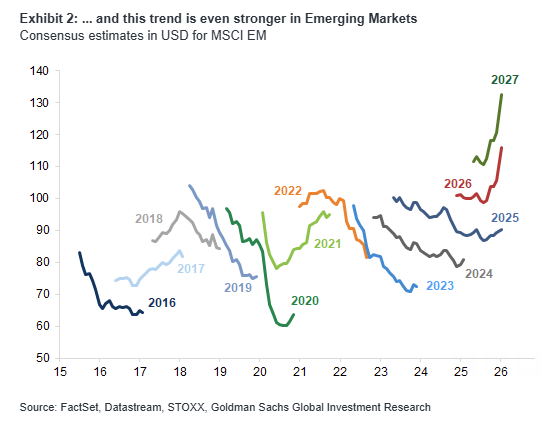
EM companies are also positing strong earnings growth…
Goldman Sachs
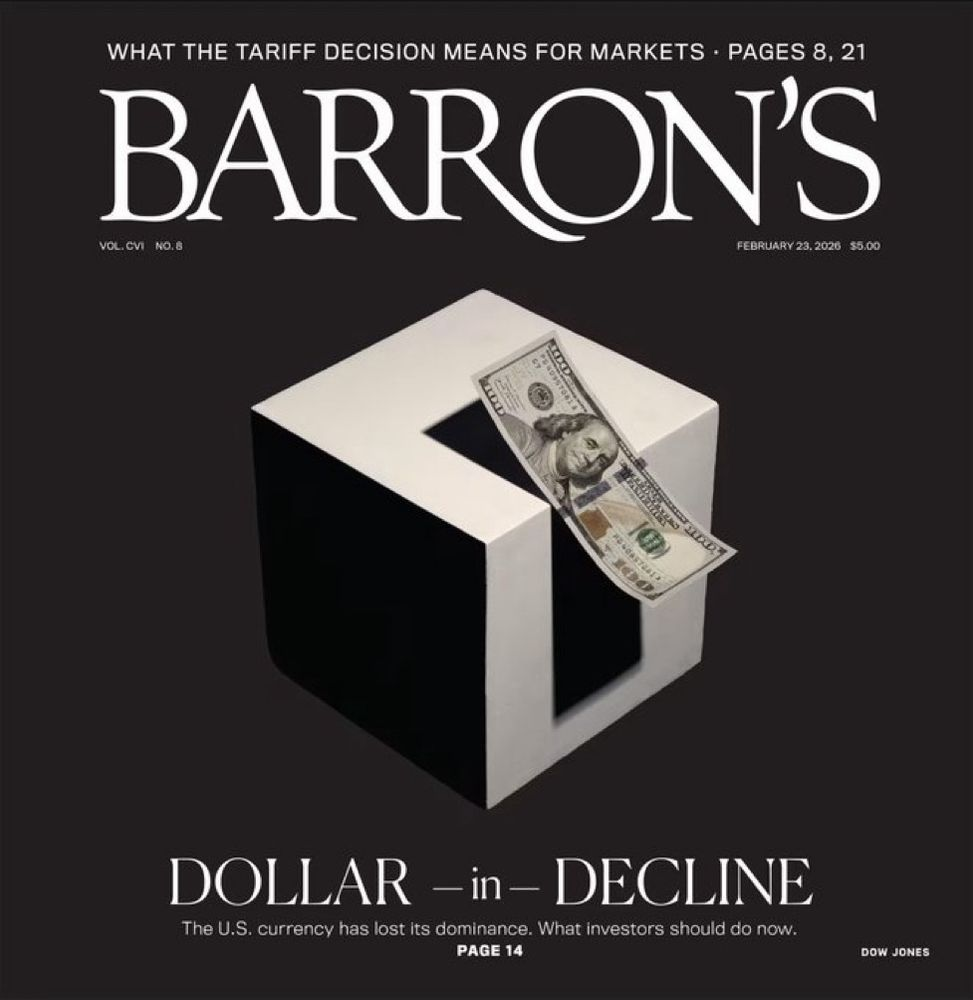
Barron's put the ink out on the weakening dollar this weekend…
The dollar is in decline, and investors have to learn to live with it.
The past 12 months were tough for the greenback. The U.S. Dollar Index, which measures the dollar’s value against a basket of developed currencies, slid 8% over the past year—and the list of potential concerns grows longer and longer. They include the breakdown in the U.S.-led multilateral system, growing concern that the dollar will continue to be weaponized through sanctions and seizures, worries about Federal Reserve independence, unease about profligate U.S. government spending, and a long overdue rebalancing as growth and yields abroad become more relatively attractive.
None of that implies the dollar will suddenly fall from grace, abandoned in a wave of panic selling. It isn’t about to lose its reserve status, suddenly replaced by the Chinese yuan or another currency. But the dollar is becoming less popular for savings, for trade, and as the ultimate safe asset. That makes diversification, through international stocks and bonds, especially in emerging markets—and a dollop of gold as a buffer—good options for the years ahead…
Think of it as quiet quitting rather than a Sell America frenzy. Instead of dumping U.S. Treasuries en masse, many central banks are letting their bondholdings mature and replacing them with gold. Many Treasury investors are cutting U.S. duration risk—moving to shorter-term bonds—says Cameron Brandt, director of research at EPFR.
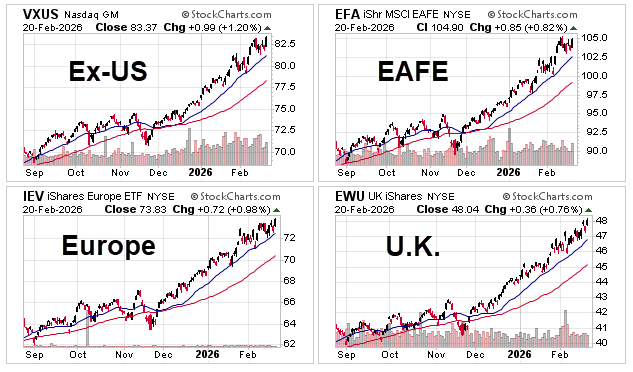
Now for a glance at what is streaking. How about 13 up weeks in a row for these index ETFs…
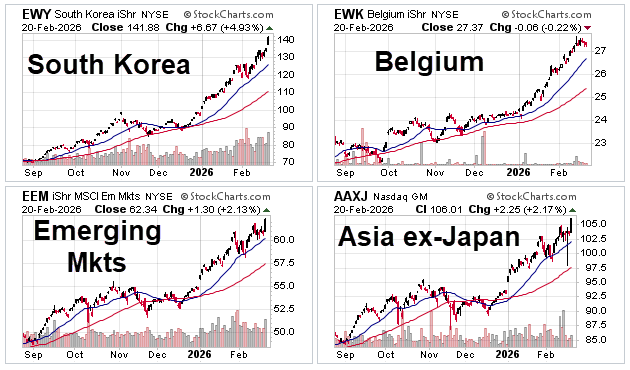
And 10 weeks up for these index ETFs…
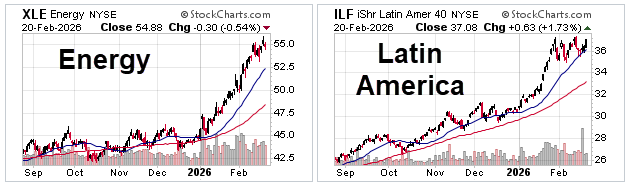
9 weeks up for the index ETF…
As discussed previously, 27 deals worth over $100b (sized $1b+) over the last two weeks…
- Nuveen agreed to buy U.K. asset manager Schroders (SDR.uk) for $13.5 billion, bolstering its business in Europe with a storied London investment house that dates back more than two centuries. Nuveen, the asset-management arm of the Teachers Insurance and Annuity Association of America, said Thursday the combined group would oversee nearly $2.5 trillion in assets. Under the proposed deal, Schroders’ shareholders would receive up to £6.12, equivalent to about $8.34, for each of their shares, including dividends. That represents a 34% premium to Schroders’ closing price.
- Danaher (DHR) has entered into a definitive agreement to acquire Masimo (MASI) for $180 per share in cash, valuing the transaction at approximately $9.9 billion, including assumed debt and net of acquired cash. The deal represents a multiple of about 18x estimated 2027 EBITDA, or 15x including expected annual synergies. The deal represents a 38% premium to MASI’s share price.
- Australia's Qube Holdings (QUB.au) agreed to an A$11.7 billion ($8.26 billion) buyout offer from a consortium led by Macquarie Asset Management to take the logistics firm private. The agreement follows months of talks after a MAM-led consortium made a non-binding offer in November for Qube, which gave the company an enterprise value of A$11.6 billion. Qube owns ports, intermodal terminals and bulk handling facilities across Australia.
- Gilead Sciences (GILD) has agreed to buy the rest of development partner Arcellx (ACLX) in a deal that values the biotechnology company at about $7.8 billion at closing. Gilead said it will pay an initial $115 a share in cash for the 88.5% of Arcellx it doesn’t already own, a 79% premium to itss closing price of $64.11 for the Redwood City, Calif., company. Arcellx investors will also receive non-transferable contingent value rights worth an additional $5 a share based on future sales of Arcellx’s lead pipeline candidate anitocabtagene autoleucel, or anito-cel, an investigational CAR T-cell therapy for patients with the blood cancer multiple myeloma.
- Privately-held Platinum Equity has agreed to sell Spanish waste management company Urbaser to Blackstone and EQT for $6.6 billion, the company said in a statement on Thursday. Blackstone and EQT will acquire equal 50% stakes in Urbaser and jointly manage the company, the two buyout groups said in separate statements.
- IHS Towers (IHS) has agreed to be acquired by MTN Group (MTN) in a $6.2 billion all-cash deal. The telecommunications company said that MTN, a South Africa-based mobile operator, has agreed to pay $8.50 a share to IHS shareholders, which it said was a 36% premium to the company’s one-year weighted average share price. The company announced earlier Tuesday that it has agreed to sell its Latin America tower operations to Macquarie Asset Management in a deal with an enterprise value of $952 million.
- Clear Channel Outdoor Holdings (CCO) agreed to be sold to Mubadala Capital, in partnership with TWG Global, in a deal with a $6.2 billion enterprise value. The transaction is worth $2.43 a share. The company said the deal provides a 71% premium to the unaffected share price of Oct. 16, the last trading day before media reports about a potential deal. Clear Channel, a dominant force in classic billboards, has enhanced its digital presence over the years.
- Japan's Sumitomo Forestry (1911.T), opens new tab agreed to acquire U.S. homebuilder Tri Pointe Homes (TPH) for $47.00 per share in cash, valuing the deal at about $4.5 billion. The offer represents a 29% premium to Tri Pointe Homes' closing price on Thursday, the companies said in a joint statement.
- Hapag-Lloyd (HLAG.de) is buying Israeli competitor Zim Integrated Shipping Services (ZIM) for $4.2 billion as the shipping firm looks to bolster its capacity. Germany-based Hapag-Lloyd said that it signed a deal to buy Zim for $35 a share in cash, a 65% premium to Zim’s closing price of $21.18. The total deal price of around $4.2 billion will be funded from cash reserves and external financing of up to $2.5 billion. The merger would secure Hapag-Lloyd's market position as the fifth-largest shipping line in the world with a modern fleet of over 400 vessels.
- Cencora, Inc. (COR) has agreed to merge its subsidiary, MWI Animal Health, with Covetrus in a deal valuing MWI at $3.5 billion, creating a comprehensive, technology-driven animal health platform. Upon closing, Cencora will receive $1.25 billion in cash, $800 million in preferred equity, and hold a 34.3% stake in the combined entity. Covetrus is currently owned by the private equity firms Clayton, Dubilier & Rice (CD&R) and TPG Capital.
- Veris Residential (VRE), formerly Mack Cali Realty, has agreed to be taken private by a consortium led by Affinius Capital and Vista Hill Partners in an all-cash deal worth $3.4 billion, including debt, the U.S. multifamily real estate investment trust. The deal follows a five year push to exit office assets and streamline the business, CEO Mahbod Nia said. Veris shareholders will get $19 for each share they hold, representing a premium of 13.3% to its last closing price.
- Mister Car Wash (MCW) announced it has entered into a definitive merger agreement to be acquired by Leonard Green & Partners in an all-cash transaction, valued at an enterprise value of ~$3.1bn. This represents an EV/EBITDA multiple of ~8x 2027e adj. EBITDA, and ~9x LTM adj. EBITDA. The $7.00 per-share offer reflects a 29% premium to MCW’s 90-day volume-weighted average share price. At the time of its June 2021 IPO, MCW traded at a peak NTM EV/EBITDA multiple of ~25.5x.
- Ovintiv (OVV) agreed to sell its Anadarko assets in Oklahoma to an undisclosed buyer for $3 billion, as the company sharpens its focus on higher-margin plays in the Permian Basin and Canada's Montney. The sale includes roughly 360,000 net acres, representing substantially all of Ovintiv's acreage in the Anadarko.
- Nexfibre Networks Ltd., the broadband venture owned by Telefonica SA (TEF) and Liberty Global Corp. (LBTYA), has agreed to buy the owner of fiber challenger brand Netomnia Ltd. in a deal valued at £2 billion ($2.7 billion), marking the first major consolidation in the crowded UK market. Telefonica, Liberty and Nexfibre’s other joint venture partner, InfraVia Capital Partners, will commit £1 billion to Nexfibre to fund the acquisition of Substantial Group.
- NatWest Group (NWG.uk) agreed to buy one of Britain's largest wealth managers, Evelyn Partners, for 2.7 billion pounds ($3.68 billion), including debt, in a bid to expand its wealth management business. For Permira, patience has proven a virtue. More than 12 years after it locked eyes with the firm that would later grow into UK wealth manager Evelyn Partners, the private equity firm has bid farewell in a £2.7 billion sale that makes its investors more than three times their money. NatWest is paying 15 times EBITDA for Evelyn, while shares in publicly-listed peers are trading at multiples of around 9-10x.
- Blackstone Inc. has agreed to acquire residential services provider Champions Group from existing owner Odyssey Investment Partners. The deal values Orange County, California-based Champions at about $2.5 billion. Champions is a provider of essential home services, specializing in heating, air conditioning, plumbing and electrics. Odyssey invested in Champions, then known as Service Champions, in 2021, but didn’t disclose terms.
- QXO (QXO) agreed to buy closely held building materials distributor Kodiak Building Partners for about $2.25 billion in cash and stock, continuing its rapid acquisitive expansion. QXO said the deal would be highly accretive to its 2026 earnings, expanding its addressable market in construction materials to $200 billion. Owners of Kodiak, a Colorado distributor of lumber and other building products, will receive $2 billion cash and 13.2 million shares, which QXO will retain the right to buy back at $40 per share.
- Portland General Electric (POR) announced it will buy most of PacifiCorp’s utility assets in Washington state for $1.9 billion, including two wind farms, a natural gas-fired power plant, 4,500 miles of transmission and distribution lines, plus about 140,000 customers. PacifiCorp is a wholly owned subsidiary of Berkshire Hathaway (BRK) and will be exiting the Washington state with its sale.
- Real estate investment firm Kennedy-Wilson (KW) will be acquired by a consortium led by its CEO William McMorrow and Fairfax Financial (FFH.to) for about $1.5 billion. The consortium will acquire all remaining shares for $10.90 each in cash, a sweetened offer from the previous $10.25 in November, representing a 10.2% premium to the stock's last close. In November, the consortium said that private ownership would reduce the cost and administrative burden of being publicly listed, allowing management to focus on its strategy.
- Privately owned Seattle-based Saltchuk Resources, Inc. has agreed to acquire Nasdaq-listed Great Lakes Dredge & Dock Corporation (GLDD), the largest dredging contractor in the United States, in an all-cash deal valued at $1.5 billion. Saltchuk will launch a tender offer to purchase all outstanding shares of the Houston-based company for $17.00 per share in cash. The offer represents a 25% premium to Great Lakes’ 90-day volume-weighted average price as of February 10 and a roughly 5% premium to its all-time high closing price.
- EBay (EBAY) will acquire the secondhand fashion platform Depop from Etsy (ETSY) for approximately $1.2 billion, adding an app popular with younger consumers to the online auction site’s core marketplace business. Etsy acquired Depop for $1.63 billion in 2021.
- Hims & Hers Health (HIMS) acquires digital health firm Eucalyptus for $1.15B, an international leader in digital health, accelerating the company’s ability to bring access to high-quality, personalized care to more people across the world.
- Enhabit (EHAB) said private equity firm Kinderhook Industries will buy the home-health services provider and take it private in a deal worth about $1.1 billion. Under the deal, Enhabit shareholders will receive $13.80 per share in cash, a premium of about 24% to the company's last closing price. The offer values Enhabit at about 10 times its expected 2026 earnings. The Dallas based company will keep its name and continue operating its 249 home health locations and 117 hospice locations across 34 U.S. states.
- Freight forwarder AIT Worldwide Logistics has been acquired by the private equity firm Greenbriar Equity Group in a purchase from another investment group, The Jordan Company L.P. (TJC). Terms of the deal were not disclosed, but it represents one of the largest private acquisitions to date in the global freight forwarding sector, according to AIT Chairman and CEO Vaughn Moore. Following the deal, TJC, alongside members of AIT’s executive leadership team, will remain invested in the company. While owned by TJC for five years, AIT expanded its global footprint, acquired 14 businesses, and increased its gross revenue by more than 300%, the company said.
- KKR & Co. has agreed to buy a majority stake in XCL Education Holdings Pte in a deal that values the Southeast Asian school operator at about $1.3 billion, according to people familiar with the matter. The company has K-12 school campuses across Southeast Asia, including XCL World Academy in Singapore, the American School of Bangkok’s Sukhumvit campus, and Vietnam Australia International School, according to its website. Its other shareholders include Singapore state investor Temasek Holdings Pte.
- Liberty Global Ltd. (LBTYA) agreed to buy out its partner Vodafone Group Plc (VOD) in Dutch telecommunications company VodafoneZiggo for €1 billion ($1.2 billion) in cash and a stake in a new holding company. Vodafone will get 10% in newly formed Ziggo Group, which will include VodafoneZiggo and Liberty Global’s interest in Belgian telecom Telenet Group. Liberty Global plans to list Ziggo Group in Amsterdam next year, spinning off its entire 90% holding to shareholders, it said.
- SM Energy to sell certain South Texas assets to Caturus Energy, LLC for a cash purchase price of $950M. The assets are approximately 61,000 net acres and approximately 260 producing wells in its southern Maverick Basin position in Webb County, Texas, along with related support facilities. Production from these assets is expected to average approximately 37-39 MBoe/d in 2026 (45% liquids, 9% oil) and generate approximately $160 million of asset-level cash flows for the full year, excluding corporate burdens(1). As of December 31, 2025, net proved reserves associated with these properties were approximately 168 MMBoe.
Various News Sources
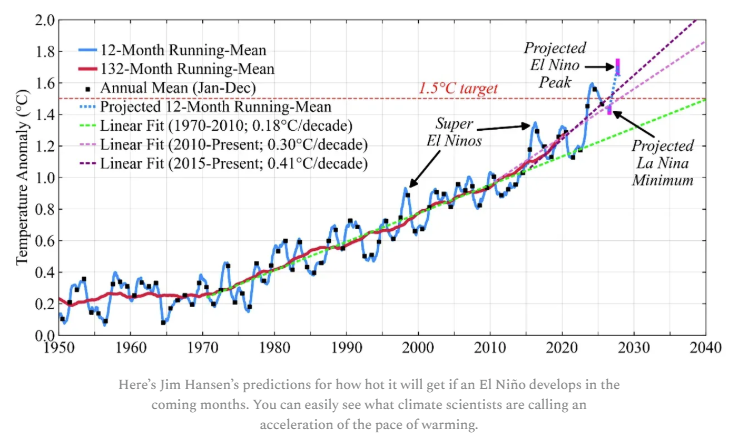
Now would be a good time to make sure your property insurance has adequate coverage in the event of a total loss…
We’re still in a La Niña phase in the Pacific right now—the cooler part of the cycle that meant that 2025’s global temperature was “only” the second or third highest ever, trailing 2023, the last big El Niño year. But that hot phase seems to be returning, and somewhat faster than expected. In the last few weeks, big Kelvin waves have been moving eastward across the Pacific, driving warmer water before them; these can sometimes peter out, but strong westerly wind bursts across the region—counter to the usually dominant trade winds—seem to indicate this one is for real; the best guess of the various forecasters is that sometime between June and September the world will enter an El Niño cycle.
When that happens, prepare for bedlam. Each El Niño event in recent decades has gotten steadily worse, because each one drives the temperature to a new record. That’s because each is super-imposed on a higher baseline temperature that comes with the steady warming of the planet. As James Hansen and his team pointed out in a paper last week, the expected low temperature at the close of the La Niña this spring is expected to be about 1.4 degrees Celsius above pre-industrial temperatures, which is higher than the maximum from the last El Niños. We are ever further into the great overheating.
We get fires and floods all the time now, but we get lots more of them when the temperature tilts sharply up. As Eric Niiler reported in the Times, the Pacific warm current “brings the potential for extreme rainfall, powerful storms and drought across some areas of the globe.”
Learn more about the Hamilton Lane Strategies
DISCLOSURES
The information presented here is for informational purposes only, and this document is not to be construed as an offer to sell, or the solicitation of an offer to buy, securities. Some investments are not suitable for all investors, and there can be no assurance that any investment strategy will be successful. The hyperlinks included in this message provide direct access to other Internet resources, including Web sites. While we believe this information to be from reliable sources, Hamilton Lane is not responsible for the accuracy or content of information contained in these sites. Although we make every effort to ensure these links are accurate, up to date and relevant, we cannot take responsibility for pages maintained by external providers. The views expressed by these external providers on their own Web pages or on external sites they link to are not necessarily those of Hamilton Lane.