
Weekly Research Briefing: The Dog Days of Summer

We have entered the summer vacation handoff period. While many American families are wrapping up their vacations to prepare for the next school year, the European families are heading out of their cities to climb some mountains or walk the beaches. The financial markets have yet to find time for rest and relaxation this summer.
Last week featured many significant events to digest:
- Continued strong earnings by the Seattle AI cloud giants Amazon and Microsoft
- The 9th pause of a major attack by the US on Iran
- Fed Chairman Kevin Warsh suggesting a more silent Fed with less forward guidance
- US 30-year bond yields surge to 22 year highs
- The liquidation of a $40b+ hedge fund leading to an end to forced selling of AI and semiconductor stocks
- An acceleration in Merger Monday as M&A activities continue to ramp even into the summer doldrums
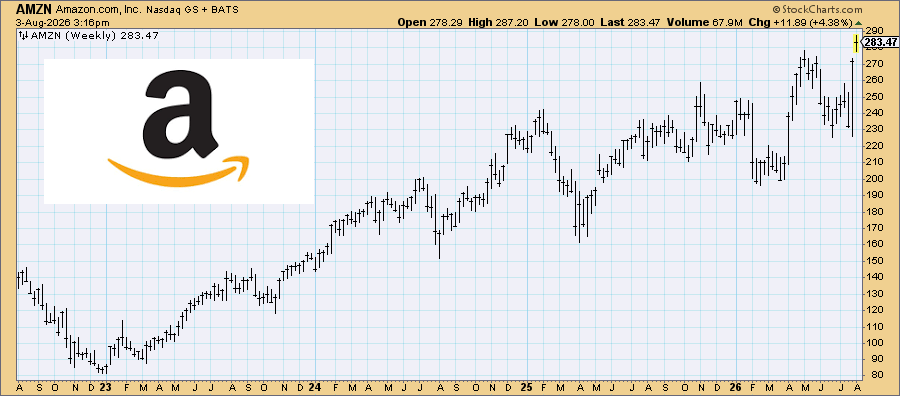
Trading desks and departments across all areas of finance right now are incredibly busy. Equity and fixed income trading, corporate finance, IPOs, mergers and acquisitions, commodity desks are all moving money while a war and higher risk-free yields continue to threaten. While the major macro items are more difficult to analyze, the micro items are not. Seeing the continued surges in cloud revenue growth at Amazon and Microsoft combined with their confidence in future visibility and returns, further reassured those invested in AI. It shouldn't be any surprise that Amazon traded to a new all-time high today while other hyperscalers moved sharply higher. Even Oracle has jumped 20% in three days. Erase any worries you might have had about AI data center financing.
This week, the markets will continue to analyze the Iranian War news while also studying the newest post-FOMC comments from Fed members. For economic data, it is jobs week with the nonfarm payroll and employment data released on Friday. Many eyes will look for a pickup in the job numbers given the recent strengthening of ISM, Durable Goods, and positive earnings commentaries. SpaceX will also report its first quarterly earnings on Tuesday followed by a large partial unlock of its stock two days later. Now let's see if the public stock can get out of the doghouse. Have a great week.
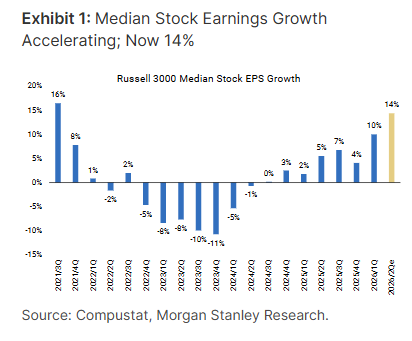
To start off, corporate earnings growth is broadening out as recent results show…
This is good for the economy and the markets as investors spread their new investment dollars to other industries and sectors. Expect the interest in semiconductor stocks to continue to diversify into companies benefitting from the chips and usage of AI.
Morgan Stanley
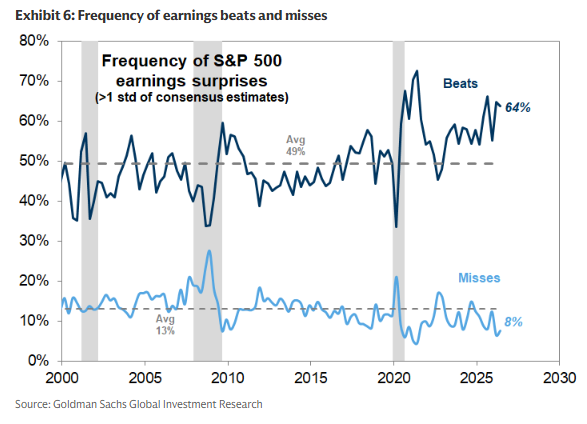
Earnings beats continue to be elevated relative to past periods…
Nearly 2/3 of S&P 500 companies have beaten consensus EPS estimates this quarter, one of the highest rates on record. This represents one of the highest frequency of earnings surprises on record, exceeded only by last quarter, the Q3 2025 reporting season, and the COVID reopening period in 2020-2021.
Goldman Sachs
Future earnings estimates continue to ramp making the S&P 500 cheaper almost daily during this earnings period…
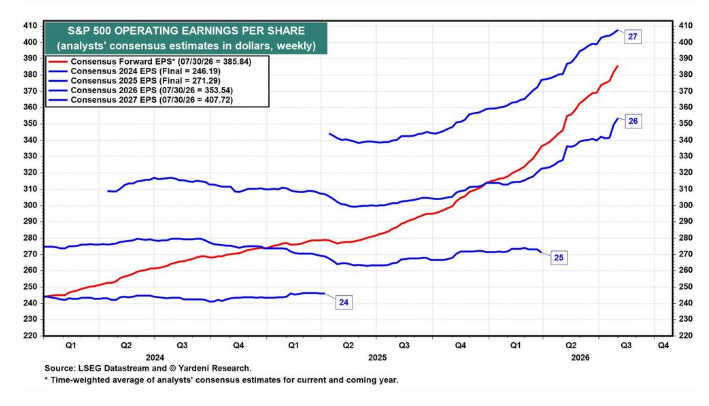
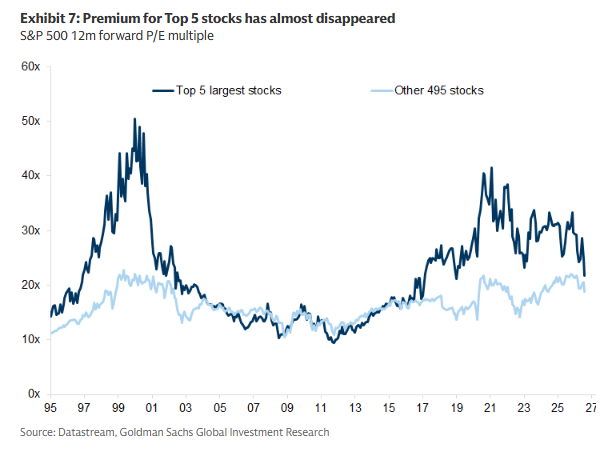
While this chart excludes the Friday and Monday jump of the hyperscaler stocks, it does show how much the Big 5 P/E multiples have compressed…
As Exhibit 7 shows, the biggest five stocks in the US now have a P/E ratio only marginally above the other 495 but had previously been on a premium consistently since 2017. It also marks a very big change from the dot.com era. Back then, valuations reached a much greater high, but they came down as stock prices collapsed. This time, prices have adjusted more modestly, but earnings have remained exceptionally strong.
Goldman Sachs
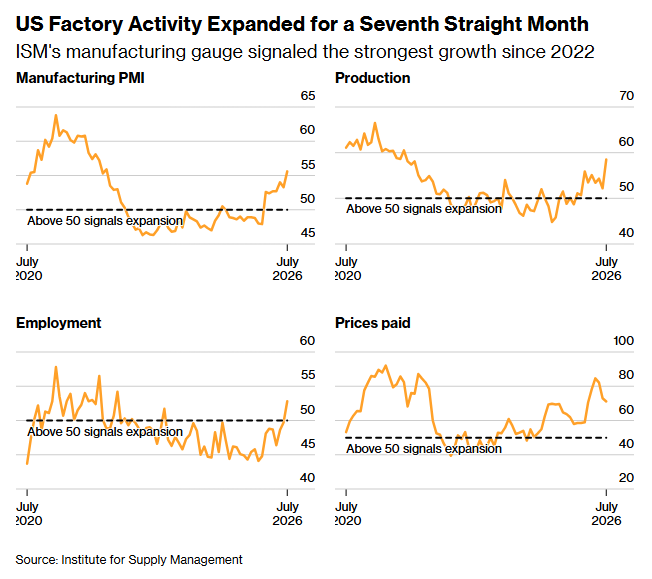
Not hurting anything in the equity and credit markets is the recent strengthening of US Factory Activity…
US manufacturing activity expanded in July at the fastest pace in more than four years as demand remained strong, production surged and firms added workers.
The Institute for Supply Management’s July manufacturing gauge rose to 55.6, the highest since May 2022, according to data out Monday. Readings above 50 indicate growth, and the sector has now been above that mark for seven consecutive months.
The gauge for production rose to 58.5, its highest level since late 2021, while the employment measure indicated manufacturers increased headcount for the first time since September 2023. New orders growth — a sign of demand — also picked up.
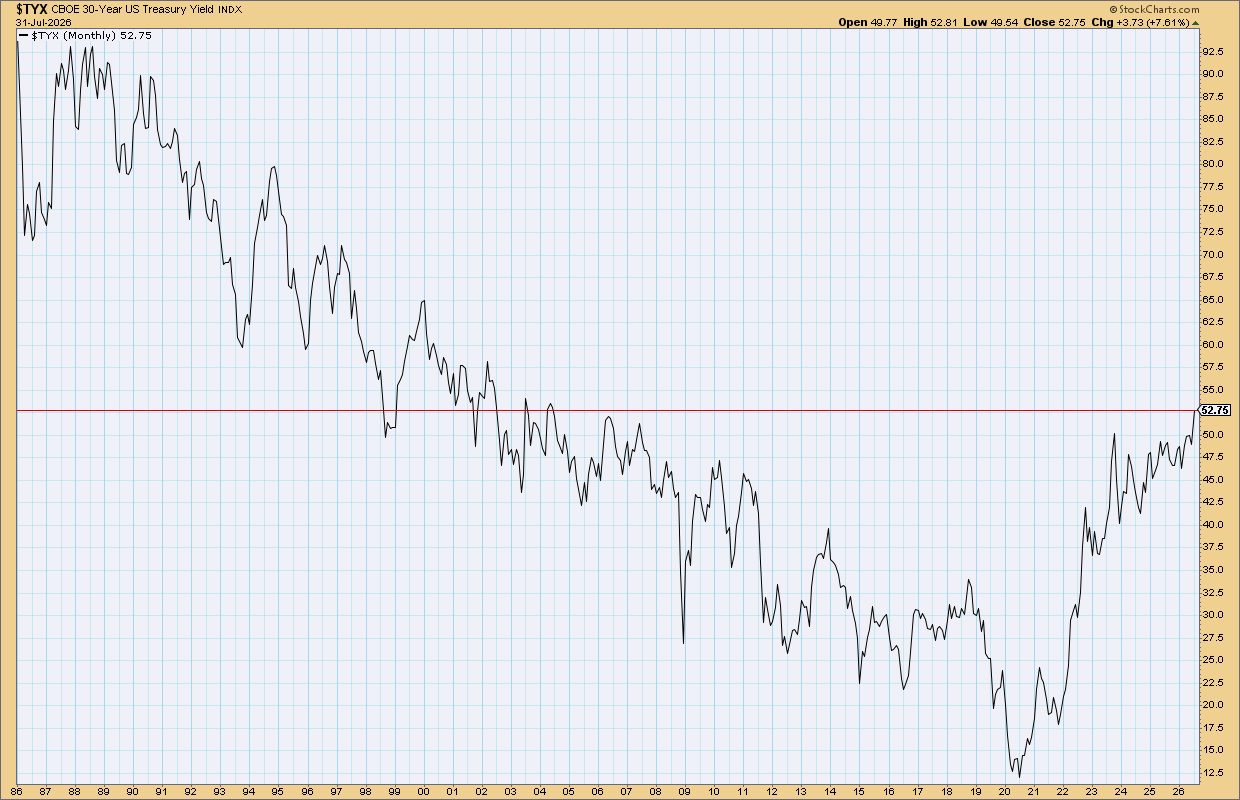
And while the strengthening economy does play a role in our new 22-year high in 30-year Treasury yields…
There are a few more factors at play today which is causing a flight from US Treasuries. The first point goes to last week's comments by the new Fed Chairman that the FOMC might reduce the number of meetings, give less forward guidance and not reveal its projections. This could only add more volatility to risk-free interest rates which will make financing future US government debt more expensive.
StockCharts
Both the economists and the major financial press were surprised and disappointed by the Fed Chairman's comments…
Warsh’s performance - Surprises & disappoints. Fed chairs have hosted post-meeting conferences since 2012, and last week’s was the most troubling (by a long shot). In particular (i) Warsh failed to tie his tough talk on inflation to any conditional plan of action, (ii) Failed to give any color on the reasoning for the Committee’s decision to remain on hold, and (iii) Raised suspicions he could move the goal posts, casting doubt if core PCE would remain the Fed’s preferred inflation measure.
J.P. Morgan
The bond markets were unhappy with Federal Reserve chair Kevin Warsh’s press conference on Wednesday, following the central bank’s decision to keep rates steady. The Treasury yield curve steepened, meaning the difference between short-term and long-term borrowing costs increased. It was a “bear steepener” — the two-year yield fell as the odds of a rate increase for the rest of the year declined, while the 30-year yield jumped to 5.2 per cent, the highest level since 2007.
This steepening, and its magnitude, is an unusual reaction following a “hold” decision. The only other similar instance followed the November 2010 meeting, when the Fed rolled out its second round of quantitative easing. It suggests investors have lost some confidence in the ability of Warsh’s Fed to rein in inflation. Though there was a higher than usual degree of uncertainty about the central bank’s decision beforehand, on balance investors had expected rates to stay unchanged. The bond market’s jitters came from Warsh’s press conference, where he all but refused to explain the Fed’s decision to do nothing, despite persistently above-target inflation.
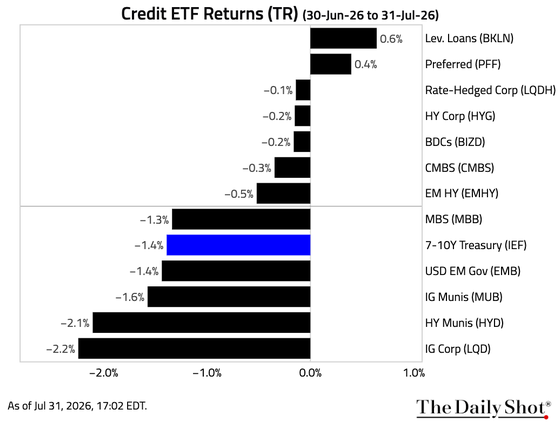
An interesting look at Credit ETF returns for July…
The volatility in AI stocks and flood of data center issuance had an impact on investment grade bond ETF performance. And the rise in US Treasury yields hit anything with duration. But all in all, not too bad.
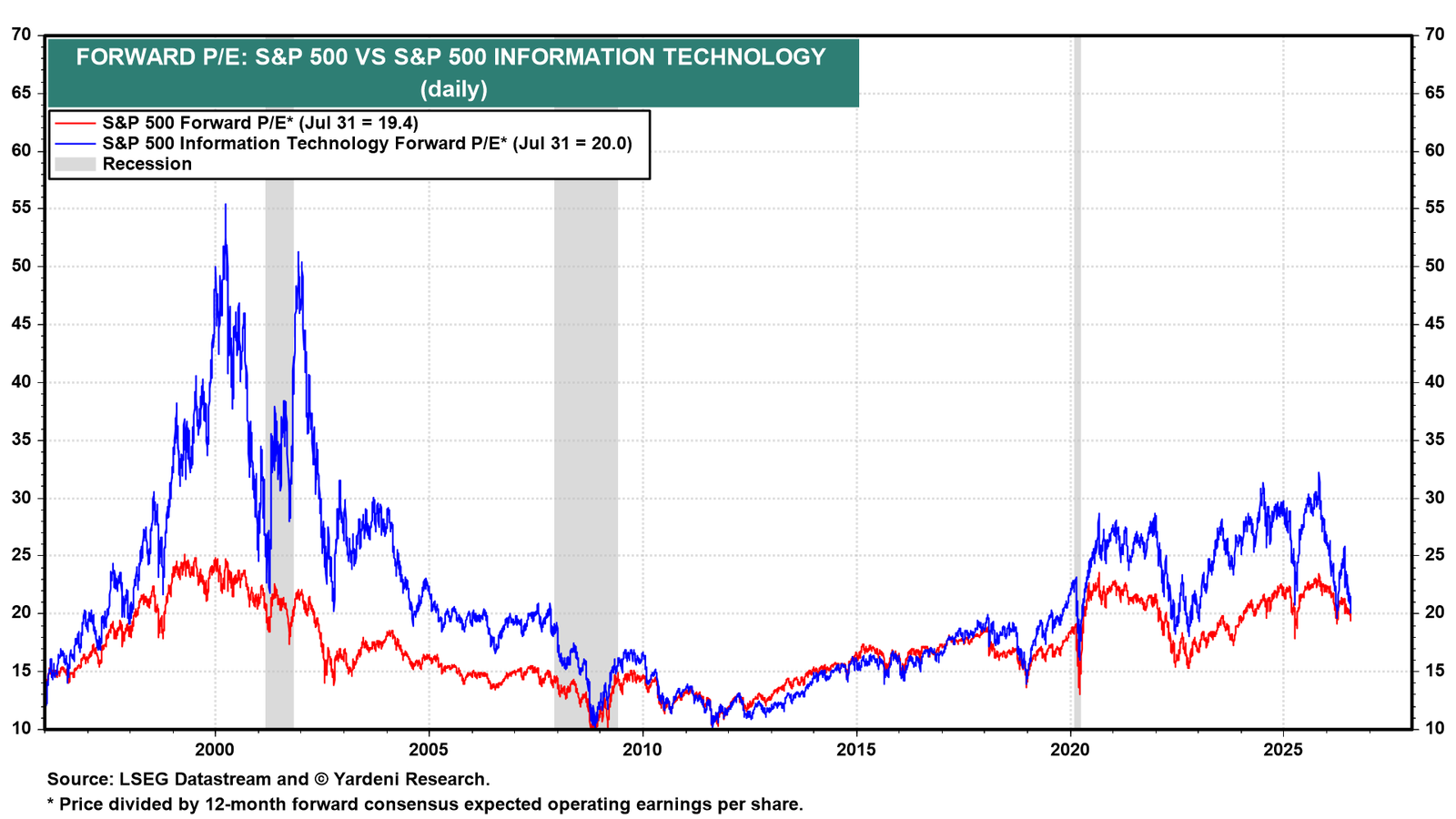
The July reversal in momentum stocks and Situational Awareness hedge fund pop even pulled Technology sector valuations to below that of the S&P 500…
Comparisons to the 1999 Tech Bubble are looking less and less credible. The S&P 500 Information Technology sector's forward P/E is 20.0, just 0.6 points above the S&P 500's 19.4 (chart). At the 2000 peak, the gap was as wide as 30 points.
About those big hyperscaler results last week…
Extremely positive results and commentary out of both Microsoft and Amazon. And the double digit percentage price moves by both (along with Alphabet) tells you that the stock market has still underestimated the investments being made right now by the major hyperscalers. Just look at the 60%+ jumps in annual recurring revenues (ARR) from the previous quarter for AWS and Azure. Both of these companies have access to computing power and customers are lining up to pay them for that.
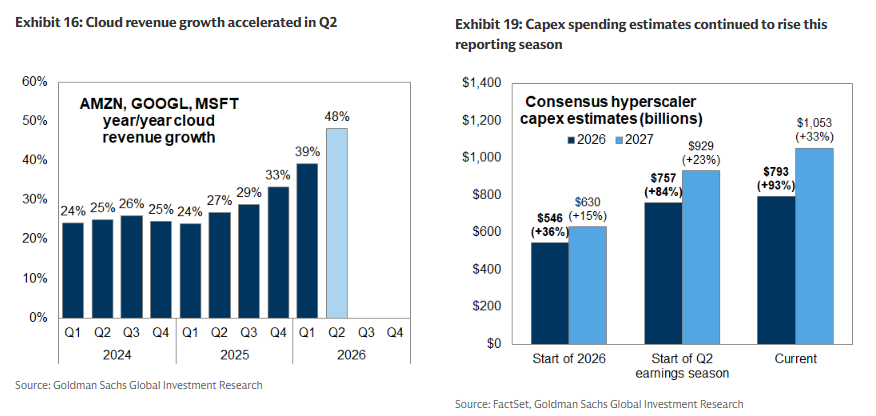
Hyperscaler results this quarter showed increasing evidence of return on AI investment in the form of strong revenues. Alphabet, Amazon, and Microsoft each reported above-consensus revenue growth, with cloud revenues rising by 48% year/year in Q2, an acceleration from 39% growth in Q1…
Estimates for hyperscaler capex in 2026 rose only modestly this quarter but forecasts for spending in 2027 jumped by nearly $125 billion. In previous years, the typical pattern was for moderate capex revisions in the middle of the calendar year. While consensus estimates for 2026 hyperscaler capex have been lifted by a relatively modest $36 billion since the start of the reporting season, 2027 capex estimates have jumped from $929 billion (23% annual growth) to over $1 trillion (33% growth).
Goldman Sachs
Cloud revenue growth is accelerating despite supply constraints…
Cloud revenue growth is no longer solely a function of incremental capacity additions, but also improving utilization, higher-value AI services, and expanding AI-driven consumption of broader cloud infrastructure.
- Microsoft: For context, Azure accelerated to +43% Y/Y growth with management attributing upside to efficiency gains across CPU/GPU fleets, process improvements, and faster deployment of new capacity, while Azure's incremental capacity was monetized almost immediately.
- Google: GCP accelerated to +82% Y/Y growth, driven by enterprise AI products, AI infrastructure services, core GCP workloads, and growing contributions from TPU system sales.
- Amazon: AWS delivered its fastest growth rate (+37% Y/Y) in 18 quarters, supported by both AI and traditional cloud workloads, with mgmt emphasizing that AI adoption is increasingly driving incremental consumption across storage, databases, networking, and core cloud services.
Morgan Stanley
Amazon Web Services capex dollars appear to be very well spent…
“At this level of spend and higher, we have clear line-of-sight to strong financial returns. I'll explain why. There are two major parts of the investment, the data centers and the servers and networking equipment that go into them. These have different capital cycles. Data center capital is spent starting two years before we can put servers into them to start monetizing. Once a data center opens with servers plugged in, we start generating significant revenue right away and then get to monetize these data centers for 30-plus years without having to spend that start-up capital again. Servers and networking equipment operate on a shorter cycle. We typically purchase these a few months before putting them into service, so we have strong visibility into customer demand before we trigger the spend. If the demand isn't there, we won't spend the capital. For servers and networking equipment, on average, it takes a little less than three years to break even on that investment. The servers currently have a useful life of at least five to six years and most of our AI capacity these days is being contracted for at least five-year terms. That means that we're driving significant free cash flow on the servers and network of equipment in the two to three years after we break even.”
(Amazon CEO Andy Jassy)
AWS visibility into 2028 also sounds great…
“In fact, the demand we already have for 2028 is striking. And remember, enterprises are still very early in using inference at scale in their current production applications. We long believed AWS could become a few $100 billion revenue business, and now believe it will be at least double that and very possibly be $1 trillion annual revenue business for us in time with very appealing accompanying free cash flow and return on invested capital.”
(Amazon CEO Andy Jassy)
No wonder that Amazon hit all-time new highs on Monday…
StockCharts
Facebook also said they have plenty of demand for the computing power that they are building…
META CEO: "...we're getting a lot of offers for compute at a significant premium over what we paid for it...the high-level observation is that there's just nowhere near enough compute for all the demand. That is why we see that basically, we are getting a large number of offers for the compute that we have"
@TheTranscript_
Eaton makes products for power infrastructure and thermal management. And business visibility looks good…
“Total U.S. data center backlog has grown to 307 gigawatts or 15 years of backlog at 2025 build rates, up from 12 years in our last update. Only roughly 20% of this backlog converts near term. The majority will translate to 2028 and beyond deliveries, a very nice tailwind for Eaton for years to come...Just think about this 300 gigawatts of announcements versus the 50 gigawatts that was built over decades that’s going to be online by the end of this year, 6x what this industry built ever is going to be built in the next years to come.” - Eaton CEO Paulo Sternadt
More earnings comments from an infrastructure construction, steel, and copper company also suggests that AI growth is large and benefitting more than just the semiconductor companies…
MTZ (2Q26 Research Recap): “…but backlog hit a record ~$7.8bn with a book-to-bill of 1.3x, renewables extended its streak to 12 consecutive quarters of sequential backlog growth, and management described data center demand as “absolutely unreal” and still in “early innings,” with investment plans that are “multiples of what it is today.”
NUE (2Q26 Call): “With all that said, the demand drivers across the spectrum are incredible… But the reality is it's not a pricing delta that's driving that. It is a demand picture that we're seeing. The robust demand almost in every product group area that we have is either at or near-record backlogs, record order entry rates, and is driving a, again healthy returns for our shareholders. So again, this isn't where we saw in '21 or '22 where you had a really rapid spike of HRC and kind of knew it wasn't sustainable or for very long. It is a very different condition today.”
FCX (2Q26 Call): “As we speak with our customers across the US, they continue to report robust copper demand and order books associated with AI data centers and related energy infrastructure and improved demand from the auto sector, which is more than offsetting weakness in private construction”
J.P. Morgan
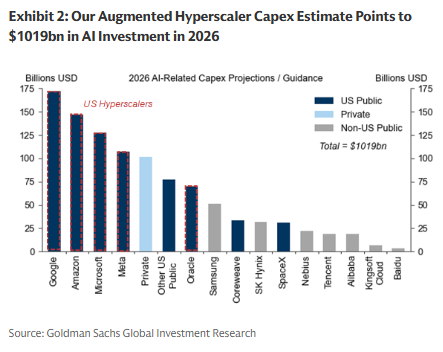
Updated numbers show that the top 5 Hyperscalers should account for about 80% of AI capex this year and drive spending to over $1 trillion…
AI investment is a key focus of macro markets, but measuring it is not entirely straightforward. The most frequently cited measure is the projection for almost $800bn in 2026 capex from US hyperscalers. However, this estimate ignores investment by private and foreign companies and captures non-US and non-AI investment.
To address these measurement issues, we adjust hyperscaler capex projections to exclude pre-AI investment trends, augment these data with capex estimates for foreign and private AI-exposed companies, and allocate investment globally based on the location of announced hyperscaler investments. After these adjustments, we estimate that 2026 AI investment is set to total $1019bn globally and $581bn in the US.
Goldman Sachs
Financial stocks continue to hit new highs and should be a major beneficiary of AI deployment to increase productivity and lower costs…
The boss of Lloyds Banking Group is preparing to wield the axe on its cost base as the bank doubles down on AI ambitions.
Charlie Nunn, the chief executive of the financial services giant, said AI is “going to impact work” and “require us to reskill people and hire new people” as he revealed a new strategic plan for the blue-chip lender.
Nunn is targeting around £2bn in cost savings by 2030 as part of a new plan dubbed Accelerate 2030.
The banking chief is aiming to reduce the group’s overall cost-to-income ratio to less than 45 per cent in 2030, which will mark a drop from 50 per cent in 2026.
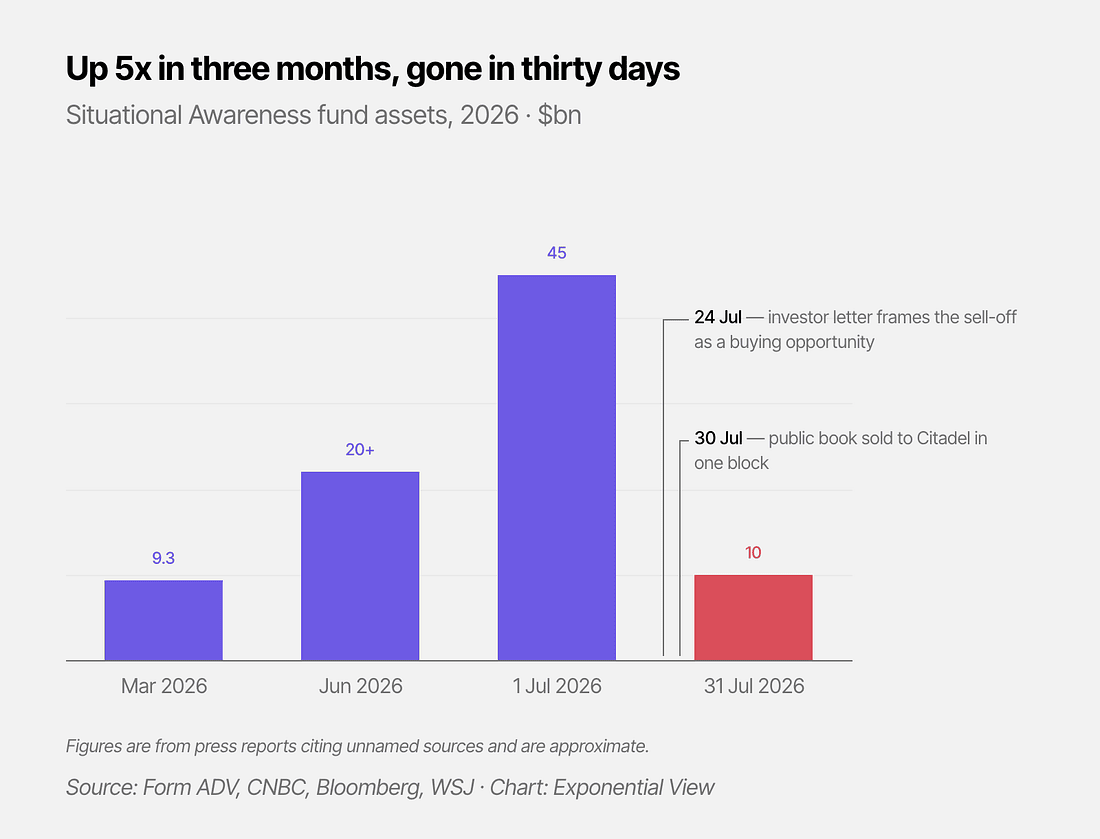
Now about that hedge fund blowup. Here are Marc Rubenstein's notes…
In the space of a month, the 29 US-listed long positions in Aschenbrenner’s portfolio fell by an average of 21%, while short positions such as Adobe rose by 26%. Combined with leverage of three to four times, that spelt disaster. The fund was down 67% for the month; strip out private company holdings such as Anthropic, which made up around $10 billion of the $45 billion peak assets, and the public portfolio was down around 85%.¹
We’ve talked about margin calls here before. Aschenbrenner tried to avert his on July 24 in a letter that invited investors to inject fresh capital. “At times, we call out opportunities that seem like a particularly good time to add funds, if you have been waiting for one,” wrote Aschenbrenner. But by then, his problems were well-telegraphed and the market took over:
“As these moves proceeded, we started to see increasingly adverse trading in names publicly associated with us. These dynamics are essentially similar to a bank run: vulnerability begetting more vulnerability. We worked to keep the portfolio within our risk parameters, but gradually this became more difficult as positions rapidly moved against us and market liquidity dried up.”
It’s a story all too familiar. Faced with increasingly punitive margin calls, Aschenbrenner was forced to liquidate most of his public portfolio via a single block trade at a 10% discount to market value. The transaction, with Citadel, removed all leverage from the fund, allowing Aschenbrenner to enjoy his wedding without his phone vibrating and return to a business bruised but still standing.
A great read by Felix Salmon on the trillion dollars of fine art that is going to flood the market in the future…
When you inherit art that was expensive when acquired, it’s difficult to think of it as “stuff” that could be thrown away or given to a thrift store. At the same time, storing and figuring out what to do with it can be enormously challenging. One way of making sure someone appreciates the art is to sell it. But finding buyers can be extraordinarily difficult. Most artists get forgotten over time. Even living artists have a hard time selling their work. A dead artist, like Vaughan, needs a dealer who’s committed to resuscitating interest in them — and those dealers are few and far between, since it’s nearly always easier to sell the work of a living artist than a dead one.
Just looking at items that can be sold for cash on the secondary market, which is a tiny minority of all the art out there, roughly $1 trillion of art is expected to change hands just in the next 10 years, per Deloitte. No one is ready. The great wealth transfer includes a vast quantity of paintings and sculptures. A small proportion of it will have some sentimental value and be kept for that reason, but most of it is going to get moved out one way or another — sold, donated or even trashed.
“We look after about 350 family office collections in 28 countries,” says Philip Hoffman, chairman and founder of the Fine Art Group, which advises families on their collections. “In most of those, the next generation haven’t discussed what they’re going to do with it. Many of them aren’t really interested.”
The problem lies not just with the heirs but also — indeed, mostly — with the collectors. Do the scions even want all that art? Of all the families he deals with, “I can only think of about five that have thought about it,” he says. The rest are in various forms of denial, he says, simply choosing to believe their children would love nothing more than to continue to steward their collection.
To the contrary, as a general rule, “The next gen don’t want it,” Hoffman says. “They want something different.”

Imagine a more sustainable world in which we didn't have to harvest trees for consumer paper products…
For two decades, Kimberly-Clark has scoured the Earth for a material that could replace wood fiber. The maker of Scott paper towels, Cottonelle toilet paper and Huggies diapers now says it has made a breakthrough.
Paper-based products of the future, the company says, could be made with hesperaloe, a plant with long, pointy leaves that grows in arid climates.
Fiber from the plant can be used to make paper towels, toilet paper and other products that are both stronger and softer than wood-based equivalents, executives from Kimberly-Clark said. If production reaches scale, it could also be cheaper and less environmentally damaging than cutting down trees, they say.
“We call it our Goldilocks discovery,” said Craig Slavtcheff, the company’s top research-and-development officer. The company plans to announce its findings later Monday.
Kimberly-Clark describes its continuing efforts to commercialize the findings as a “moonshot,” and executives caution that there is a long research runway ahead. Still, they expressed hope that hesperaloe could help them reach a previously stated ambition to eventually stop using fibers from natural forests in their products.
If you live in the Southwest, you probably have a yard full of these plants…
H. parviflora has many benefits for the gardener, such as its innate drought tolerance and its love of high temperatures and bright, hot sun; likewise, it has developed natural adaptations to withstand winter temperatures at or below freezing. It is popular also for its architectural form, its pollinator-attracting flowers, and its overall ease-of-maintenance.

Learn more about the Hamilton Lane Strategies
DISCLOSURES
The author has current equity ownership in: Alphabet Inc.
The information presented here is for informational purposes only, and this document is not to be construed as an offer to sell, or the solicitation of an offer to buy, securities. Some investments are not suitable for all investors, and there can be no assurance that any investment strategy will be successful. The hyperlinks included in this message provide direct access to other Internet resources, including Web sites. While we believe this information to be from reliable sources, Hamilton Lane is not responsible for the accuracy or content of information contained in these sites. Although we make every effort to ensure these links are accurate, up to date and relevant, we cannot take responsibility for pages maintained by external providers. The views expressed by these external providers on their own Web pages or on external sites they link to are not necessarily those of Hamilton Lane.