
Weekly Research Briefing: Fall Begins

Let's hope the most red we see this fall happens on the leaves of the trees and not on our screens or in our portfolios. As in years past, September remains a tricky one for the markets. This year, rising energy prices and interest rates are keeping a lid on stock prices. Just look at Monday's upward price surge on a day when oil prices and interest rates fell. The markets need more of this to accompany the piles of leaves in our yards.
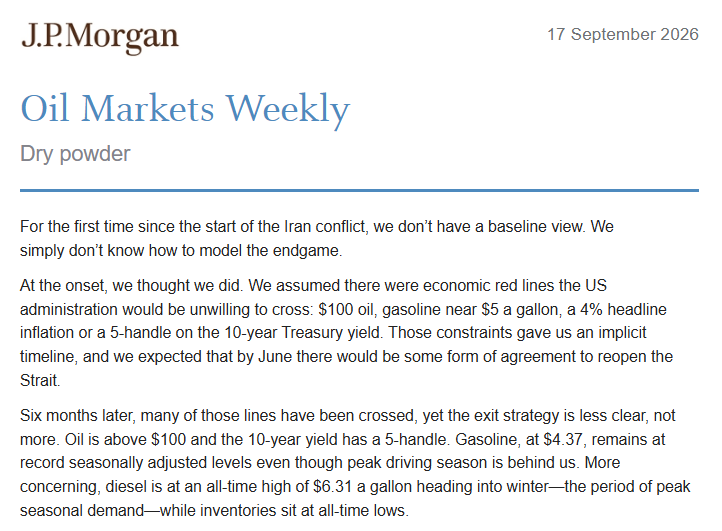
The energy markets were on high alert this weekend as a military escalation against the Houthis was averted in the final hours. Stay tuned to see how this impacts future US and Saudi relations. So, should we assume more talks are coming? Meanwhile, two days by car to the north, Ukrainian attacks on Russia have intensified taking out the country's largest oil refinery. This will put further pressure on European diesel prices. Given all of the current uncertainties, J.P. Morgan's top energy analyst wrote this weekend what we are all thinking: “For the first time since the start of the Iran conflict, we don’t have a baseline view. We simply don’t know how to model the endgame." Cheers to their honesty.
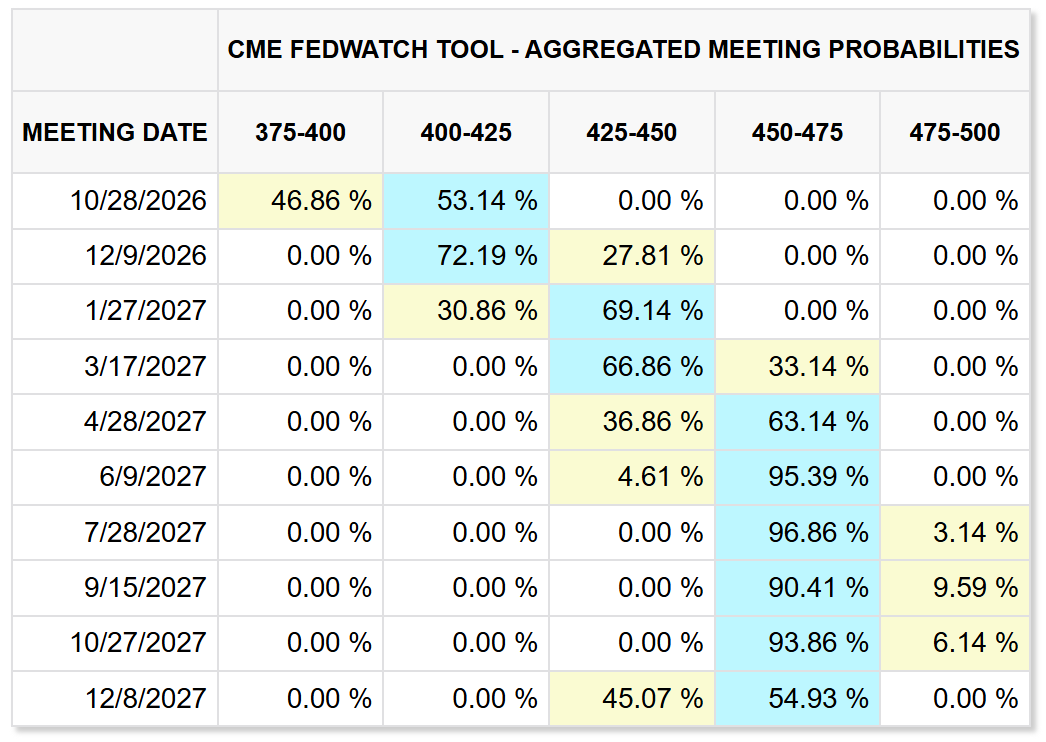
In Washington last week, the Fed raised rates as expected, while Fed Chair Warsh noted that inflation has remained above target for five years now. The +0.25% rate hike will benefit retirees and savers who invest in short-term or adjustable-rate debt instruments. It will make life a bit more expensive for those who borrow short-term or hold adjustable-rate debt instruments (like credit cards, lines of credit or US Treasury debt). Looking ahead, the market now sees a 50% chance of a +25bp rate hike at the October meeting, and a 70% chance of a follow-on hike in January when the FOMC voting members shuffle for 2027.
The corporate earnings outlook continues to look strong as we head into the October earnings period. Analysts continue to lift Q3 and Q4 earnings estimates as good news offsets bad news heading into the end of the big September conference season. While politicians who have never used AI debate its regulation in Washington, the hyperscalers and neoclouds continue to build, buy and lease as fast as possible while global investors happily provide financing. Keep an eye on the many new large financings hitting the market this week including Softbank's $11b in offerings. It will be a quiet week for data with only New Home Sales, Durable Goods & the University of Michigan consumer sentiment data on deck.
The election is now six weeks away. Studies have shown that by now, most voters have made their decision and they could be filling out and returning their ballots this week. The GOP has a Ft. Knox-sized war chest to advertise to voters, but that is combined with the lowest approval rating to date for the current President. An end to the wars in the Middle East and Ukraine/Russia could be a winning trump card, but can or will they play it? As of today, the prediction markets have made their bet and it looks favorable for moving trucks, realtors and blue balloon inflators in the Washington D.C. area. Enjoy the piles of leaves and have a great week.
Natasha Kaneva put to paper what many of us have been thinking…
The White House has thrown out the script so no sense trying to pick the ending of this film.
J.P. Morgan
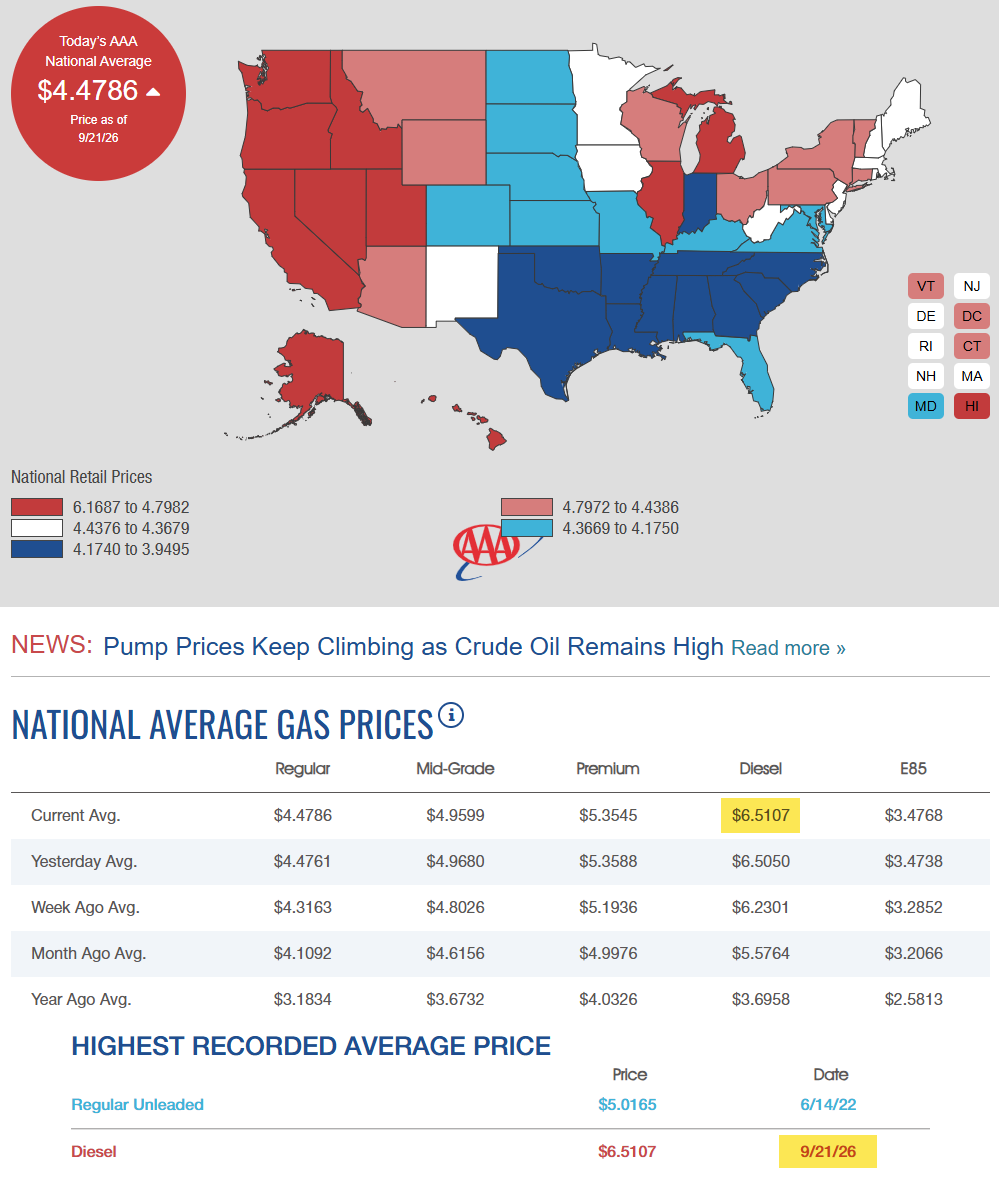
Good thing that my first car, a diesel engine Oldsmobile Cutlass Supreme, didn't survive my journey to date…
My premium gasoline tank fill up was a personal record of $150 this weekend for 24.1 gallons. Meanwhile across the US, the average price of diesel in the U.S. hit a record $6.51 today, according to AAA, up nearly 17 percent over the past month.
Get Mel Gibson on the phone. Mad Max: Operation Oil Can is being written in real time…
Even better if you can get Steve Martin to cameo a re-enactment of the gas station oil can scene from 'The Jerk'.
A worldwide shortage of motor oil is becoming more acute, with prices of the car engine lubricant reaching new highs, oil-change shops running dry and a US retail group rationing sales to do-it-yourself customers.
The surge in the cost of base oil used for the full synthetic motor oil required for many newer cars far outpaces steep price rises for crude oil, petrol and diesel. The US price of so-called Group III base oil has almost quadrupled since February to a record $12.45 a gallon on Friday, according to Argus Media…
Walmart’s website this week reported low stocks for several brands. “We work closely with our suppliers to keep products available at the low prices our customers expect,” Walmart said.
“There will be some spot outages that we have to just deal with,” said Mauricio Quezada, chief executive of Jiffy Lube, a US oil-change and auto-repair chain. Jiffy Lube was part of Shell until its $1.3bn sale to a private equity firm in July and still received most motor oil from Shell’s Pennzoil business, Quezada said.
Motor oil sells in small volumes but serves a critical function greasing the insides of internal combustion engines. Global lubricant base oil exports are typically only about 350,000 barrels a day, a fraction of the more than 100mn b/d world oil market.
Don't forget that diesel fuel moves all truck transportation which will make your grocery bill more uncomfortable…
"Amid soaring diesel prices, Food at Home CPI could rise to 7-8% over the next 6 months, up from the current low single digits (2.1% in August)."
BofA Global
This is not the headline that any GOP candidate wants to see as ballots hit the mail boxes…
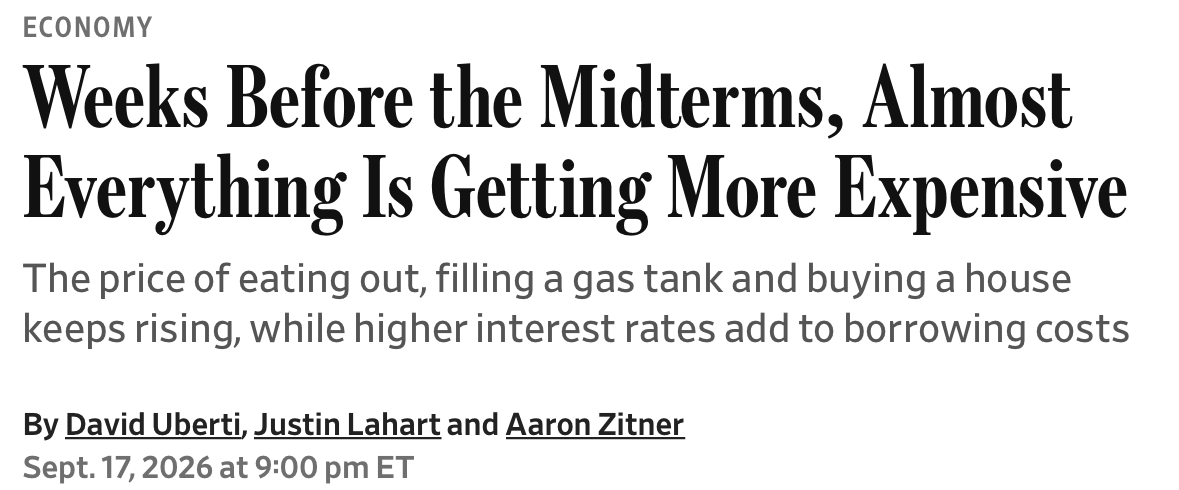
Do the prediction betting markets have inside information this time?
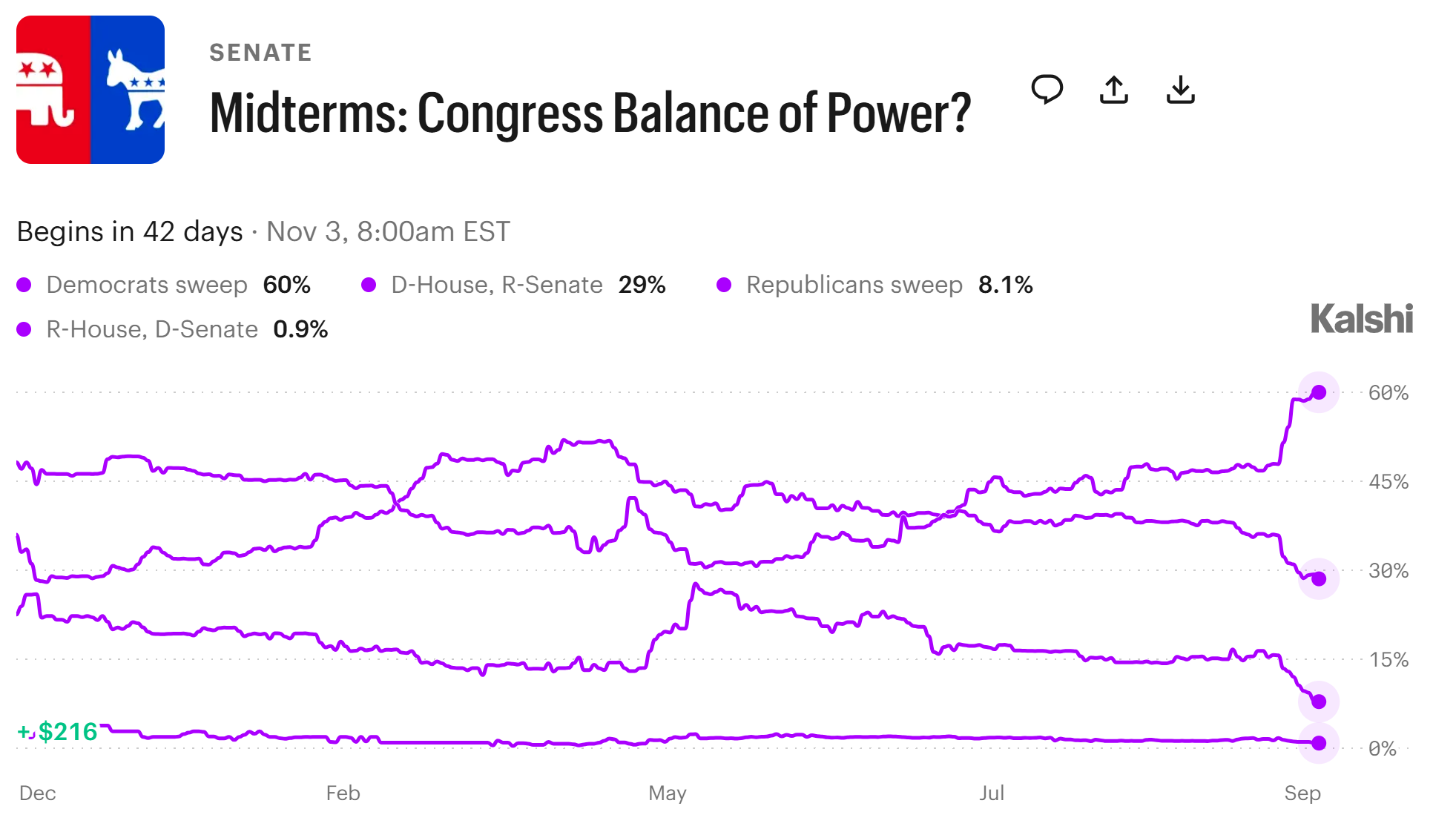
A perfect summary of why the FOMC raised the Fed Funds Rate last week…
Fed Chair Kevin Warsh says 3 things changed that led to the rate hike today:
- Strength of the economy. "The economy has strengthened. It’s a judgement I have and the committee has."
- Inflation summer trends weren’t passing his test for moving toward 2% "clearly and at sufficient speed"
- Geopolitics (aka war in Iran and oil/diesel). Warsh says "Our judgement about what is the most likely or least likely geopolitical situation has changed"
@byHeatherLong
And if current financial conditions are not restrictive, then we can assume that future hikes are possible…
“I would be hard-pressed to describe broad financial conditions as restrictive. This view was widely shared by the committee. So we removed a dose of accommodation.” - Federal Reserve Chairman Kevin Warsh
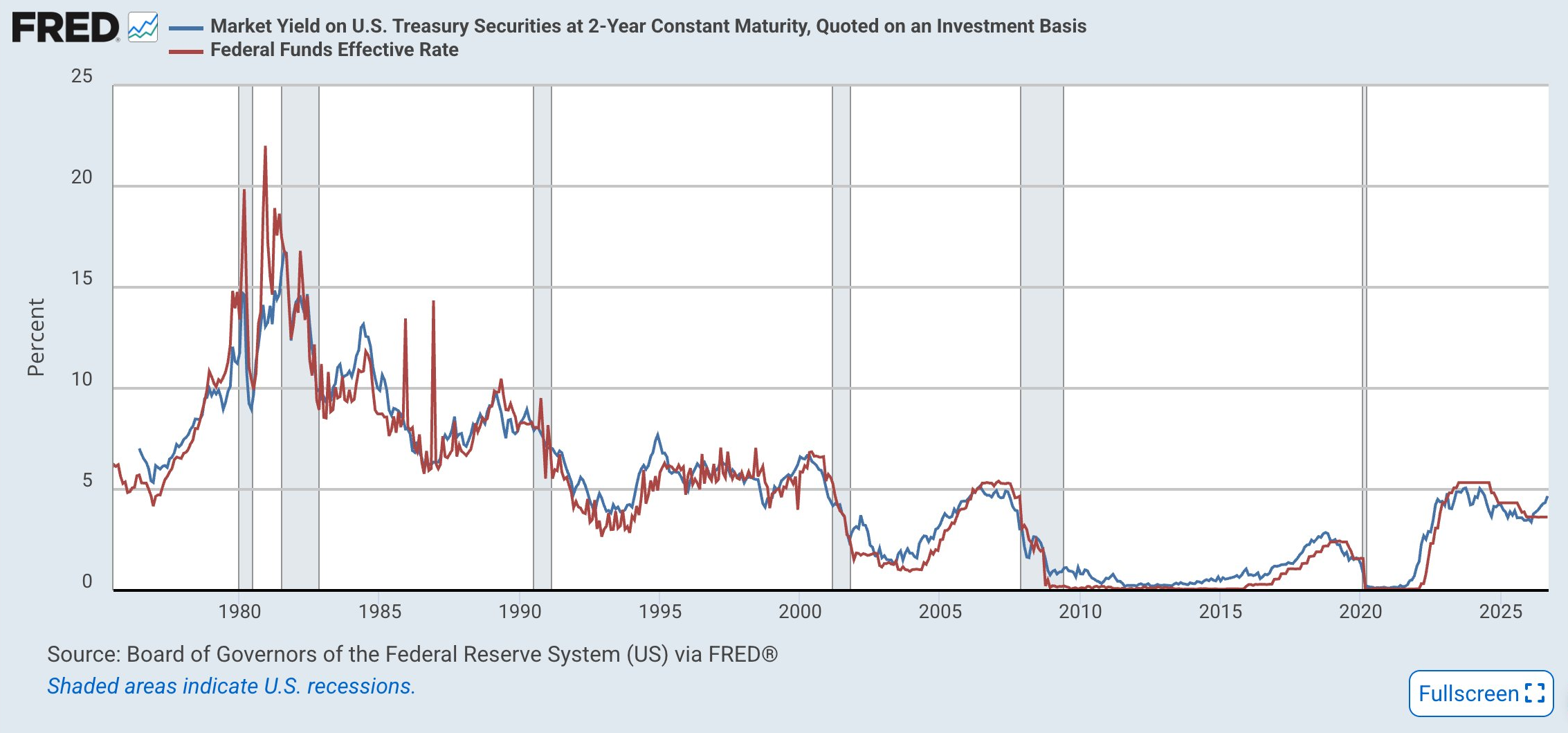
No better predictor of the Fed Funds rate than the 2-year Treasury note…
@MebFaber: The only guide the Fed needs.
October rate hike is a coin flip…
Then a bit more likely for another hike in January when the FOMC gets a bit more hawkish as voters trade chairs.
Plenty of price increase talk making it through the September conference presentations…
Mark Costa, CEO of industrial giant Eastman Chemical, said in May that the one-two punch of interest rates and inflation was forcing his industry into a corner. Eastman makes the plastics, additives, and other materials used in products as diverse as medical devices, animal feed, and car windshields.
“Everyone had their back against the wall and had no room to absorb these increases,” Costa said on Fox Business. “Everyone is very quickly raising prices faster than I’ve ever seen in 20 years.”
On the retail side, unexpected pressure from energy and raw materials costs will “fully offset” the benefit of $730 million in tariff refunds, Home Depot CFO Richard McPhail said last month.
“There’s just so much uncertainty right now. … You think inflation, interest rates, fuel prices,” McPhail said last week at a conference.
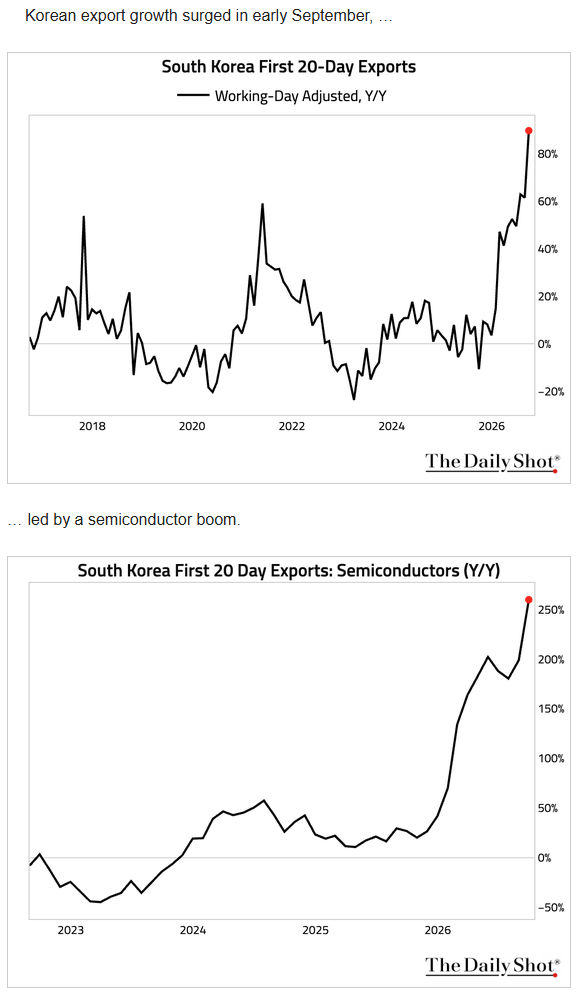
If you need an AI capex thermometer, look no further than South Korean exports which are increasing weekly…
Semis are about 2/3'rds of exports but growing very rapidly and should be 3/4 in short time.
The Daily Shot
OpenAI says that ROI isn’t the main concern which means pedal to the metal…
“So back to your question, absolutely, if we have to pace things, we will always make investment decisions based on a strong ROI. But from where I sit today, there is so much opportunity to drive growth, that I’m still highly focused on getting more compute to keep that flywheel going.” - OpenAI CFO Sarah Friar
Hyperscalers are spending $8 trillion over the next 5 years. And the big financials are ready to help…
“...with respect to AI financing, if everyone is right and the build-out of the compute capability in the next 5 years is going to take $8 trillion, there’s going to be a lot of financing to do that. Now I’m not sure it’s going to be a straight line. I’m not sure everybody is estimating at the end of the day, the right capital needs that they’ve got the right pricing models. But I do think there’s going to be a lot of demand, and there’s going to be a lot of needs.” - The Goldman Sachs Group CEO David Solomon
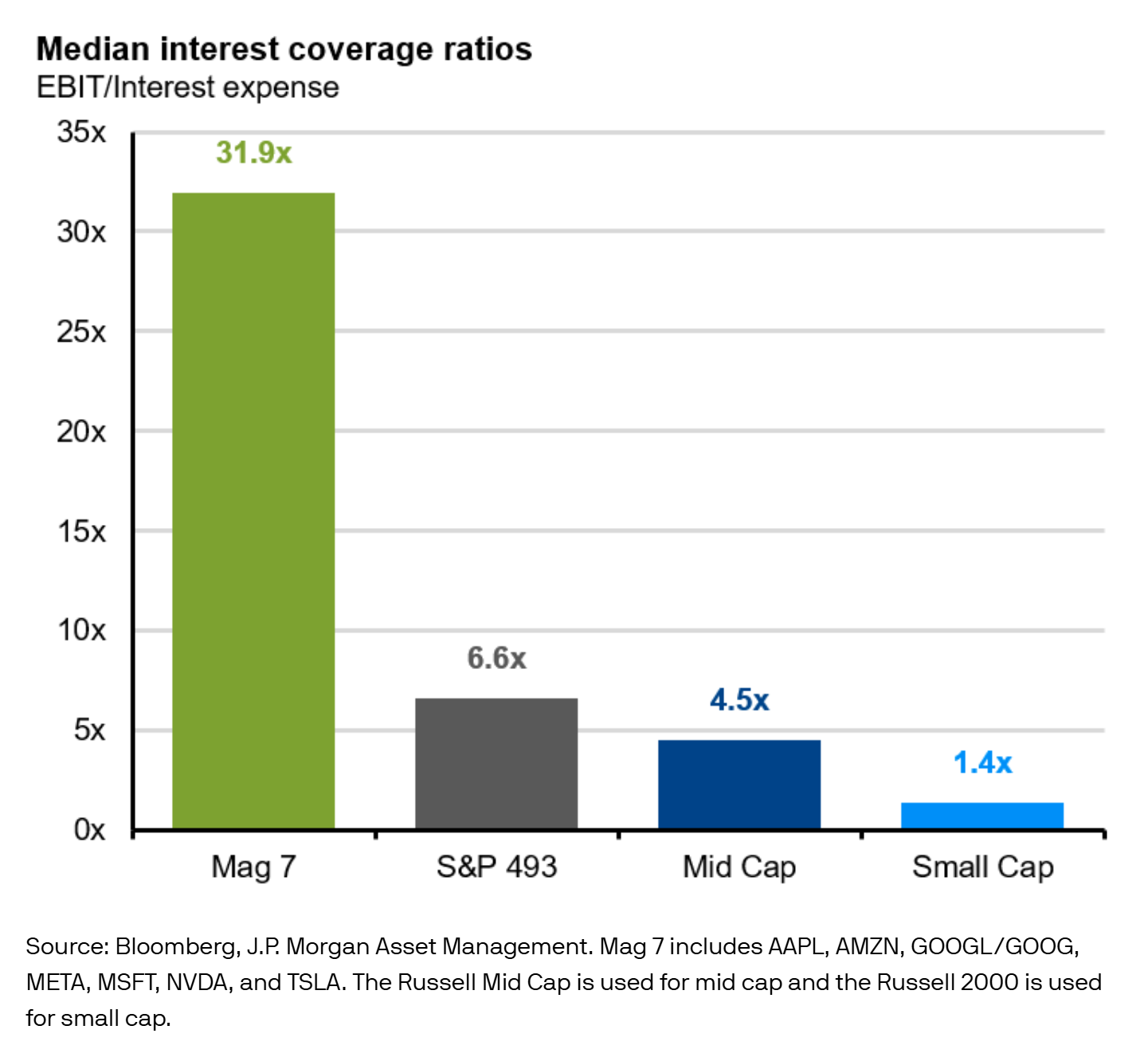
Many are concerned about the credit risks associated to AI capex. That looks misguided…
With the Federal Reserve unanimously raising the federal funds rate, corporate borrowing costs will likely move higher as well. The chart of the week examines which areas of the market are best positioned to absorb those higher financing costs. Looking at interest coverage ratios, a measure of a company's ability to meet interest payments from operating earnings, the Mag 7 stands out as particularly well positioned. Strong profitability and healthy balance sheets leave these companies with significant flexibility to increase borrowing and continue investing in growth, an increasingly valuable advantage as abundant cash flows become less of a tailwind. The picture is less favorable for the rest of the market. Compared to the Mag 7, many companies across the broader S&P 500, as well as mid- and small-cap stocks, have less capacity to absorb higher interest expenses, making them more vulnerable to a restrictive monetary environment.
Rumored AMD price hikes confirm AI shortages…
AMD REPORTEDLY PREPARES ~10% CHIP PRICE INCREASE AS TSMC COSTS RISE
AMD has notified partners of an expected roughly 10% price increase tied to higher TSM wafer costs, according to a report cited by Wccftech.
The increases are expected to affect AI accelerators, consumer GPUs and motherboard chipsets, with new pricing policies planned for Q4.
AMD relies heavily on TSMC for its advanced-node CPUs and GPUs, making wafer pricing a key input cost.
@wallstengine
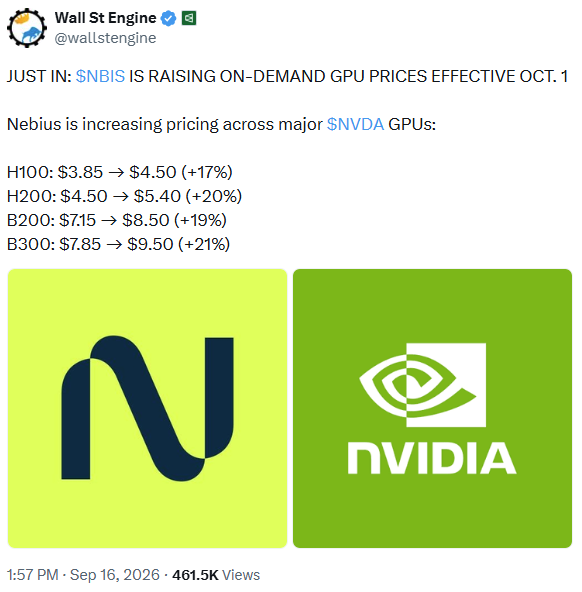
As does this European AI-neocloud raising prices 20% for its Nvidia hardware resources…
Not only does this describe the current hardware shortages, but it will also push customers to sign longer term contracts to secure compute capacity. Contracts can then be used to purchase capex and/or get financing.
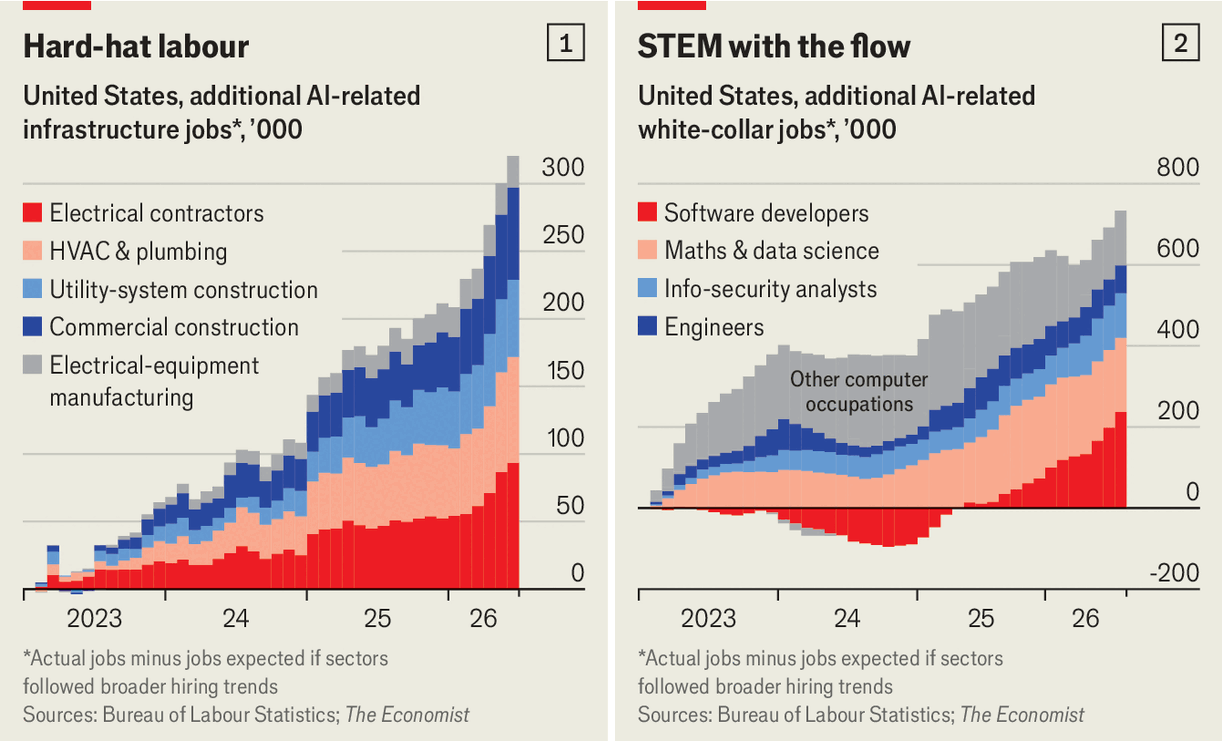
Remember when AI was going to eliminate all jobs? Welcome to the AI jobs boom…
PERHAPS machines will make many humans unemployable eventually—but there is no sign of it yet. On September 4th the Bureau of Labour Statistics reported that the American economy added 162,000 jobs in August, far above expectations. The unemployment rate is 4.1%, lower than in almost 90% of months over the past half-century. Young workers, often cast as the first victims of artificial intelligence, are doing just fine: the gap between unemployment among 20-24-year-olds and the overall rate is close to a multi-decade low…
AI-related layoffs get lost in a churning jobs market where employers shed roughly 1.7m workers in a typical month. And the evidence so far is that AI is already creating a lot of jobs to replace those it has destroyed. The vast sums pouring into data centres and power generation have set off a race for construction and infrastructure workers. AI startups are hiring like there is no tomorrow. Incumbents racing to keep up are creating new AI roles. And by making some workers more productive, AI may be increasing demand for their services.
Add it all up, and The Economist estimates that AI has so far created around 1m new jobs in America. That easily exceeds the roughly 200,000 lay-offs attributed to AI since mid-2023, and appears more than enough to offset weaker hiring in many back-office roles. America’s AI infrastructure splurge has created many of them.
The one industry most affected by job shrinkage is now seeing productivity explode higher…
"S&P 1500 Software revenue per employee has gone parabolic. If you are looking for evidence that AI is starting to impact the real economy, this is exhibit A."
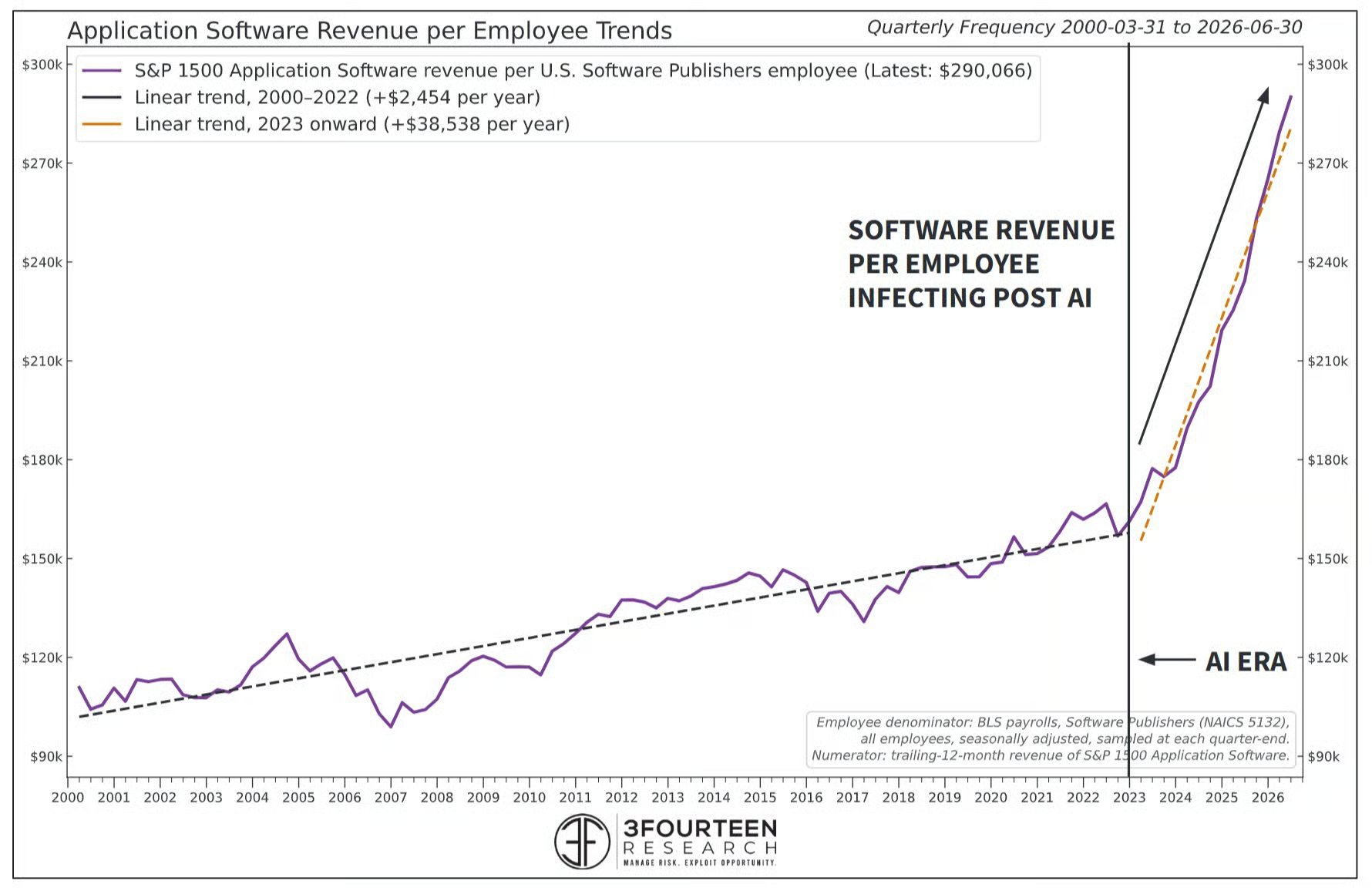
@3F_Research
Gonna need more power…
From Eaton speaking at a conference yesterday, just jaw dropping numbers:
“So, when we released our Q2 numbers the total announced projects for data centers was 307 gigawatts to be built, just think about that. And now today, we checked this week, it’s already 342 gigawatts. So, a month later, it’s already more. And then you contrast to what this industry has ever built. We have installed 50 gigawatts. So, today operating, there are 50 gigawatts. So, we are talking about between 6x and 7x what exists today is what’s going to be built in the next years. Most of this is not going to turn into ‘27 or ‘28 revenues. So, it’s going to be a longer cycle, that’s the way to think about it.”
@pboockvar
What is driving the AI demand? Companies are finding more ways to harness its abilities. Is yours?
Coca-Cola CEO: AI is materially reducing creative production costs and cycle time in consumer campaigns.
“We're doing the creativity work of the campaigns with a fraction of the cost and a fraction of the time.”
@TheTranscript_
Service companies with reduced value add and stale pricing are about to get hit by consumer's growing use of AI…
"While US telcos traded down on concerns on X chatter around Meta’s Muse and rival AI agent Instinct has focused on their new ability to make outbound calls to U.S. businesses, including negotiating phone and cable bills on behalf of users. This could become a risk for telcos because AI agents can wait on hold, escalate with support teams, switch users to cheaper plans, remove add-ons and claim credits at scale—potentially increasing pressure on ARPU, retention economics and customer-service costs. The same risk applies to European names as these AI assistant role out. But its NOT just telcos as other industries could also face pressure -industries most at risk are those with recurring bills, negotiable pricing, confusing add-ons, high churn incentives and customer-service friction—including cable/broadband, insurance, utilities, banks/credit cards, subscriptions, travel, healthcare billing, retail returns, auto leasing and gyms. If AI agents can persistently call, wait on hold, compare offers, cancel services, claim credits and renegotiate terms on behalf of customers, companies that rely on inertia or under-claimed discounts could face higher retention discounts, lower add-on revenue, more support volume and weaker pricing power."
Goldman Sachs
If you use the AI product, then you know why so much value has been created in so little time…
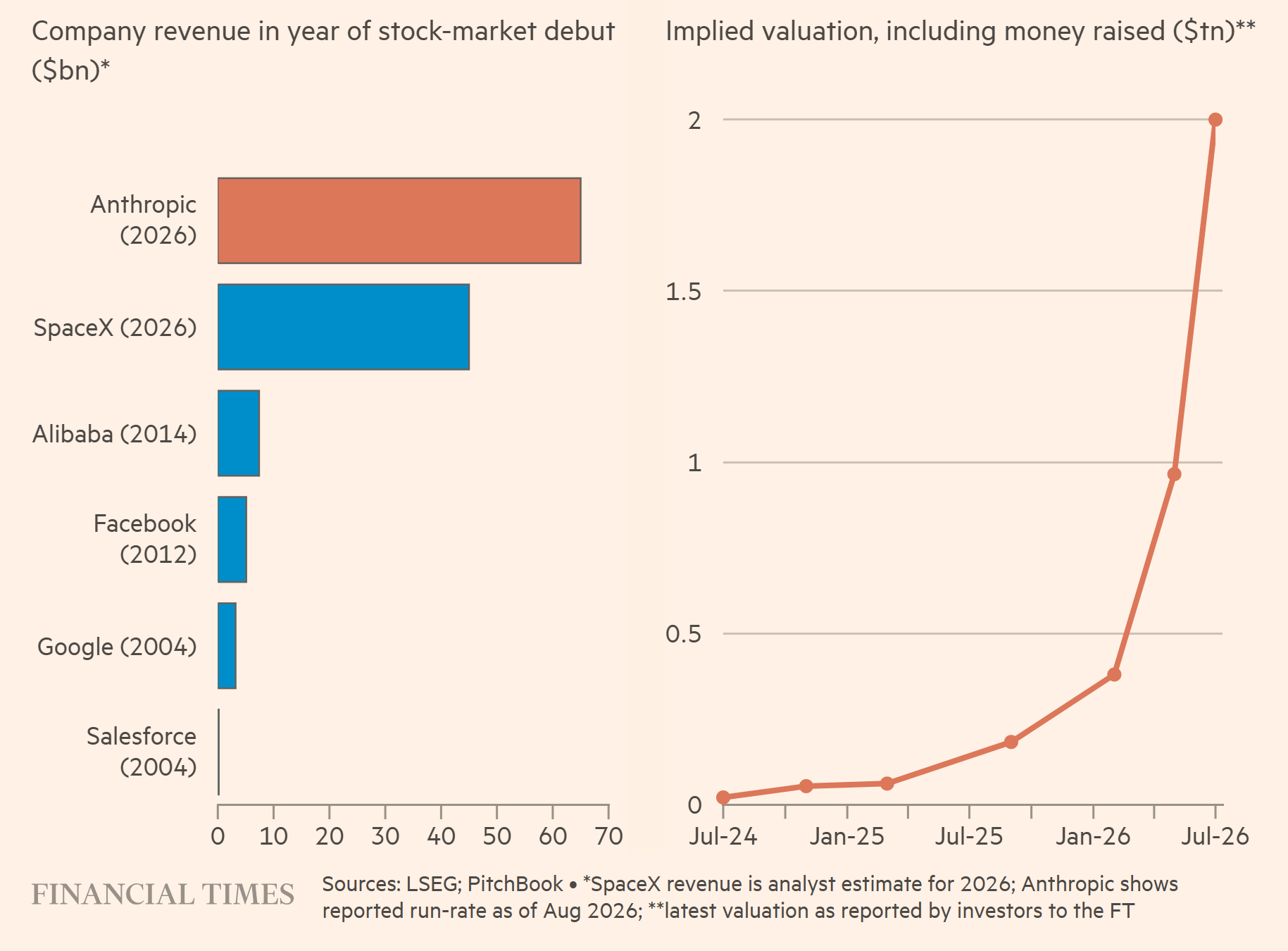
Expect the Anthropic IPO to be a lively Thanksgiving dinner conversation topic as the next 4 comma market cap goes public as the leaves fall over the next 8 weeks.
Founded in 2021, the creator of Claude hadn’t even produced a dollar in revenue until 2023. By August, it was making around $65bn on an annualised basis, although such unofficial numbers should be treated with kid gloves. This growth seems to have come as a surprise to Amodei too. Only 18 months ago, Anthropic expected its revenue in 2027 to be just $12bn.
Now, some investors predict a revenue run-rate of $320bn by the end of next year. They are not impartial, of course. But if they are right, then $2tn would represent a valuation of just seven times its 2028 sales. That’s a little less than Microsoft, according to LSEG. SpaceX, meanwhile, trades at 16 times that year’s revenue. Take that as the benchmark — they are both companies with wild aspirations and charismatic leaders — and Anthropic could in future be worth $5tn.
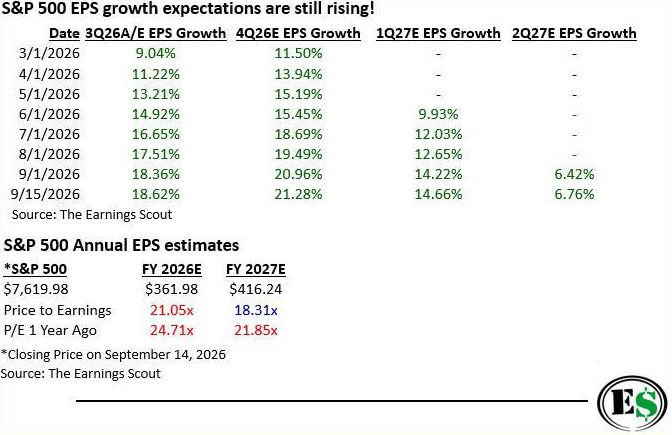
I was surprised to see current earnings estimates continue to march higher. One direction… UP!
@EarningsScout
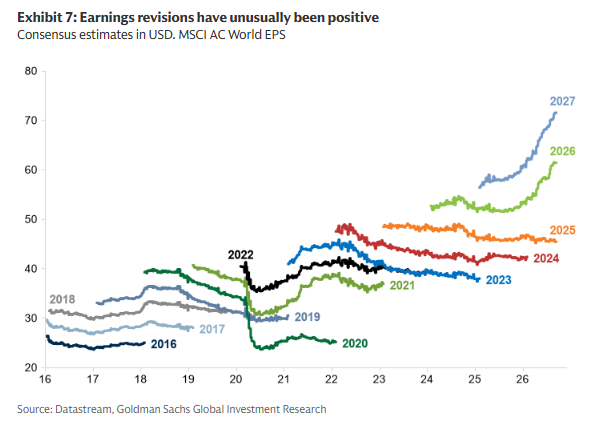
Looking beyond the S&P 500, shows earnings revisions growing around the world…
Supportive profit growth has been accompanied by positive earnings revisions, with 2026 and 2027 estimates moving higher across major regions. There are four broad areas which have been driving much of this profit growth. First, technology earnings continue to be very robust. Second, rising energy prices have pushed up profits in the commodity sector. Third, banks have generally enjoyed strong earnings backed by positive nominal GDP growth, steep yield curves and strong private sector balance sheets. Finally, sectors such as Industrials have benefited from the surge in AI capex spending which has spilled over into improved revenues for the ‘pick and shovels’ of AI infrastructure. The breadth of the earnings' growth has also increased the opportunity for investors to diversify across sectors as well as countries.
Goldman Sachs
And if you are afraid of the US valuation multiple, go hunt in another country…
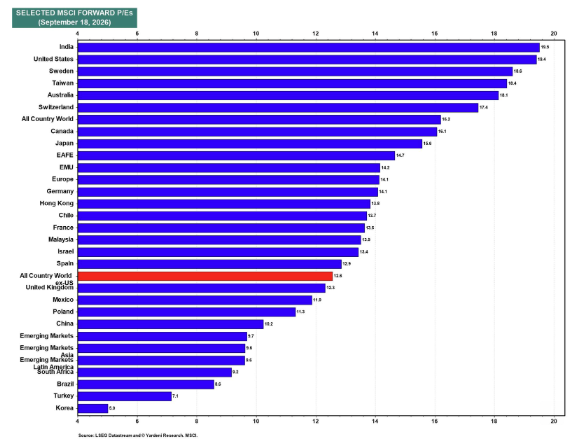
Make a special note of the Korean forward P/E multiple below and then go back and look at that South Korean export chart.
The US MSCI trades at a 19.4 forward P/E versus 12.6 for the ACW ex-US, 15.6 for Japan, 14.2 for the European Monetary Union (EMU), 9.7 for Emerging Markets, and 5.0 for South Korea. Korea is at a 14.4-point discount to the US.
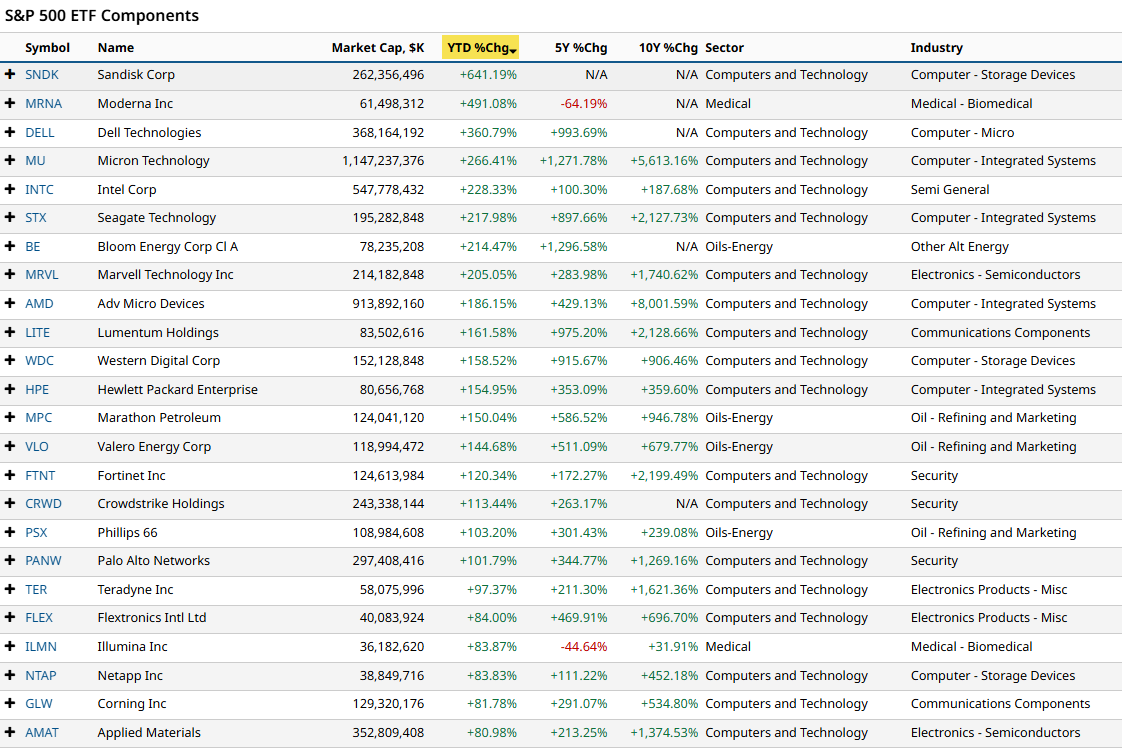
Also interesting is this listing of the S&P 500 stocks ranked by YTD change thru Monday…
Tech, tech, tech and Oil refiners. The stocks on this list are not telling us that the AI capex trade is ending tomorrow.
barchart
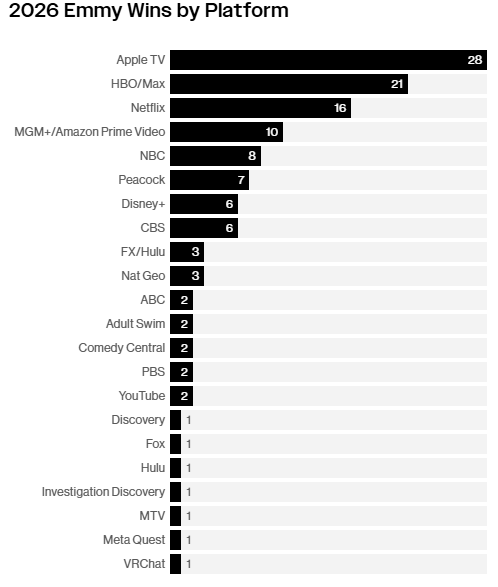
Lastly, a tip of the hat to Apple TV and all the awards across their smaller platform…
It made us even turn on Widow's Bay which will give you something different to think about then the financial markets!
Learn more about the Hamilton Lane Strategies
DISCLOSURES
The author has current equity ownership in: Eaton Corp PLC, Apple Inc., and Nvidia Corp
The information presented here is for informational purposes only, and this document is not to be construed as an offer to sell, or the solicitation of an offer to buy, securities. Some investments are not suitable for all investors, and there can be no assurance that any investment strategy will be successful. The hyperlinks included in this message provide direct access to other Internet resources, including Web sites. While we believe this information to be from reliable sources, Hamilton Lane is not responsible for the accuracy or content of information contained in these sites. Although we make every effort to ensure these links are accurate, up to date and relevant, we cannot take responsibility for pages maintained by external providers. The views expressed by these external providers on their own Web pages or on external sites they link to are not necessarily those of Hamilton Lane.