
Weekly Research Briefing: Testing Leverage Points

While the US and Iran continue to fight over the control of the Strait of Hormuz, several new financial tussles hit the markets last week. Most important was the newly expanded trade war between the US and its second largest trading partner, Canada. We will now see which country has greater leverage in the negotiations. 50% tariffs on all Canadian imports would surely damage most manufacturers north of the border. However, limiting the flow of crude oil, natural gas, electricity, aluminum or fertilizers would clearly impact American consumers and manufacturers. The puck has dropped, with bone crunching hits expected for both sides as this disturbing game plays on.
The US Treasury also decided to pick a fight with the bond market as 5% interest rates have gone too far for the Oval Office. But is issuing short term paper to buy long term bonds the answer? It won't be if inflation moves higher, causing interest rates and future debt servicing costs to rise. US bond investors would prefer the government to tackle the root cause of the federal deficit instead of rearranging the deck chairs.
American ranchers are also going to use their leverage to take up a battle with a yet to be named mystery meat. We don't know the meat's origin or cut, but we have been told that it will be heavily discounted. This should do little to incentivize US ranchers to increase their herd sizes this fall or to vote in the November mid-term elections. Also on the ballots in November will be political support for data center buildouts. Barely an issue a year ago, the tussles over building data centers today have reached a feverish pitch. It will be interesting to see how many politicians win or lose their local elections as this issue moves to the top of many interest lists.
The equity markets continue to click along near all-time highs. While technology stocks and AI themes are taking a mid-August vacation, other sectors and stocks are moving to new all-time highs. Leading energy stocks has been Valero, the refinery company, which has benefitted from the wide cracking spreads. Freeport-McMoRan is leading the materials sector to highs as copper prices and demand rise. Visa and Mastercard are leading the financial sector higher. And Labcorp and Quest Diagnostics are leading the healthcare group to new heights. No wonder dividend equity portfolios are doing so well right now.
A quiet week is expected, apart from two main events. The first is Nvidia's earnings release on Wednesday afternoon. Then on Friday, Fed Chairman Kevin Warsh will take the podium in Jackson Hole. It will be interesting to hear his comments about the White House's plan to stop long term interest rates from rising higher. Enjoy your week.
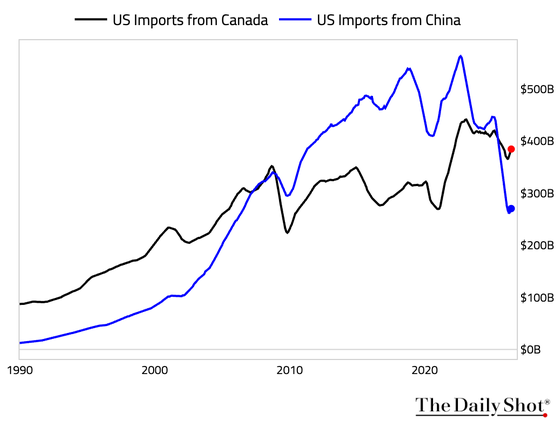
The US and Canada square off for a trade war…
Canada is now our 2nd largest trading partner after Mexico. But our new trade war tactics now rival our battle with China.
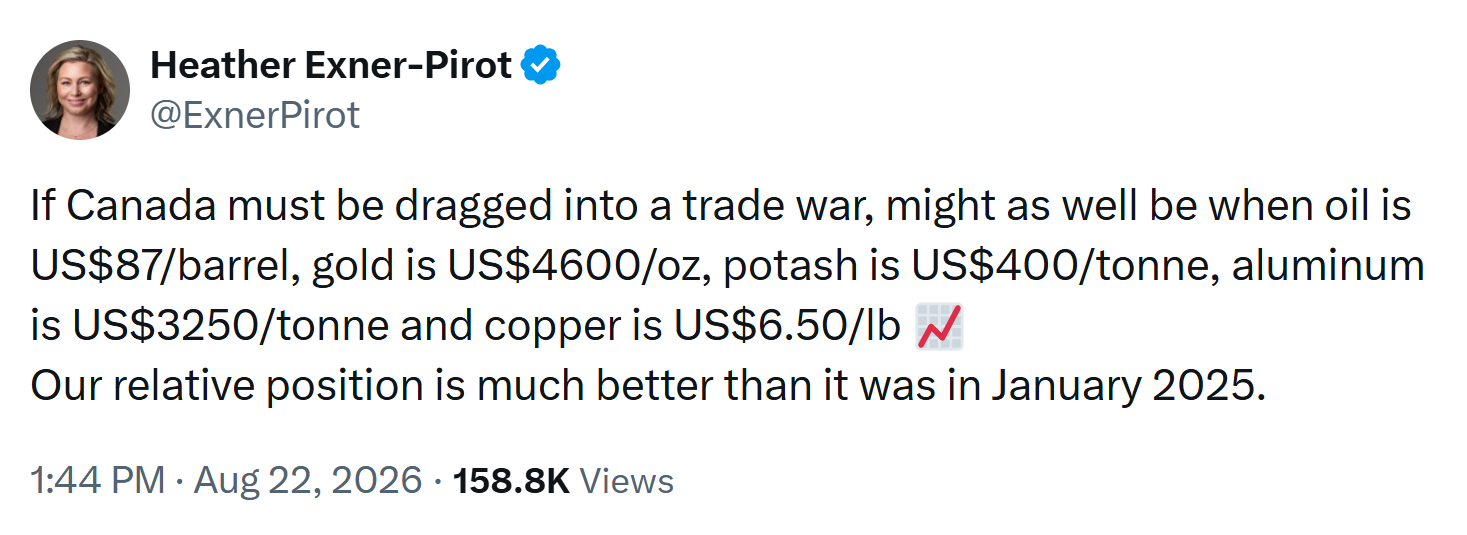
The Canadian PM reminded the US of his top playing cards…
"Canada fuels American growth, supplying 99% of their natural gas imports, 85% of their electricity imports, 60% of their crude oil imports. I don’t think they want us to stop sending any of that energy."
Canadian Prime Minister Mark Carney
And given the abundance of raw commodities that Canada holds, they are in a good position to find other global customers…
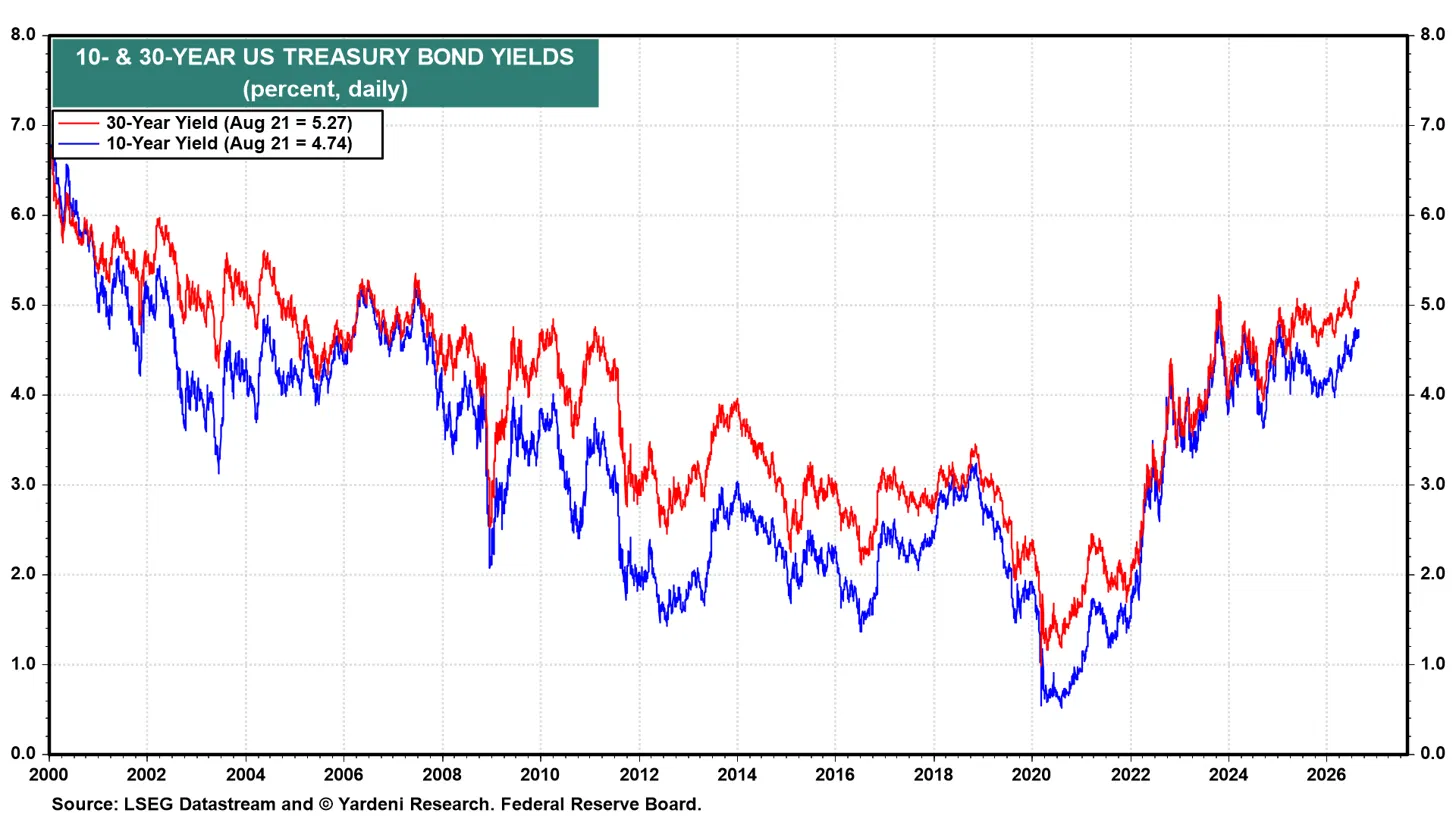
Then the US Government decided that 5% was their line in the sand for longer term debt yields…
Even though Treasury Secretary Bessent is not a fan of market intervention and yield curve control, the White House still sent him to do their bidding. (Don't forget that Bessent came from the 'House of Soros' which broke the Bank of England.)
It is no surprise that the bond and banking market became immediately skeptical…
“It’s a little bit like paying your mortgage with your credit card,” James Sullivan, the co-head of global fundamental research at JPMorgan Chase, told CNBC. “It can work for a while, but eventually the mismatch starts to become more obvious.”
The easiest way to keep long term interest rates low…
Trying to control the yield curve is expensive and ultimately futile. The popular saying is that you can’t fight the Fed, but it should also be that you can’t fight the long end of the curve. Monetary policy can set short-term rates, but it doesn’t control long-term rates. Monetary policy has some influence — some of the current spike could be because the new Fed chairman is less transparent, or the Fed may be giving up on its inflation target. But no matter what the Fed does or says, long-term yields are set mostly by markets.
A government or central bank can try to keep rates low by buying bonds itself or requiring banks and pensions to buy them. But eventually market conditions will prevail. Financial repression also comes at a steep cost; Japan is a cautionary tale. Its government tried for decades to cap long-term rates, and the result was low growth and distortions in financial markets. Now that inflation has returned to Japan, its central bank must choose between higher rates or inflation, and it is struggling to defend the yen.
The lesson is that if a government wants to keep long-term interest rates low, there is really only one way: debt reduction. This truth was forgotten, and sometimes denied, for the last 20 years.
Concerned US citizen and market expert, John Arnold, has some thoughts…
Market doesn't give notice before it revolts against the debt. But so far this month, as debt crossed $40 trillion, the 30-year bond yield hit a 19-year high, gold rose 13%, silver +18%, GSCI commodity index +5%, BTC +19% and the dollar weakened. Markets are saying something.
The administration’s only response thus far has been to issue short-term debt to buy back long-term debt and talk about cracking down on waste and fraud. The reality is that neither party is close to having the political will to address the fundamental drivers of the debt.
Markets may settle down. This may just be a blip. Or it could mark the return of the bond vigilantes. No one knows. But it’s alarming how unserious both policymakers & public remain about supporting the difficult measures needed to address the fiscal problem spooking markets.
@johnarnold
Home Depot doesn't see interest rates helping the housing market right now…
“With respect to rates, I think we -- as we’ve said over the past few years, housing turnover, just as one -- kind of one point in the economy that we watch has been at historical lows. It has never been lower as a percentage of the housing stock and every time we’ve seen it hit the sort of 3% of the housing stock changing hands over history, it’s always bounced up relatively quickly. We’ve seen housing turnover at these low levels for 4 years now. So I don’t think that we’ve seen much volatility from the recent increase in rates. We do know that when we see step downs, we begin to see a little bit of life come into housing, but there’s just no sign of an inflection point at this moment.” - The Home Depot CFO Richard McPhail
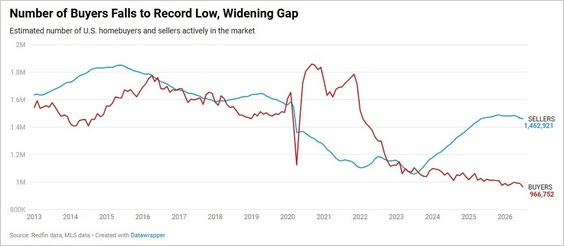
No wonder the mismatch between the number of home sellers and home buyers has completely flipped since the 2021–2022 period…
@JeffWeniger
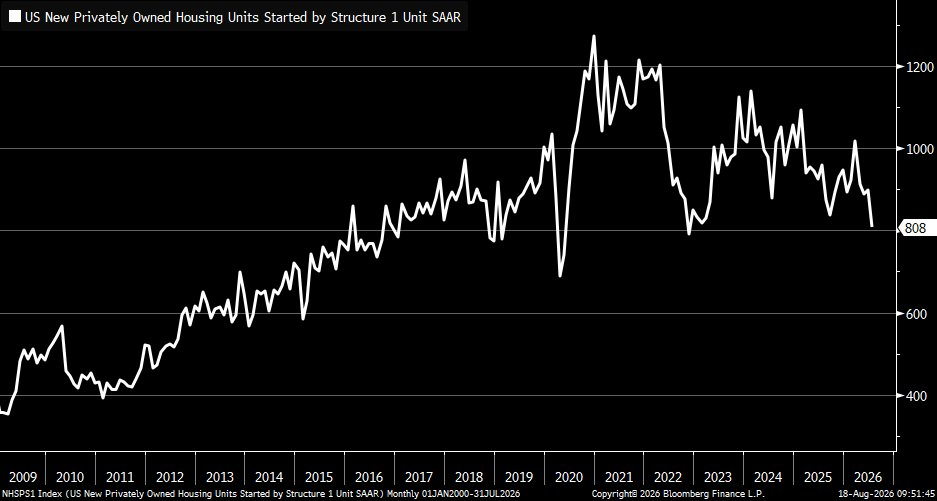
Just little reason for a homebuilder to get a housing start permit right now…
@KevRGordon: Single-family housing starts fell by 9.9% in July and are close to breaking thru their November 2022 low.
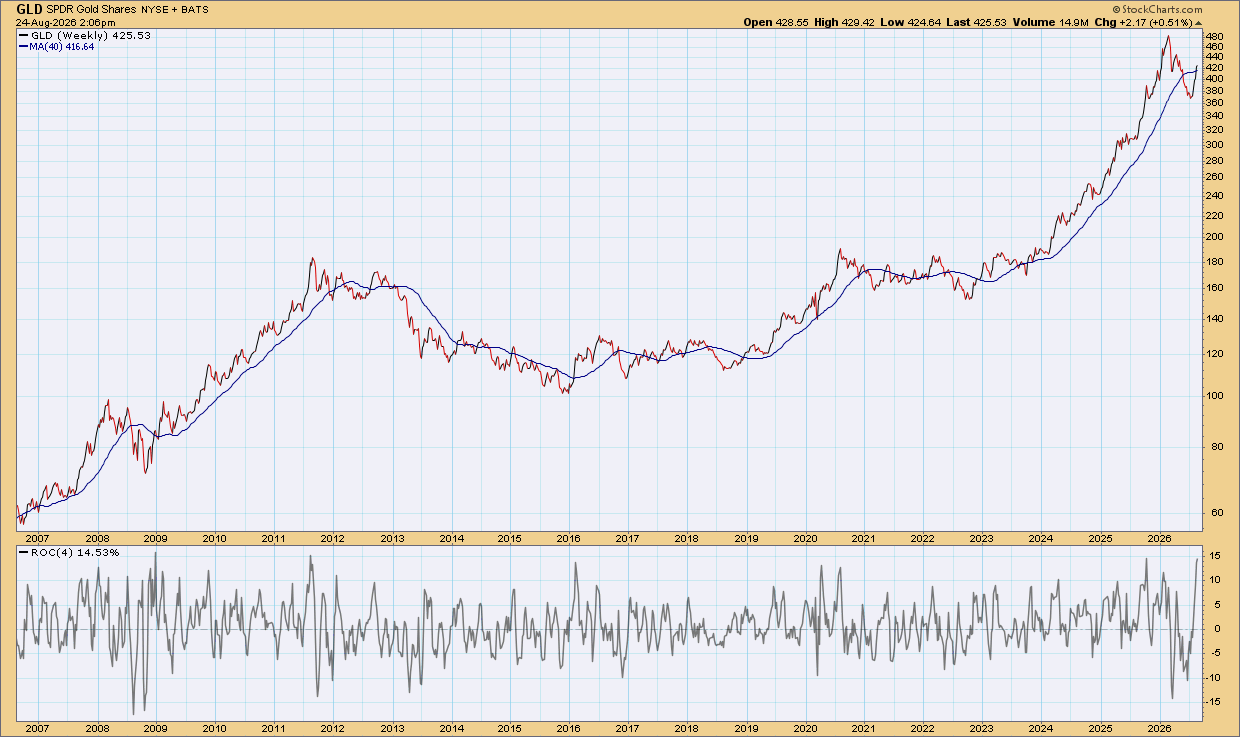
But Gold is working on one of its best 4-week moves in the last twenty years as it loves the US Treasury bond intervention plan…
Inflation worries rising will push precious metals higher and sink the US dollar. Even Bitcoin finding some new interest.
StockCharts
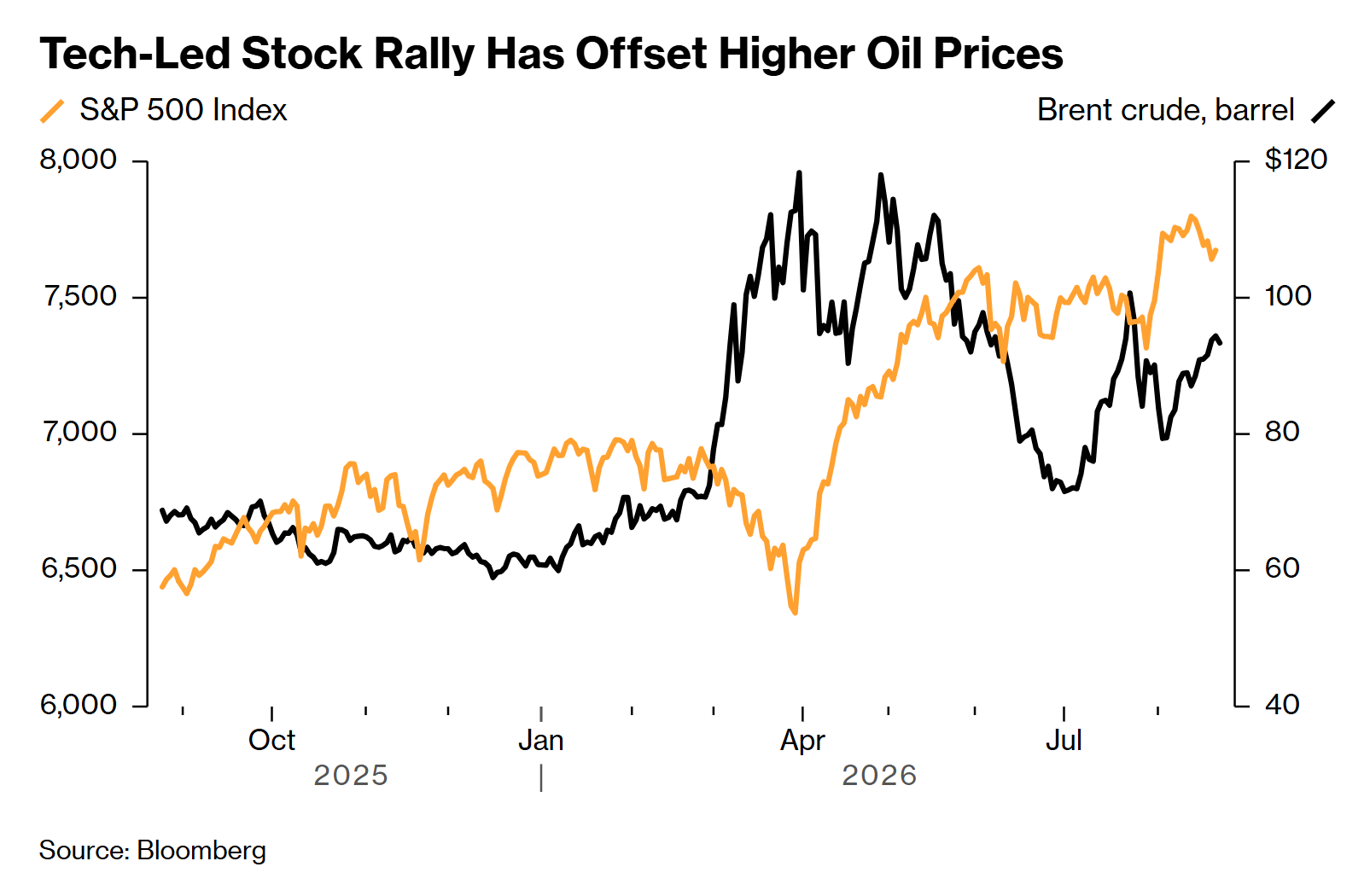
Tech stocks taking a rest as oil prices move back toward the triple digits…
Brent crude prices climbed about 30% since early July to trade around $93 per barrel amid renewed fighting in the Middle East and delays in reaching a permanent US-Iran peace agreement… Stocks have suffered more when oil rises than they have benefited when it falls, Morgan Stanley’s Michael Wilson said, making stable crude prices increasingly important for the market.
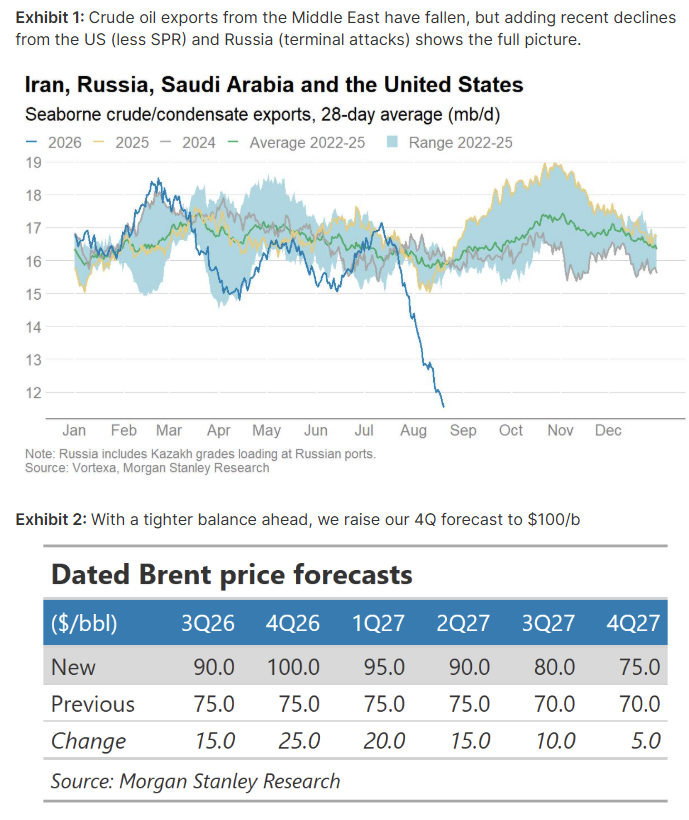
And as global excess supplies run dry, Morgan Stanley is raising their oil price forecasts…
Supply is tightening, inventories are drawing and the SPR buffer is diminishing. We now forecast a more drawn-out Middle East supply recovery, which leaves the market in deficit throughout 4Q and 1Q. With that, we revise our Brent forecasts higher, peaking at $100/b in 4Q.
Morgan Stanley
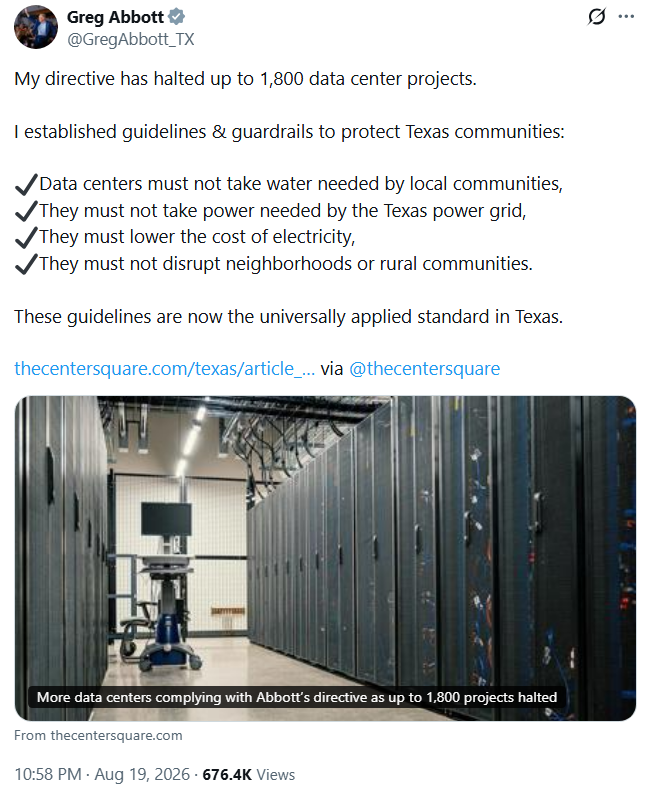
Blocking data center development has now become a bipartisan effort as Republicans slide in the polls…
In November, Texas Gov. Greg Abbott declared his state the “epicenter of AI development” while announcing a $40 billion investment by Google.
Less than a year later, the Republican said he halted approvals of some 1,800 new data centers worth billions of dollars on concerns that they use too much power and water. The move earlier this month drew the ire of President Trump, who this week staunchly defended the centers as an economic engine.
A growing voter outcry over data centers that strain resources and fuel a technology capable of putting Americans out of work is becoming a mounting liability for Republicans and some Democrats in this fall’s elections. Abbott’s opponent in his bid for a fourth term, Democrat Gina Hinojosa, has hammered him on the issue while climbing within a few percentage points in recent polls.
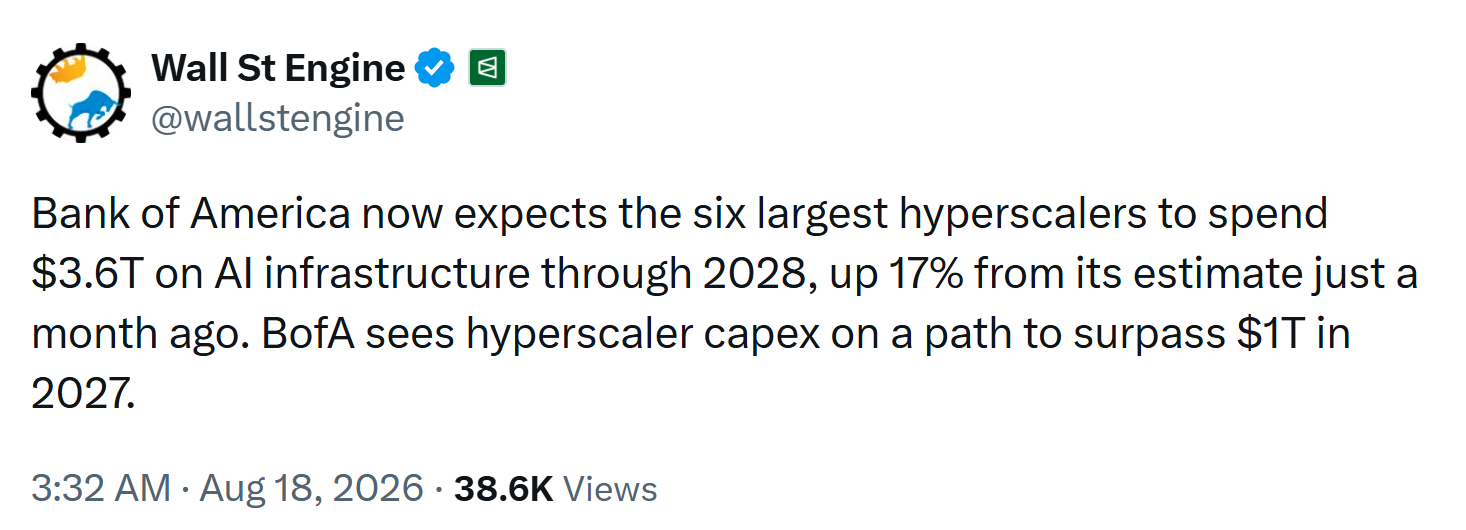
But the markets will need to keep an eye on just how far the blocking of development goes…
AI hyperscaler buildouts are still the main engine of growth for the US economy. It is just that few homeowners want a mega-data center in their backyard.
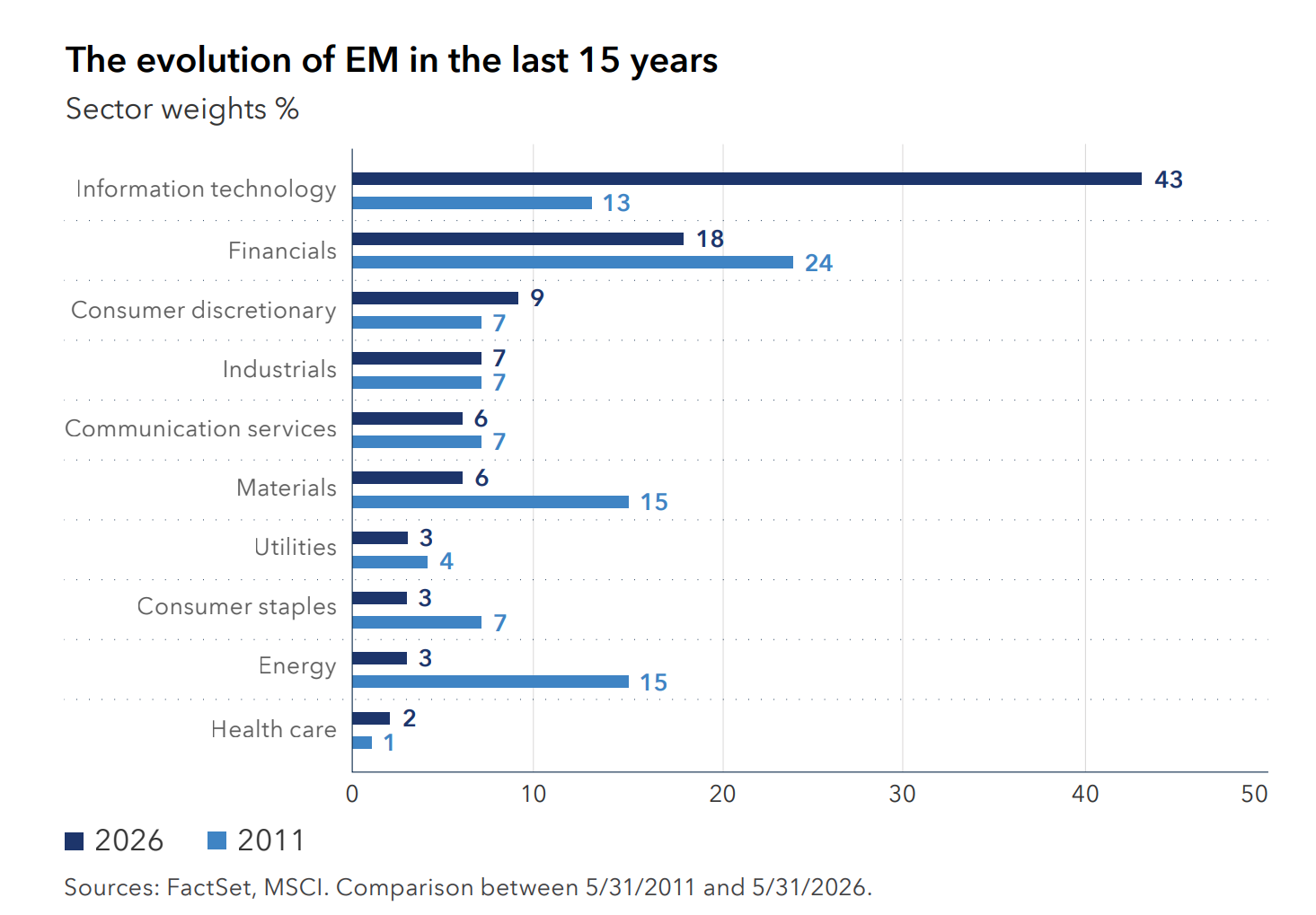
Speaking of tech, keep in mind that the composition of the EM equity indexes has changed meaningfully over the years…
EM economies have evolved significantly over the last 15 years. With the exit of Russia from the investable group, EM is now much less dependent on energy, commodities and banking. At the same time, the demand for semiconductors, memory chips and other hardware — the physical components of the AI revolution — has caused a technology boom.
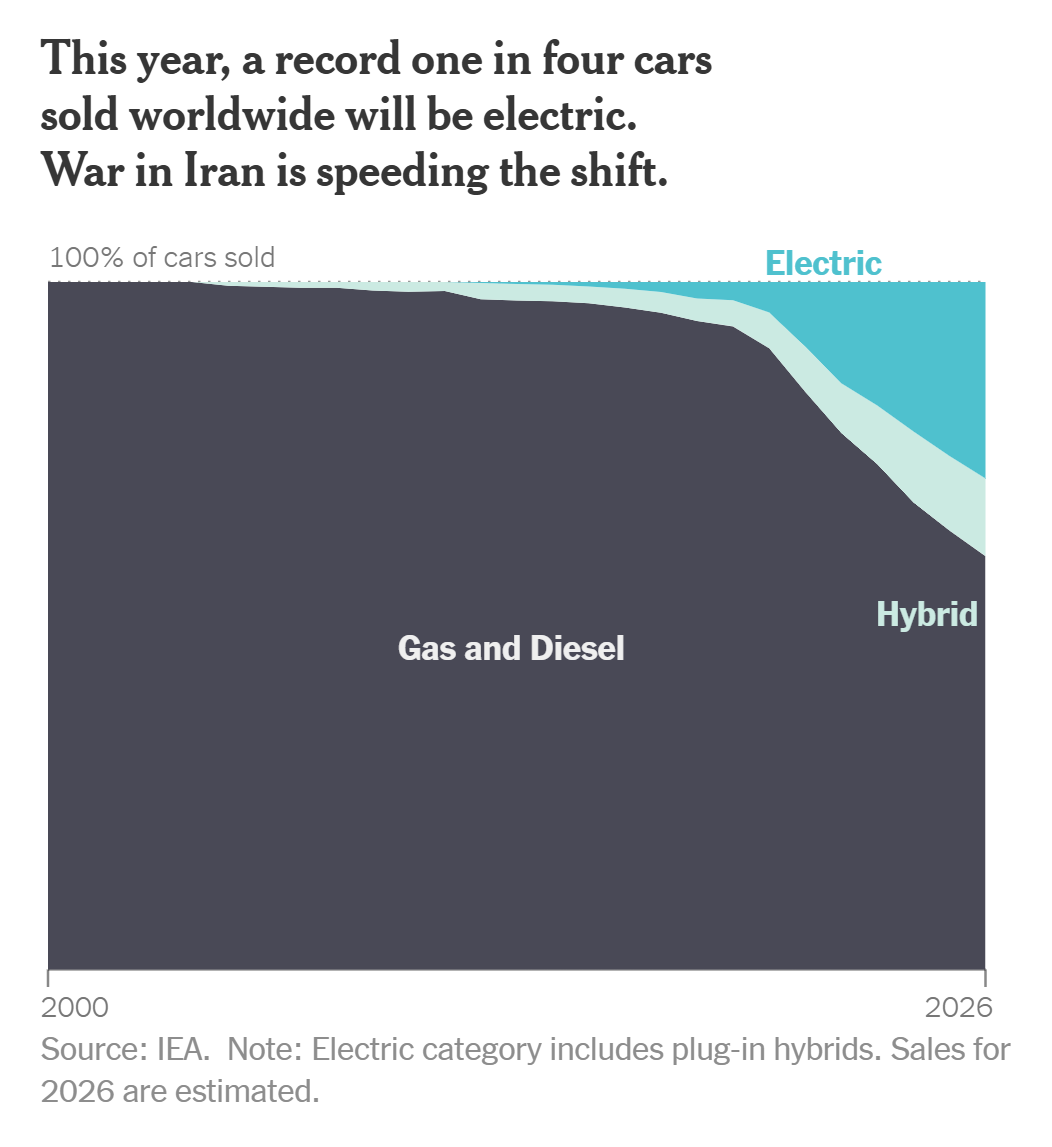
One silver lining to the soaring prices of gasoline & diesel fuel…
Electric car sales are on track to hit record highs this year, with 29 percent of all new cars purchased around the world expected to be either purely battery-powered models or plug-in hybrids, according to a recent report from the International Energy Agency. That’s a sharp increase from just 4 percent in 2020.
The boom in sales was somewhat unexpected. Some analysts had predicted a slower market for electric vehicles this year — until the U.S. war with Iran and the closure of the Strait of Hormuz caused oil and gasoline prices to spike. That has led to a frenzy of electric car sales in many unexpected corners of the globe.
In South Africa, sales of electric cars more than quintupled in the first half of this year compared to the same period last year. In Laos, imports of battery-powered vehicles from China are soaring. And in countries as different as Australia, Colombia and South Korea, the E.V. share of total new car sales has nearly doubled since fighting in the Middle East began.
The rise of electric vehicles is upending international car markets. Total sales of traditional cars with internal combustion engines have been in a steady decline, and this year, they’re expected to reach their lowest level since the early 2000s.
Learn more about the Hamilton Lane Strategies
DISCLOSURES
The author has current equity ownership in: Nvidia Corp.
The information presented here is for informational purposes only, and this document is not to be construed as an offer to sell, or the solicitation of an offer to buy, securities. Some investments are not suitable for all investors, and there can be no assurance that any investment strategy will be successful. The hyperlinks included in this message provide direct access to other Internet resources, including Web sites. While we believe this information to be from reliable sources, Hamilton Lane is not responsible for the accuracy or content of information contained in these sites. Although we make every effort to ensure these links are accurate, up to date and relevant, we cannot take responsibility for pages maintained by external providers. The views expressed by these external providers on their own Web pages or on external sites they link to are not necessarily those of Hamilton Lane.