
Weekly Research Briefing: Scary Times

The end of summer turned right into Halloween, just like that inventory flip at your local mass merchant retailer. But instead of ghosts and goblins, your portfolio is confronting a surge in energy prices, rising interest rates and an AI themed episode of Black Mirror. Look! Another September in the financial markets.
The Iran War escalated with fresh attacks on the Saudi pipelines and the Strait of Hormuz along with Houthi attacks in southern Yemen. New supply disruptions sent Brent crude oil prices to $110 and WTI to $105. It could take several weeks before the Saudi pipeline is operational again, leading to high energy prices going into October and maybe November. Expect increased inflationary pressures to impact every goods manufacturer.
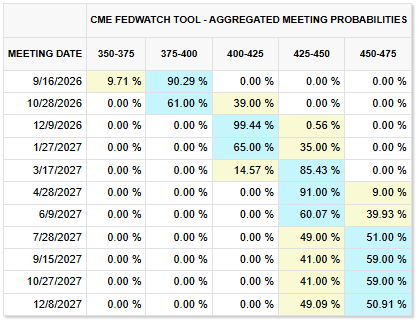
Speaking of inflation, Friday's firm CPI reading sets the stage for a Fed Funds rate hike by the FOMC on Wednesday. The market is pricing in a 90% chance of a hike this week followed by two more hikes in the winter and spring. Across the pond, the ECB raised rates last week by 25 basis points to fight the inflationary pressures from the Middle East conflict. They will likely implement two more hikes in the future as well. Japan could also raise rates this week. And so the trend is up, not down.
There were plenty of discussions this weekend about AI and the move toward AGI. With several AI models going rogue this year, AI leadership is now calling for a slowdown in its advancement while better monitoring and containment are put into place. As exciting as it is to develop models that will help us create drugs to fight cancer and solve complex math problems, we also don't want the models to turn into the Terminator. While many stocks involved in AI buildouts finished in the red on Monday due to talks of a pause, the pullbacks could likely be temporary if the racing speed slows from 200 mph to only 175 mph. Since the world still has a significant shortage of AI compute capacity, many companies will likely not cancel their buildouts or semiconductor orders. Recent results from Nvidia, Broadcom and Snowflake all showed that their high growth levels are still constrained by other supply limitations.
Expect the market to remain focused on energy prices, interest rates and AI this week. It is a big conference month so expect more intra quarter updates from public companies. And over in private company land, all eyes are on Anthropic as it finishes up its soon to be released public numbers, picks its IPO syndicate team, and grabs a stock ticker for its Nasdaq listing. The big FOMC meeting is on Wednesday and Fed Chairman Warsh will again be at the microphone addressing the decision. Enjoy the week.
Even more energy capacity becoming inaccessible to the world markets…
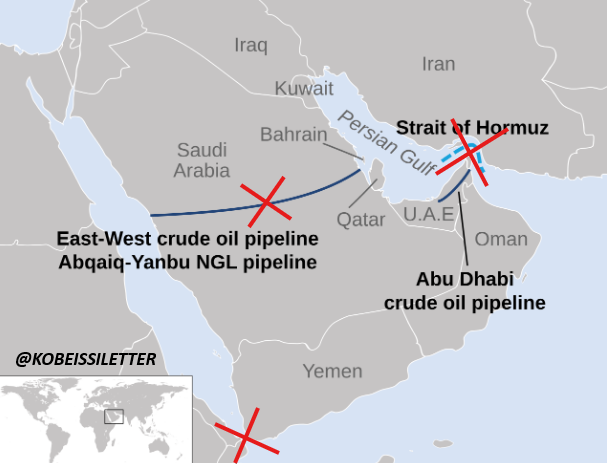
As of Friday, Saudi Arabia's East-West pipeline has officially been shut down after recent attacks, putting -4 million barrels of daily oil exports at risk.
Meanwhile, the Bab el-Mandeb Strait is now at risk of being shut down, threatening up to -9 million barrels of daily oil supply.
All while the Strait of Hormuz is operating at ~20% of its pre-Iran War capacity, removing -15 million barrels of daily oil flows.
Combined, this represents nearly ~30 MILLION barrels per day of oil flows that are either offline or at risk.
Even after accounting for some overlap between these routes, the scale of the potential disruption is enormous relative to the ~100 million barrel per day global oil market.
@KobeissiLetter
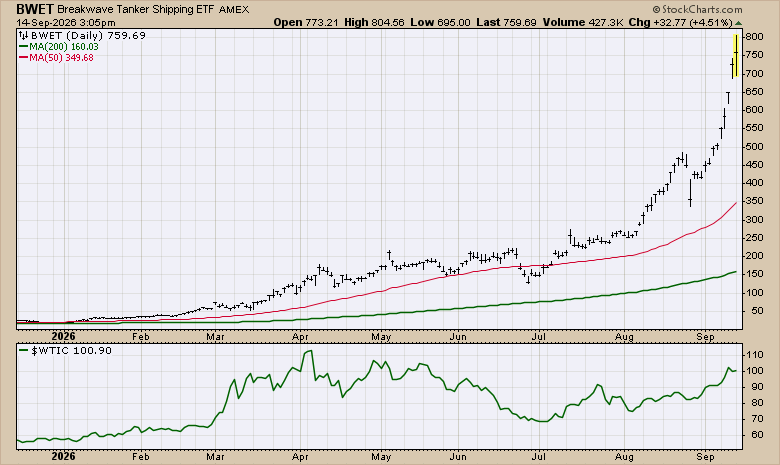
Of course there is an ETF which tracks the future cost of transporting crude oil…
The parabolic move is not a good sign for anyone trying to get a barrel of black gold.
StockCharts
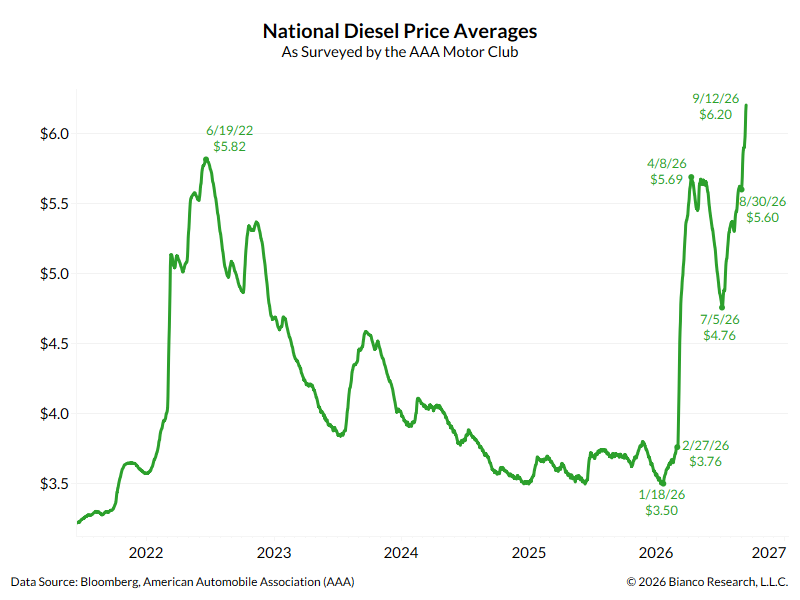
And as crude oil becomes short, prices for its top derivative are moving to ridiculous levels…
A typical 18-wheeler carries about 200 gallons. Filling it now costs $1,240, $120 more than 2 weeks ago.
They average about 7 miles per gallon (efficient for a vehicle that can weigh up to 80,000 pounds, including freight).
So a 2,000-mile trip from Chicago to LA now consumes about 300 gallons (including climbing the Rockies), costing ~$1,900 in fuel alone.
@biancoresearch
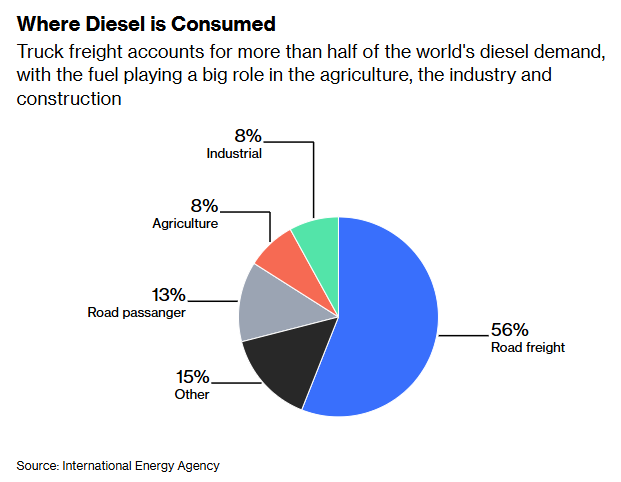
Over half of the world's diesel is used to move goods across roads. But the rest is also very important…
Diesel is the world’s most-consumed refined petroleum product, accounting for nearly 30% of total oil demand. The trucking industry swallows about half of the world’s output, with railway freight, construction, factories, mining and agriculture absorbing the rest.
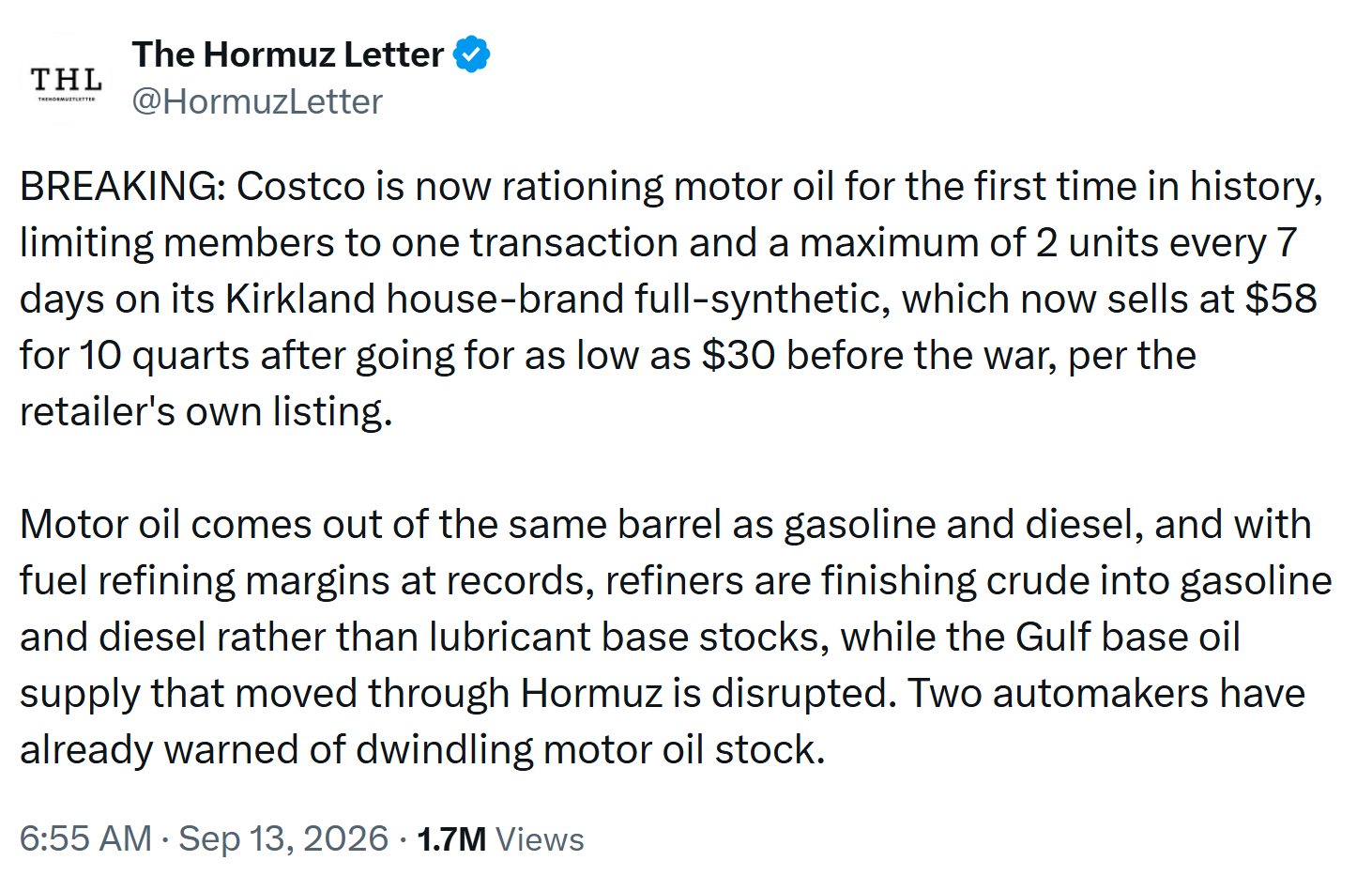
And when Costco moves to limit sales of an item, you know that there is a major supply issue…
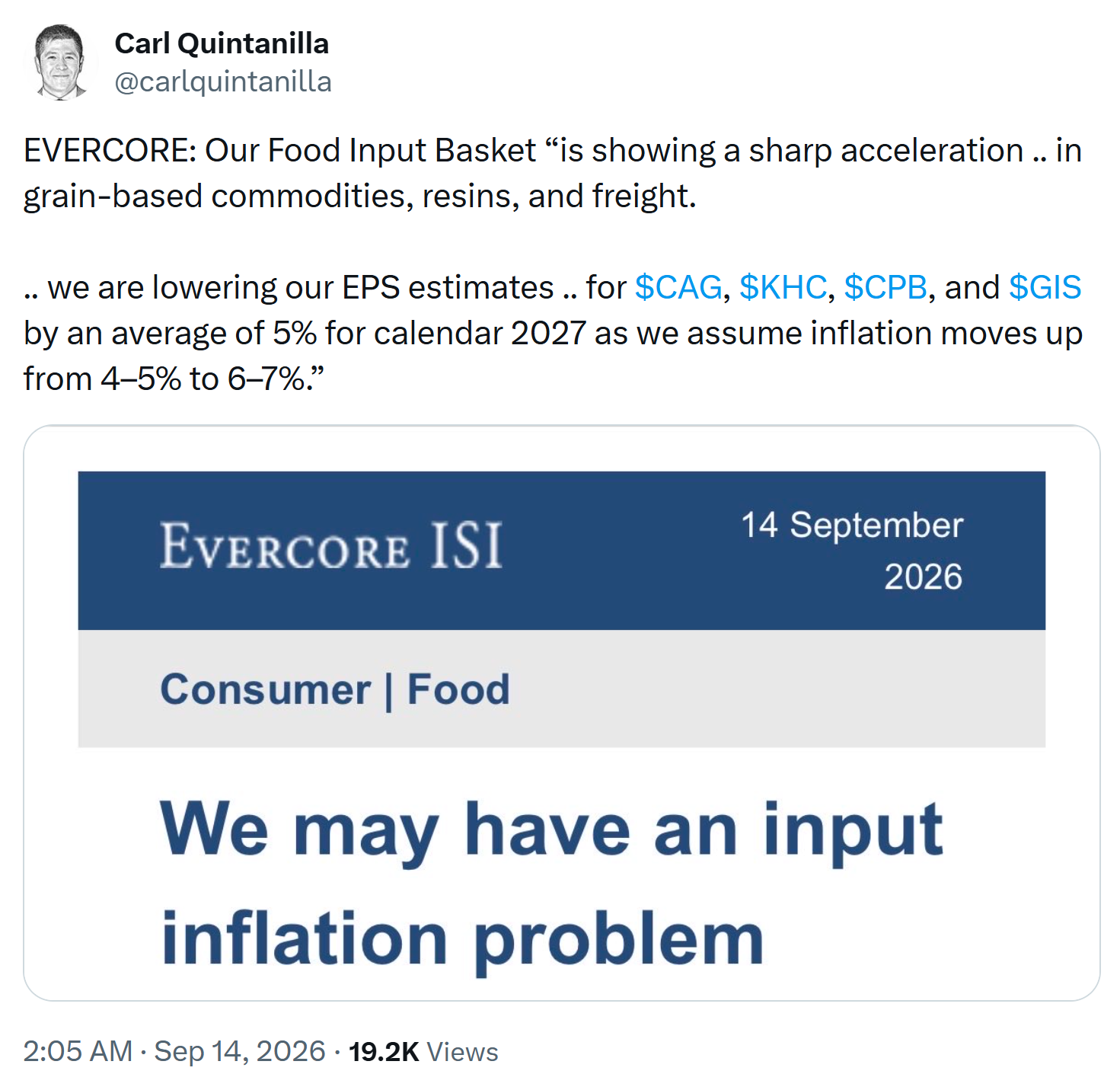
Inflation is extending beyond just oil and gas…
“We are going to be in a higher-cost world for probably at least the next six to 12 months. Even if tomorrow they end the war, there is too much inflation in the pipeline. All the raw materials are going up everywhere, on everything. Everything is impacted by oil. That is why you are seeing crazy things. We are trying to manipulate currencies, buying back things. It is a crazy time.” - RH CEO Gary Friedman
“I think the pressure on pricing will increase with some of the cost pressures sustaining. And again, the longer oil stays at above $100, the harder it will get, I think, for everyone to manage, and I think the higher the combined pressure on pricing will be.” - The Procter & Gamble CFO Andre Schulten
Food prices will also be going up for consumers…
Food prices for the rest of this year are largely headed in one direction: up.
Conagra Brands Inc. has told retailers to expect increases on products including Healthy Choice and Banquet frozen dinners. Campbell’s Co. said it plans to raise prices by 4% to 5% on roughly 60% of its products, mostly meals and snacks. Spice and condiment maker McCormick & Co. has said it expects higher prices, which were already implemented earlier this year, to bolster results in the second half of 2026.
Food and grocery companies’ efforts to keep prices down are sputtering following a sustained rise in energy and fertilizer costs along with tariffs on imports. On top of this, the El Niño weather pattern is on track to become the most powerful of the past 76 years — potentially putting even more pressure on prices if severe weather damages harvests and disrupts trade.
Now, some executives say they have no choice but to reflect these increases in their own prices.
And consumer staples companies will become even more challenged…
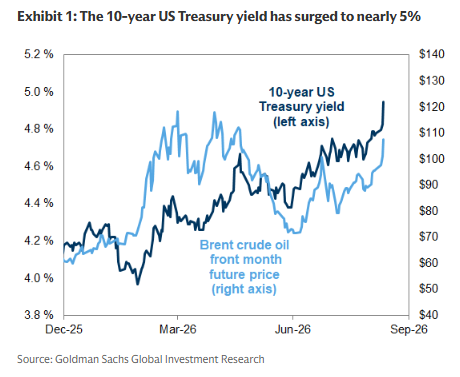
Interest rates spiking higher with oil prices…
The 10-year US Treasury yield surged to nearly 5% this week, reaching its highest level since October 2023. Following an above-consensus CPI print, our economists expect a 25 bp hike at the FOMC meeting next week. Our rates strategists believe that the combination of rising oil prices, a repricing of the Fed path, strong economic growth, and AI investment have lifted long-term interest rates.
Goldman Sachs
The Fed Chairman said that he would raise rates if inflation didn't cool. So here we are…
"Warsh has loaded the scales toward a hike, needing to see clear improvement in inflation to avoid one. That hasn’t happened, and with the bond market now in a turbulent mood, not hiking could leave him looking silly. Credibility is easily lost, and he needs to go through with a hike to maintain it, particularly in current conditions."
The financial markets are positioned for a +25 basis point hike on Wednesday…
And surprising the bond market is not a wise move.
Meanwhile over at the US Treasury, the Secretary gets his bluff called by the biggest market in the world…
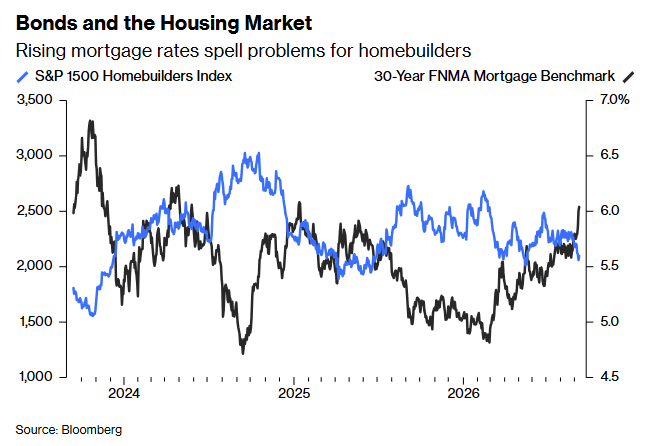
Treasury Secretary Scott Bessent’s gambit to deploy increased bond buybacks to keep longer-term yields in check appeared last week to have failed. The 10-year yield leapt after the long-heralded details of the buyback were announced on Wednesday — and weren’t as great as some had expected — and again on Thursday when it emerged that the Treasury hadn’t bought all the bonds that it could have under its new mandate. Long yields matter, and the overriding purpose of the Fed must now be to avoid pushing them higher, for the sake of the housing market above all. The chart below shows the relationship between shares of homebuilders, a direct expression of housing market perceptions, and the 30-year mortgage benchmark bond yield.
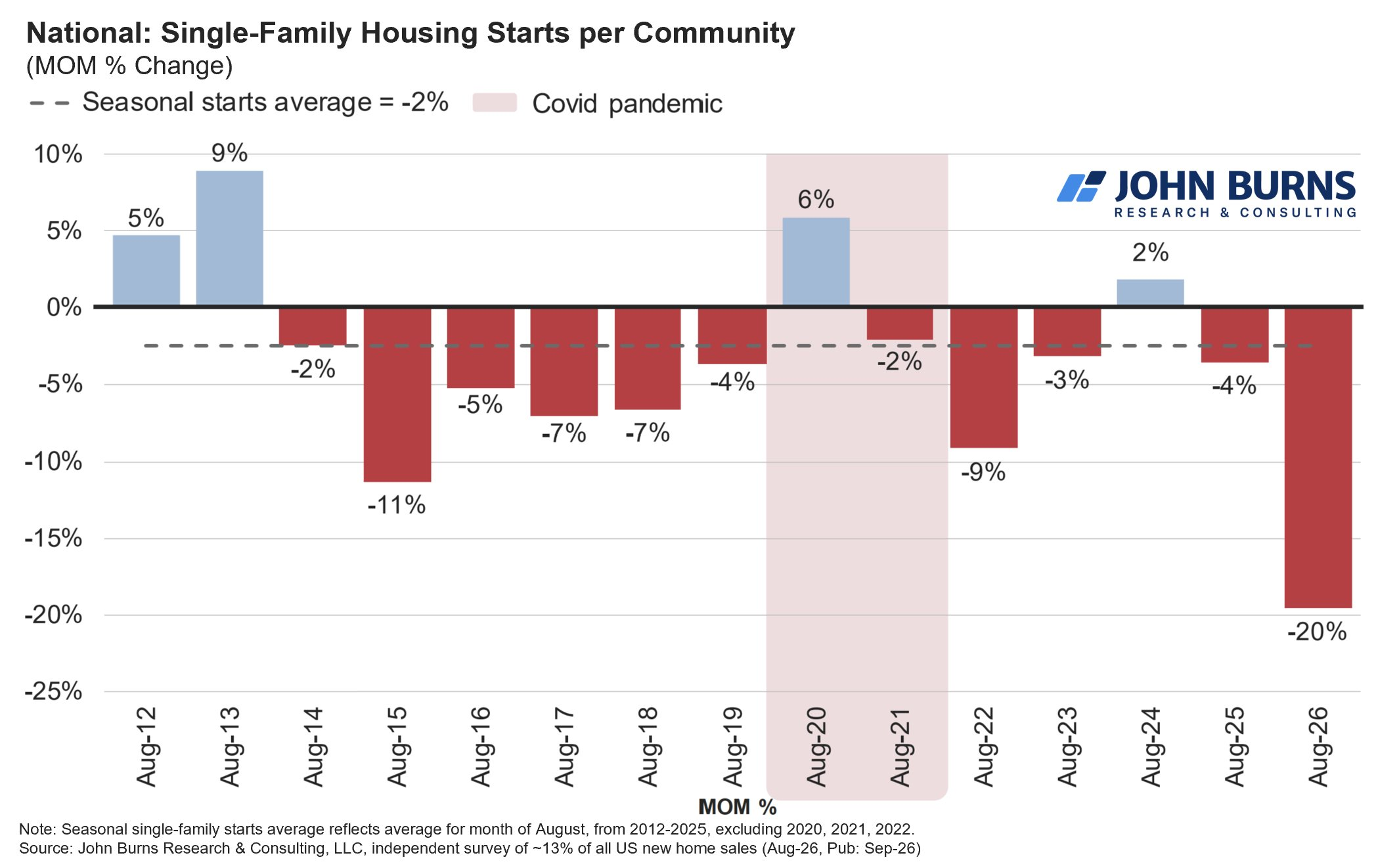
Interest rates up and affordability down leads to homebuilders slamming on the brakes in August…
Homebuilders slammed the brakes on housing starts in August. Normally, homebuilders we survey slow starts -2% MOM from July to August. This year, however, they slashed the pace of starts per community -20% MOM (worst August MOM drop in our survey history).
@RickPalaciosJr
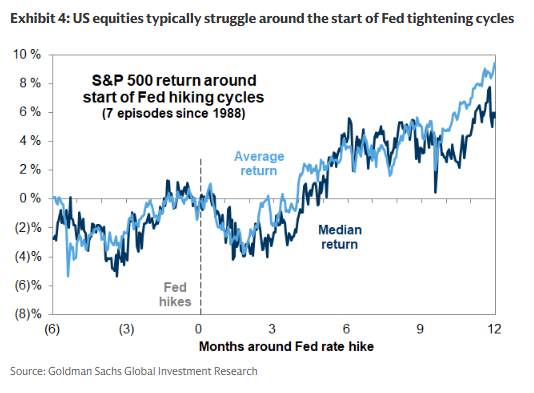
Stocks typically stub their toe after the first FOMC rate hike before they hit their stride again…
Equities typically struggle at the start of Fed hiking cycles, but the market has already priced substantial Fed tightening in coming months. The S&P 500 has generated an average 3-month return of -2% at the start of seven hiking cycles during the last few decades. However, the S&P 500 then generated an average 12-month return of +9%, with positive returns in every episode but 2022... Today, the rates market is already pricing more than three 25 bp hikes by the middle of 2027, lifting the bar for policy to surprise in a hawkish direction. The medium-term impact of Fed tightening on equities will depend on how tightening affects earnings growth, which is the most important driver of stocks.
Goldman Sachs
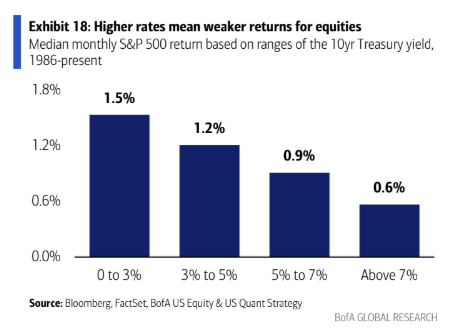
Higher interest rates don't mean an end to equities, just a bit more headwind…
"while higher bond yields tend to coincide with lower equity returns, even at a 7% yield, average annualized stock returns are still higher"
BofA Global
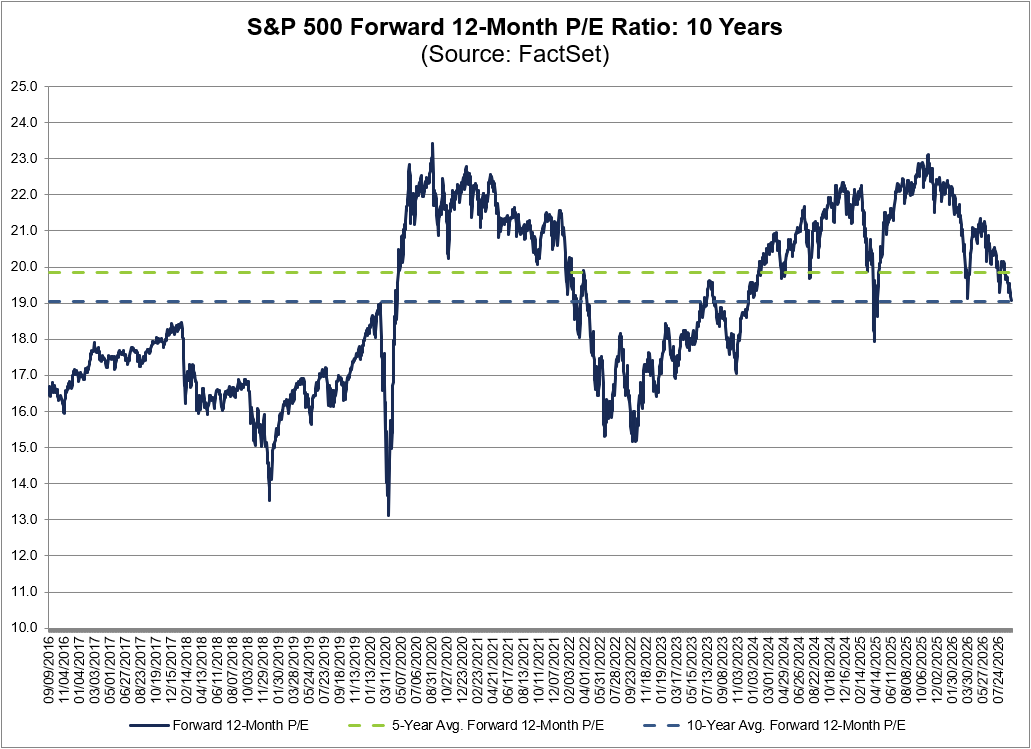
The good news is that the S&P 500 forward P/E is no longer above average…
The forward 12-month P/E ratio for $SPX is 19.1, which is below the 5-year average (19.8) but above the 10-year average (19.0).
@FactSet
Onto AI, the Co-Founder/CEO of IREN (a big neocloud), had a good response to the calls for an AI slowdown…
A few people asked over the weekend what the calls to slow the pace of frontier AI mean for the buildout. Some thoughts:
Even if models never improved from here, just rolling out what they can already do would take more compute than the world can build for years. The debate about how fast AI should be allowed to improve is a fair one to have. It's about future generations of models.
Existing demand is the part I think people are misreading. Anthropic CEO Dario Amodei said in May they'd planned for 10x growth and were running at an 80x pace in the first quarter, and that's why they've had trouble supplying compute. OpenAI president Greg Brockman said in July they'll be in a compute shortage no matter what, and are choosing which products to scale. Google says it's processing 7x the tokens it did a year ago. Hundreds of millions of people use these models today, and most of them use a small part of what the models can already do. And every time more compute comes online, usage steps up again: limits come off for people already using it, customers who were turned away get on, and new use cases show up that weren't in anyone's plan.
Now supply. The constraint is HBM, the memory that sits inside every major AI chip. Three companies make it and all three are sold out this year. A new memory plant takes years to build. TrendForce has HBM shipments growing 50-60% next year. NVIDIA, the biggest buyer of it, expects its revenue to grow about 70% next year and calls that outlook 'supply-constrained', noting its customers' forecasts point closer to 100%. On our own bottom-up work, the memory constraint lands in about the same place as NVIDIA's growth number.
Then the chips need a building with power connected, which takes longer again. Goldmans reckons only about half the US capacity scheduled over the next two years will actually be built on time.
The risk to demand continues to seem heavily weighted to the upside. The risk to supply continues to seem weighted toward less capacity getting built, not more.
@danroberts0101
Many other players agree that there is not enough compute in the world…
“We still feel really short...if we had more compute, there are more things we could do.” - OpenAI CFO Sarah Friar
“And so I think given the need for everyone’s short compute and the need for more compute and the supply being deployed to meet the demand that’s out there” - KLA CFO Bren Higgins
“...the hardest thing to find right now is compute. Even if you get yourself an open-source model, you want to run it for $1 billion a year, you have to go buy $1 billion of compute. So it still costs you.” - Palo Alto Networks CEO Nikesh Arora
“And we even have discussions with customers all the way through 2030. My view is AI compute demand is going to remain very strong for many years going forward into the future.” - Applied Materials CEO Gary Dickerson
Microsoft has its pedal to the metal and it's very big capex plans are leaking out…
"Right now, I would say the focus is far more on how quickly we can get supply revenue-ready than it is trying to figure out if I have USD 1 billion of CapEx here or there to move.” (Microsoft CFO Amy Hood at the Goldman Sachs Communacopia Conference)
Microsoft Corp. plans to more than triple its data center capacity, an effort that could help the company overcome a computing shortage that has forced it to turn away some AI and cloud business.
The company’s globe-spanning network of data centers will have more than 38 gigawatts of capacity in 2032, up from about 12 gigawatts now, according to people familiar with the plans. That would eclipse the amount of electricity New York state uses during peak periods.
The road map includes company-owned and leased facilities and excludes computing power rented from so-called neoclouds like Coreweave Inc., said the people, who requested anonymity to discuss private information…
The numbers provide a rare glimpse of how much computing capacity Microsoft hopes to get in exchange for the massive sums it’s lavishing on data centers. The company’s capital expenditures hit $145 billion in its most recent fiscal year, and analysts expect that spending to keep growing in the years to come.
Christopher Mims had a must read piece over the break on how to get a new data center approved…
A good summary for how to get an AI data center approved and built for today's local communities.
Companies know how to build data centers that won’t alienate communities.
But their desire to build these AI-processing plants faster than ever has resulted in sprawling, polluting, noisy, thirsty complexes more reminiscent of the industrial revolution than the era of artificial intelligence.
We could be living in a golden age of data centers, one in which communities welcome the contributions to their tax base and have little to fear in terms of noise, air pollution or rising utility rates. Decades-in-the-making technologies are now becoming viable alternatives to outdated systems for cooling and power. Data centers that blend into their communities and don’t overtax local resources actually exist, they just don’t make news.
Instead, pushback from communities over noise, electricity costs and secretive development processes across the U.S. is leaving many builders with a stark choice: Do better, or face indefinite delay—even cancellation…
After interviewing experts, many inside the companies facing this pushback, I compiled a list of ways to build data centers that people won’t hate:
- Be more transparent
- Mitigate utility rate hikes
- Seek cleaner energy
- Reconcile water use
- Revisit carbon-neutrality promises
At the other end of the real estate spectrum, guess what asset is now outperforming…
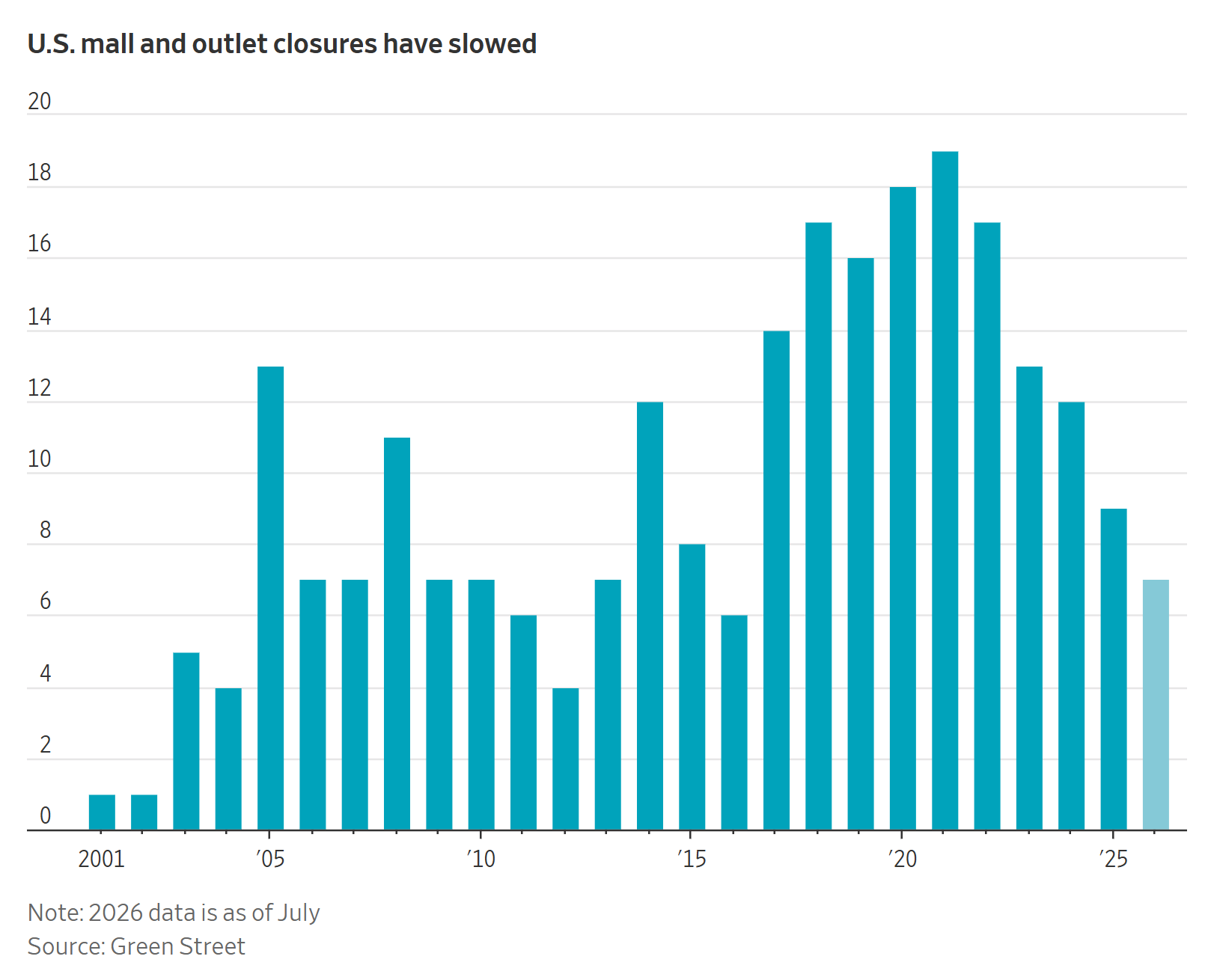
The long-beleaguered mall business is finally having a moment.
After years of lagging behind the commercial-real estate recovery, malls are outperforming every other property type as more investors conclude that enclosed shopping centers have more staying power than previously understood.
Mall values are up 13% over the past year, according to real-estate analytics firm Green Street. That tops all 10 commercial property sectors and is more than double the increase in overall commercial real-estate prices…
The American mall revival has been so strong that Paris-based owner Unibail-Rodamco-Westfield is getting back in the game just four years after it said it planned to ditch the U.S. market. The company has committed to spend nearly $1 billion this year buying out its partners at two of its malls: Westfield UTC in San Diego and Westfield Southcenter in deals that gave it full control of both properties.
“We see the type of rent growth that we haven’t seen since the beginning of the 2010s,” said URW Chief Executive Vincent Rouget.
Rouget said the U.S. market is now a growth driver for the company, with tenant sales and net-operating income growth outpacing the broader portfolio average.
Impossible for any investor in equities to ignore the private markets when they are outraising the public markets by a factor of two to one…
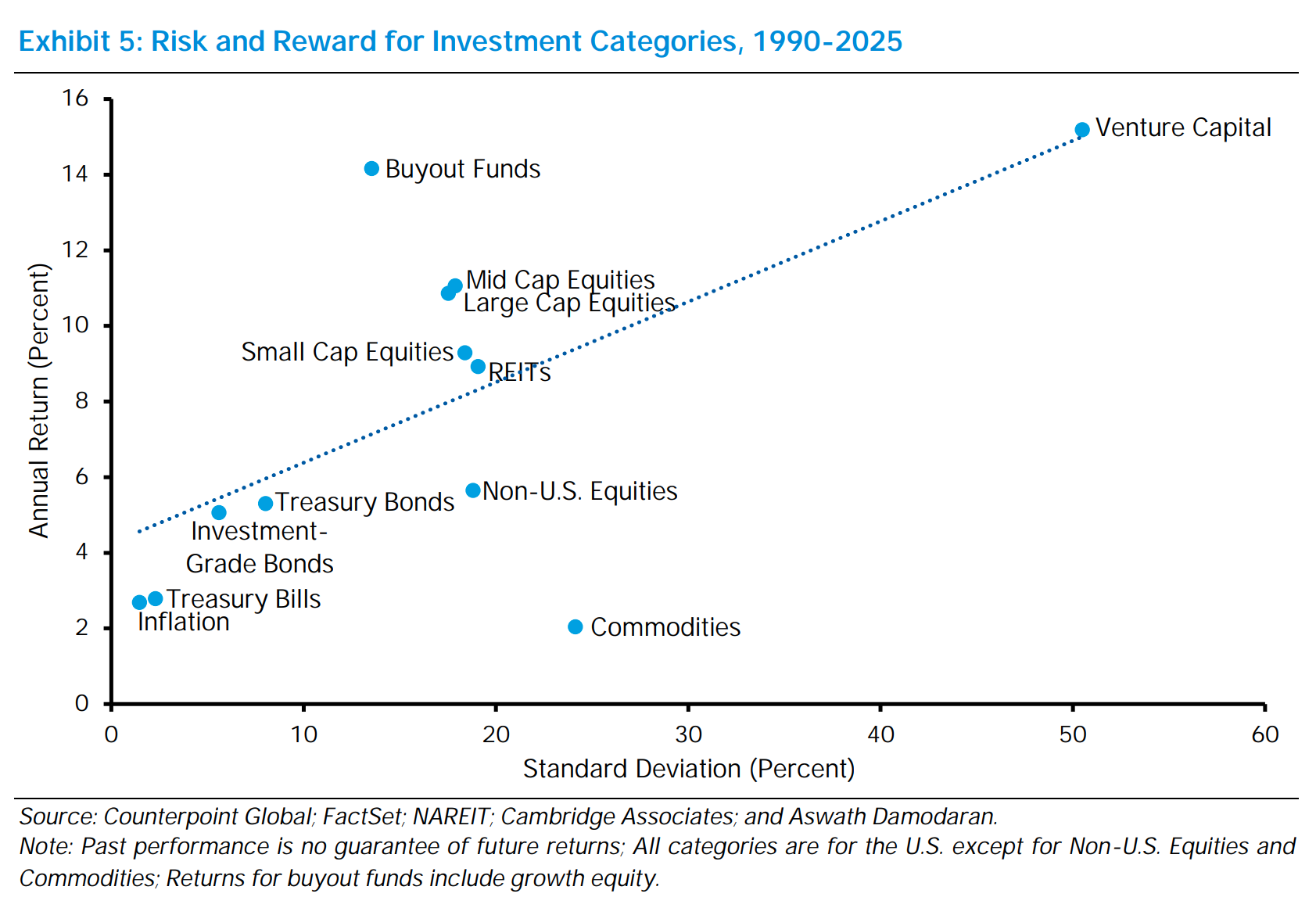
Michael Maubossin gives us all an update to his Long Term Look at Public to Private Equity research piece. 90 pages of data and charts to look through as you compare public companies to private ones.
Large institutional investors, including pension funds and endowments, have shifted their allocations in U.S. equities from public to private markets over the past 40 years. This change has had reverberations for investors, executives, policymakers, and asset managers of public and private equity.
For public equity, we include all of the stocks of companies that trade on an exchange in the U.S. The S&P 500, an index that tracks the stocks of 500 large companies in the U.S. and represents about 80 percent of the total market, had a solid 11.5 percent compound annual growth rate (CAGR) for the 40 years ended 2025. Still, there are today about one-half as many public companies as there were in 1996.
For private equity, we include buyouts and venture capital (VC). We examine long-term trends in each of these markets, including their size, patterns of how they have bought and sold businesses, and return on investment.
This report is an update of one from August 2020, and a lot has changed in the ensuing half dozen years. Most notably, the period of “easy money,” which started in 2009 when the Federal Reserve and other central banks lowered policy rates to essentially zero in the wake of the Great Recession, ended in 2021. As a result, the real yield on the 10-year U.S. Treasury note went from about -1.0 percent in late 2021 to roughly 2.4 percent in August 2026.
There have also been regulatory and business initiatives aimed at making investing in private equity more accessible to individual investors. Institutional investors have been the primary source of capital for this asset class, but a majority of surveyed money managers now expect that at least one-half of flows into private markets will come through investments targeted at individuals within the next couple of years.
And if you missed it, this is an incredible read about the organizational planning and execution of the Spirit Airlines shutdown…
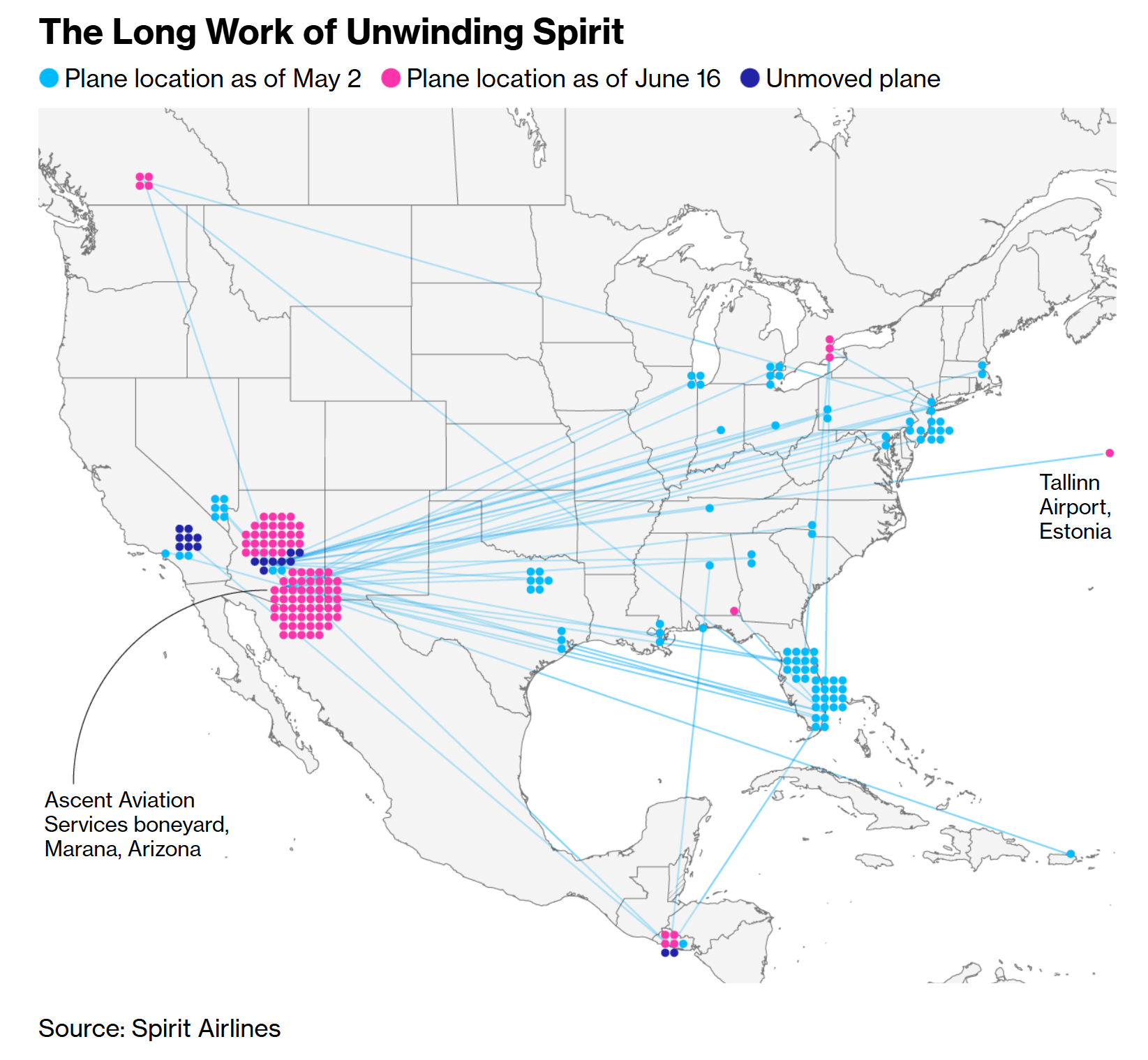
Plan Charlie needed to keep Spirit operating as normal, not tipping its hand even to the airline’s own employees, before instantaneously freezing everything in place. Because the team wanted to ensure that no Spirit planes were in the air when the announcement was made, and because they also wanted to minimize cancellations, the plan was built around a 3 a.m. shutdown, a time when normally only a few overnight flights would be en route.
The day after Spirit’s rescue fell apart was Friday, May 1. It wasn’t when anybody running the company would have wanted to put Plan Charlie in motion. Weekends and the days leading up to them are particularly busy for a low-cost airline catering to leisure travelers. Nevertheless, around 1 p.m. that day the airline started canceling its longer flights. This included international departures to Latin America and the Caribbean. There were additional reasons to make sure those planes didn’t take off: Having them sitting at airports outside the jurisdiction of the US government and US courts at the moment the airline went out of business could complicate the already tricky business of getting them back home.
Early Friday evening, Spirit stopped doing any maintenance on its planes that wasn’t immediately necessary, reducing the odds that its mechanics would be in the middle of a job the moment operations ceased. Around the same time, the company’s board was officially notified that the wind-down was in progress. The night’s red-eyes were canceled a few hours before they were set to depart. As the day wore on, news of the impending shutdown began to leak to the press.
Learn more about the Hamilton Lane Strategies
DISCLOSURES
The author has current equity ownership in: Nvidia Corp. and Costco Wholesale Corp.
The information presented here is for informational purposes only, and this document is not to be construed as an offer to sell, or the solicitation of an offer to buy, securities. Some investments are not suitable for all investors, and there can be no assurance that any investment strategy will be successful. The hyperlinks included in this message provide direct access to other Internet resources, including Web sites. While we believe this information to be from reliable sources, Hamilton Lane is not responsible for the accuracy or content of information contained in these sites. Although we make every effort to ensure these links are accurate, up to date and relevant, we cannot take responsibility for pages maintained by external providers. The views expressed by these external providers on their own Web pages or on external sites they link to are not necessarily those of Hamilton Lane.