
Weekly Research Briefing: Into the Clouds

May's arrival suggests many mortarboards will be flying into the air this month. If you have kids graduating this year, congratulations on helping them complete the first part of their journey. As they look to the future, let's hope that they ignore any graduation advice to explore a career in "Plastics" and instead look into a future touching AI clouds. What we learned from last week's earnings is that the major hyperscalers are accelerating capital spending to accommodate incoming revenue demand, which is pushing capex growth across many areas of the US and global economy. Or as J.P. Morgan said, "The truth is that the breadth of strength extends beyond the picks and shovels of the AI boom. Importantly, it’s extending to the picks and shovels of the picks and shovels."
Skeptics of the AI boom will be hard pressed to defend their position last week given all the data that was released. Revenue demand for AI services continues to accelerate, but hyperscalers lack sufficient infrastructure to meet all the demand. They would like to build faster but there are shortages of chips, power, land zoning approvals, and labor. If you need proof of how strong demand is running, just listen to or read the Nucor Corporation conference call transcript. They make sheet steel, beam steel and rebar which are necessary for all of the data centers currently under construction. Nucor's stock price is up 40% this year and 80% over the last 12 months proving that you don't have to own semiconductor stocks to profit from the AI boom.
With over half of the S&P 500 now reporting earnings we can say for certain that this will be one to remember. Core and reported earnings growth was much better than expected, and there were many signs of increased hiring intentions and capital expenditure step-ups. This week we will receive many more signals as the smaller and mid-capitalization companies release over 2,000 earnings reports. It is also jobs week so we will see if all the good corporate news translates to non-farm payroll growth exceeding the 50-75,000 estimates.
Little to add regarding the war in the Middle East as we reach Week 10 of the conflict. High jet fuel prices sunk Spirit Airlines over the weekend, resulting in the loss of 19,000 related jobs and many cheap tickets to Florida. As gasoline prices accelerated higher in the US Midwest over the last week, we will see how the messaging between the White House and US drivers changes. Hopefully your drive to that next graduation is a short one. Have a great week.
The biggest story of the week was the Hyperscalers post-earnings comments on capex spending…
This is the biggest cylinder in the global economies engine right now.
Microsoft – “For calendar year 2026, we expect to invest roughly $190 billion in capital expenditures [vs. $153.7bn consensus], which includes approximately $25 billion from the impact of higher component pricing. We remain confident in the return on these investments given higher demand signals and increasing product usage as well as the efficiencies we're already driving across the platform.”
Meta – “We anticipate 2026 capital expenditures, including principal payments on finance leases, to be in the range of $125 billion to $145 billion, increased from our prior range of $115 billion to $135 billion. This reflects our expectations for higher component pricing this year and to a lesser extent, additional data center costs to support future year capacity.”
Amazon – “As we've been sharing, the faster AWS grows, the more short-term CapEx we’ll spend... The free cash flow in ROIC for these investments are cumulatively quite attractive a couple of years after being in service. However, in times of very high growth, like now, where the CapEx growth meaningfully outpaces the revenue growth, the early years, free cash flow is challenged until these initial tranches of capacity are being monetized and revenue growth outpaces CapEx growth.”
Google – “We are updating our full year 2026 CapEx guidance range to $180 billion to $190 billion, up from our previous estimate of $175 billion to 185 billion, to now include investment related to the acquisition of Intersect, which closed in March. We are seeing unprecedented internal and external demand for AI compute resources. The investments we are making in AI is delivering strong growth, as evidenced by the record revenue and backlog growth in Google Cloud and strong performance in Google services. Looking ahead, these strong results reinforce our conviction to invest the capital required to continue to capture the AI opportunity, and as a result, we expect our 2027 CapEx to significantly increase, compared to 2026.”
BofA Global
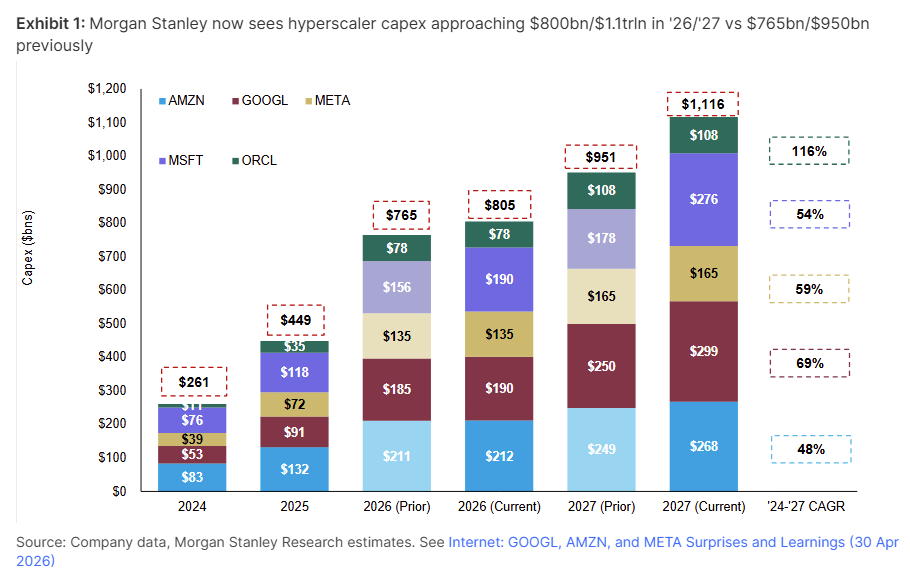
New business and capex updates have led Morgan Stanley's team to take their 2027 capex estimate thru $1.1 trillion…
In 2026, Morgan Stanley estimates that US hyperscalers will spend over $800bn on capex. To put that in perspective, it roughly matches what all the non-technology companies in the S&P 500 spent in 2025, combined.
This spending is also growing rapidly, outright and relative to expectations. That ~$800bn in hyperscaler capex we forecast for 2026? It's almost double the figure spent in 2025 and triple the figure from 2024. Next year, my colleagues estimate that US hyperscaler capital spending could hit $1.1 trillion.
True, part of this increase comes from higher prices for the components of AI. But a bigger part of it is simply ‘more’: more demand, more chips, and more power.
Morgan Stanley
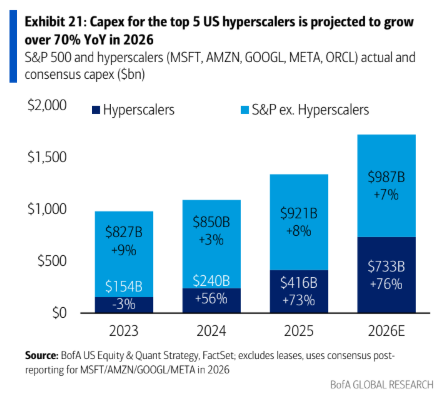
In other words, US hyperscaler capex might soon catch the spending of the other 495 companies in the S&P 500…
BofA
And corporate AI spending is not just a public company phenomena…
“At our companies — and by the way, we have 270 companies, 13,000 pieces of real estate, it’s massive in its scale — their LLM spend was up 15-fold in Q1 this year over last. Now, off a small base, yeah, but it tells you what’s happening. All these companies trying to find ways to be more efficient.” - Blackstone President Jon Gray
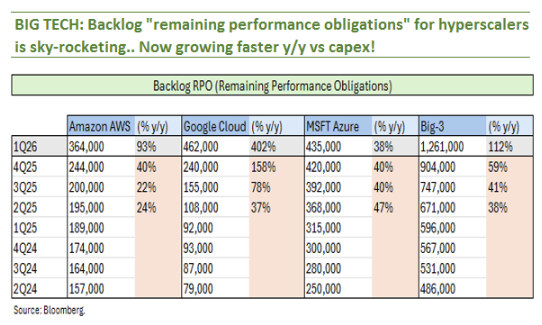
For those concerned that all the AI capex spending is being wasted, note that the backlog of RPO is now growing faster than capex growth…
J.P. Morgan
Pick and shovel players in HVAC and Power only seeing one demand direction right now…
@knowledge_vital: $CARR "Orders in our global Commercial HVAC business increased 35%, helped by data centers which were up over 500% in the quarter"
@knowledge_vital: $WCC "Data center sales of $1.4 billion were up approximately 70% and now represent 24% of our total Wesco sales"
@TheTranscript_: EQT AB: "We see global demand for AI compute and hence data centers and power consumption only accelerating. Industry estimates suggest that $4 trillion will be invested into data centers and energy Infrastructure to meet this demand over the next five years."
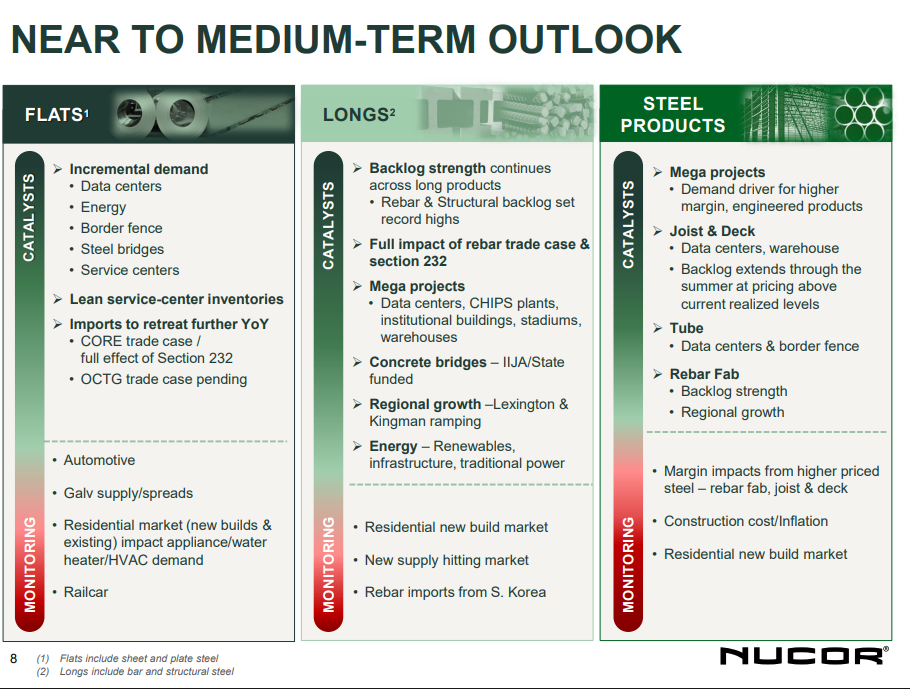
The comments from this steel company CEO are pretty eye-opening…
FYI: Longs refers to rebar and beams. Sheets are the flats that go on a washing machine.
- The demand drivers again, I'm not going to underplay this. I've been in this business a long time. I've been in our Longs product businesses or Sheet Group. And from a Longs perspective, our customers that I'm talking to today are busier than anything they've ever seen in their history. So when I tell you that demand driver -- drivers today are, it's like '21, '22, or even beyond in some cases, depending on the product group. So it is an incredible market.
- Their backlogs are at historic levels. Their customers' customers are busier than anything that I've seen in, again, my 30-year career. So, where is that going? Man, it's obviously the non-res, data centers, energy, structural side and infrastructure around energy, chips, chip plants and facilities, warehousing, and in an area that we're going to continue to see expanded into the military complex in the years to come for Nucor. So I would tell you it's hitting on all cylinders. And while data centers are white hot, everyone's looking to participate. If you pulled out all of the data center backlog from Nucor, I mean, it only takes that down about 10% (Leon J. Topalian, Chair and Chief Executive Officer, 1Q26 Call)
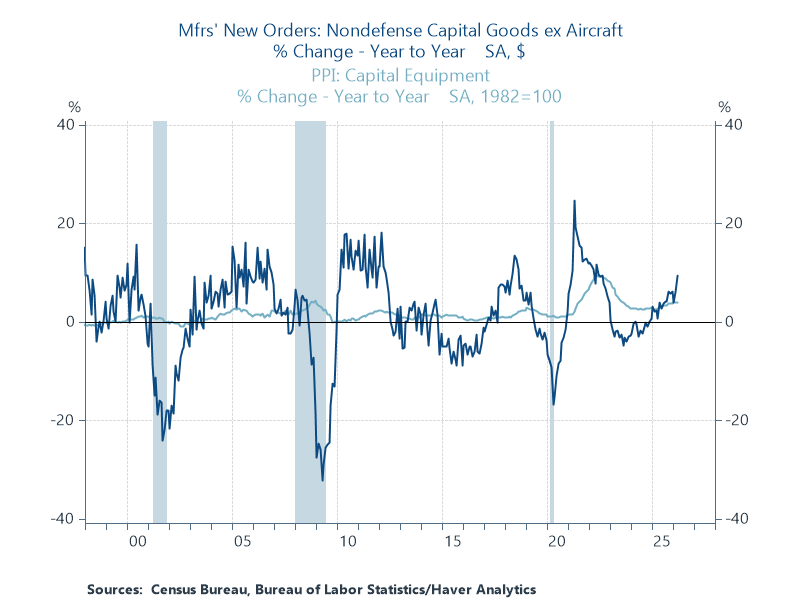
And we are seeing the AI boom push total economic data numbers higher…
@RenMacLLC: Strong investment spending is supporting the rise in the market. Core orders surged in March, climbing 3.3%, and up 9.4% over the last 12 months.
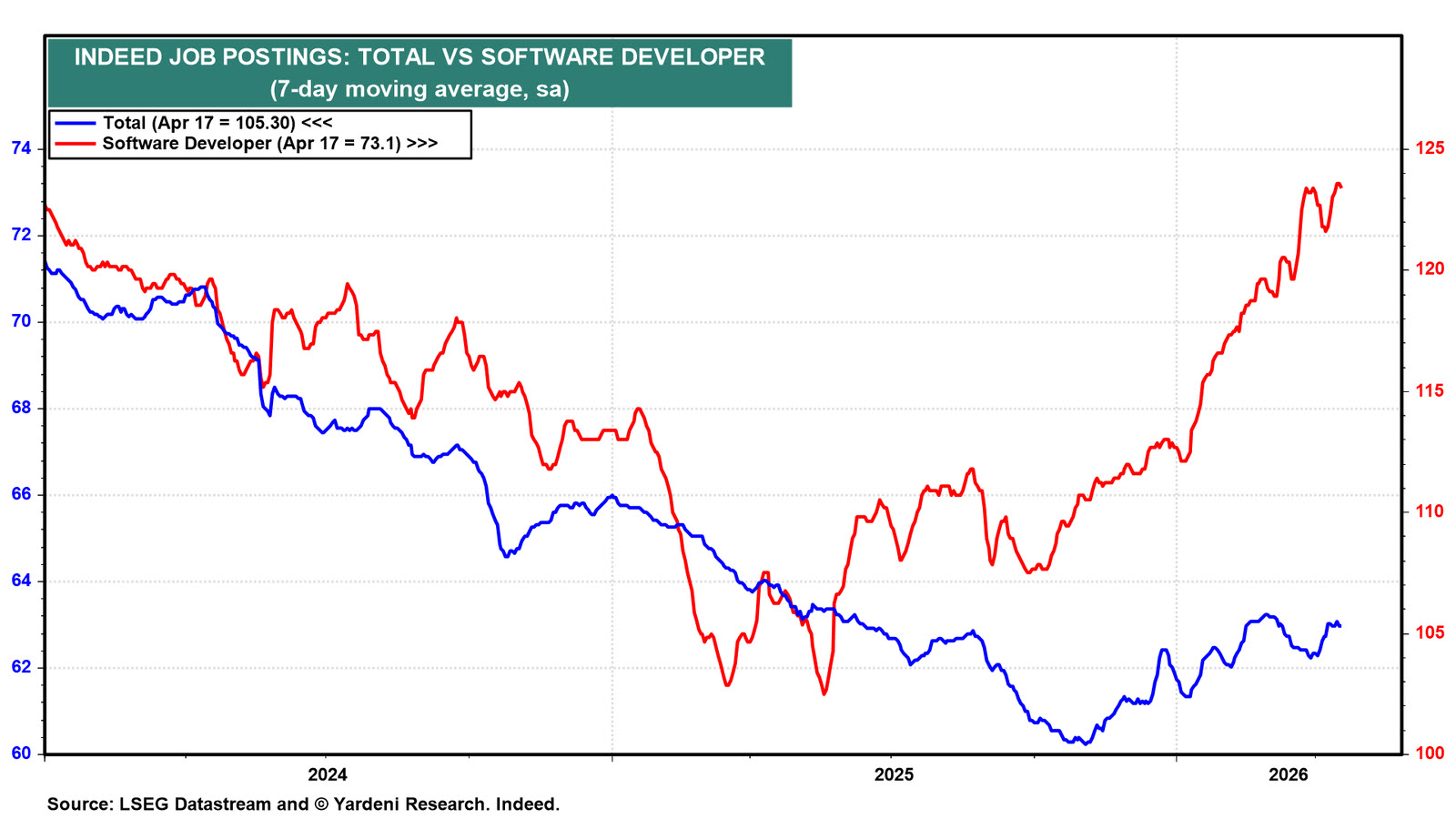
As for the rumors about the death of software: Demand for software engineers is accelerating, not decelerating…
“I can tell you we are hiring just as many software developers as we ever had inside of Amazon. And in fact, I see the demand for that really accelerating...Amazon is hiring 11,000 new SDE interns and full-time employees this year. That is not jobs going away” - Amazon AWS CEO Matt Garman
2024/2025 was the pause to evaluate. Now companies are acting on their AI rollout plans and they need more help…
Yardeni Research
Even Jerome Powell noted the strength in the consumer and economy at last week's FOMC…
“...the economy has been resilient. It really has, not just this time, but it’s been remarkably resilient for some years now. The U.S. economy has just powered through shock after shock, and consumers are still spending. And that’s what the banks will tell you, credit card companies will tell you, the retail sales numbers that we got most recently. People are still spending.” - Federal Reserve Chair Jerome Powell
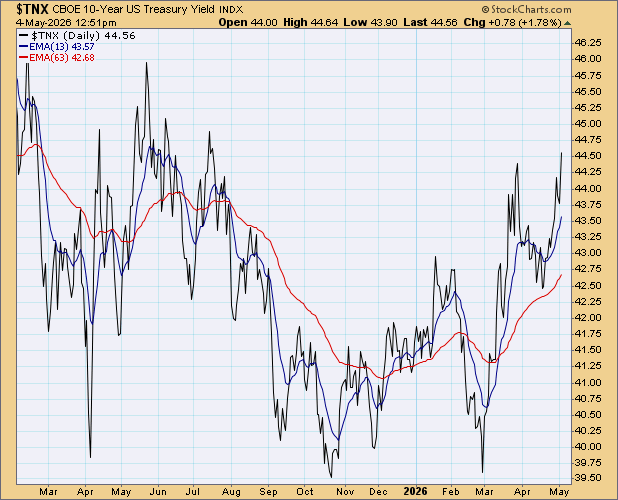
The stronger economy contributes somewhat to the rise in risk-free yields, but most of the 1% move stems from the disruption in the energy markets.…
@WalterDeemer: Ten-year yield chart. Something to keep an eye on.
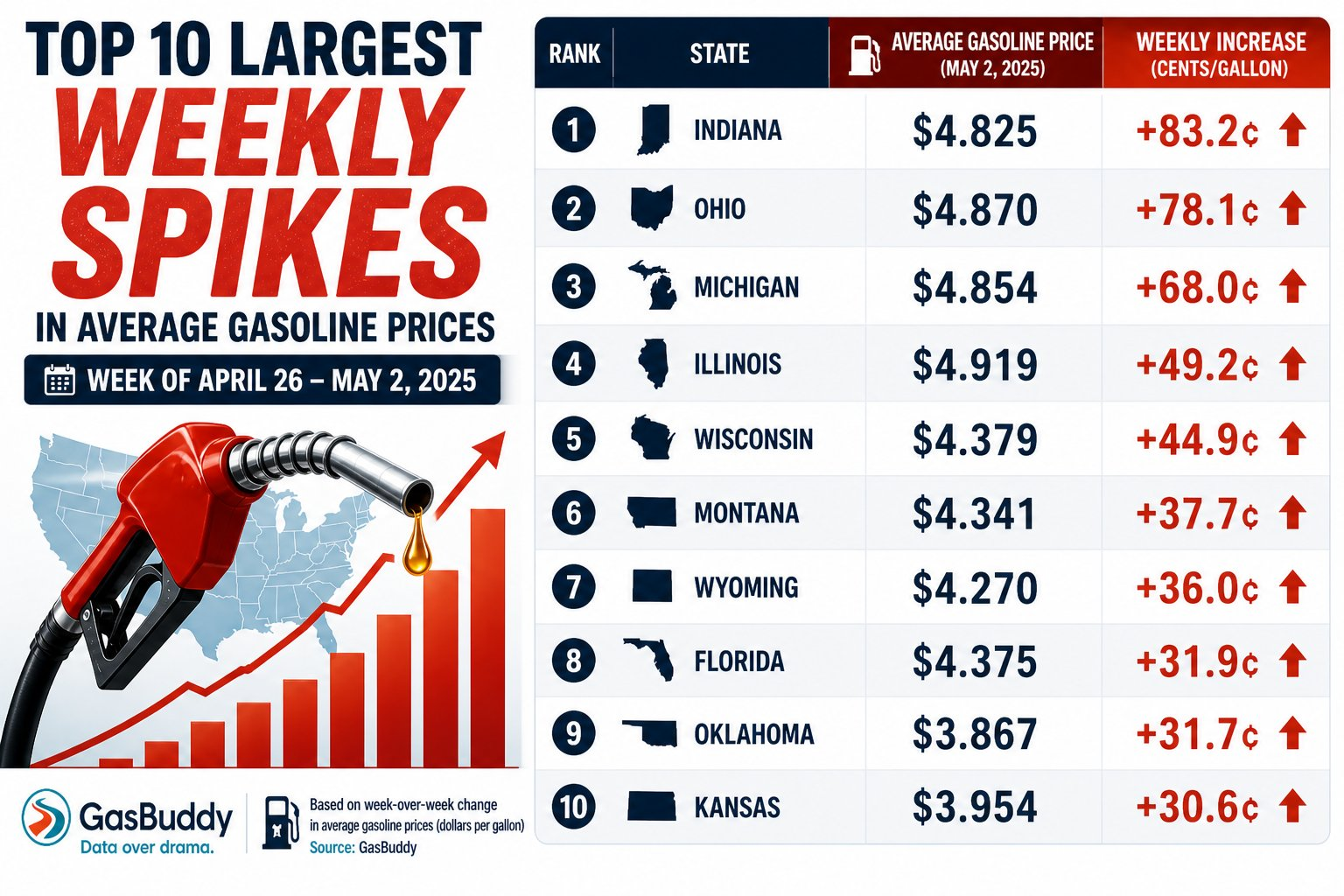
Last week the upper Midwest received a gasoline price shock as refineries switched from winter grade to summer grade fuel mixes…
@GasBuddyGuy: tremendous jumps in average gas prices, these are the top 10 states seeing average prices surge the most, all of them over 30c/gal higher from a week ago.
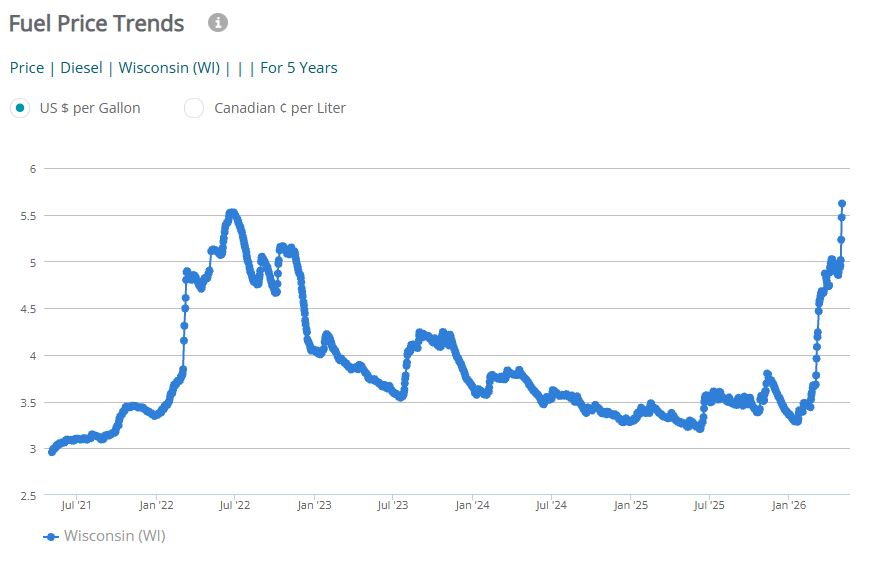
Diesel prices moved to all-time highs as distillates ran into inventory shortages and high demand from US truckers…
@GasBuddyGuy: BREAKING: #Wisconsin has set a new all-time record for average diesel price at $5.620/gal, beating out 2022's record. Wisconsin joins Illinois and Michigan with a new diesel record.
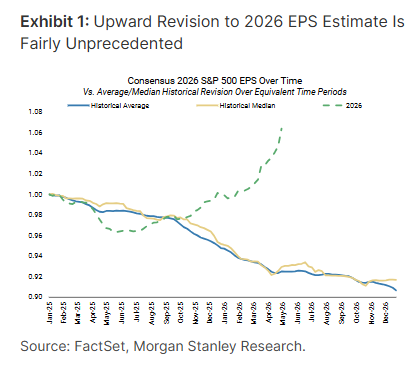
Back to last week's earnings, a surge in estimate changes after the Q1 is unusual, but in a very good way…
The fact that companies cannot hold back their sales and margins to reward their shareholders throughout the year is a very good sign for the quarters ahead.
Morgan Stanley
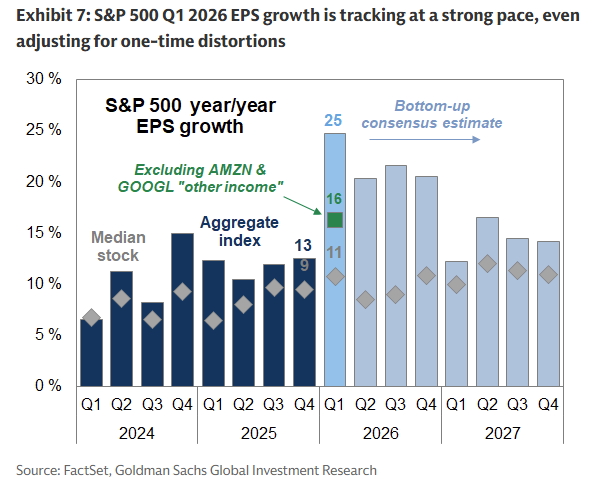
Q2 thru Q4 2026 earnings growth now looking at rates of 20% for the S&P 500 index and almost double digit growth for the average stock…
With 63% of S&P 500 companies having reported earnings, backward-looking Q1 2026 results have been exceptionally strong. While the aggregate S&P 500 EPS growth rate of 25% is distorted by idiosyncratic one-time benefits, earnings growth is tracking at a 16% pace excluding those items, and companies have reported the lowest frequency of EPS misses in 25 years outside of the COVID reopening period.
Goldman Sachs
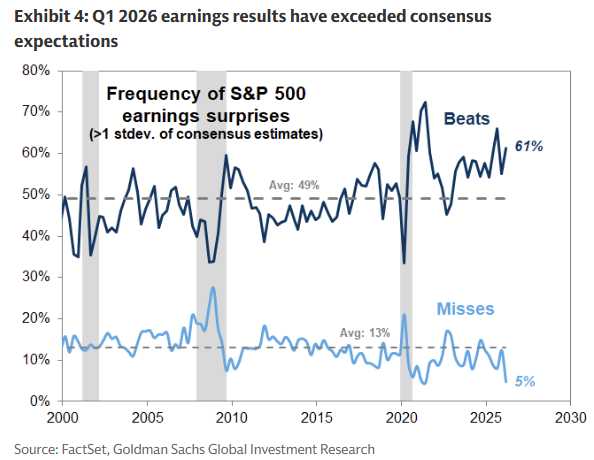
Also of importance, the rate of earnings misses this Q1 has been extremely low…
Backward-looking results have been strong. 61% of S&P 500 companies have beaten consensus EPS expectations by more than a standard deviation of estimates, above the historical average of 49%. So far, only 5% of companies have missed earnings estimates, the smallest share in over 25 years of data history outside of the 2021 COVID reopening period. Revenue surprises have been similarly positive.
Goldman Sachs
Stronger earnings and lower P/Es not just a US S&P 500 phenom. Here is what is going on in the Asia Pacific region…
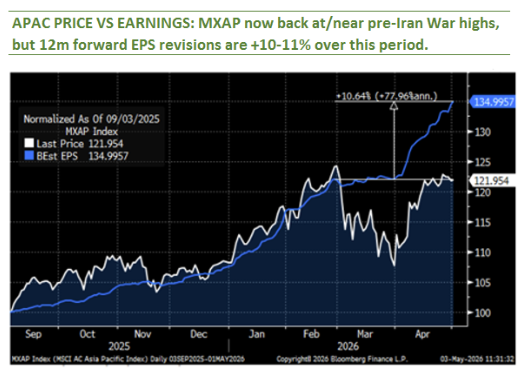
J.P. Morgan
Another reminder that the picks and shovels of the picks and shovels can get rewarded…
Small cap value stocks are outperforming the S&P 500 by almost 1000 basis points this year
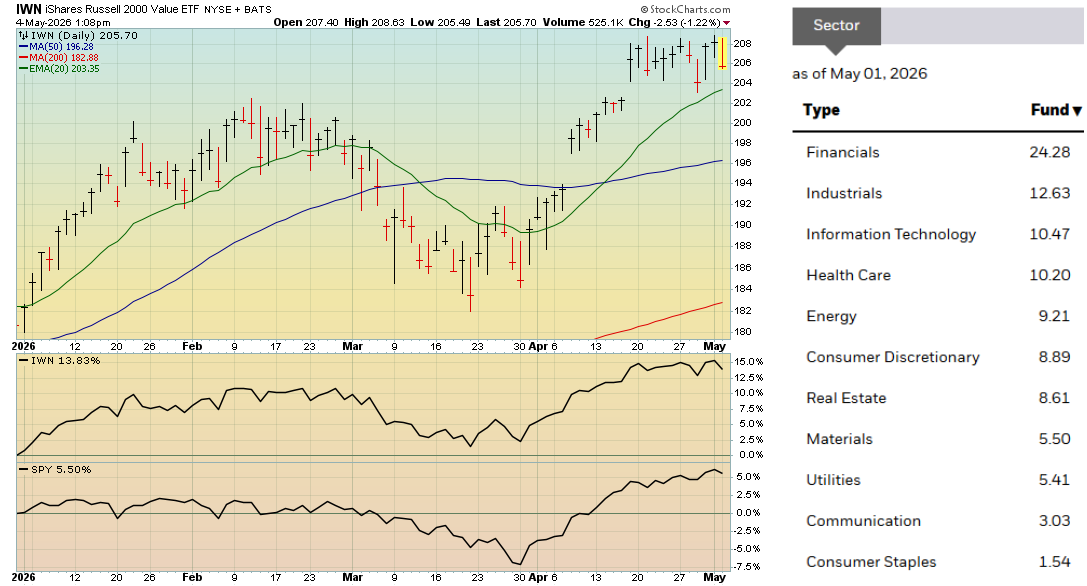
StockCharts, iShares
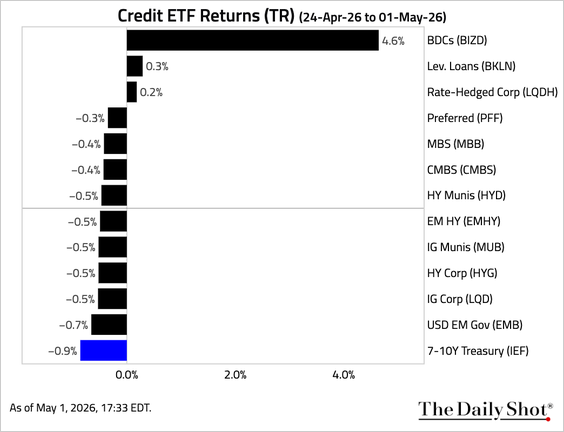
Meanwhile, buyers are quickly returning to the public private credit vehicle space…
I wonder how much has to do with the Software Sector indexes beginning to toy with a 20% bounce off their April lows?
A 3-year chart of the major BDC index ETF showing an attempted recovery…
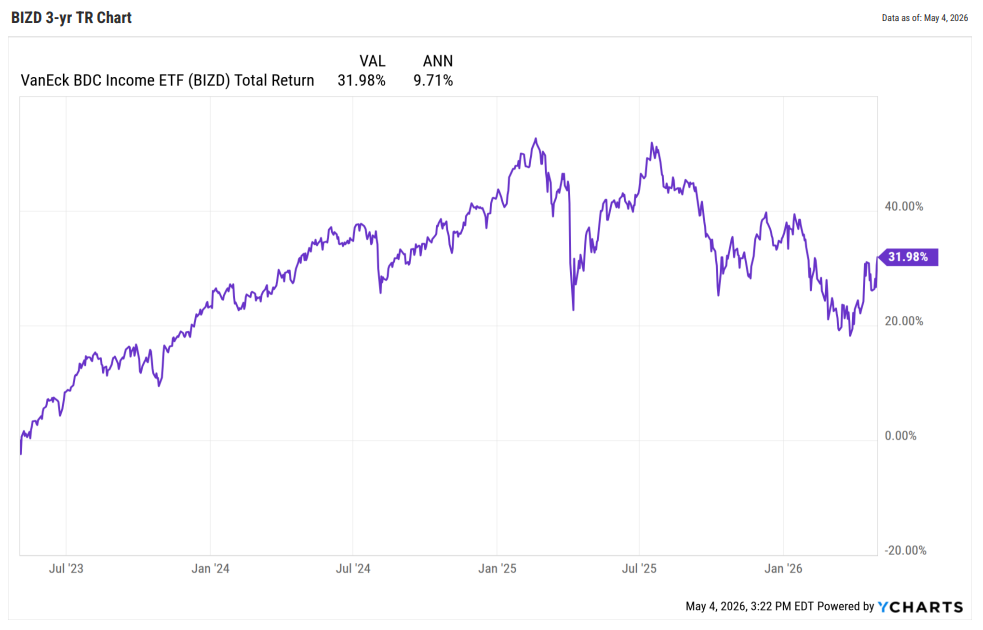
Ycharts
The Q1 inflows reported from Alternative Asset AUM firms last week did not show the worries about private market investing that I see daily in the major and minor financial press…
Ares +$30 billion with $4 billion from Retail/Private Wealth
Blackstone +$69b with $10b from Retail/PW
Blue Owl +$9b with $3b from Retail/PW
TPG +$10b
For comparison purposes, US equity mutual funds and ETFs took in flows of $141 billion over the LTM. For US bond mutual funds and ETFs, the figure is $707b according to EPFR/Goldman Sachs.
"Everything we're seeing on the ground is that the institutional investor is not anxious.” (Ares Management)
"We view the near-term industry headwinds in credit retail vehicles as cyclical rather than structural and continue to see strong demand across the industry in private equity, infrastructure, and secondaries." (TPG Inc.)
And as one of the largest public BDCs noted, private credit pricing and terms have gotten more favorable…
“We are seeing a reset underway with wider spreads, lower leverage levels and more attractive overall deal terms across the market. New transactions today are being discussed at 50 to 75 basis points of enhanced levels of fees and spread alongside a half to full turn of lower leverage and tighter documentation versus the second half of last year.” - Ares Capital CEO Kort Schnabel
Speaking of private companies, one of Europe's largest is going to be acquired by its major public competitor…
KONE Oyj confirms to acquire German rival TK Elevator for €5B cash plus €15.2B shares, €700M synergies by year 3, close Q2 2027
- Consideration: €5B cash, up to 270M new class B shares valued at €15.2B (April 28 close).
- Implies €29.4B enterprise value including net debt.
- Combined: €20.5B revenue, 65% from service and modernization.
Trade The News
And to capitalize on the need for more electrification for the AI boom, a 25x forward P/E public large cap company is buying from private equity…
- Hubbell Inc (HUBB) to acquire NSI Industries for $3.0B cash. Expect to be accretive in 2026. $3.0 billion transaction to be financed with cash on hand and debt. Purchase price represents ~15.5x anticipated 2026 EBITDA.
- Definitive agreement to acquire NSI Industries, a portfolio company of Sentinel Capital Partners and a leading provider of electrical fittings, connectors, components and wire management products, for $3.0 billion in cash, subject to customary adjustments.
- “We are excited to add a high growth business in NSI to Hubbell’s Electrical Solutions portfolio,” said Gerben Bakker, Chairman, President and CEO. “As electrification megatrends drive attractive growth across the electrical industry over the next several years, NSI offers highly complementary products and industry-leading brands to our HES portfolio across strategic growth verticals including light industrial, datacenter and network infrastructure applications. The acquisition of NSI fits clearly with our long-term strategy to grow our offering of critical infrastructure solutions to our core electrical and utility customers.”
Trade The News
Also of interest in M&A land, the ignored public company spinout of American Express's travel group is going private at a 60% premium…
A startup backed by General Catalyst Partners agreed to acquire Global Business Travel Group Inc., the travel platform spun out of American Express Co., in a deal worth about $6.3 billion.
Long Lake Management agreed to pay $9.50 per share in cash for the Amex-backed business-travel company, according to a statement Monday, confirming a Bloomberg News report. That represents a 60% premium to its closing price on Friday…
New York-based Amex GBT had been exploring a potential sale and working with advisers, Bloomberg News reported in November. American Express is still the company’s largest shareholder, owning a stake of about 30%, according to data compiled by Bloomberg…
Amex GBT competes in the lucrative but fragmented business-travel market against competitors such as Booking Holdings Inc., BCD Travel and Navan Inc…
Ken Chenault, chief executive officer at American Express from 2001 to 2018, is now the chairman and managing director at General Catalyst.
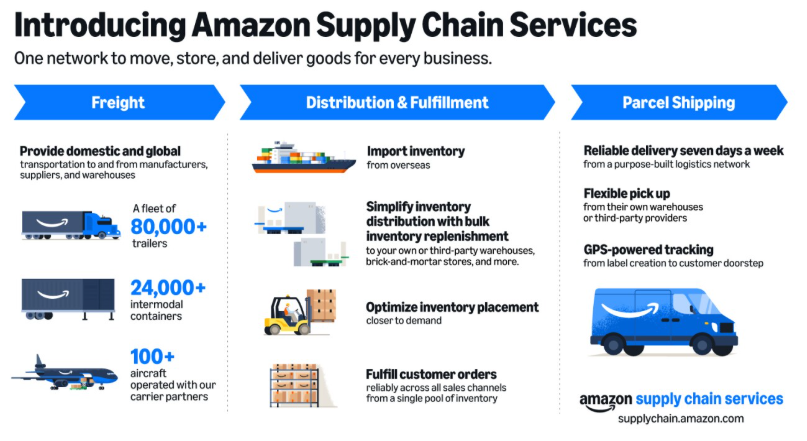
And in major business disruption news, Amazon unveils its plan to take over the total supply chain…
“We first built this network over 20 years for ourselves. We then made it available to Amazon sellers,” said Peter Larsen, vice president of Amazon Supply Chain Services. “Now we’re making it available to any business of any shape or size.”
The nation’s largest company by revenue on Monday is announcing the launch of Amazon Supply Chain Services, a centralized place for companies from consumer-goods manufacturers to apparel retailers to hire Amazon for services such as fulfillment, ocean and air shipping, and truck transportation.
The move to tie together all of its supply-chain services in one place in effect officially makes Amazon a third-party logistics provider, or 3PL, competing with the likes of transportation and warehousing giants such as DSV, DHL Group and Kuehne + Nagel International. It positions Amazon to take a bigger bite out of a global market for third-party logistics services that is estimated at more than $1.3 trillion, according to research group Armstrong & Associates.
“We think it’s a very large opportunity,” Larsen said.
Amazon over nearly three decades has assembled a supply chain spanning the globe with warehouses, planes, trucks and delivery vehicles. Its last-mile delivery service has grown to become the nation’s largest parcel carrier by volume, ahead of United Parcel Service, FedEx and the U.S. Postal Service, according to parcel-analytics firm ShipMatrix. The company has built its own logistics technology to forecast demand, plan inventory and route freight.
Learn more about the Hamilton Lane Strategies
DISCLOSURES
The author has current equity ownership in: Alphabet Inc. and Ares Capital Corp.
The information presented here is for informational purposes only, and this document is not to be construed as an offer to sell, or the solicitation of an offer to buy, securities. Some investments are not suitable for all investors, and there can be no assurance that any investment strategy will be successful. The hyperlinks included in this message provide direct access to other Internet resources, including Web sites. While we believe this information to be from reliable sources, Hamilton Lane is not responsible for the accuracy or content of information contained in these sites. Although we make every effort to ensure these links are accurate, up to date and relevant, we cannot take responsibility for pages maintained by external providers. The views expressed by these external providers on their own Web pages or on external sites they link to are not necessarily those of Hamilton Lane.