

Stocks, bonds, SpaceX, the Knicks, the Hurricanes, the Ivory Coast and Lewis Hamilton are all having a great week. No lead can be too big, and no player is too small to have an impact. Congrats to all the investors, athletes, and their fans.
Rumors about positive developments in the Middle East conflict solidified over the weekend when the US and Iran signed a MoU to end the war and open the Strait of Hormuz. The final details will be released on Friday but it sounds like Iran will move to open the Strait and stay in its lane in exchange for a few container ships of cash. As the mines are cleared and ship passage resumes, the next question will be, "When will China resume buying crude oil?"
The US & Iranian agreement removes significant uncertainty from the markets. Significant future price spikes for energy, aluminum, fertilizer, saffron and other commodities are probably off the table. CFOs and treasurers will experience less volatility around their future business activities which will give asset buyers and sellers increased certainty around valuations. This will further open up the M&A, IPO and lending markets to buyers, investors and bankers. And it doesn't hurt that company fundamentals are strong driven by the new investment cycle into AI, and a resilient US consumer. Now it is time for the rest of the world to join the uplift as fuel prices settle back, allowing for more normal economic activity.
Last week's other rocket signal was the SpaceX IPO which highlighted the market's risk appetite for owning new companies and deploying significant capital. At Monday's close, the company ended with a market cap near $2.5 trillion putting it right on Amazon's heels as the 6th largest company in the world. IPO buyers are up 42% and first trade buyers are up 28%, which should only increase the appetite for future new company listings. Now if only large pools of high quality private companies existed that were looking to go public as the macro and micro headwinds subside. Hmmm, I have a few ideas. In another sign of a healthy financial market, Fox Corp is paying $22 billion (or nearly 30x post EBITDA synergies) to acquire Roku and own the distribution for its sports and media content. Onward and upward.
This week the world will have its first FOMC meeting with new Chairman Kevin Warsh at the controls. The market expects no rate changes, and should move away from its easing bias. Will they prepare the markets for a fall or winter rate hike? Will they end the dot plots? Will they end intra-meeting Fed-speak? Stay tuned for Wednesday's press conference. Have a great week and enjoy Thursday's New York parade which should slow down the markets mid-day.
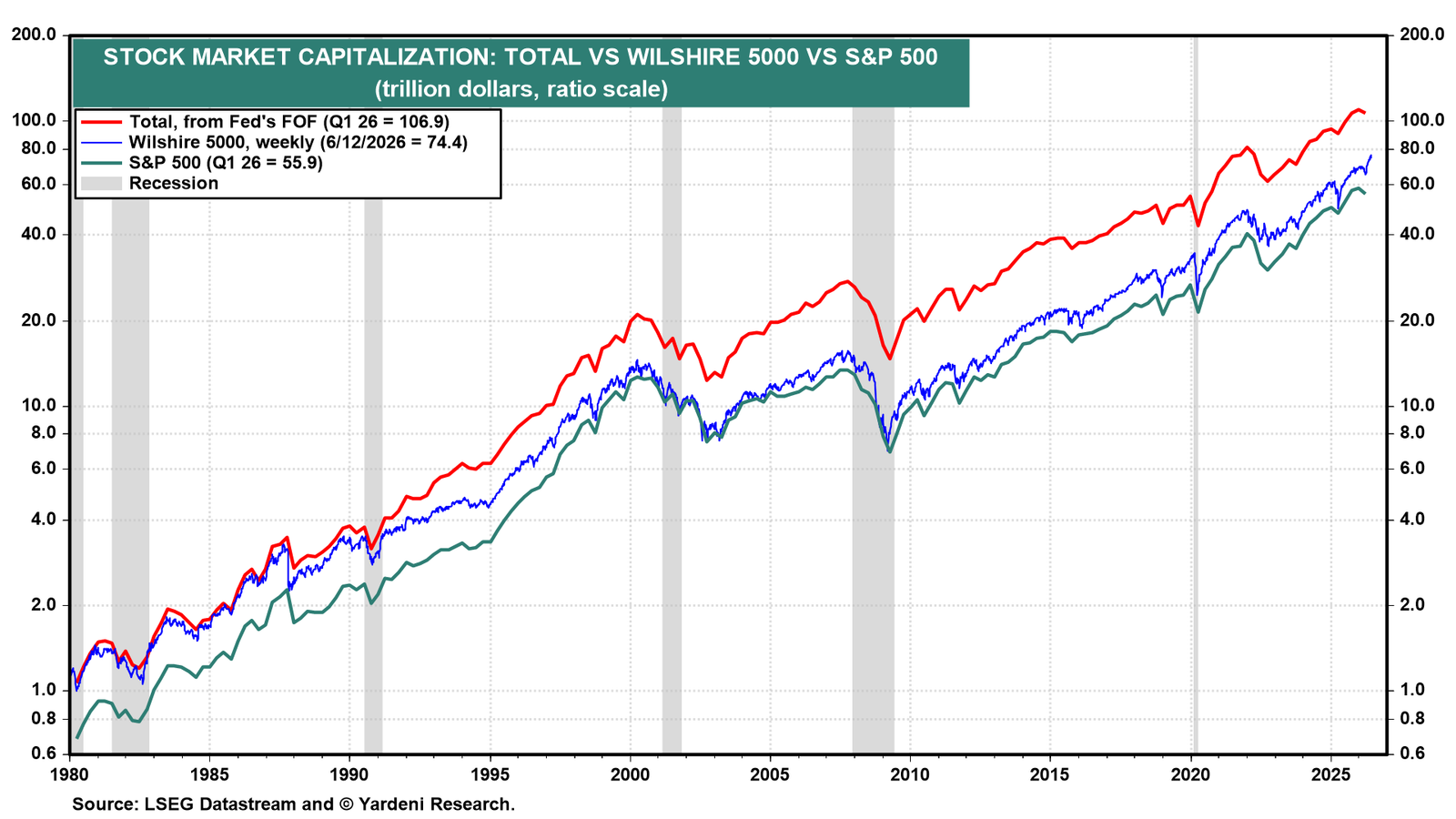
The SpaceX IPO shares offered amounted to only 10 bps of Wilshire 5000, but expect the market cap to become over 3% of the index at inclusion…
On Friday, Elon Musk, the CEO of SpaceX, went where no man has gone before. He became the world's first trillionaire. The company's IPO went off without a hitch, raising $75 billion, with its shares rising 19% on their first day of trading. While it was the largest IPO ever, it was a drop in the bucket given that the Wilshire 5000 has a $74 trillion market cap.
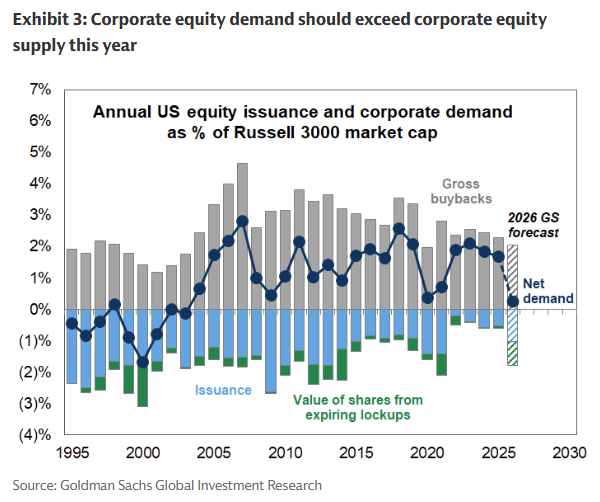
In my old days, too much stock issuance could weigh on an equity market. But we are not there yet…
Record US equity issuance will not derail the bull market in 2026. Three key reasons: First, IPO activity is rising but not extreme. 2026 is on track for roughly 100 deals, close to the 25-year average, versus over 250 IPOs in 2021 and nearly 400 in 1999. Second, supply remains modest relative to the size of the equity market. Our estimate for roughly $700 billion of corporate equity issuance in 2026 equates to 1% of Russell 3000 market cap, similar to the 2015-2019 average. Third, gross buybacks of $1 trillion should outweigh supply, with additional demand from M&A, international investors, and households. However, as lockups expire, the balance of equity supply and demand will become more challenging in 2027.
Goldman Sachs
More likely is that SpaceX just rang the bell opening a great big new IPO window…
“Obviously, there’s large IPO pricing this week. There were a couple of S-1 filings over the last few days from some of the larger names that are out there in these market capitalizations, between, say, conservatively $900 billion to upper $1.5 trillion plus. These are numbers that we’ve never seen before. And even if you think about the typical 5% to 10% that is placed off of that -- those market caps, these are larger than total company sizes that we were talking about not too long ago. So I would say, again, there, people are disciplined. I mean, yes, there’s enthusiasm around the tech names, but I think away from the tech names, companies with positive free cash flow and good outlooks are what people are focused on.” - Bank of America Co-President James DeMare
“I think it’s very healthy...if you kind of take a step back, I think the ability to create more public companies if the IPO market is open is a healthy thing for the whole ecosystem, and it’s something I welcome.” - Moelis CEO Navid Mahmoodzadegan
“We’re, of course, seeing it in the mega IPOs that are beginning this week. We’re also seeing it in the activation of the dormant sponsor community, where there are the better part of 1,400 billion-dollar companies. You can discount that as you wish, but there are a whole bunch of private companies, well more than 1,000 that need to be harvested.” - Morgan Stanley CEO Ted Pick
The big hyperscalers are pulling back on their stock buybacks, but if their AI investments prove successful, they will be back…
Wall Street analysts expect capital investment at the four, overwhelmingly spent on data centres, to rise sixfold between 2023 and 2027, to a staggering $815bn — with the result that free cash flow is expected to fall by 70 per cent.
Are the companies irrational in abandoning their old business models for something less profitable and more uncertain? No: they are betting that if they do not invest in AI, barriers to entry will fall and their old models will be destroyed.
The wager may ultimately be proved wrong, but it is logical enough. (It is interesting, though, that another cash machine company is betting the other way. Apple thinks its consumer hardware/services combination can take advantage of AI without investing in models and data centres of its own.)
These cash machines are, at least for now, spitting out much less cash. And this will have big consequences for markets.
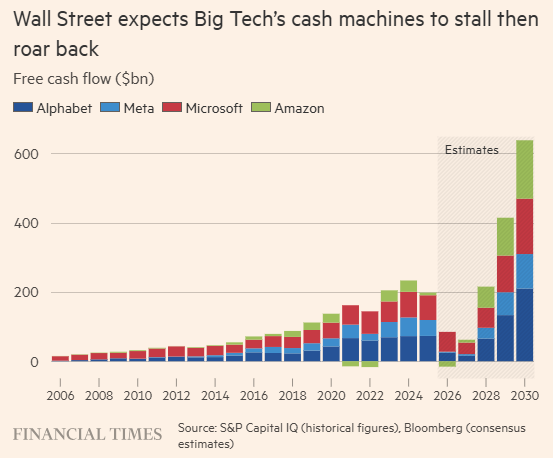
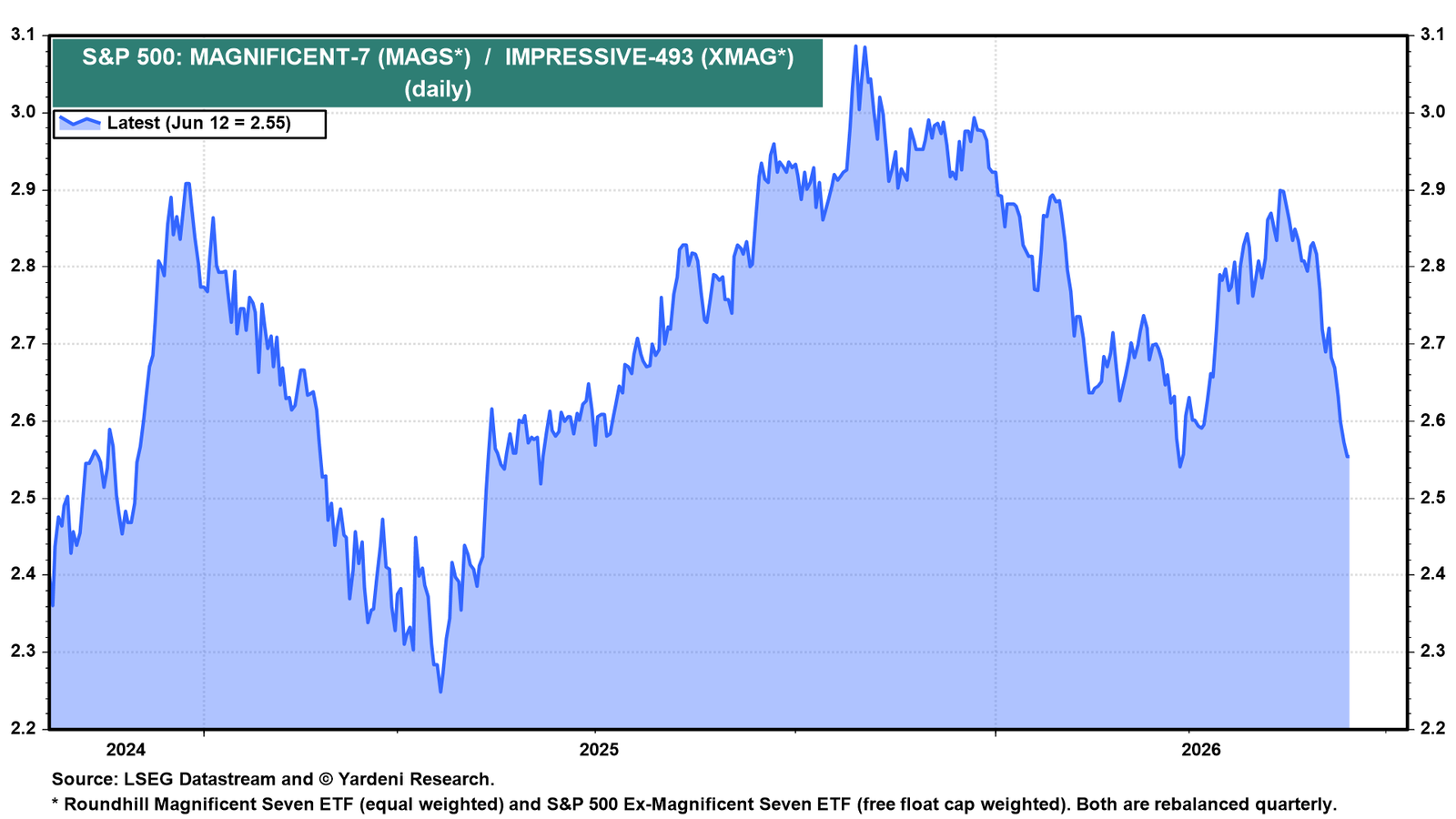
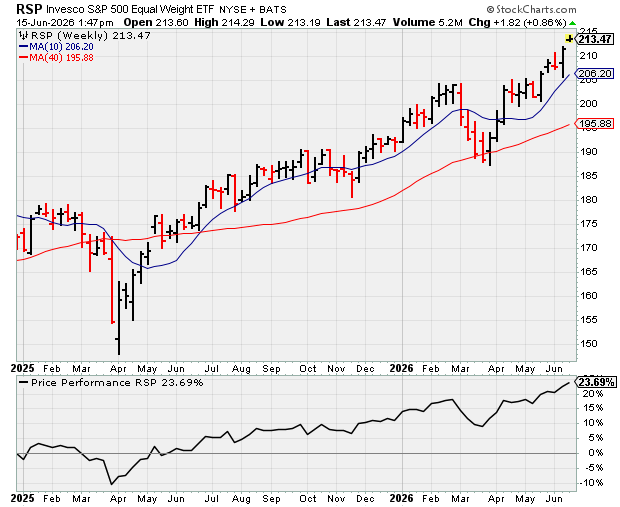
But in the meantime, investors are diversifying away from the Mag-7/Hyperscalers and into the companies benefitting from the products, services going into the data centers as well as the companies who will benefit from higher productivity…
You can see the benefit to AI spending tech winners in the holdings of the S&P 500 equal weighted index which made new all-time highs on Monday…
(Top 10: Sandisk, Dell, Intel, AMD, Seagate, Micron, Hewlett Packard, Humana, Western Digital, ON Semiconductor.)
StockCharts
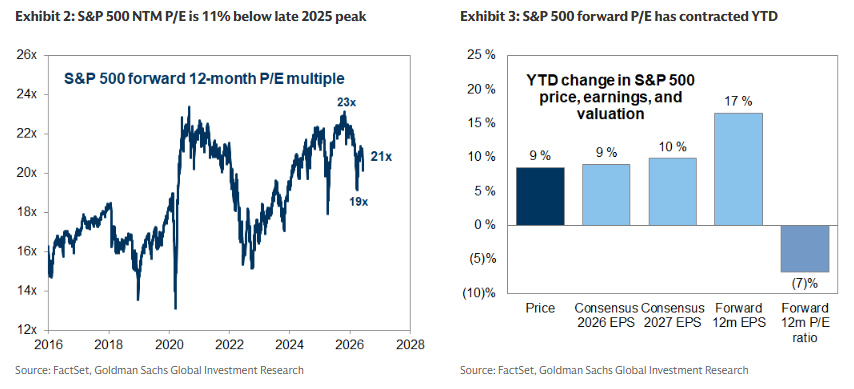
Also important to note that even as many market indexes return to their highs, their P/E's are not because earnings are growing faster than stock prices…
Following a volatile week, the S&P 500 has returned 9% YTD but trades at the same 21x P/E multiple as it did a year ago. The S&P 500 YTD return reflects a 17% rise in consensus forward 12-month earnings estimates alongside a 7% decline in the P/E multiple, from 22x to 21x. The current 21x P/E ranks in the 87th percentile since 1980.
Goldman Sachs
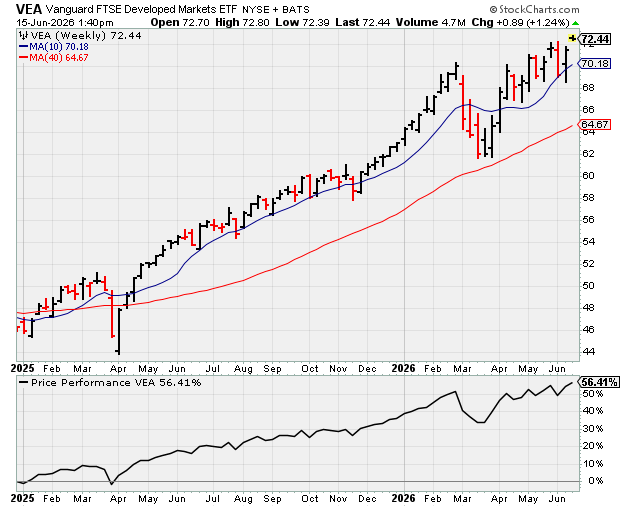
And with a Middle East settlement in hand and lower energy prices on the horizon, time for the European equity markets to set new record highs…
(Top 10: Samsung, ASML, SK Hynix, HSBC, Roche, AstraZeneca, Novartis, Nestle, Shell PLC, Royal Bank of Canada.)
StockCharts
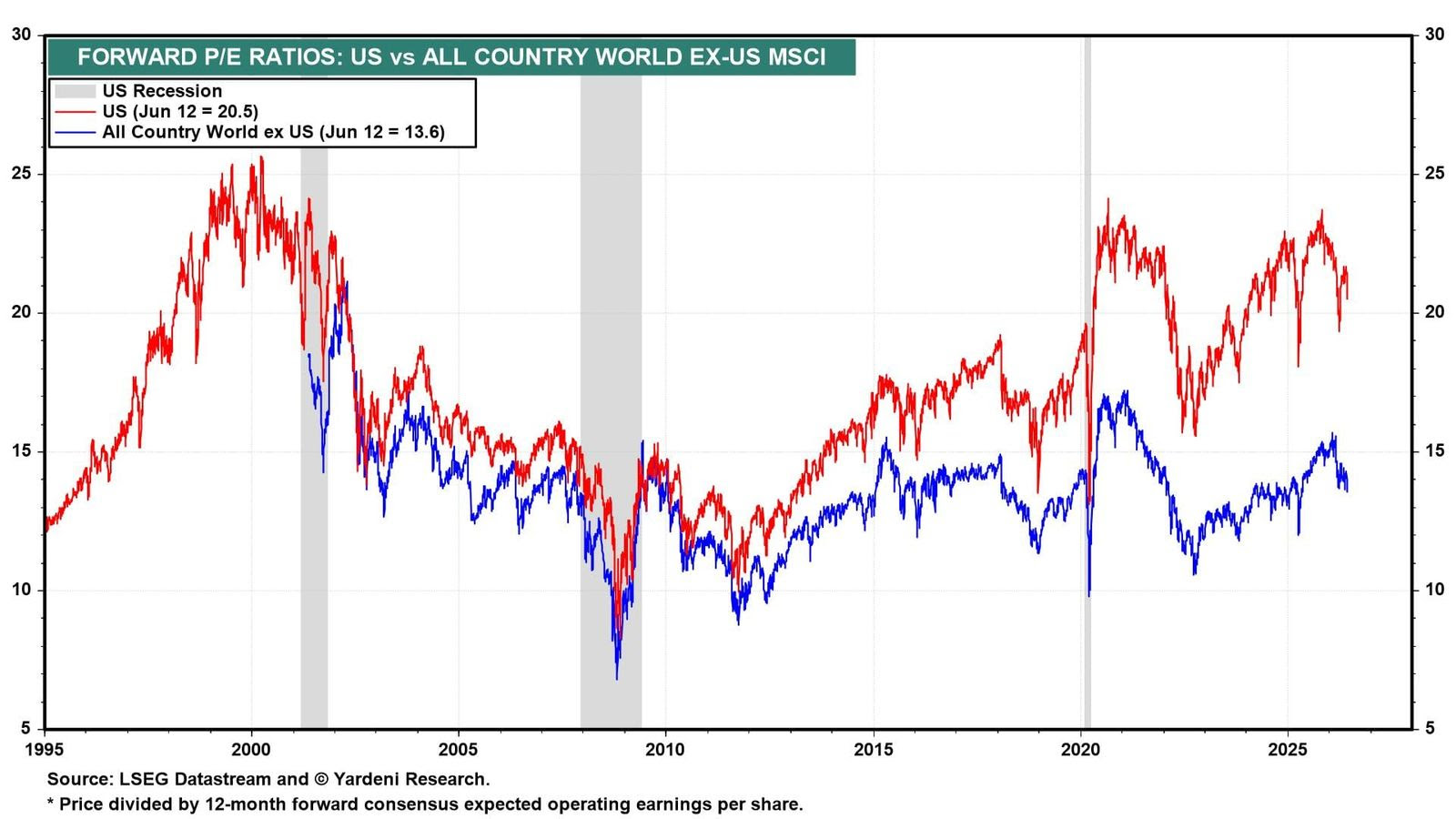
As you know, the ex-US valuations trail the US ones significantly so maybe time for a bigger catch up if the market moves toward faster, cyclical earnings growth overseas…
Based on forward P/Es, the ACW ex-US is much cheaper than the US MSCI (charts). The US is currently at 20.5, while the rest of the world is at 13.6. That's a 6.9 ppts spread.
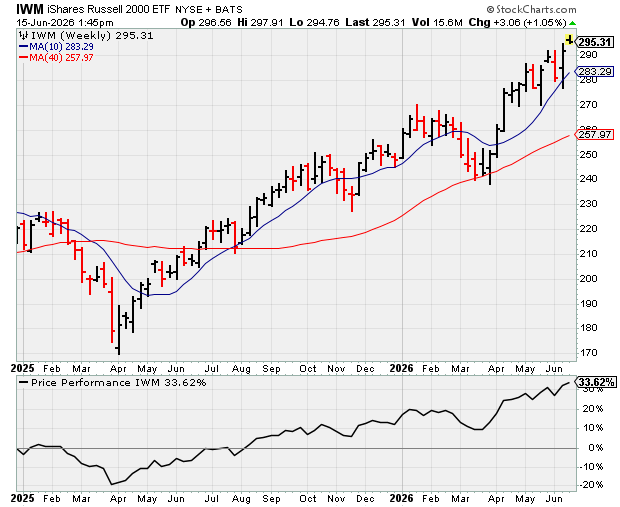
Small cap stock investors are already on it pushing the more cyclical and leveraged smaller company valuations to record highs…
StockCharts
Plenty of strong economy talk last week from the financial/banking stock conferences which should give you increased confidence to push into the more cyclical areas…
“I would say if we didn’t read any news and all we did was just really look at the data that we see in the economy and the data that we see on our portfolio, we have a really quite positive view....I think the consumer is really the strong shoulders the economy stands on. Unemployment continues to be very strong.” - Capital One CEO Rich Fairbank
“There’s more, I would say, concern and cautiousness than is what’s reflected in the general level of activity. I was joking around with someone recently and saying it’s kind of what you see broadly, whether it’s on the consumer side or on the business side, where the surveys, various surveys are reflecting considerably more caution than what we actually see in the numbers.” - Bank of America Co-President James DeMare
And an interesting banker comment about AI token usage at his company which could be relevant to many companies…
“I don’t think -- look, at the end of the day, if you just turn people loose to burn tokens, they’re going to burn tokens. And I think the bill for those tokens go up as they start pricing compute at even a breakeven cost, which they’re not today. A harness against your product development allows you to look at the problem you’re trying to solve and choose the best model to solve that problem. And in many instances, you don’t need the best model. You need the third-best model. Some models are better at mathematical computation. Some models are better at text reading and organization. Some models are better at simulation. So you got to figure that out, and you need to optimize your spend.” - The PNC Financial Services Group CEO William Demchak
Yeah, but insurance companies are so boring…
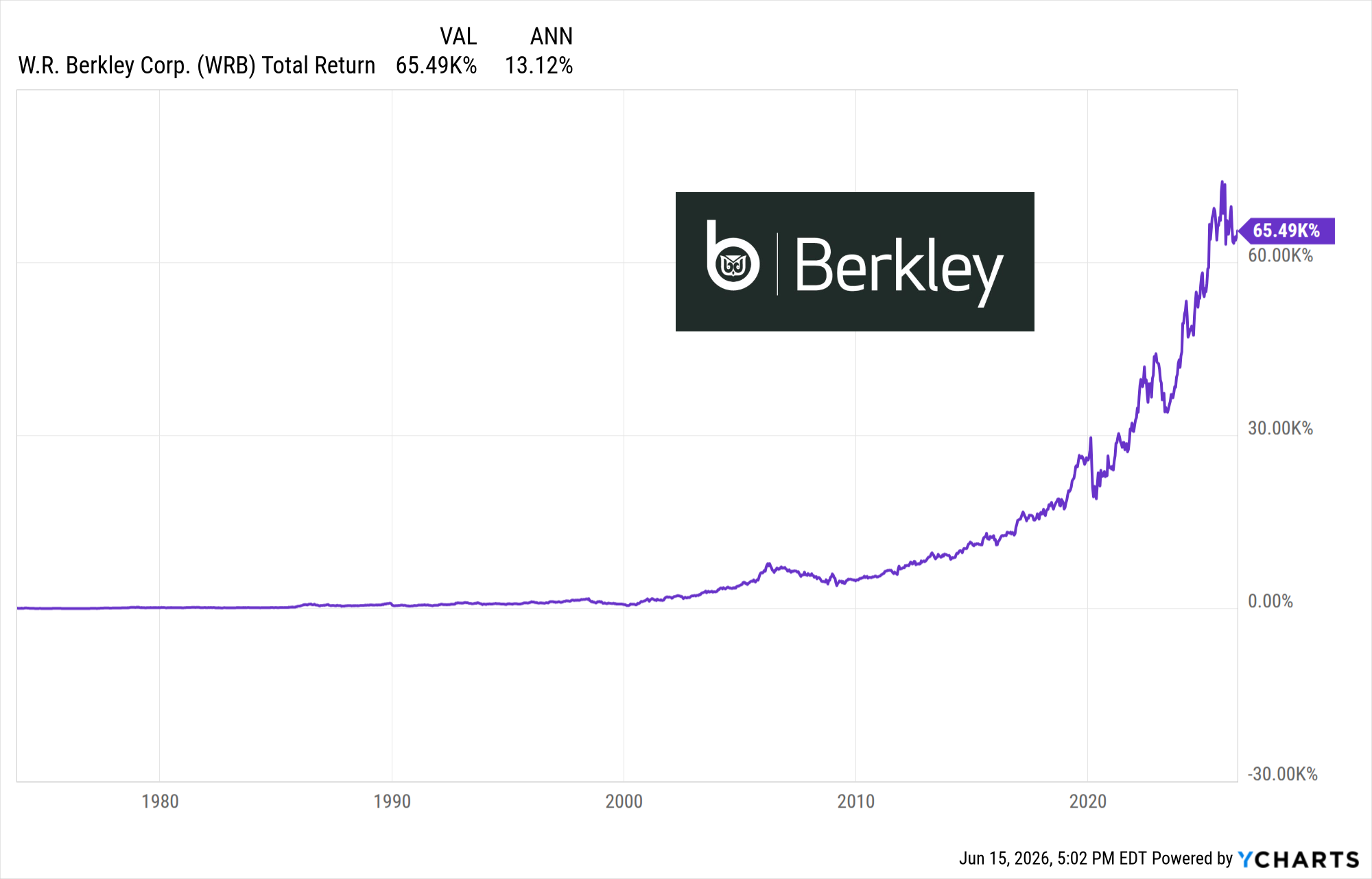
The financial markets lost a legend last week. Bill Berkley took his insurance company public in 1973. Over five decades, he expanded and grew that company to over 8,000 employees and compounded investor returns at over 13% per year. As an underwriter across many different lines of business, he had great visibility and insights in so much of the economy.
For comparison, the S&P 500 total return from 1990 to today has compounded at 10.8%.
Thanks for the time and profits Mr. Berkley.
YCharts
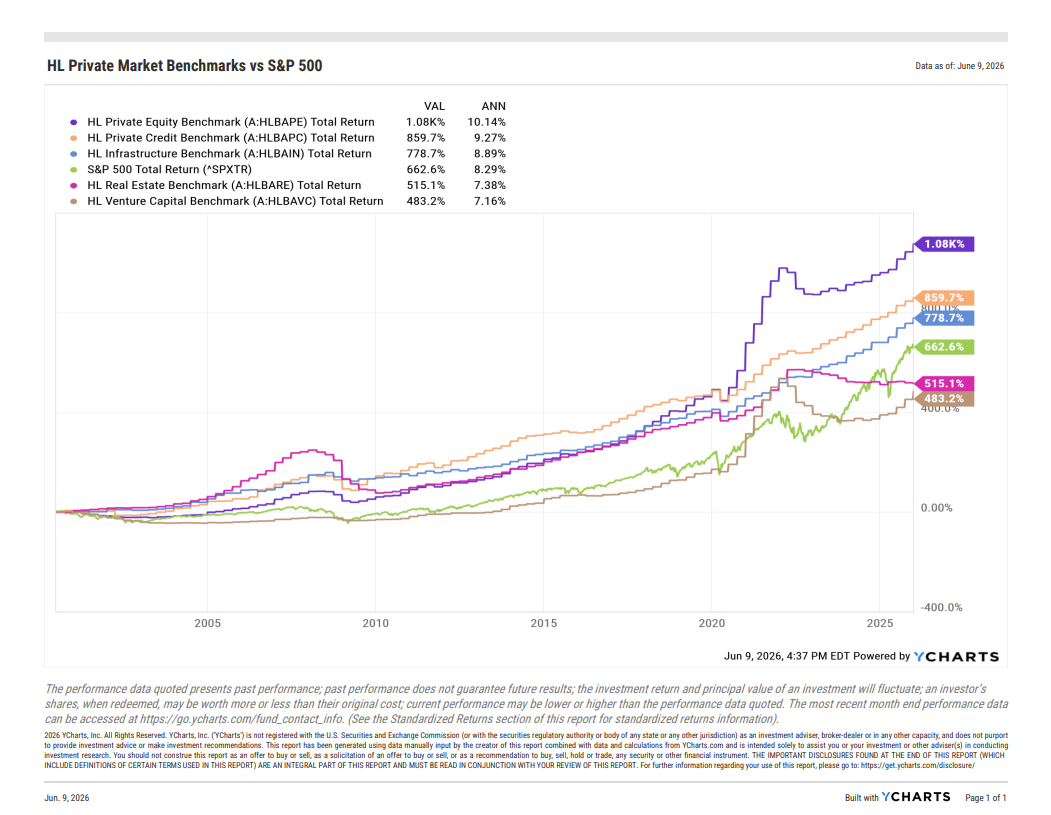
With the Q4 2025 private market LP fund numbers now in the books, our Hamilton Lane Private Market Benchmarks are now published in both YCharts and Bloomberg…
Here is an image of the 30 years of quarterly returns of our various benchmarks versus to S&P 500. Let us or your YCharts or Bloomberg representative know if you need help accessing the data series.
YCharts
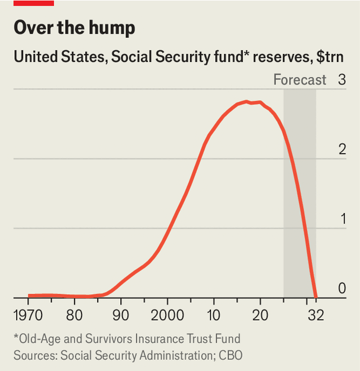
Finally, the Social Security administration released its annual report. The clock is ticking fast and the next Congress is going to be forced to deal with it whether they like it or not…
AMERICA’S SOCIAL Security trust fund for the country’s elderly citizens is now more than old enough to be drawing a pension itself. When the programme launched in 1940, its future must have seemed assured. Lots of money went in and little came out: for each retired person drawing benefits, more than 150 workers were contributing to the fund, which invested in Treasury securities.
Today, after years of demographic transformation—lower birth rates bringing fewer workers to the labour force, and longer lifespans for the fortunate recipients—the ratio of workers to recipients is less than three to one. In 2017 the reserves held in the trust fund peaked at $2.8trn. Since then, the fund’s size has dropped by $400bn, with more money leaving it in payments to retirees than has entered it in the form of contributions. Outflows are accelerating, and some time around the end of the next presidential term, in late 2032 or early 2033, the fund will run dry.
Washington has a little more than six years to find a remedy, which means that senators elected in November may still be serving their term when the fund runs out. If nothing is done, the immediate consequences for pensioners will be dire. Payments will drop by around 23%, and will slide further in the following decades.
Learn more about the Hamilton Lane Strategies
DISCLOSURES
The author has current equity ownership in: W.R. Berkley Corp.
The information presented here is for informational purposes only, and this document is not to be construed as an offer to sell, or the solicitation of an offer to buy, securities. Some investments are not suitable for all investors, and there can be no assurance that any investment strategy will be successful. The hyperlinks included in this message provide direct access to other Internet resources, including Web sites. While we believe this information to be from reliable sources, Hamilton Lane is not responsible for the accuracy or content of information contained in these sites. Although we make every effort to ensure these links are accurate, up to date and relevant, we cannot take responsibility for pages maintained by external providers. The views expressed by these external providers on their own Web pages or on external sites they link to are not necessarily those of Hamilton Lane.