

Market anchors in the Middle East are re-emerging as the struggle for the Strait of Hormuz continues. Monday's 8-10% jump in oil prices indicates that the Persian waterway is again closing to all traffic. This should push US gasoline prices back above $4 per gallon and also warn global airlines that jet fuel will again be in short supply. Maybe President Trump will detail more of his plans for the SoH and Iran in Thursday night's national address.
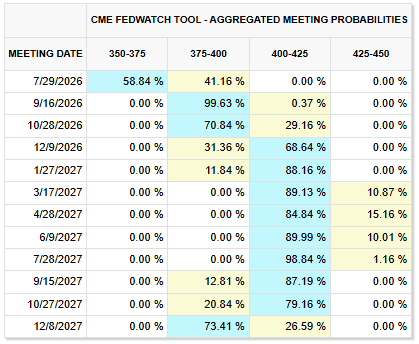
Rebounding energy prices will turn the heat up on the Fed as the end-of-month FOMC meeting approaches. The surprisingly strong US economy was already increasing the odds of a 25 basis point increase in the Fed Funds rate. Now, higher energy costs might just solidify that hike. Fed Governor Waller noted on Monday that the next meeting could be very actionable. The markets are putting the odds close to a coinflip.
Concerns are also growing regarding the projected returns on the trillions of dollars being deployed on AI capital spending. Uncertainty has risen as global memory chip stocks continue to swing wildly after Micron's better than expected earnings three weeks ago. The Korean stock market index is now in a 25% correction as both Samsung and SY Hynix are both in 30%+ retreats. This is occurring even with recently increased AI capex estimates from several leading Wall Street analysts. It feels like the story is shifting from 'If you build it, they will come' to 'If you build it, how much will they pay and what will the return be'. That answer could now dictate the future prices for over half of the market cap of the S&P 500. Furthermore, AI sentiment isn't helped by SpaceX returning toward its $135 IPO price from its peak of $225.
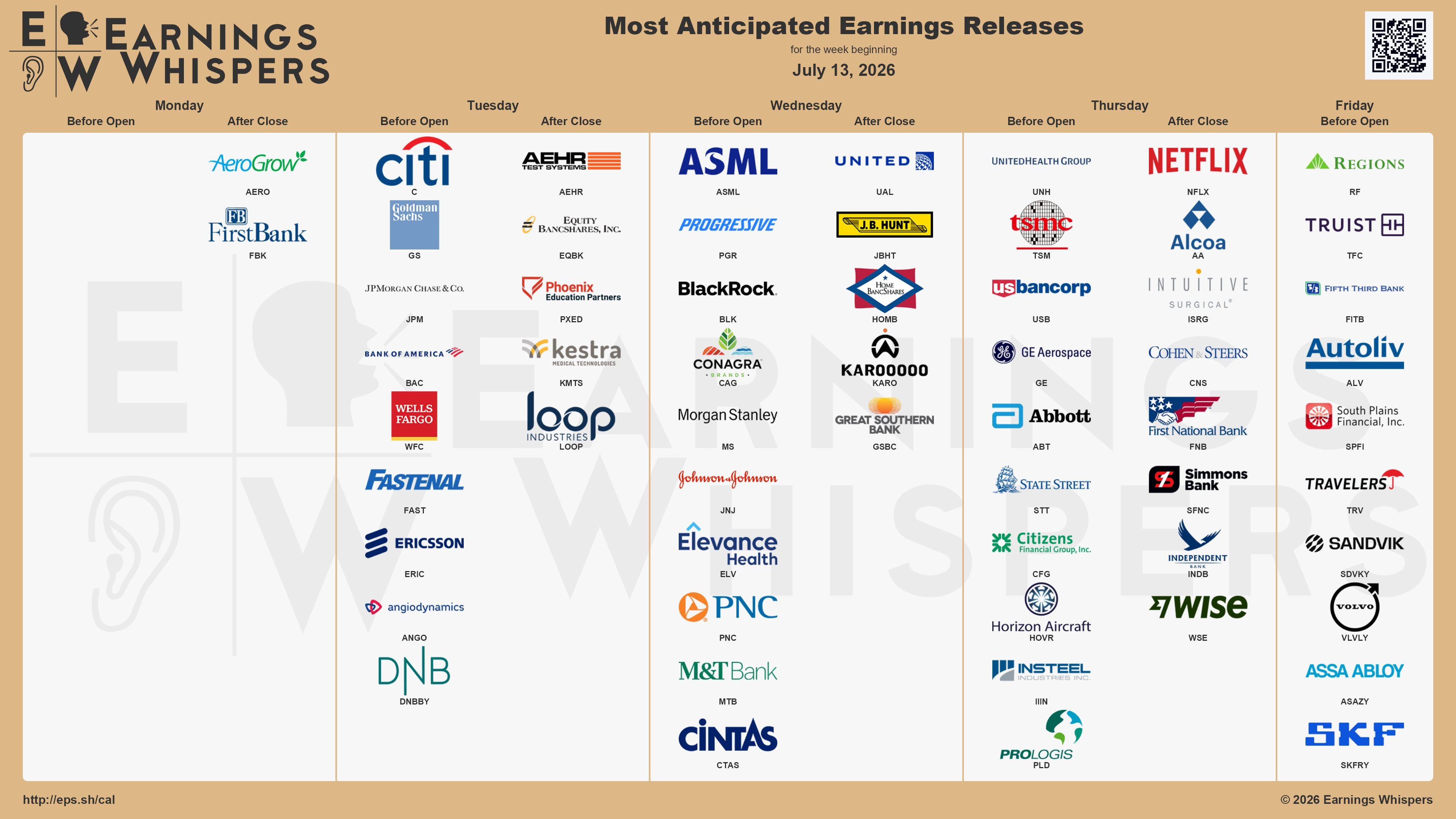
Could blowout Q2 earnings be the catalyst to free the market's anchor? We are about to find out as the big banks and financial companies report this week. But keep in mind that earnings expectations are much higher given the market's 10%+ move during the Q1 earnings season. Along with the earnings flood, this will be a big week for US data: CPI, PPI, Empire & Philly Fed, Retail Sales, Home Starts, Industrial Production, and UofM Consumer Sentiment. The quarterly Beige Book will be released along with a full slate of Fed speakers. So welcome back from vacation, get in your seat, and buckle up.
If my math is correct, this should be my 700th Weekly Research Briefing. Hopefully we have presented some helpful investment ideas to you over the past 15+ years. Thanks for reading and have a great week.
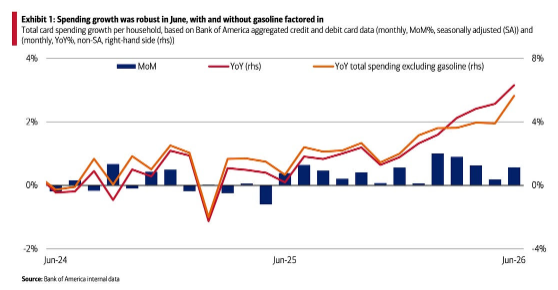
The US consumer economy is also having a high scoring summer as recent card spending growth shows…
Heading into the summer, consumer spending momentum was very strong, with total credit and debit card spending rising 6.3% year-over-year (YoY) in June - the strongest growth in over four years - according to Bank of America internal card data. With gasoline prices falling, the increase in spending growth is almost entirely a discretionary story.
BofA Global/Sam Ro
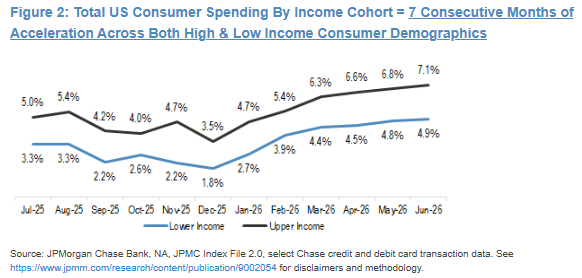
Equally important is that spending is accelerating across the board…
J.P. Morgan
Evidence of strengthening industrial activity also from a major distributor…
“I think we’re probably in sort of third inning if I -- that might be conservative, but we are starting to see changes in behavior. So the most notable now that we haven’t sized yet, but we’re watching closely is summer shutdown patterns are changing significantly. So whereas we would have had preplanned shutdowns, particularly in automotive, those are being canceled. Those are not -- or they’re not being announced as they would have been. So it’s still spotty, but it’s real. And so I think that’s probably the best indicator that we have.” - MSC Industrial Direct CEO Martina McIsaac
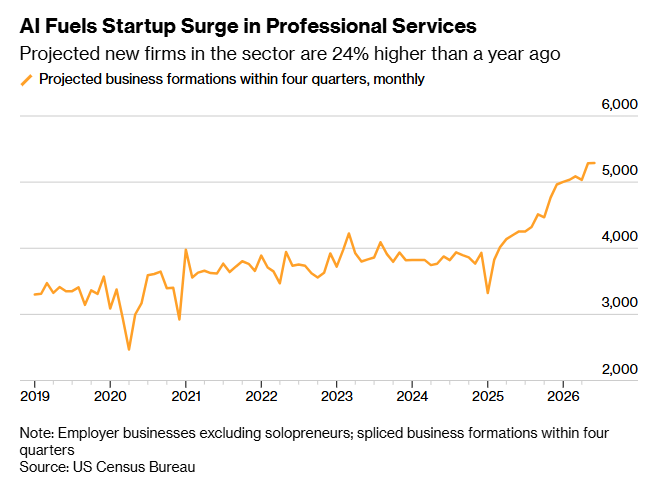
And AI appears to be a significant help to new small business formation figures…
“AI is like the next-generation force multiplier for small businesses,” said van Zyl, head of Askari Defense Inc. in Atlanta.
Nationwide, economists say we’re seeing a second wave in the business formation boom that started in the Covid-19 lockdowns, when worried and laid-off workers rushed to start their own businesses. Only this wave appears closely correlated with AI’s growth, economists say, with the strongest gains in sectors amenable to AI usage, such as professional services.
Across all industries, the US Census Bureau projects 29,700 new businesses will form monthly within a year, based on initial IRS paperwork filed by entrepreneurs. That’s 17% more than formations projected a year ago, based on June data published Thursday.
The AI-friendly professional services sector (architects, lawyers and advertisers) is expected to see even faster growth, with more than 5,000 companies formed monthly over the coming year, a record in data going back to 2004 and 24% more than a year ago.
Economic strength could very easily push the FOMC to hike rates in two weeks…
US activity is picking up along with an extra free kick from the World Cup. If the Fed doesn't lift at the next meeting, then the markets are locked for an increase at the September meeting.
Fed Governor Waller confirmed on Monday that the July meeting could be actionable…
Federal Reserve Governor Christopher Waller said policymakers may need to raise rates in the near term if underlying inflation continues to signal broad price pressures.
“If we get another hot reading on core inflation this week, then the FOMC will need to consider tightening monetary policy in the near term,” Waller said Monday, referring to the central bank’s rate-setting committee, in remarks prepared for an event in New York…
“No matter how you cut it, or what measure you want to use, inflation is up this year,” Waller said. “At this point, I am concerned about the elevated pace of core inflation.”
He pointed to the version of the Fed’s preferred inflation gauge that strips out volatile food and energy components. The core personal consumption expenditures index hit 3.4% in the year through May. It began rising in January, Waller said, before the US-Iran war began, and “has steadily moved up.”
US economic strength is also evident in the extreme tightness of High Yield corporate spreads…
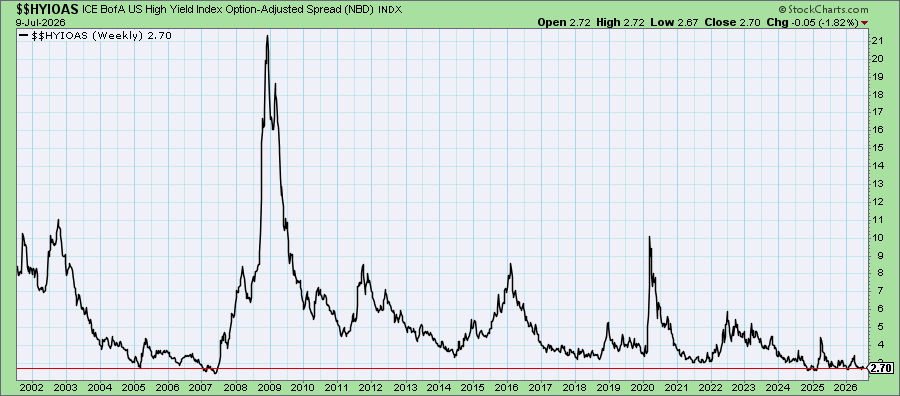
StockCharts
Along with the rabid demand for credit, US equity issuance is also soaring…
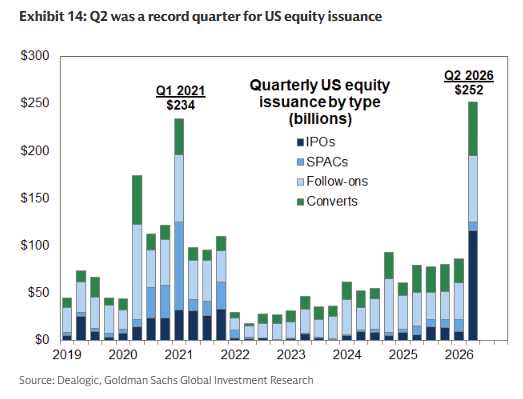
Goldman Sachs
Demand for stocks is no longer confined to only an AI outperforming story…
Small Cap value continues to outperform Large Cap growth companies as the market broadens from the hyperscalers toward the future beneficiaries of AI usage.
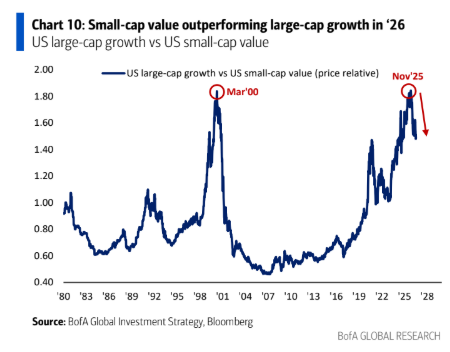
BofA Global
The market environment for passive ETFs has shifted toward one of active equity management…
Stock-to-stock correlation inside the Russell 1000 just touched levels seen only a handful of times in ~40 years. A quiet index $SPX. A loud tape w/ winners and losers canceling each other out. Think alpha vs beta.
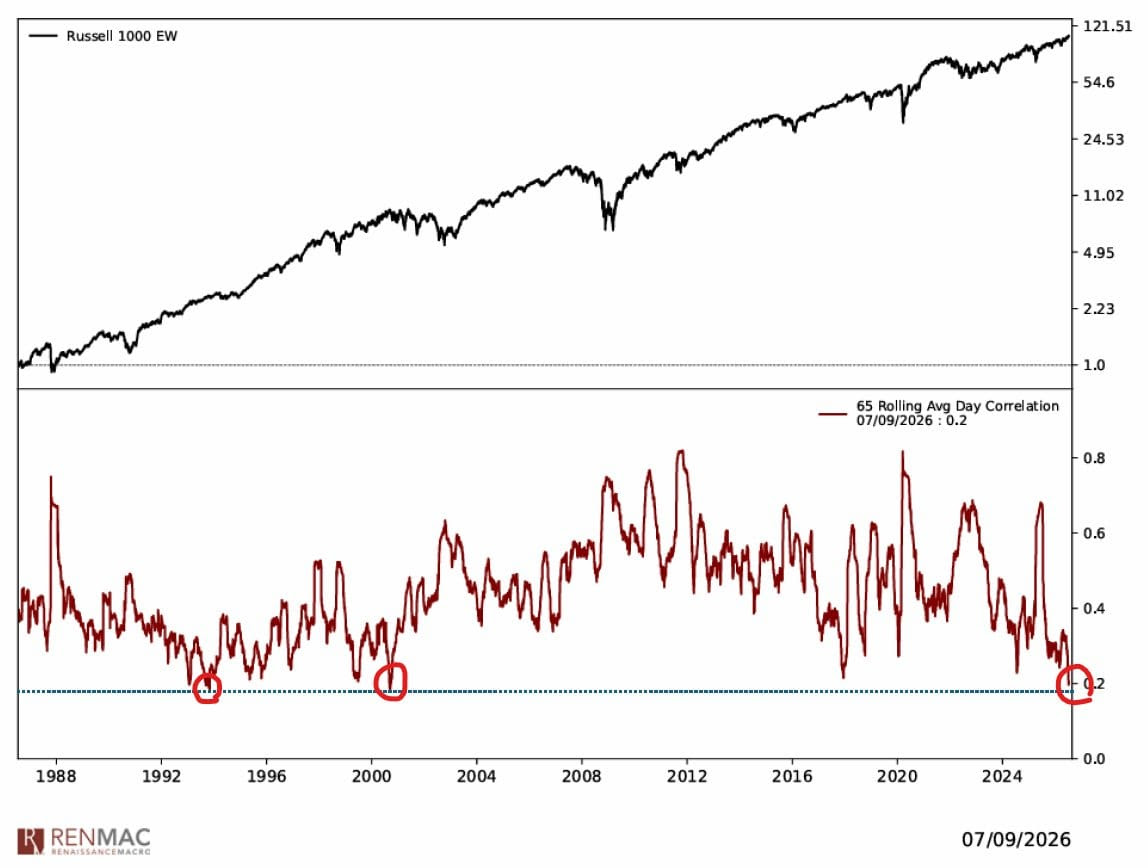
@RenMacLLC
Time for the Q2 earnings season to begin…
@eWhispers
As AI capex dollars roll through the US economy, many farmers and ranchers are hitting the lottery with their large pieces of rural acreage…
SALEM TOWNSHIP, Pa.—When land developers drove to Marilee and David Kiliti’s farm two years ago, the couple invited them into their home, sat them down and sliced up some deer bologna.
The men told the Kilitis that their 89-acre farm in this rural town of 4,000 might be worth more than $20 million. To Marilee and David Kiliti, that ridiculously high price sounded like a bunch of deer bologna.
The couple thought the fields where the family raised and butchered hogs would be lucky to fetch even a fraction of that. Unlike other parts of the state, there was no oil or natural gas in the ground.
But the developers had no interest in farming or fuel. The Kilitis’ land was worth a fortune—more than $22 million—as the future site of a data center…
The Kilitis are one of 96 families in Salem Township, an unassuming community in the northeastern part of Pennsylvania, who collectively sold about 1,700 acres to a single data-center developer, QTS, an arm of the investment firm Blackstone. The families sold for an average of $330,000 an acre and earned $5.5 million on average. The total sale price was $586 million.
And of course the Bay Area real estate markets continue to have lifting bids…
San Francisco’s pandemic-era doom loop has been replaced by a land grab, driven in part by anxiety about how artificial-intelligence wealth will impact home buying.
“It’s definitely the Wild, Wild West,” said David Cohen, founder of City Real Estate. “The market has had a huge influx of new demand.”
Buyers are rushing to front-run anticipated IPOs from giants like OpenAI and Anthropic, local real-estate agents said. “For many people not in AI, the feeling is, ‘If we don’t get in before the big AI IPOs, we’re going to miss our window,’” said Kate Tomassi, an agent at Sotheby’s International Realty – San Francisco Brokerage.
In reality, AI money is already flowing, agents said. Wealth is rippling across the entire AI ecosystem, from hardware manufacturers to AI developers. Some employees at leading, still-private AI companies are already armed with liquid cash from secondary-market transactions and novel arrangements with local lenders.
“I’ve got junior guys who are selling secondary shares and buying $10 million homes,” says Phil Chen, a real-estate agent at Christie’s International Real Estate Sereno. Tomassi adds, “The money is real, and it’s a lot of cash.”
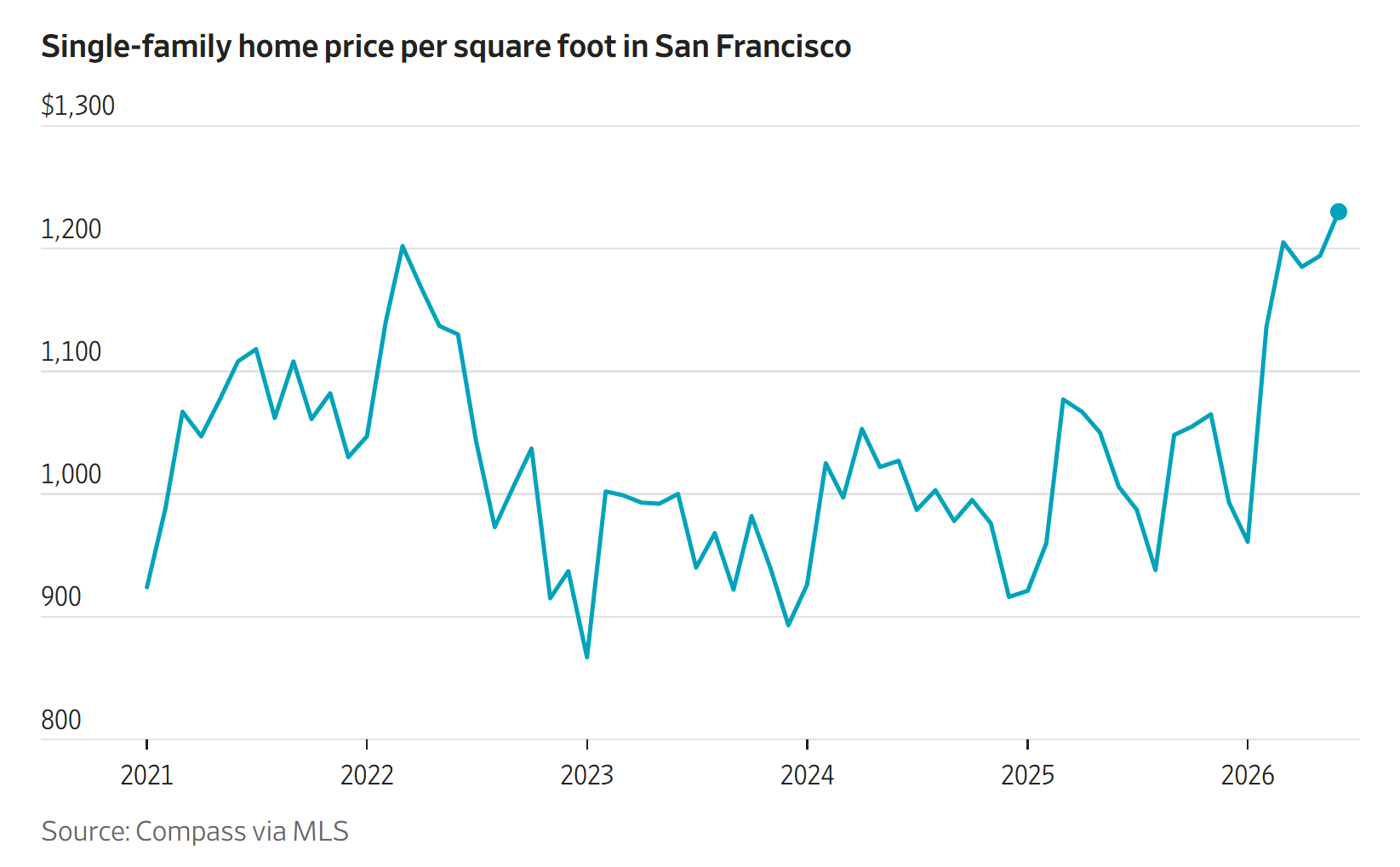
Redfin even calculated that the next two mega-IPOs could provide employees with an amount equal to 1/3 of all home value in San Francisco…
With the wealth created through the two massive AI public offerings coming down the pipeline, current and former employees of OpenAI and Anthropic could buy nearly one-third (29%) of all homes in San Francisco, where both companies are headquartered. That’s not just homes listed for sale–it’s 29% of all homes in the entire metro area…
SpaceX employees could hypothetically pool their IPO windfall to buy roughly 40% of all the homes in San Antonio, one of the closest major metros to the company’s Starbase, TX headquarters, according to a separate Redfin report. The total value of all homes in San Antonio was roughly $297 billion in 2024; we estimate SpaceX employees hold roughly $200 billion in equity at the midpoint of our 10–15% ownership estimate, which comes to $120 billion post-taxes.
Hmmm. Crypto bros pivoting to AI data centers…
Rather than betting on the next breakthrough technology in artificial intelligence, Novogratz wants to own the very infrastructure the industry relies on, by staking his claim in Texas.
That conviction about grid-connected power — as well as the turf and data centers built on top of it — is transforming Galaxy into an AI infrastructure landlord alongside its existing crypto businesses.
“It’s the simplest part: get power, find a good tenant, lease it, borrow the money and build it and then you’re a landlord,” Novogratz said. “For me, I want to get as much power as I can and I want to get it leased as quickly as I can because after that I am just a rent collector.”
Galaxy is not the only crypto company to pivot to AI during a prolonged rout in Bitcoin — far from it. A growing number of firms have been seeking fresh opportunities in AI as their native businesses have become less lucrative.
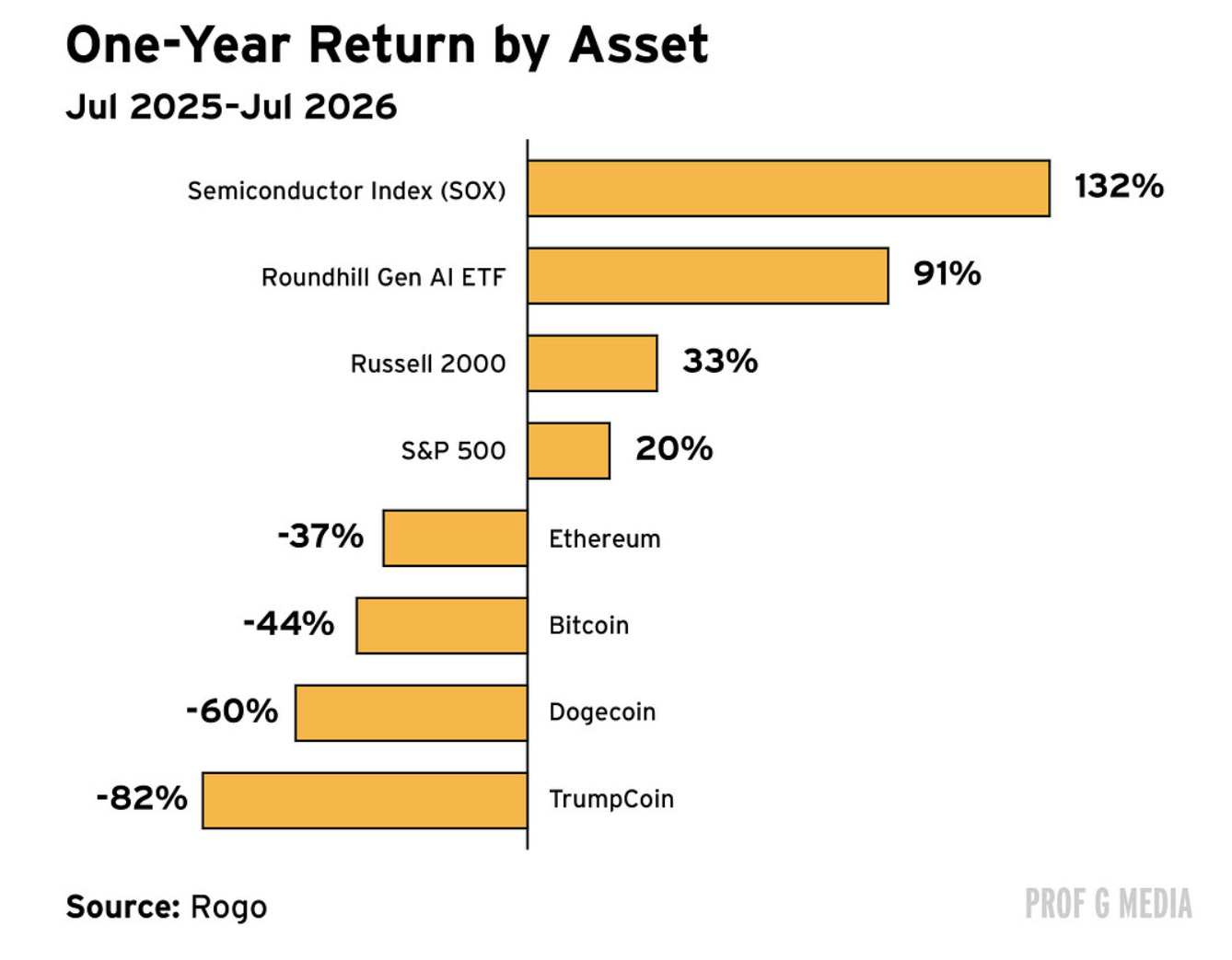
Or said another way "The Great Brotation"…
The crypto market has now erased more than half of its value in the past eight months, and bitcoin ETFs have seen $8 billion in outflows in the past eight weeks. Meanwhile, AI has become the new frontier. It’s the technology people are most excited about, and it has captured the same sense of disruption and possibility that crypto once represented.
Meta equity raise coming after earnings in two weeks?
The Facebook/Instagram/WhatsApp on Monday increased its mega AI data center size and cost significantly.
The company said in a blog post on Monday that the site in Richland Parish, Louisiana — home to what will be Meta’s largest data center — will be a 5GW facility and cost over $50 billion. That’s higher than the $27 billion figure that was revealed in October, when Meta and Blue Owl Capital formed a joint venture to help with the buildout and management of the facility, originally planned as a 2GW data center.
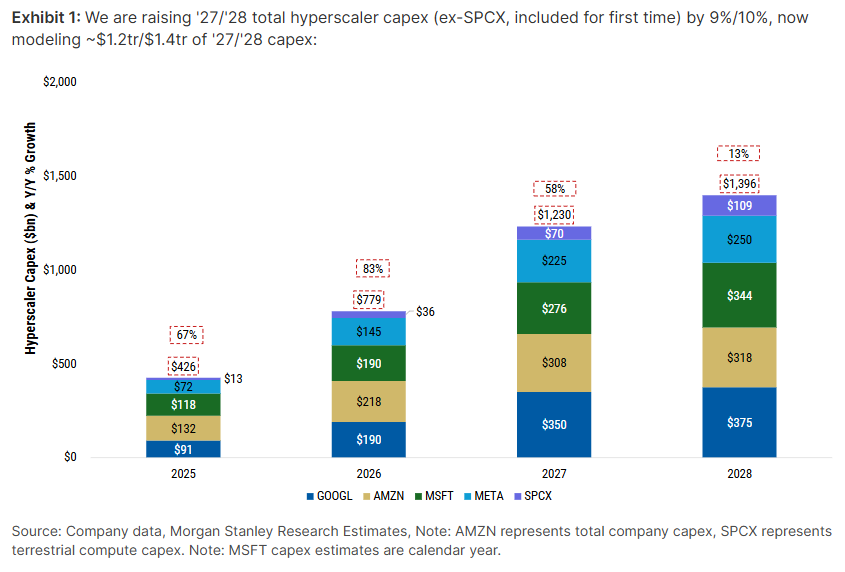
As a result of recent hyperscaler announcements combined with higher construction and build costs, AI capex figures are again on the rise…
These estimates are from Morgan Stanely. Goldman Sachs, BofA Global and others have also raised their figures this month.
Updated bottom up cost per GW and rising forward capacity expectations cause us to raise hyperscaler capex to $1.4t in '28 painting a path to 120 GW (from 30 in '25)… We have written extensively about the rising value, strategic importance and monetization optionality associated with access to compute. In effect, limitations on chips/racks, powered shells and other bottlenecks are stretching timelines from breaking ground to opening data centers to as much as 3 years. Furthermore, we also believe growing social backlash to data center development and political uncertainty into the '28 presidential election are causing hyperscalers to start building sooner to emphasize job creation. This adds even further to inflationary pressures.
Morgan Stanley
Now to pay for it: Investment grade debt supply is being driven by AI, Banks & M&A…
The entire +33% jump in US IG supply YTD has been driven by three sectors: AI, M&A and banks. Away from those three categories, IG supply is mostly unchanged from 2025 (Exhibit 7, Exhibit 8). That makes sense, as downside risks to supply created by higher borrowing costs and strong earnings offset the upside risks to supply created by +$39bn increase in maturing debt in 2026 relative to 2025. That suggests these three sectors should continue driving incremental issuance volumes in 2H-2026 as well.
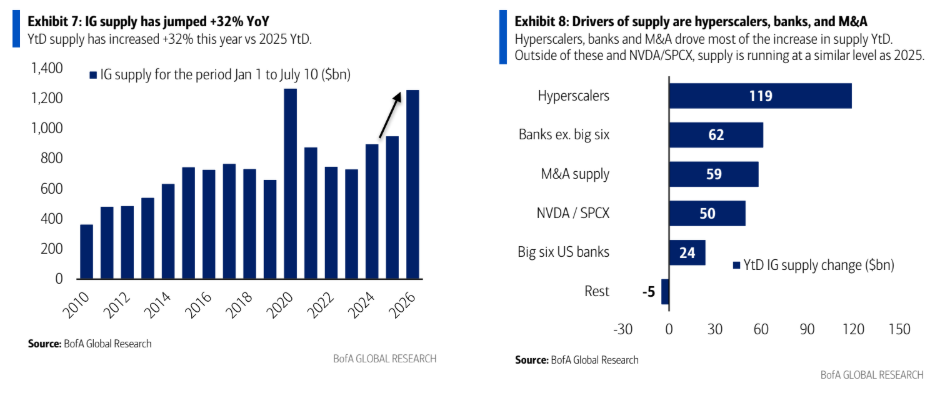
BofA Global
This year's hyperscaler debt has been bought, but the prices paid are getting more expensive…
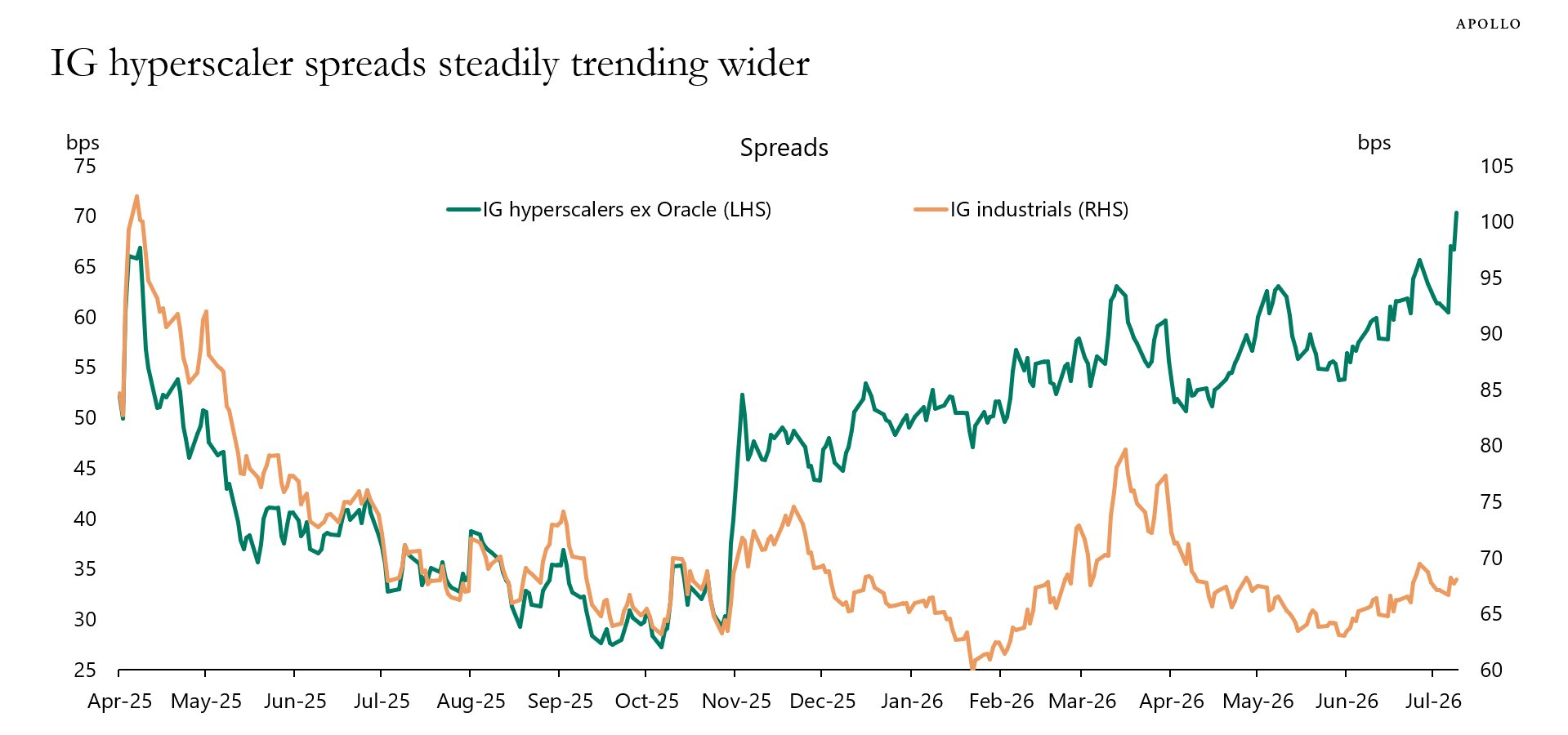
Something to chew on: Silicon Valley has historically funded the growth of money losing products, but is this one too large to float?
“We still need visibility for when AI revenues will start to fund much of this cash need. Expect more advertising plays from LLMs, Token prices have to decline to drive Enterprise adoption. Expect LLMs to chase more vertical profit pools, legal, life science, expecting physical AI companies. Pure models will continue to see arbitrage with open source touching 30% usage, depth will create a better moat, breadth will commoditize. It’s not a demand problem - ‘it’s a monetization problem’. Silicon valley has always built product with intensity and the market has funded adoption years. This time it might just be too big and the market may not have capacity to fund everyone. ‘Darwinian moment for AI providers?’” - Palo Alto Networks CEO Nikesh Arora
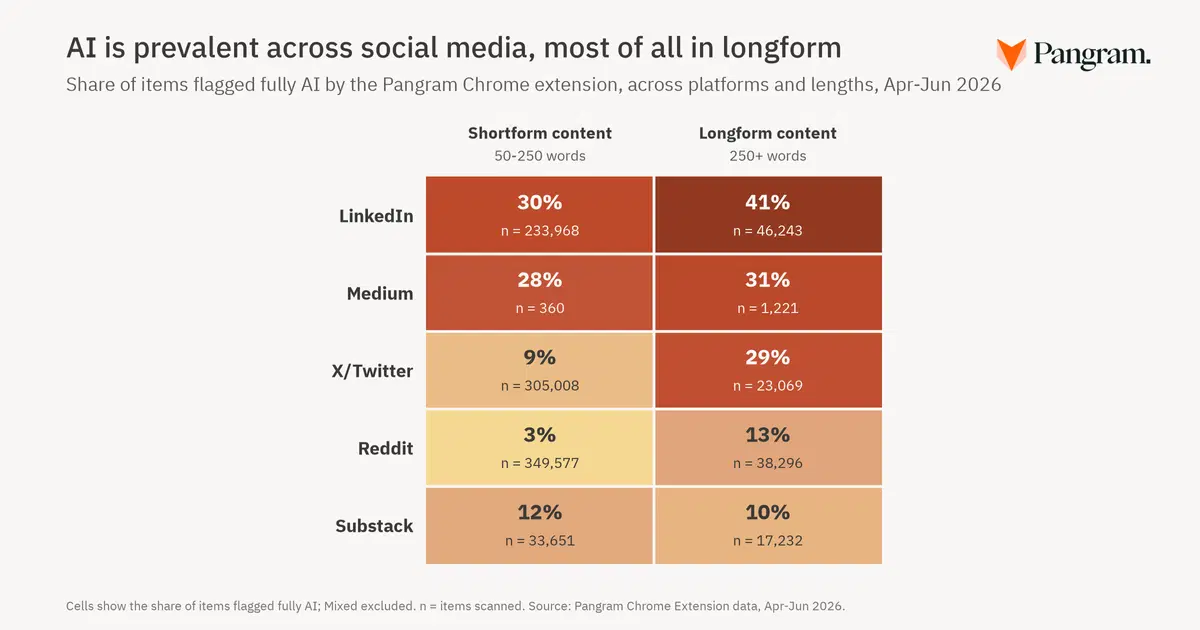
If LinkedIn doesn't solve its AI content problem, it might soon become Microsoft's next restructuring problem because users aren't going to read AI slop…
AI-generated content appeared across all social media platforms in our data set. The average AI rate across all scanned items was 13.8%, but specific rates varied by platform and item length. On four out of five platforms, longer content was more likely to be AI-generated than shortform content. Across all platforms, one in four longform items (25.72% of items over 250 words) were fully AI-generated.
Substack was an exception; there, the rate of fully AI-generated content remained fairly flat, and longer, more substantial posts were actually slightly less likely to be AI-generated compared to shorter ones.
LinkedIn was the most AI-saturated platform, where more than 40% of longform posts flagged as fully AI-generated. However, if we included mixed AI and human content, X/Twitter was the worst off: almost half of X articles were either fully AI-generated (23.9%) or AI-assisted/mixed (22.9%), with only 53.2% of X articles flagging as fully human-authored.
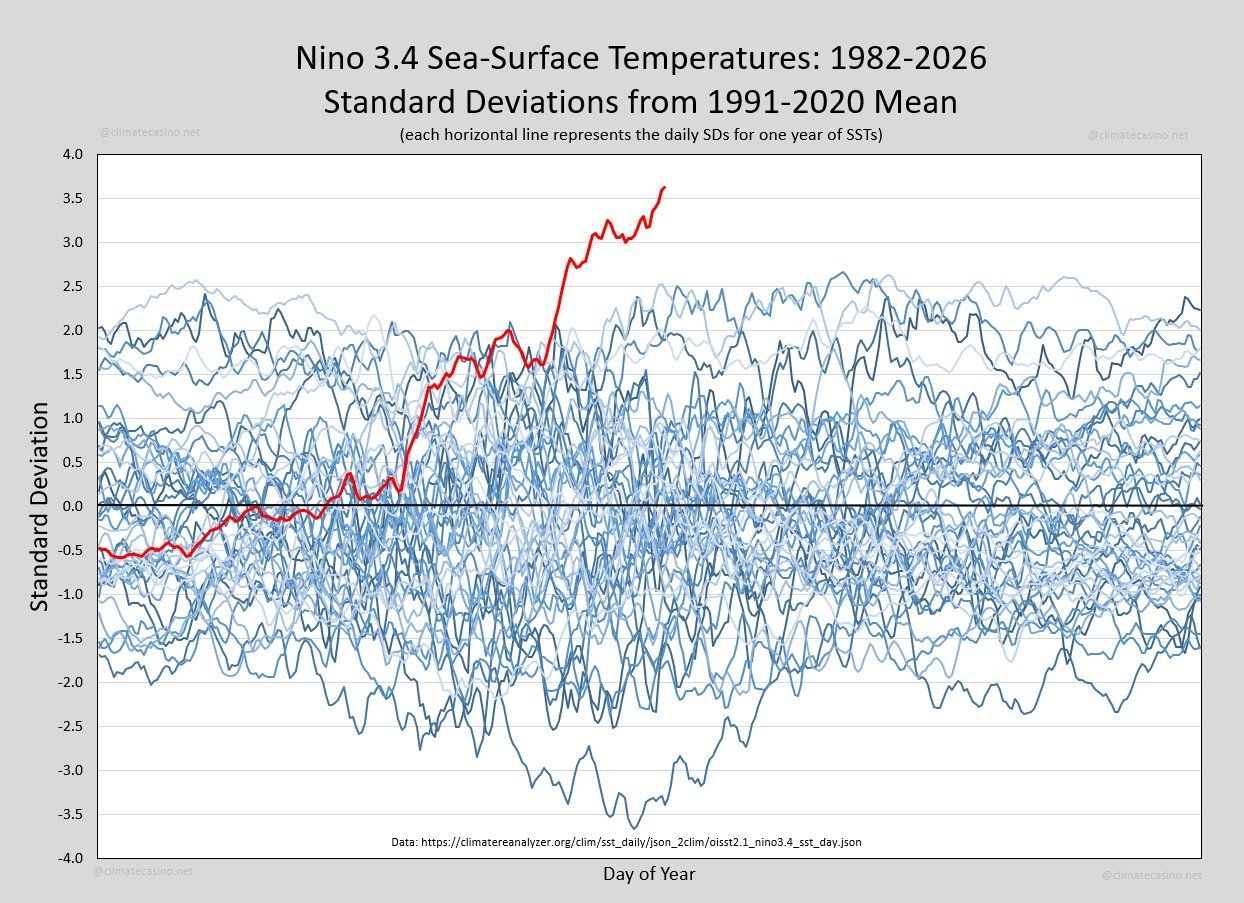
I saw all-time record high temperatures in Wyoming this weekend…
If it feels like your summer temperatures feel a bit different this summer, blame the Pacific Ocean. Then send it some ice cubes.
@JuanBordera
El Nino should lead to a lower Atlantic hurricane season…
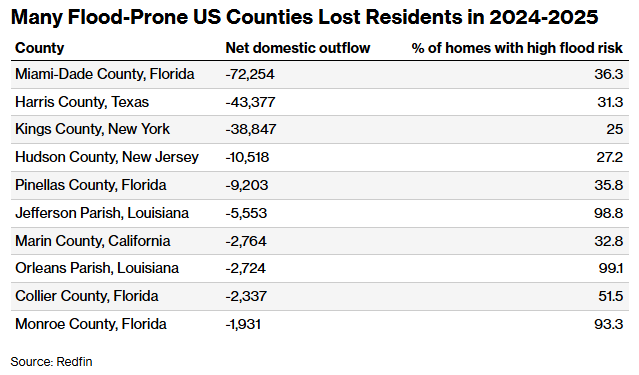
Maybe 2026 is the year to sell and move to higher ground.
Americans are leaving some of the nation’s most flood-prone communities at an accelerating pace, suggesting that climate concerns are beginning to influence migration decisions alongside more traditional factors such as housing costs and quality of life.
High-flood-risk US counties — those classified in the top 10% for their share of homes that are very vulnerable to flooding — lost a net 63,357 domestic residents from mid-2024 to mid-2025, nearly double the outflow recorded over the previous 12-month period, according to an analysis released Wednesday by real estate brokerage Redfin. In 2024, flood-prone counties collectively posted a net population loss for the first time in five years.
Meanwhile, counties with relatively low flood risk gained nearly 70,000 residents on net, the largest increase since 2018…
“Affordability is still the primary reason people move, but affordability and climate risk are becoming more tightly linked,” Redfin Chief Economist Daryl Fairweather said. Rising insurance premiums and homeowners association fees, and maintenance costs associated with extreme weather, are increasing the cost of owning a home in flood-prone areas, she said.
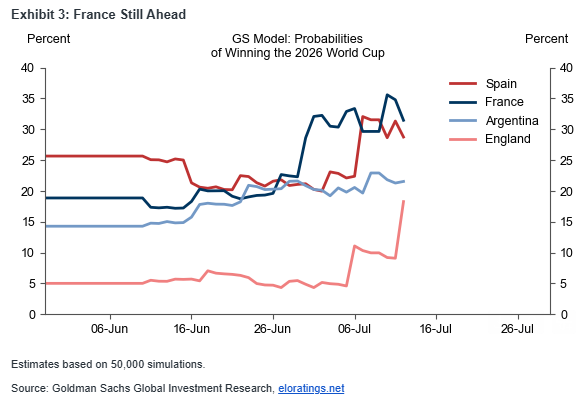
Finally, even with all the World Cup matches, three of the four favorites made it through to the finals…
That was a pretty good WC. Hopefully you made it to a game or watch party. Good luck to your final team.
Goldman Sachs
Learn more about the Hamilton Lane Strategies
DISCLOSURES
The information presented here is for informational purposes only, and this document is not to be construed as an offer to sell, or the solicitation of an offer to buy, securities. Some investments are not suitable for all investors, and there can be no assurance that any investment strategy will be successful. The hyperlinks included in this message provide direct access to other Internet resources, including Web sites. While we believe this information to be from reliable sources, Hamilton Lane is not responsible for the accuracy or content of information contained in these sites. Although we make every effort to ensure these links are accurate, up to date and relevant, we cannot take responsibility for pages maintained by external providers. The views expressed by these external providers on their own Web pages or on external sites they link to are not necessarily those of Hamilton Lane.