
Weekly Research Briefing: Odd and Bizarre

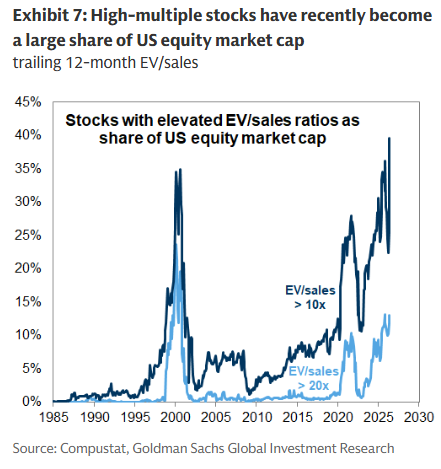
Stock markets hit record highs yet skepticism remains. A record 40% of the S&P 500 is trading above 10x enterprise value to sales, but the AAII investor survey shows more bears than bulls. Credit spreads are near all-time lows yet private credit firm valuations are trading 30-60% off their highs. The Strait of Hormuz remains closed, global reserves are heading toward critical levels, and yet crude oil trades below $100. Inflation is up, while Bitcoin and Gold are down.
Optimism about future earnings drove the markets to last week's highs. AI-related sectors and exposed companies did most of the work, but other businesses are now seeing an acceleration. Just take a look at Fastenal, Host Hotels & Resorts and even Macy's. Friday's volatility spike and the market's 2.5% sell-off might suggest that the upward move was too quick. Sure, 1,000 S&P 500 points in four weeks is a big deal, but it is also a signal of market strength.
Last Friday's better-than-expected payroll data provided a good test for the market. As the labor market strengthens and inflation grows, the US equity market must prepare for Fed Fund rate increases. If it can absorb increased interest rate expectations, it should have no problem absorbing a trillion dollars of IPOs and secondary deals headed its way. SpaceX was the big IPO expected to be bought and traded this week, but Alphabet jumped the line with its own $85 billion equity deal last week (anchored by Berkshire Hathaway). And now Meta is looking at a significant fundraise which can only mean that Microsoft and Amazon are also looking at equity raises to pair with their significant debt deals to fund their data center buildouts. Bottom line is that your hyperscaler capex figures are too low.
One surprise last week was S&P's decision to stick by its index inclusion profitability hurdle which disqualified SpaceX from this year's inclusion. If the IPO launches from its IPO price, active managers and other index includers will have the last laugh. But S&P plays the long game. The big index may have missed Amazon from its 1997 IPO to 2005, but the index caught the move from $2 to its current value.
Besides the biggest IPO of all-time, the market will also receive data on the CPI and PPI which could help determine future interest rates. The US Treasury will watch closely as it brings its own basket of 3-yr, 10-yr and 30-yr bonds to market. The ECB will also look to raise interest rates this week as an insurance policy against its rising inflation figures. And on Thursday, football fans will rejoice as teams take the pitches across North America. Let's see if any other teams can crash the Spanish, French, Argentinian and Brazilian party. Have a great week.
Friday's action left a mark. Monday's bounce was uneventful as MidEast tensions interrupted…
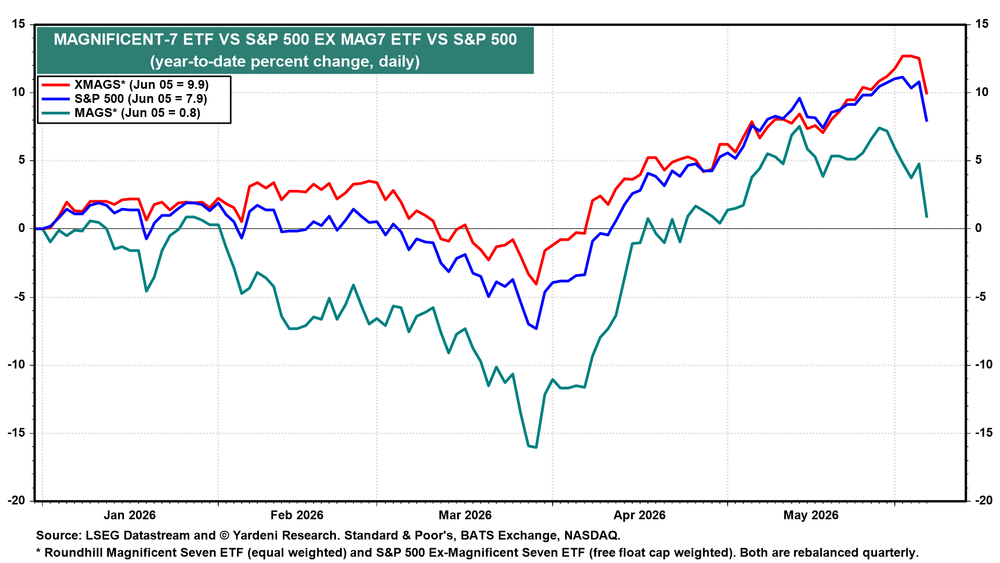
The Magnificent-7 stocks took the brunt of the hit on Friday, along with tech hardware and semiconductor stocks. Year-to-date through Friday, the Roundhill Magnificent Seven ETF is up just 0.8%, while the S&P 500 excluding the Mag-7 ETF is up 9.9%, ahead of the cap-weighted S&P 500's 7.9% (chart). The “493,” i.e., the rest of the S&P 500 stocks collectively, is holding up.
The main fuse to Friday's sell-off was the stronger than expected US payroll data…
Great news that the data was stronger. But difficult news if you are an employer trying to hire in a 4.3% unemployment rate environment. Say goodbye to any future Fed Fund rate cuts and prepare for hikes as the UE rate heads toward a 3-handle.
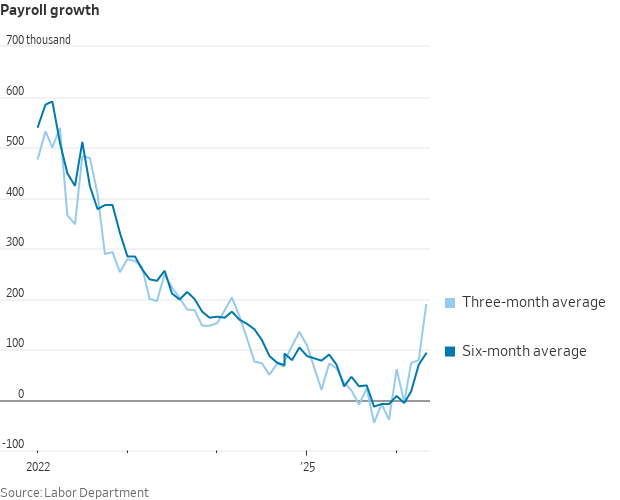
@NickTimiraos: The U.S. economy added 172,000 jobs in May and the unemployment rate held at 4.3%.
There were large upward revisions to March and April, raising the three- and six-month hiring averages to 188,000 and 92,000, respectively.
US economic activity remains strong and higher interest rates may be on the horizon according to Dallas Fed President Lorie Logan…
“Meanwhile, economic activity remains strong. Consumer spending is robust, partly supported by wealthy households’ investment gains. Although higher energy prices have weighed on lower-income households, the US economy as a whole has weathered the shock so far.”
“I’m increasingly concerned that higher interest rates could be necessary later this year to fully restore price stability and appropriately balance both sides of the Fed’s dual mandate”
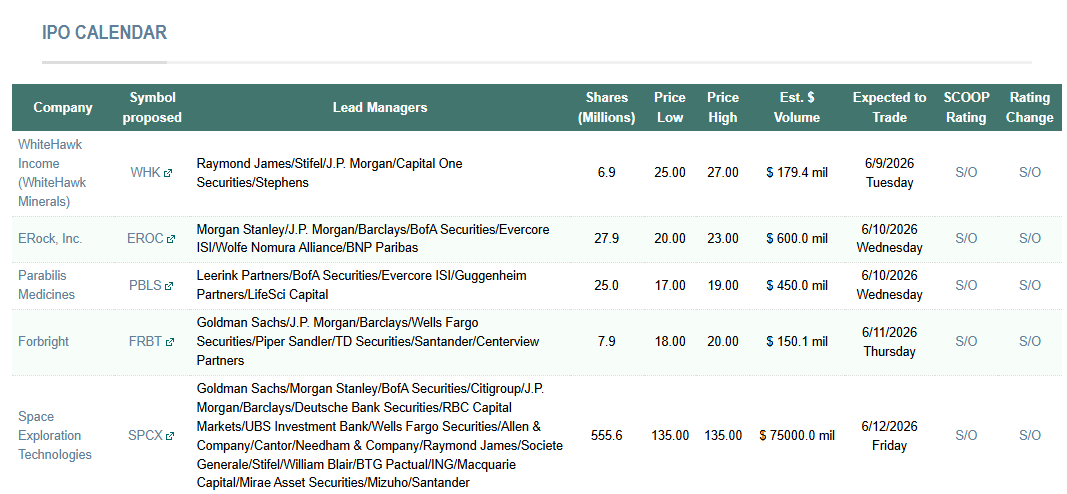
A small IPO calendar this week with one notable standout…
The S&P indexes stand by their profitability rule…
And invites SpaceX to lunch next decade. Same goes for any other future AI company.
S&P Dow Jones Indices said Thursday it won't fast-track the inclusion of SpaceX and this year's other giant IPOs into the S&P 500.
Rules governing the benchmark stock index require newly listed companies to trade on an exchange for at least a year and to show a track record of liquidity and profitability before they become eligible for inclusion. The committee that oversees the index had considered waiving those requirements to speed the inclusion of SpaceX, OpenAI and other so-called megacap companies that could go public as soon as this year.
The group said Thursday it had decided against making those changes, meaning the newly listed companies must wait at least 12 months before inclusion.
The committee said in a news release that the current methodology “provides substantial market coverage and sector balance” despite the trade-offs “between strict adherence to these eligibility requirements and broad representativeness.”
Many investors had expected the index committee to change the rules to account for the newly minted megacaps.
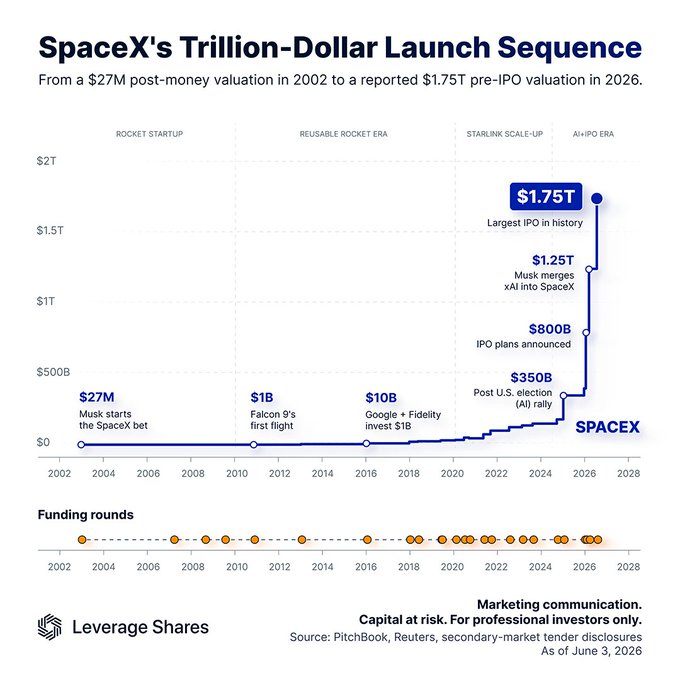
While the S&P 500 won't be jumping on the SpaceX train this week, many past investors will be closely watching their gains…
@LeverageShares
There will be many more AI IPOs and hyperscaler capital raises according to David Solomon, CEO of Goldman Sachs…
- “The reason these companies are going public now is because they have to they have capital needs that are so voracious that it is not prudent for them to try to do one hundred percent of it in the private market and not have a public currency. It’s just not prudent. And that’s why I think you’re going to see a bunch of these companies go public because they actually need the capital.”
- Regarding Alphabet/Google: “This one of the largest, if not the largest secondary fall on equity offering ever...I think you’re going to see more companies issue equity because capital is available. You want to be cautious about this. If you get it wrong, if you totally rely on debt and you get it wrong, you will really regret it if you wind up having a downside scenario that’s tougher than you expected.”
With the market for highly valued stocks breaking out, why wouldn't any company try to raise equity capital right now?
Alphabet Inc. gave you the okay to sell a little equity right now. Meta and others will be next.
Goldman Sachs
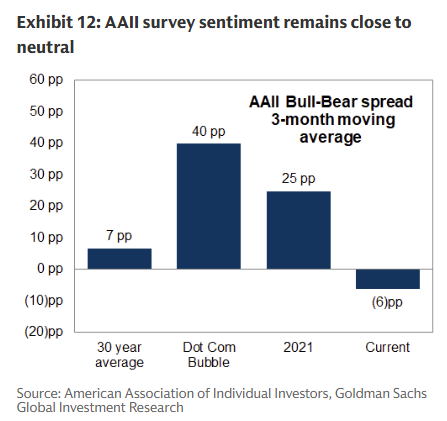
That said, not all investors are in a buying mood…
The American Association of Individual Investors (AAII) survey, which tracks bullish versus bearish sentiment on the stock market, remains well below its 30-year average. In fact, as of the latest weekly reading, survey respondents with bearish views (37%) outnumbered respondents with bullish views (36%).
Goldman Sachs
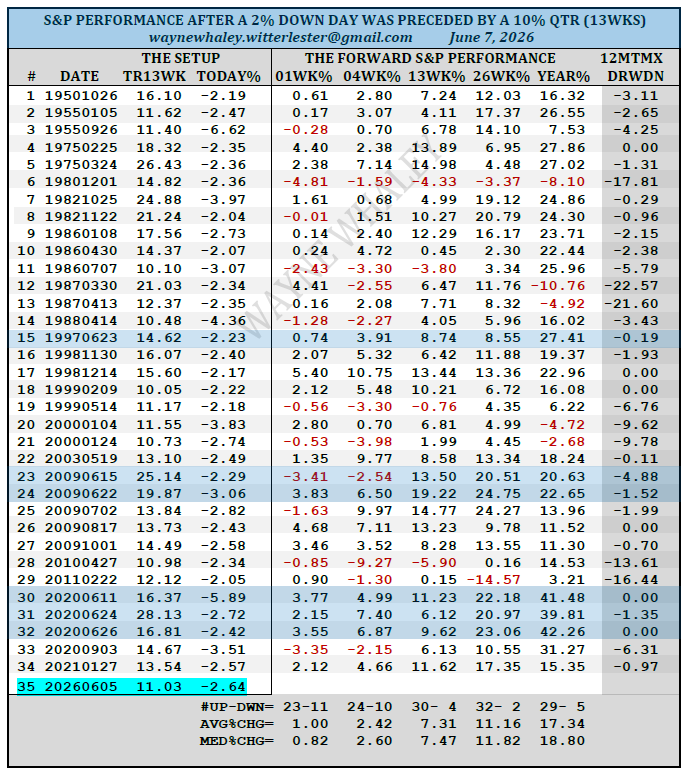
Interesting study showing that a big pullback after significant strength should often be bought (especially in June)…
WHEN A TWO PCT DOWN DAY PRESENTS ITSELF ON THE BACK OF A TEN PCT QTR
On Friday, June 5th, the S&P experienced a 2.64% Down day which occurred on the back of a 11.03% Qtr (13 wks).
Since 1950, I see 34 prior occasions in which a Down 2% Day occurred on the back of a trailing double digit gain over the prior 13wks.
The forward performance in those 34 cases was, on avg, of the Bullish friendly variety with the 10% moves, 13 wks later, 12-0 to the positive.
The six color highlighted cases which occurred in Junes played out particularly well for the Bulls.
@WayneWhaley1136
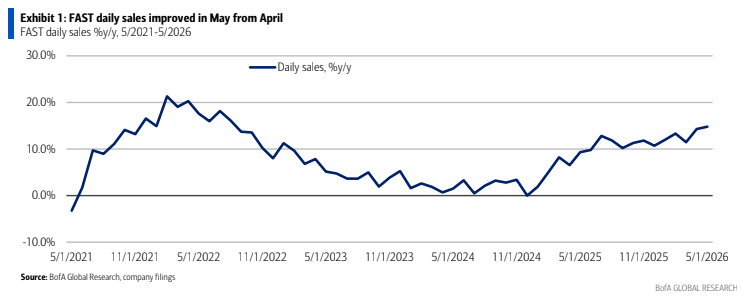
As mentioned, Fastenal is seeing a pickup in its monthly sales…
Fastenal continued with strong May daily sales, growing 14.8% (+20 bps from FX), up from 14.3% y/y in May. On a m/m basis, daily sales grew by 4.6%, beating Fastenal’s benchmark of 4.0% for May. Our conversation with the company was constructive, with growth coming broadly across the business, with sequential growth in all end markets with the exception of non-residential.
BofA Global
And a 76 hotel/41,700 room operator also seeing improving trends…
Host Hotels & Resorts – Key takes from Dan Politzer following meetings at REITweek: Management was optimistic on lodging fundamentals, and hasn’t felt this good about its customer/RevPAR outlook since 2015, when it was early in the lodging cycle. We could envision upside to 2Q RevPAR guidance for ~4.4% (i.e., similar to 1Q), as April was +4.4%. For 2Q-4Q26, HST could continue to benefit from short-term booking strength.
J.P. Morgan
High gasoline prices are music to Costco's ears…
Speaking on the earnings call, CEO Ron Vachris said unrest in the Middle East disrupted fuel markets and drove more consumers to Costco’s lower-cost gasoline offerings.
“The result was record-breaking volumes all 3, 4-week fiscal periods of the quarter set successive all-time company volume sales records with the final 5 weeks of the quarter, becoming our top 5 volume weeks ever,” said Vachris.
Vachris added that elevated fuel prices encouraged many members to visit Costco gas stations for the first time. According to him, shoppers who regularly purchase fuel at Costco locations also tend to spend more inside warehouses, making gasoline operations an important driver of long-term customer loyalty.
High token usage and their cost became much more widely mentioned last week…
“As enterprises become more and more successful, the cost of deploying AI agents from all perspectives, from efficiency perspective, from performance perspective, and hard dollar perspective, it is becoming a topic of discussion and topic of concern because these line items were never in anybody’s budget, right? Here’s a simple example. If you take a very conservative estimate of an employee you have trained to leverage AI agents and spends $200 a week through tokens, if you multiply that, it’s about $10,000 a year if you take a 50-week. For 40,000 employees, that’s about $400 million. For 90,000 employees, you’re talking about $900 million. That line item never existed a few years back.” - Cisco AMD CIO Hasmukh Ranjan
Uber won't be the first company to monitor AI token usage…
Uber CEO: "We blew through our AI budget in a quarter, for the whole year essentially. And it is forcing us to adjust. We are going to meter headcount increases because, to the extent that my engineers are getting much more efficient, their throughput is increasing. They're becoming superhuman in terms of their output. One, there's a cost to that, and it's a significant cost. And at the same time, we're kind of metering the increase in headcount."
More details about how Uber will monitor…
Uber Technologies Inc. has set usage caps on some artificial intelligence-powered tools used by its staff, a move meant to manage costs after the company blew through its AI budget earlier this year.
The rideshare giant is limiting all employees to $1,500 in monthly token spending per AI coding tool, an Uber spokesperson said in response to a Bloomberg News inquiry. That means spending on one tool doesn’t have a bearing on the budget for another. The limits, which have been instituted in recent months, only apply to agentic coding software such as Cursor or Anthropic PBC’s Claude Code.
Every employee has a dashboard where they can track their usage across various tools. The company has also implemented a process by which individuals can seek permission to exceed their normal cap.
“We think this is all a pretty straightforward way to responsibly encourage agentic AI adoption and experimentation at scale across the company,” the spokesperson said.
While token cost eats at corporate users, data center builds are hitting more neighborhoods…
A new style of architecture is rising in the sprawling suburbs of the Sonoran Desert: windowless data centers that hum 24 hours a day and guzzle as much electricity as a midsize city.
As Microsoft and other tech giants expand their footprints in one of the nation’s largest data-center markets, a high-stakes battle is unfolding over how to pay for the massive power-grid upgrades needed to drive the AI revolution.
Arizona Public Service, the state’s largest utility, sits at the center of the firestorm. APS is proposing a 45% electricity-rate increase for “extra-large energy users,” primarily data centers, and a roughly 14.5% increase for residential customers.
Nearly everyone is unhappy.
Expect data center discussions to be a top campaign issue going into the November elections for every level of political office…
Shark Tank impresario Kevin O’Leary wanted to build data centers on 40,000 acres in rural Box Elder County, Utah, a parcel of land more than twice the size of Manhattan. A Deseret News-Hinckley Institute of Politics poll found most Utah voters opposed the plan, with almost 85% of Democrats, a majority of independents and fewer than half of Republicans in favor. They have deluged Utah’s Republican governor, Spencer Cox, with letters, rallied at the state Capitol with signs reminding him that sharks aren’t welcome in the state, and filed to put the project to a public vote…
This isn’t about local zoning. Rather, it’s the latest battle in the war that might determine the future of artificial intelligence. And that war is about public acceptance, not technology. A year ago, this was all an abstract worry, but the data-center revolt is the war’s first real battle – one in which the industry’s leaders seem to be trying to lose…
AI might unleash miracles of productivity, cure cancer, or make energy too cheap to meter. Its advocates have promised all that and much more. But it can’t do any of those things – or at least it can’t do them in the United States - if the public rejects the technology. That’s exactly what it’s doing right now, as the public’s acceptance of new data center construction has dropped a staggering 49% in just the last nine months and industry-backed candidates floundered in Tuesday’s elections despite massive spending.
Team Omaha writes an 11-figure check to invest in its previously described "most beautiful business model of all time"…
The second question is why is Berkshire Hathaway suddenly, after all these years, interested in Google, and at only a slight discount to its all-time high price? Does it really just come down to the fact that Buffett is no longer making investment decisions, and Greg Abel, his successor as CEO, is?
In fact, you can make the case that Abel is actually just replaying Buffett’s strategy, only this time Berkshire Hathaway is See’s Candies, and Google is BNSF. At the end of last quarter Berkshire Hathaway had $373 billion in cash, and $25 billion in free cash flow in 2025. How many companies could actually employ that cash in a way that generated a high rate of return?
It’s hard to imagine a better option than Google. The company is not only investing in AI, but has optionality in terms of outcomes: its Services business benefits from the investment, it is in contention at the model layer with Gemini, and it can sell capacity to the frontier labs. Moreover, that capacity has a sustainable cost advantage because of TPUs, which means that in a world where compute becomes a commodity — as hard as that is to imagine right now — Google is the hyperscaler that is poised to make the most profit.
It is worth noting that $10 billion is a relatively small amount of money to both companies. To that end, perhaps the primary utility is as a signaling mechanism. On Google’s side, the signal is that the expected demand is actually far greater than anyone thinks, and that the company is ready and willing to fund supply using all means at its disposal, including equity; for them Berkshire Hathaway’s investment is an endorsement of this view and a validation of the wisdom of the investment. And, on the flip side, if the signal is correct, then Berkshire Hathaway is getting a deal and putting its cash flow machines to work building the future.
Something to note if you are long apparel retail: GLP's are now causing smaller sized wardrobes and wreaking havoc with inventory and margins…
At peak weight loss, those taking GLP-1 medications can drop a clothing size every month. Jeans, bras and athleisure wear are often the first items replaced. Then come tops and dresses, as well as adjustments to rings, bracelets and shoe sizing. Retailers from Levi Strauss to Costco Wholesale and Walmart are working to understand the shift.
The returns trend is particularly acute in larger sizes. Returns for medium, large and extra-large items jumped the most, according to Impact Analytics. “As you lose weight or you have a shift, you’re, like, ‘OK, I need to buy medium and large to see what fits better,’ ” said Agrawal.
Lisa Primm, a 57-year-old retired social worker, has spent around two years on Zepbound, for a while dropping a clothing size every few weeks. The Ypsilanti, Mich., resident is down 115 pounds—now a four instead of a 22—but isn’t always confident that smaller dimensions will fit.
“I still order size medium and six or eight,” she said. “Then I end up returning for a smaller size.”
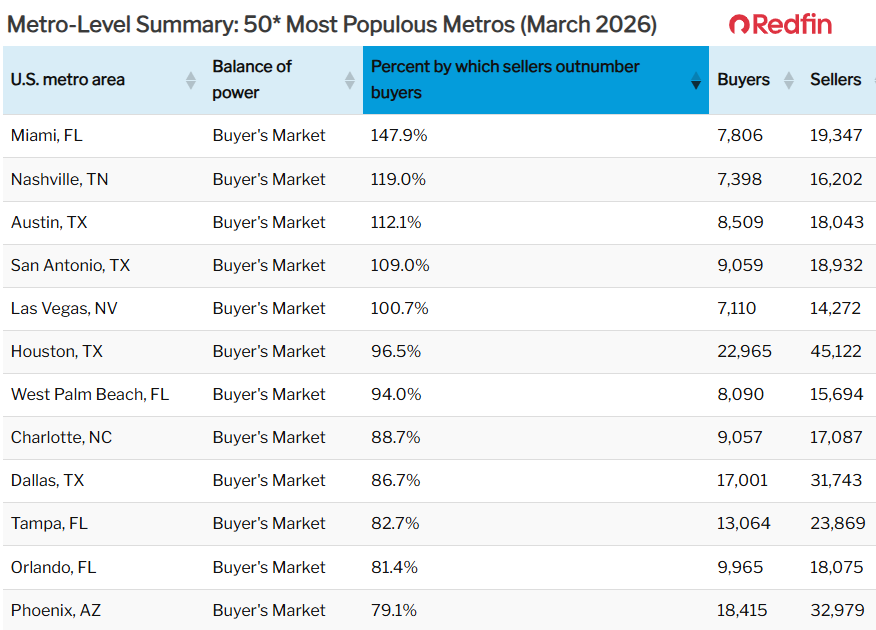
Sunbelt markets for sale…
@charliebilello: Miami, Florida is the strongest buyer's market in America with home sellers outnumbering homebuyers by 148%.
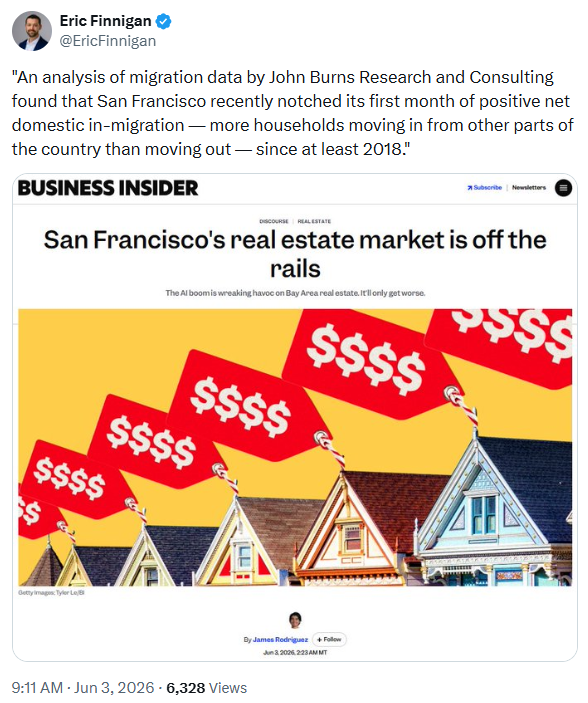
And San Francisco is being bought…
Time for the US housing industry to grow up, modernize itself and make housing more affordable for the younger generations…
“The housing crisis has become acute enough that from policymakers’ standpoint, they realize that how we produce homes has to change,” said Arica Young, director for housing access and affordability at the Lincoln Institute of Land Policy. “You look at Japan — or Sweden, where something like 80% of homes are produced in a factory — and we’re still building homes the way we did 100 years ago.”
Supporters say factory-built housing offers many of the same advantages that transformed other industries: faster production, lower labor needs and greater economies of scale. Homes can be completed up to 50% faster because construction isn’t slowed by weather, while manufacturers can operate with fewer workers at a time when the industry in the US faces labor shortages and a looming wave of retirements. Large producers also benefit from bulk purchasing; Clayton Homes, for example, builds as many as 35,000 homes a year, allowing it to negotiate better pricing than a builder who builds 75 homes a year.
Advocates also argue that factory production can improve quality. A contractor working long days across multiple job sites isn’t going to square the corner perfectly every time, but a factory can.
The approach is more common outside the US. Eighty-four percent of Swedish homes have prefabricated elements, according to Global Construction Review. In the Netherlands, it’s 20%, while in Japan it’s 15%. In the US, only 5% of housing has any significant prefabrication, according to the report.
Sweden’s embrace of factory-built housing was born partly of necessity: Long winters, limited daylight and heavy snowfall made traditional on-site construction inefficient, pushing more of the building process indoors.

Australia is showing the world how to welcome batteries, and end fossil fuels…
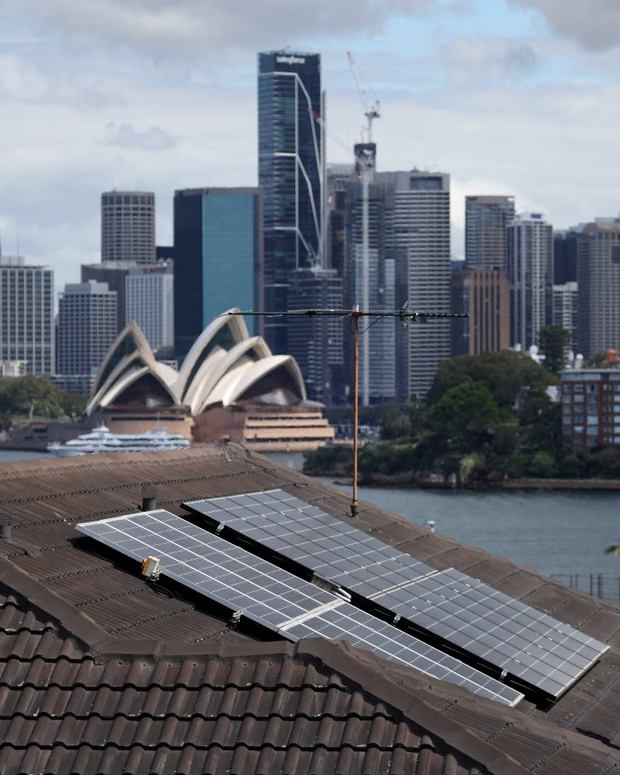
Quietly, and with surprisingly little fanfare from the rest of the world, Australia is pioneering a revolution in home renewables and battery use, proving what is possible with the right policies. The country was already one of the global leaders in domestic solar power, with panels on one in three homes. It also remains, however, a major contributor to the climate crisis through its vast fossil fuel exports. But it is batteries that are giving Australia a new burst of speed.
Nearly 60% of the household-scale battery capacity installed across almost 200 countries – every nation except China - this financial year will be in the southern continent, according to a recent analysis. Since July, about 415,000 have been connected. It is roughly one unit for every 25 Australian homes.
Industrial-scale batteries are being built nearly as quickly, with Australia (population: 27 million) trailing only China (1.4 billion) and the US (350 million) in new capacity after connections more than doubled last year. The increase in battery usage big and small is starting to bring down the cost of electricity from the nation’s spindly power grid, which includes more than 40,000km (24,850 miles) of transmission lines and cables between tropical far-north Queensland and the southern island state of Tasmania…
Previously, power prices would rocket in the evenings as gas-fired power – the most expensive form of energy generation on the Australian grid – was turned on to meet peak demand. With solar and wind now providing nearly half the electricity, and coal-fired power plants gradually closing, gas has been used to fill gaps after the sun sets.
But batteries are increasingly taking over that role. Total gas-fired generation was 24% lower across three months this summer compared with the year before. Tennant Reed, the climate change and energy director with the Australian Industry Group, representing more than 60,000 businesses, says it has “completely changed how electricity prices are formed”.
“The role of gas used to be in the evening to meet the evening peak and that came at a cost, because gas is not a cheap fuel. But more and more, every day, it is batteries that are surging into the market at 6pm,” he says. “Gas will still play a backup role but, on average, batteries are not as expensive as gas peakers and they are pushing those [gas plants] out even as electricity demand increases.”
I've never seen a non-collector car gain value off the lot…
Most cars lose value the moment they leave a dealer’s lot. The RAV4 hybrid gains it.
Used, late-model versions of the RAV4 hybrid often list for more than their original sticker prices, even with thousands of miles on their odometers. In some cases, they cost more than a new 2026 model fresh from the Toyota Motor Corp. factory.
CarMax recently advertised a 2024 RAV4 Hybrid XSE with 29,000 miles for $46,998, which is higher than that trim’s original $38,735 sticker price.
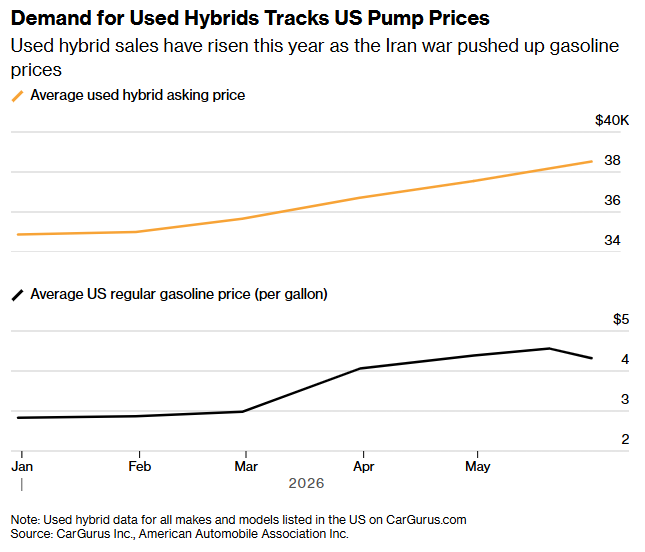
The price inversion seems to defy a natural law of used-car economics. But it illustrates some of the most powerful forces driving the US auto market this year.
The Iran war sent gas prices surging, with the national average for regular well above $4 per gallon. Some car buyers have responded by snapping up used electric vehicles, which often sell at a steep discount from their original price. Others who are either unwilling or unable to go fully electric have turned to hybrids, which pair an electric motor with a gas-burning engine. Long considered a niche product in the US, they’re now highly coveted.
And for the moment at least, there aren’t enough new hybrid RAV4s to go around.
Learn more about the Hamilton Lane Strategies
DISCLOSURES
The author has current equity ownership in: Alphabet Inc. and Berkshire Hathaway Corp.
The information presented here is for informational purposes only, and this document is not to be construed as an offer to sell, or the solicitation of an offer to buy, securities. Some investments are not suitable for all investors, and there can be no assurance that any investment strategy will be successful. The hyperlinks included in this message provide direct access to other Internet resources, including Web sites. While we believe this information to be from reliable sources, Hamilton Lane is not responsible for the accuracy or content of information contained in these sites. Although we make every effort to ensure these links are accurate, up to date and relevant, we cannot take responsibility for pages maintained by external providers. The views expressed by these external providers on their own Web pages or on external sites they link to are not necessarily those of Hamilton Lane.