
Weekly Research Briefing: Full Flow Gusher

Reading the market related news this year has been like trying to drink from a fire hydrant. It feels like we have been subject to a quarter's worth of news in just one week. And whenever I think that I am close to finishing up the Weekly Research Briefing over the weekend, a new firehose of news appears on Sunday night to shred my initial draft. Luckily for our investment portfolios, the financial markets have learned to look past most of POTUS 47's many press comments and tweets and stay focused on the long term. New highs in public equities across the board again on Monday with big caps joining small caps and US stocks following international stocks higher. Who is planning a Dow 50,000 party this week?
After not wanting to hear the word "affordability" in 2025, the term seems to have taken up residence and is now living in the Lincoln Bedroom for 2026. Just look at all the actions, threats and tweets to start the year:
- A 10% cap on credit card interest rates
- Ban on institutional buying of single-family homes
- A push on Fannie/Freddie to accelerate buying of residential mortgage-backed securities
- Defense companies' restrictions on issuing dividends, buying back stock and executive compensation
- Pushing US energy companies to invest in high-risk Venezuelan oil production
- And don't forget, threatening to forcibly take control of the Federal Reserve
Free market capitalism has been put in the White House freezer while corporate statism, economic populism, socialism and other-isms have been cooked up on the range and in the oven and are now headed for the dining room. While most of these ideas are being brushed aside by the markets, the continued threat against US central bank independence is an ongoing worry. Luckily the Fed Chairman has more friends in Congress than the President and they are making their case known to the Oval Office.
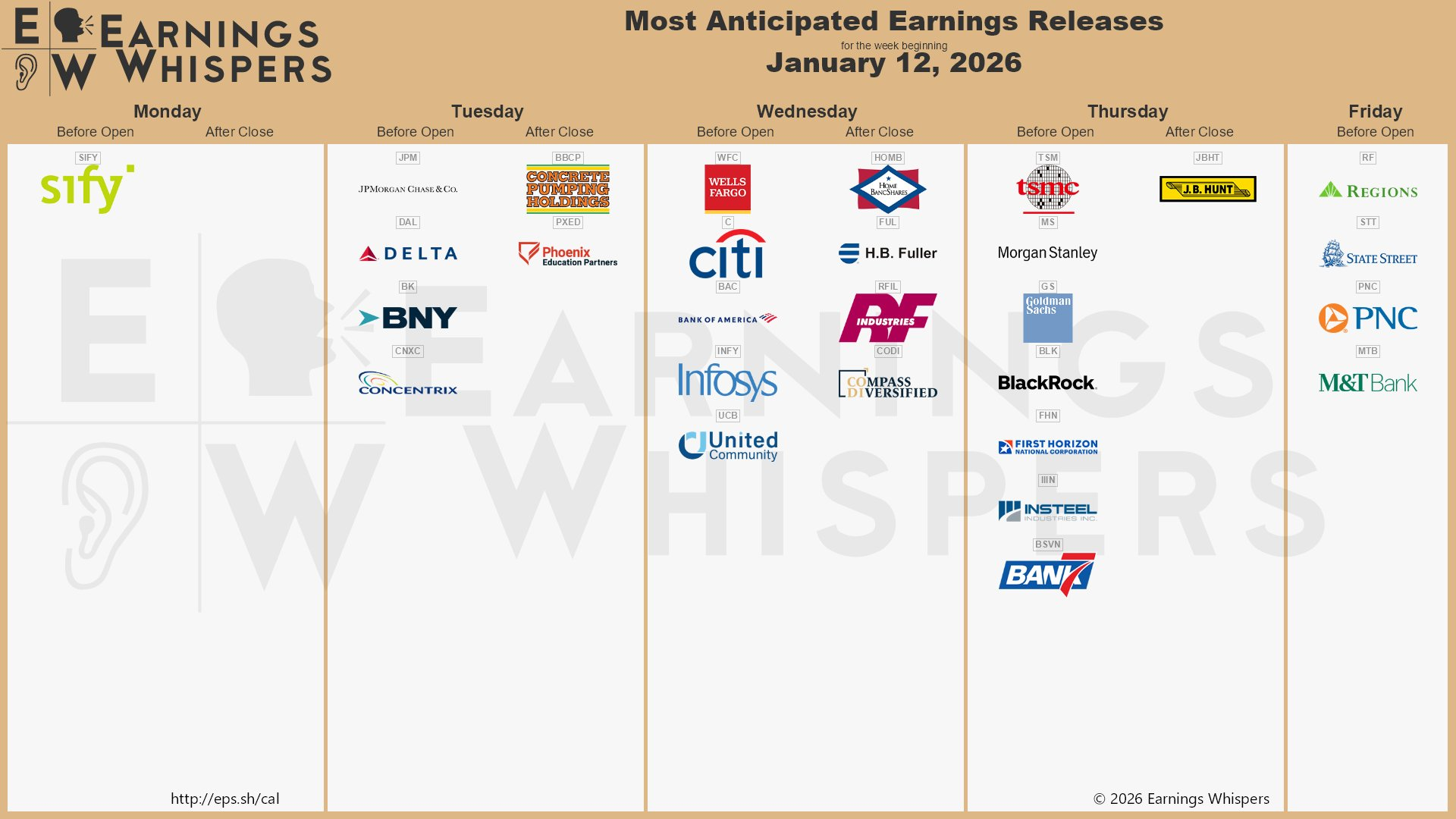
The Q4 2025 earnings reporting season starts this week with the big banks kicking us off on Tuesday. Expect them to report solid earnings, with solid loan growth, expanding net interest margins, stable loan losses, and a booming investment banking business. For economic news, we will get the CPI on Tuesday, Retail Sales & the PPI on Wednesday, the Philly & Empire Fed manufacturing on Thursday and a full fire hydrant of Fed-speak all week. And I wouldn't expect any less flow of ideas and threats from the White House. Have a great week.
Don't expect Jerome Powell to go anywhere until his term ends in 2028...
"The threat of criminal charges is a consequence of the Federal Reserve setting interest rates based on our best assessment of what will serve the public, rather than following the preferences of the President.
This is about whether the Fed will be able to continue to set interest rates based on evidence and economic conditions — or whether instead monetary policy will be directed by political pressure or intimidation."
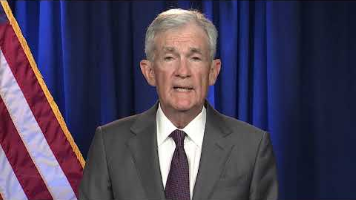
YouTube: Statement by Federal Reserve Chair Jerome H. Powell
The Senate Banking Committee will no longer be considering any new Federal Reserve nominees for any position including the upcoming Chairman slot...
Today, Senator Thom Tillis (R-NC), a member of the Senate Banking Committee, issued the following statement:
“If there were any remaining doubt whether advisers within the Trump Administration are actively pushing to end the independence of the Federal Reserve, there should now be none. It is now the independence and credibility of the Department of Justice that are in question.
I will oppose the confirmation of any nominee for the Fed—including the upcoming Fed Chair vacancy—until this legal matter is fully resolved.”
And all living former Federal Reserve Chairs and US Treasury Secretaries have issued their support for continued Fed independence...
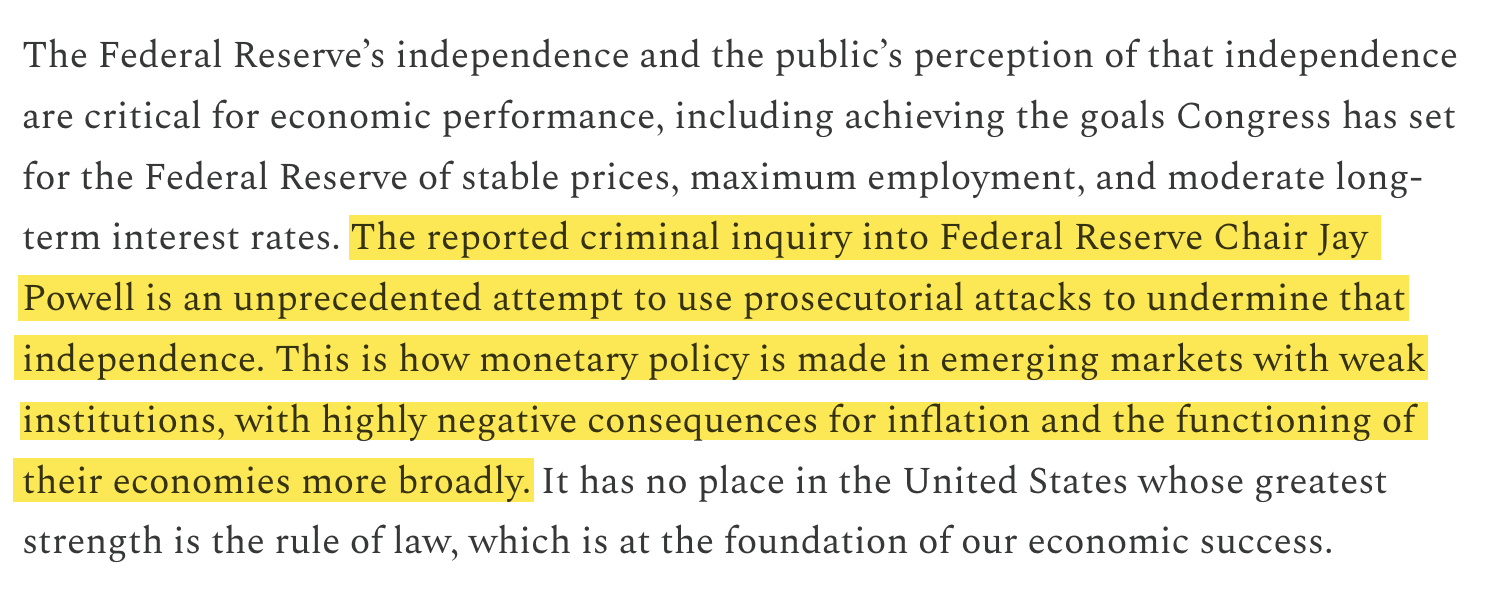
Wall Street's Evercore/ISI thoughts on the White House attack on the Fed Chairman...
".. This is the first time Powell has decided to fight back. We are stunned by this deeply disturbing development .. the administration and the central bank are now in open war –- something Powell and .. Bessent have tried strenuously to avoid. .. This is unambiguously risk off."
".. We expect that almost the entire FOMC .. will rally behind Powell .. Moreover, we think it is now more likely that Powell will stay on as a governor .. after his term as chair ends, and more likely that others – Barr in particular, also Jefferson – who might have left will stay on too."
".. This would deny the new chair a majority and constrain rate policy .. almost certainly resulting in fewer cuts than would otherwise have been the case, but also raising the risk that the Trump administration will try to find other legal tools to attack the Fed .."
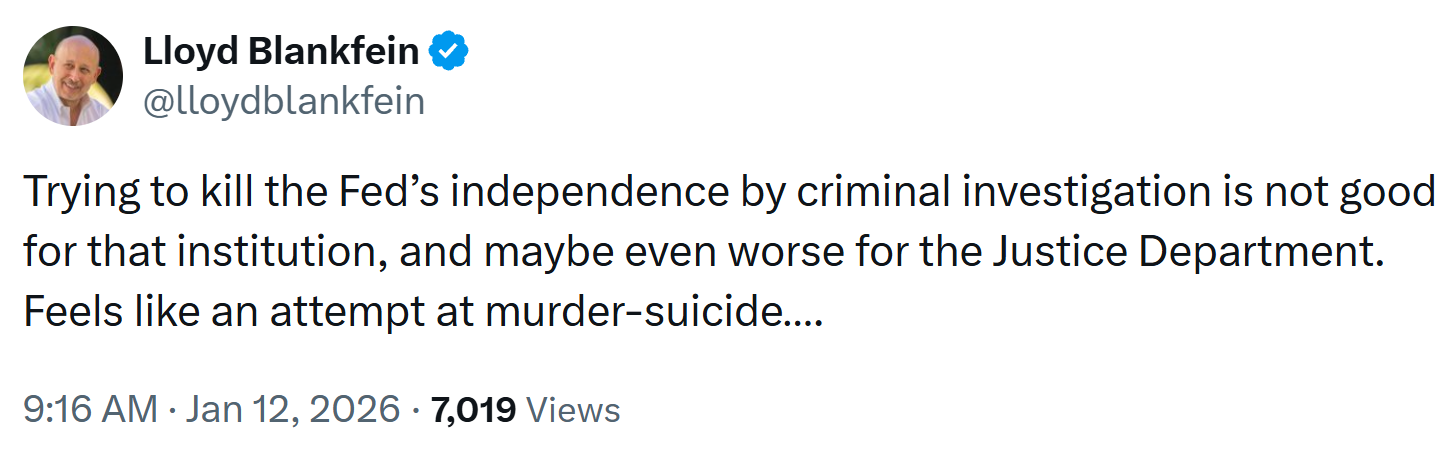
And current thoughts from the Senior Chairman of Goldman Sachs...
As for the attack on institutional owners of US rental homes, the Wall Street Journal knows that it is a ridiculous accusation...
Institutional investors simply aren’t to blame for the more than 50% increase in housing prices since early 2020. The biggest culprit is inflation followed by the higher interest rates to contain it. Owners who locked in low mortgage rates are now reluctant to move, which means fewer homes for sale.
The longstanding problems for housing supply are zoning regulations and permitting red tape that limit new construction. Mr. Trump’s tariffs and worker deportations are also raising costs and exacerbating labor shortages. Housing starts in August were down 6% from the prior year and permits were 11.1% lower, according to the Census Bureau’s latest data
Right now, the US housing construction industry needs all the buyers that it can to keep it going...
@RenMacLLC: Housing starts, which hit a fresh low in October, are running below housing completions. This means units under construction will keep falling.
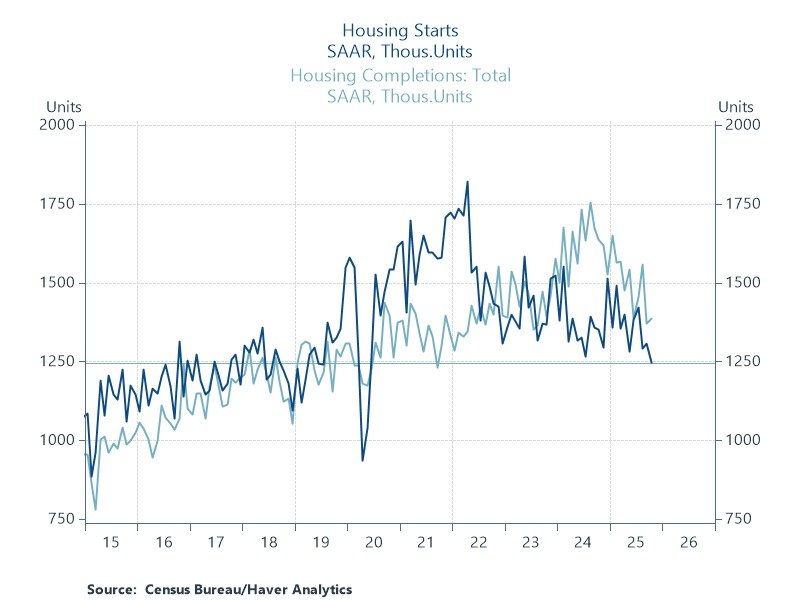
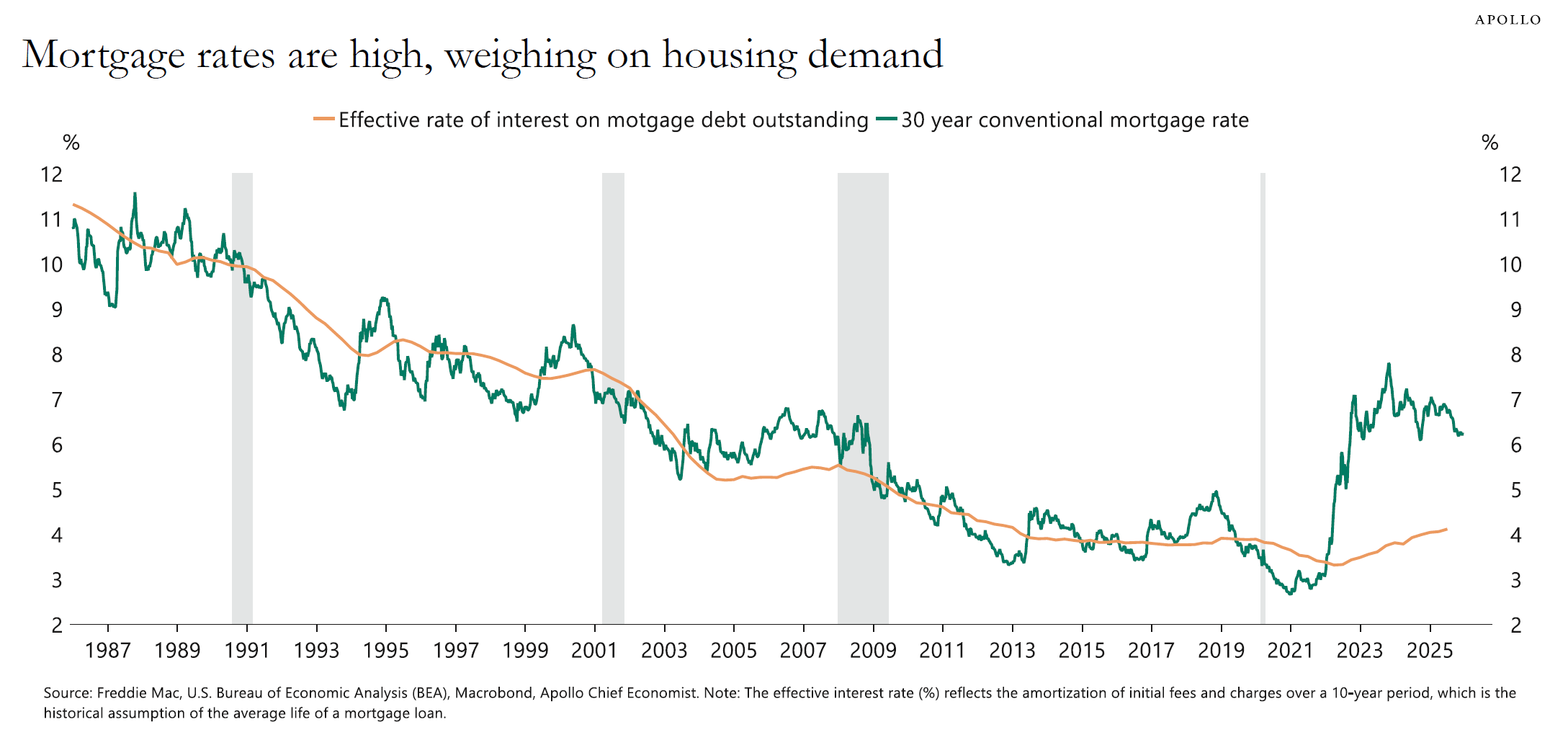
If the White House wanted to help the US residential construction industry and new home owners, they should try and find an incentive to get homeowners with less than 4% mortgages to sell...
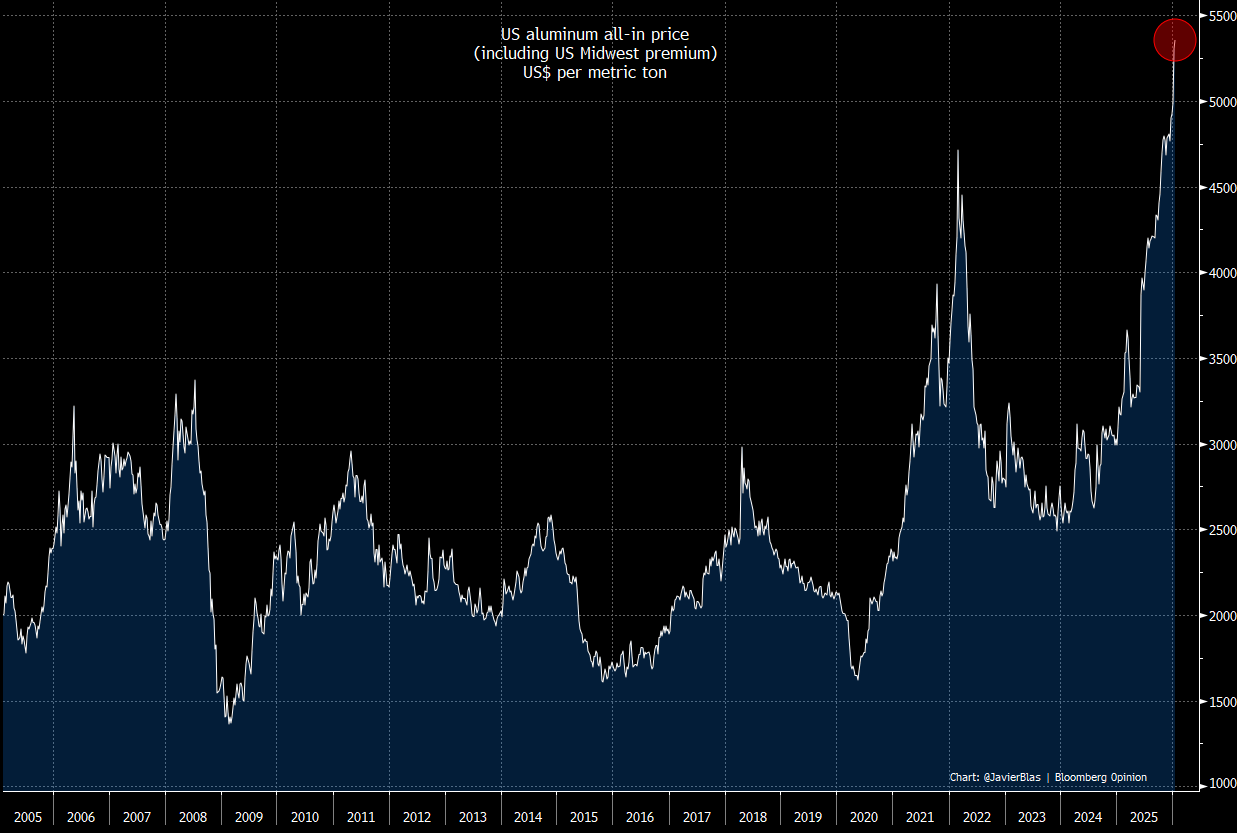
The White House could also end the tariffs on aluminum which is having a painful impact on the construction industry right now...
CHART OF THE DAY: Due to the impact of Trump's tariffs, the all-in cost of aluminum in America has surged to a record high well above $5,000 per metric ton (LME price + US Midwest premium). The impact would be soon felt on anything made with aluminum -- including beer cans.
@JavierBlas
I have heard of Venezuelan crude oil as having the same consistency as peanut butter...
In other words, it is a troublesome liquid-solid that must be heavily processed, or it is difficult to store and transport. The amount of investment needed to increase its output will be massive. In addition, there will be political and social issues to consider for the country.
Venezuela holds the largest reserves in the world, more than Saudi Arabia and the U.S., and for decades was one of the stars of the oil world. But recent years have brought a crushing descent. Venezuela has been producing well under a million barrels a day—less than North Dakota—and accounts for less than 1% of world oil production.
Estimates range widely for what it would cost to bring back the industry. One reasonable guess is $20 billion to boost Venezuela’s output to 1.5 million barrels a day from the 870,000 barrels it produced in November. To get back to the 3.4 million barrels a day of peak production at the end of the 1990s could cost $100 billion or even more, including new facilities, infrastructure and environmental remediation.
But what will it take to persuade companies to make such big bets on Venezuela again? The country’s state-owned oil company, devastated by years of corruption and political turbulence, doesn’t have the money or technology for a recovery, let alone a massive upgrade. The international oil companies who do will want to be confident about security, regulation and the legal foundations of their investment, given that Venezuelans across the spectrum—including most of the 70% of the public that voted against Maduro in the last election—believe the country’s oil resources belong to the nation and are essential to the recovery of their battered economy. Any real plan for reviving Venezuela’s oil industry has to reckon with the political legacy of the country’s long, turbulent history with its petro riches.
Chevron has joint venture assets in the country already, so it is easier for them to support an expansion in production...
"I think we have a path forward here very shortly to be able to increase our liftings from those joint ventures 100% essentially effective immediately...We are also able to increase our production within our own disciplined investment schemes by about 50% just in the next 18 to 24 months" - Chevron Vice Chair Mark Nelson
@TheTranscript_
But for every other company with shareholders and employees, Venezuela is way down the list of capex projects...
“If we look at the legal and commercial constructs, frameworks in place today in Venezuela, today it’s uninvestable,” Woods told Trump in a meeting that included many of America’s most prominent energy executives and some of the president’s top lieutenants.
“Significant changes have to be made to those commercial frameworks, the legal system, there has to be durable investment protections, and there has to be change to the hydrocarbon laws in the country.”
Woods said the company’s assets in Venezuela had been seized twice since Exxon first entered the country in the 1940s.
His remarks underline how the biggest energy groups remain reluctant to rush into making big capital commitments in Venezuela even as Trump seeks to cajole them into pouring “at least $100bn” into the country to increase production and drive down US oil prices.
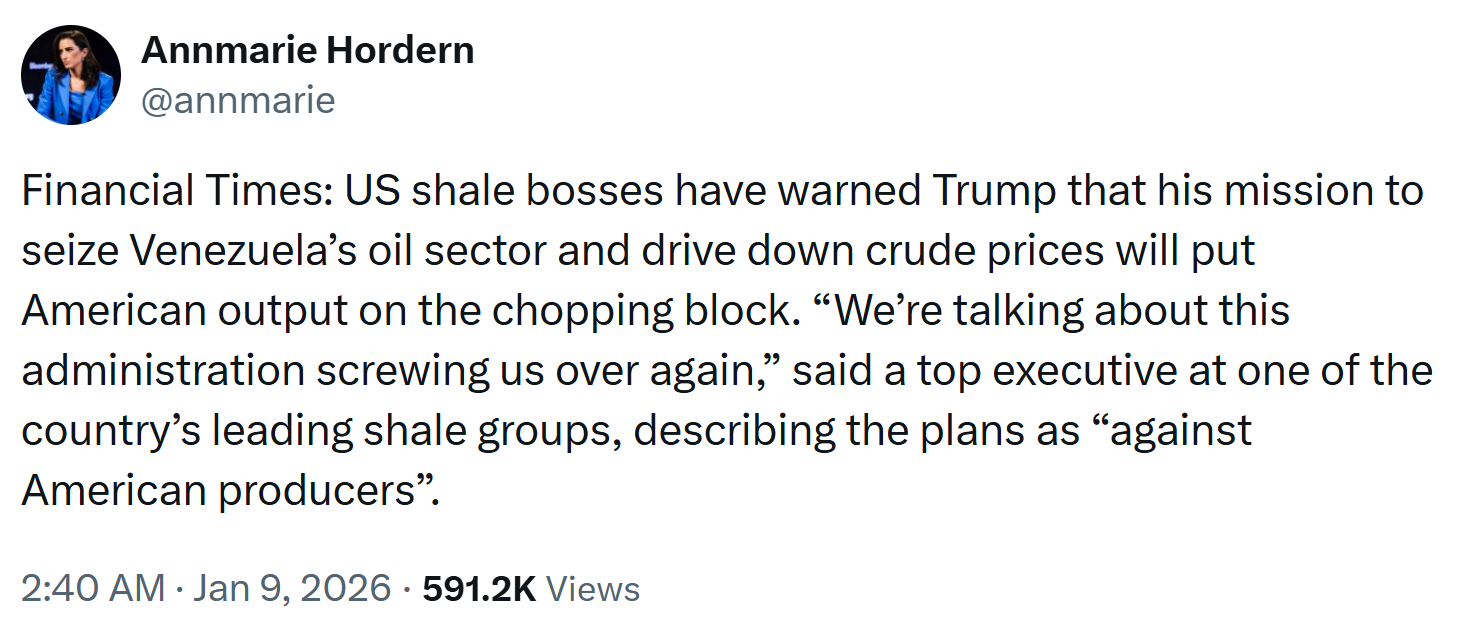
And don't forget that the US shale industry grew from Venezuela's production slowdown...
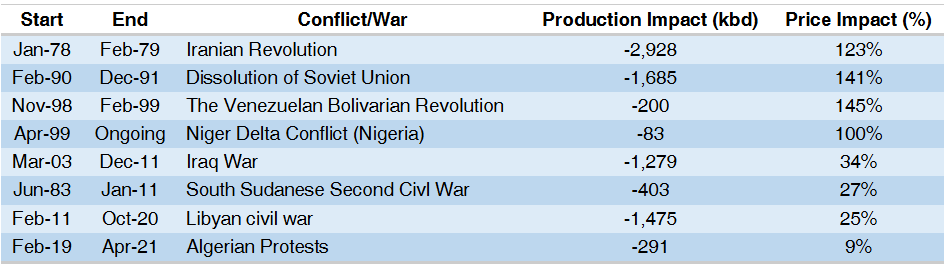
Regime changes in oil-producing nations have led to an average +30% increase in crude prices. Let's see how VZ will stack up...
Since 1979, eight notable regime changes have occurred in oil-producing nations, with prices spiking by 76% from onset to peak and averaging a 30% increase, leaving lasting effects. As a result of these regime changes spikes in oil prices averaged +76% from onset to peak, with a 30% increase over the three-month period from the onset of the conflict and eventually settling 30% higher than pre-conflict levels.
As a reminder, Iran currently produces about 3.4m bpd or so of crude and exports 1.8-2m bpd , nearly all to China, so there is significant potential for disruption. Current significant global oil oversupply and OPEC spare capacity would mute the overall market impact even should there be any disruption to Iranian flows, but given bearish positioning in oil and oil equities the upside risk.
J.P. Morgan
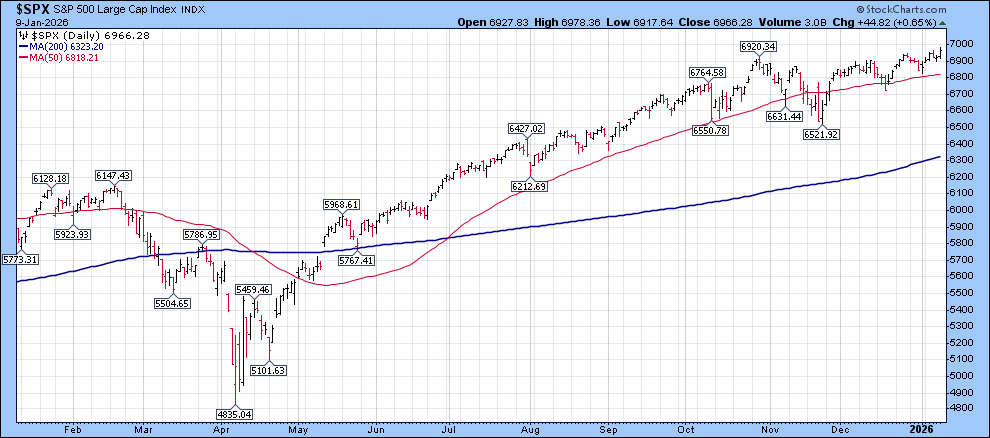
Meanwhile, the S&P 500 remains unaffected by the news wires as new all-time highs were again set last week...
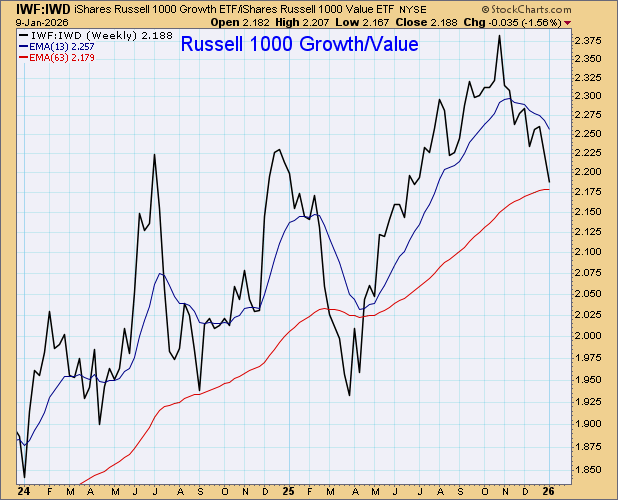
And look at the outperformance of Value over Growth since October. Let's see if earnings will provide a further reason to outperform...
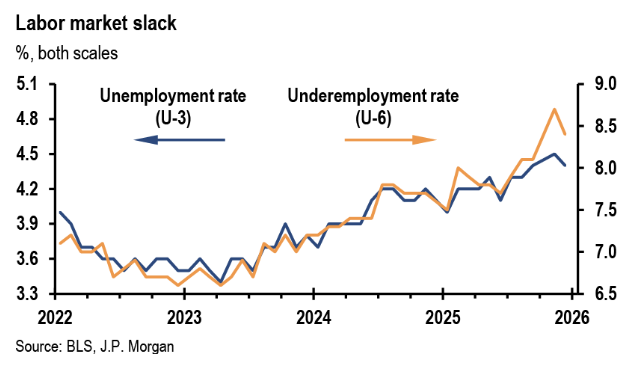
Friday's jobs data eased fears over a runaway unemployment rate. This helped lower expectations for a future Fed rate cut...
Over the second half of 2025 the economy seems to have settled into an equilibrium of slower labor supply growth met by slower labor demand growth, though with few signs of further deterioration. The recent stabilization in the unemployment rate should finally bring some cohesion to the FOMC, and we now look for the Committee to be on hold at the meeting at the end of the month. After that we see the Fed holding the target range for the funds rate steady at 3.5-3.75% for the rest of the year; the proposition that rates are restrictive looks increasingly untenable given economic and financial developments.
J.P. Morgan
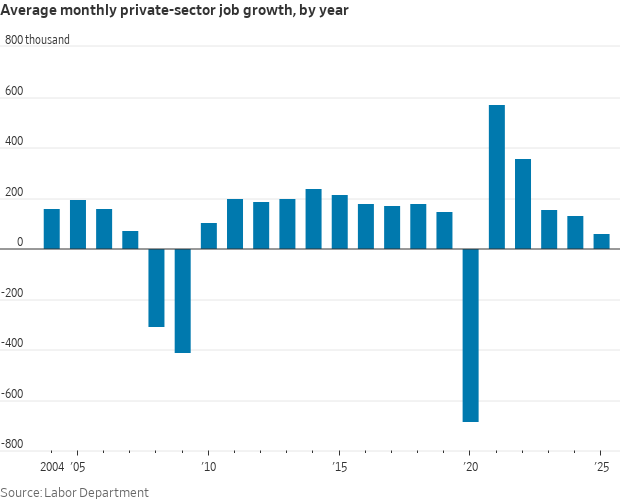
But for the year, private sector job growth came in at the weakest since COVID and the GFC...
@NickTimiraos: Private sector employers added 61,000 jobs per month on average in 2025, which is the weakest pace of private-sector job growth since the so-called "jobsless recovery" of 2003 for an economy that wasn't in recession.
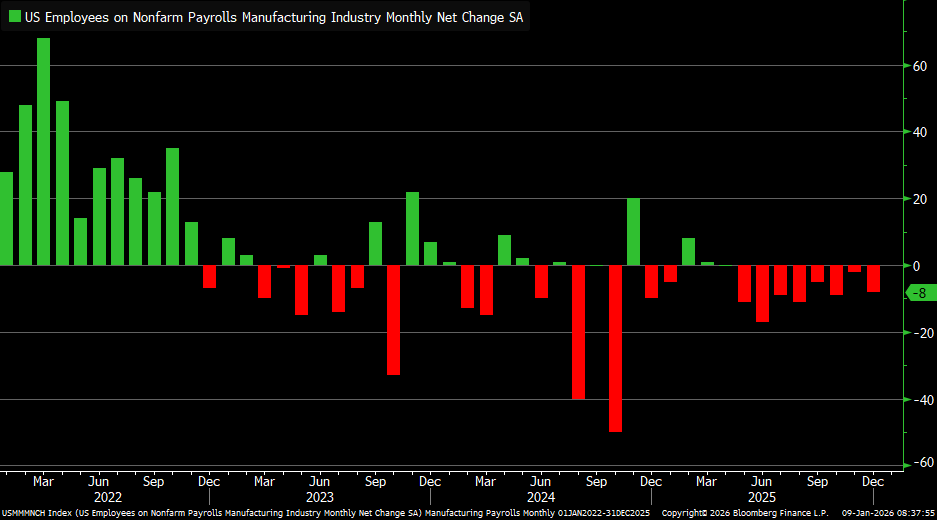
US manufacturing jobs will not start improving until tariff uncertainty ends and future business certainty begins...
@KevRGordon: Manufacturing payrolls -8k in December... eighth consecutive month of declines for the manufacturing sector
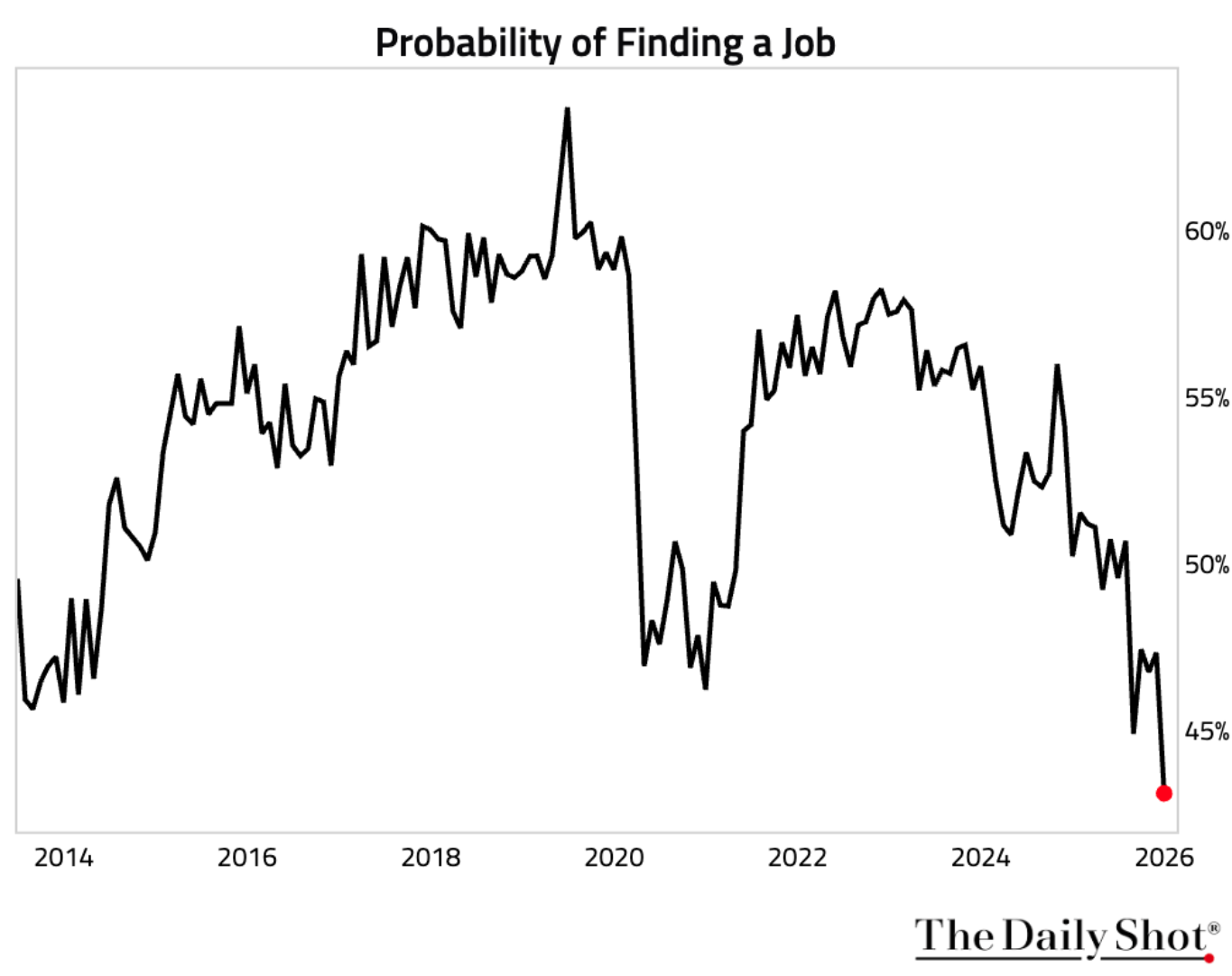
Consumer's outlook on finding a new job continues to dim...
@SoberLook: The New York Fed’s consumer survey points to growing anxiety about the labor market. Perceived job security worsened, and confidence in finding new employment slumped to the lowest level since the survey began.
Albertson's earnings showed that lower-income shoppers are stretched and even middle-class showing signs of pressure...
“Consistent with what you’ve heard from others, the environment remains mixed and continues to reflect pressure across income segments. At the low end, shoppers are clearly stretched, putting fewer items in the basket each trip and prioritizing essentials while visiting more frequently as they manage their cash flow. Middle-income households, which have been relatively resilient, are showing some signs of softening, with increased price sensitivity and trade-down behavior emerging in certain categories.” – Albertsons Companies CEO Susan Morris
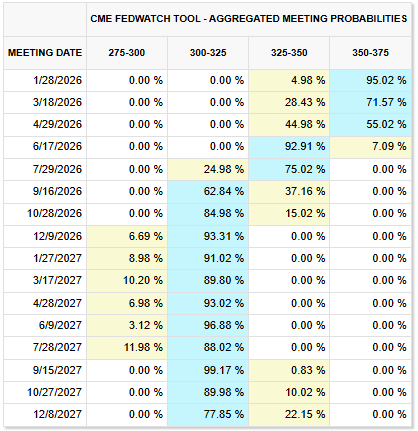
Combine Friday's better unemployment rate along with the new strengthened Congressional support for Fed Chair Powell and the FOMC rate cut odds continue to fall...
January is now off the table. March is now down to 28% and April at 45%, meaning the first cut has now been pushed to June. A second cut is not until September.
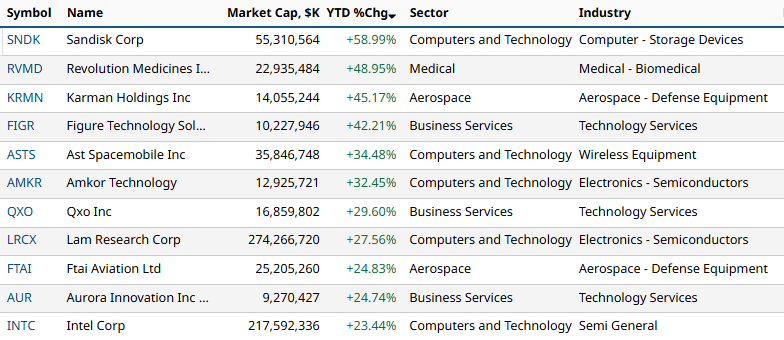
Back to the markets, these Russell 1000 stocks have put up a great year of performance just in the first 6 trading days of 2026...
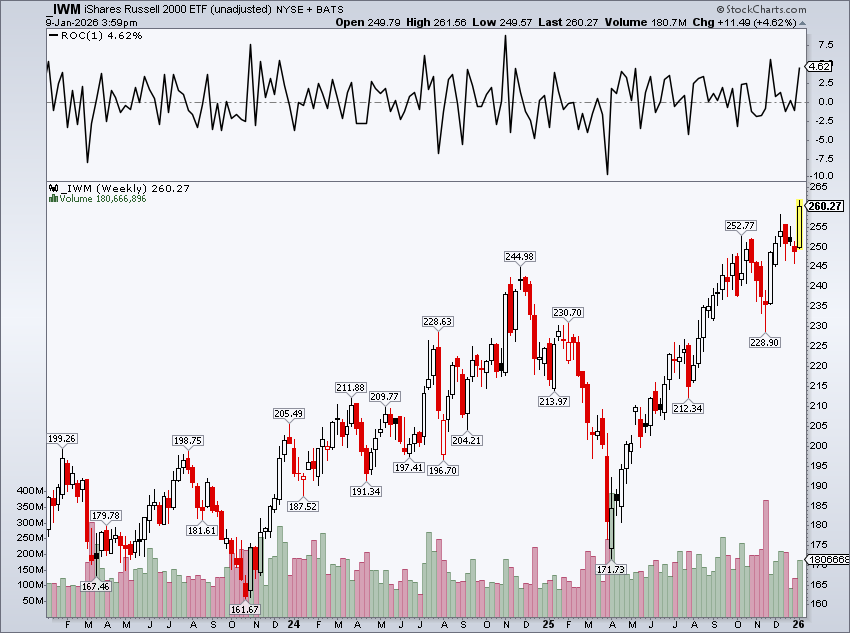
And US small caps are off to a great start...
@MikeZaccardi: $IWM massive week, +4.6%, to a record weekly settle @stockcharts
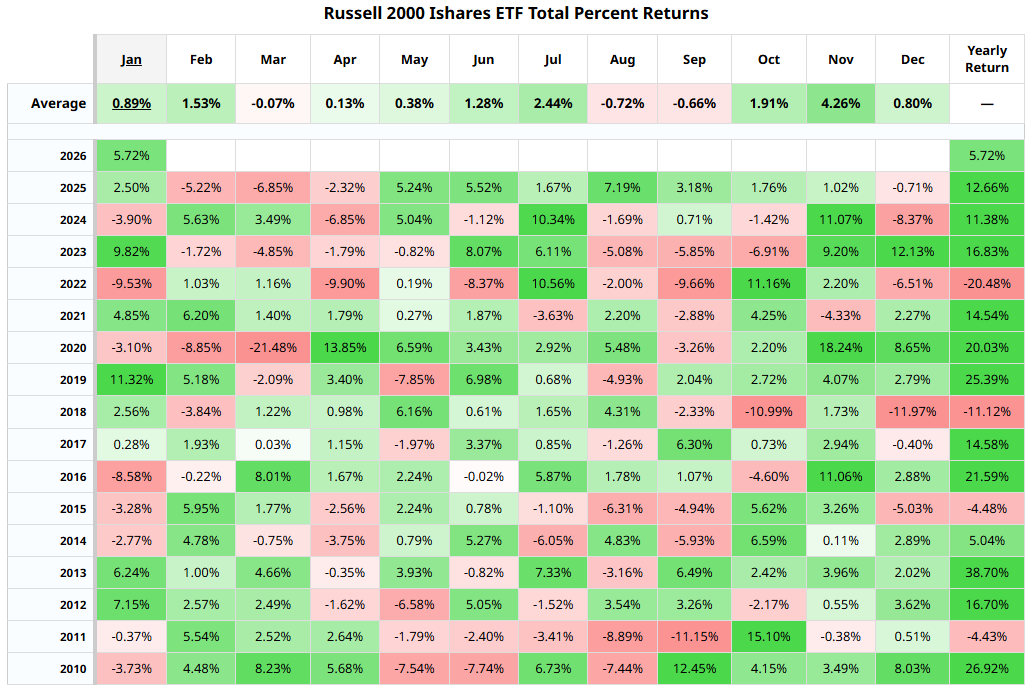
The past four times that the Russell 2000 started January with a 5%+ gain worked out well for the rest or the year...
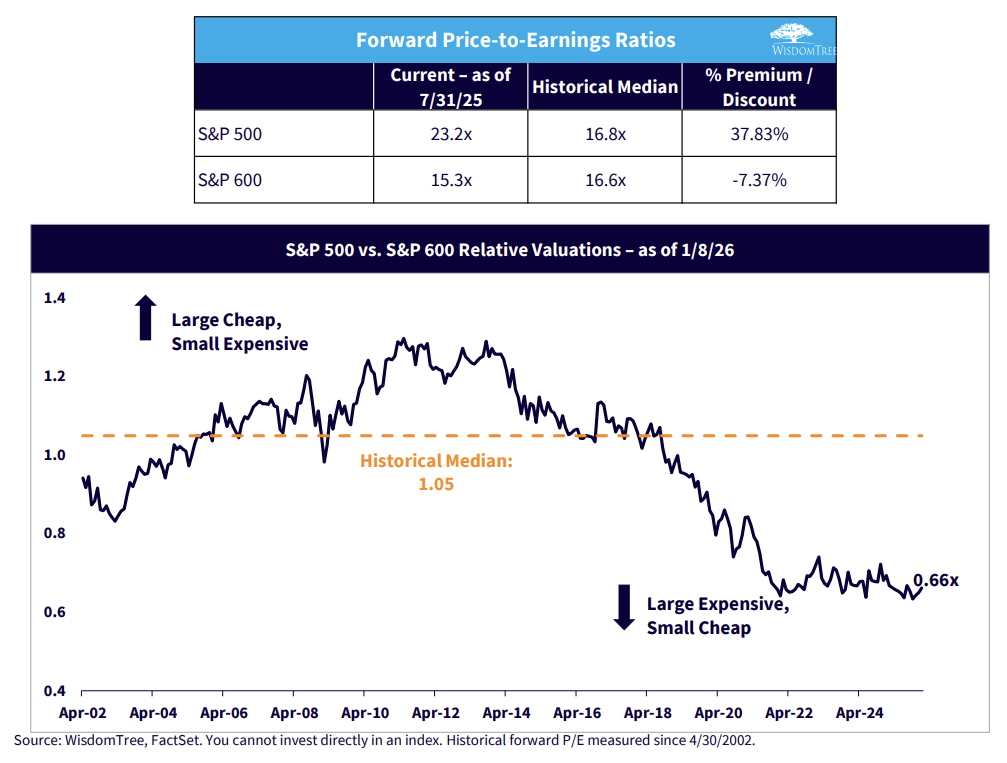
This look at Small Cap vs Large Cap valuation history might help show you where to place your chips...
Even Permabears Have Portfolios. Where Jeremy Grantham Sees Value Now...
He might have been wrong on US equities, but I still find value in knowing where he is finding the most value.
Where do you see value now in public markets?
Outside the U.S. The investment bubble is extreme in the U.S., as it was in 2000, but there are plenty of reasonably priced opportunities elsewhere, as there were in 2000. My biggest investment for my family is in international developed-market value stocks. I have also invested in emerging market stocks...
Which non-U.S. markets look most appealing to you?
Right behind international developed-market value, we have a big position for the family in Japan. The Japanese corporate system has been steadily improving for 20 or 30 years, and the market is still cheap. Plus, the yen, at 155 per dollar, is ludicrously cheap. It used to be breathtakingly expensive to visit Japan. Now it’s a cheap holiday.
Earnings begin this week. Peak for the reporting season will be the last week of January and first week of February...
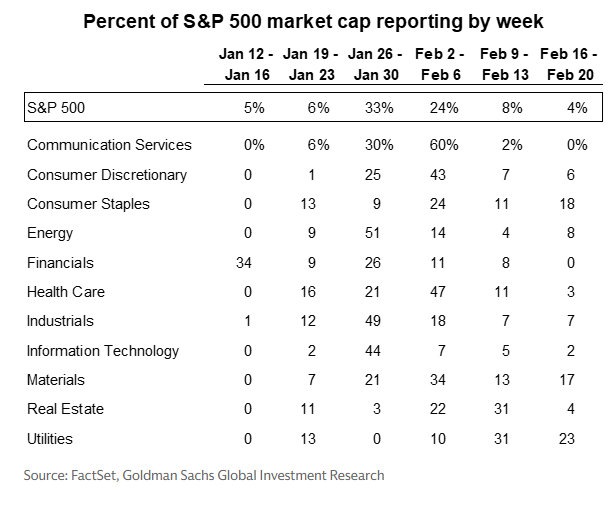
Goldman Sachs
The calendar for this week. The big banks will set the early tone...
@eWhispers
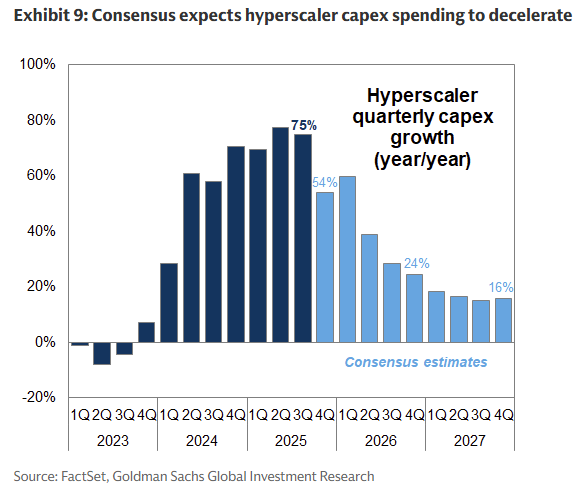
Maybe the most important numbers will again be the Hyperscaler capex figures which will show up with the big tech and semi reports...
The trajectory of capex spending established this quarter will have meaningful implications for the earnings outlook and share price performance of stocks involved in the AI build-out, including the largest stocks in the index. Consensus estimates show hyperscaler year/year capex growth slowing from 75% in 3Q to 54% in 4Q and to 24% by the end of 2026. We expect AI spending will exceed consensus estimates again this quarter, but agree that a deceleration in the pace of AI capex growth is likely in 2026.
Goldman Sachs
Speaking of hyperscaler capex, Facebook decides to write a big check for nuclear...
Meta Platforms on Friday unveiled a series of agreements that would make it an anchor customer for new and existing nuclear power in the U.S., where it needs city-size amounts of electricity for its artificial-intelligence data centers.
The Facebook parent said it would back new reactor projects with the developers TerraPower and Oklo and has struck a deal with the power producer Vistra to purchase and expand the generation output of three existing nuclear plants in Ohio and Pennsylvania.
Financial details weren’t disclosed, but the arrangements are among the most sweeping and ambitious so far between tech companies and nuclear-power providers. Vistra and Oklo shares both rose about 15% shortly after the stock market opened. TerraPower is privately held.
Meta aims to see the first new reactors delivered as early as 2030 and 2032, a speedy target even for more-conventional power projects. Its purchase of nuclear power from Vistra starts later this year and will keep power on the grid.
And why was the CEO of Caterpillar at CES last week? Because power is the #1 bottleneck to AI data center development...
"Why bring all of this to CES? Well, interesting, because the biggest bottlenecks in technology today, they're not in software. They're actually in the physical world. AI needs more chips. Chips need minerals that are pulled from the ground. Data centers demand power more than today's grids can provide. In the entire digital economy, needs infrastructure that can be built faster, run harder and stay online, no matter what. Those aren't software problems. Those are problems Caterpillar is uniquely positioned to solve."
@TheTranscript_
And in local data center news...
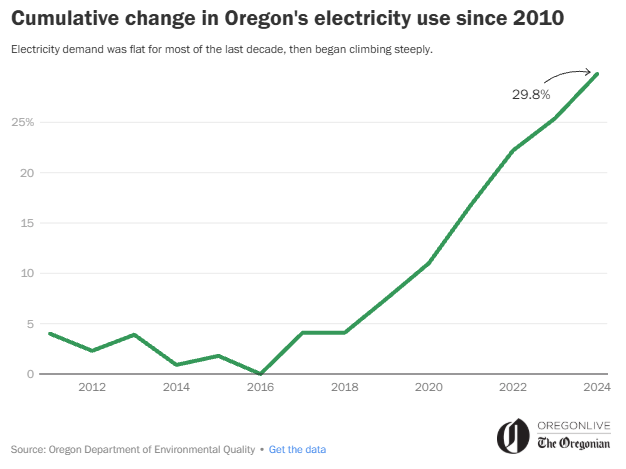
Oregon is a leader in data center square footage and energy use due to its proximity to the Columbia River dams for power, its direct connections to the transpacific fiber-optic cables, the lack of a state sales tax and very generous property tax breaks for businesses. But as the hyperscalers look to get even bigger in the state, future power needs will need to be addressed.
The state’s population growth stalled after the pandemic. Oregon’s job market flatlined and the regional economy fell into malaise. Those are phenomena usually associated with a decline in power consumption.
But something unexpected happened. Oregon’s electricity use jumped.
Data centers, lured by billions of dollars in local tax breaks, turned everything upside down. While consumer and commercial power demand has remained relatively constant for more than a decade, big tech companies have sent electricity consumption soaring from one side of the state to the other.
Power planners say that’s only the beginning. They expect artificial intelligence to trigger a massive increase in power use at new and existing data centers in the years ahead...
A new study commissioned by regional utilities concluded that within five years, the Northwest may need nine gigawatts more than it currently has the capacity to provide. That is an immense amount of energy, roughly equal to all the electricity Oregon uses today.
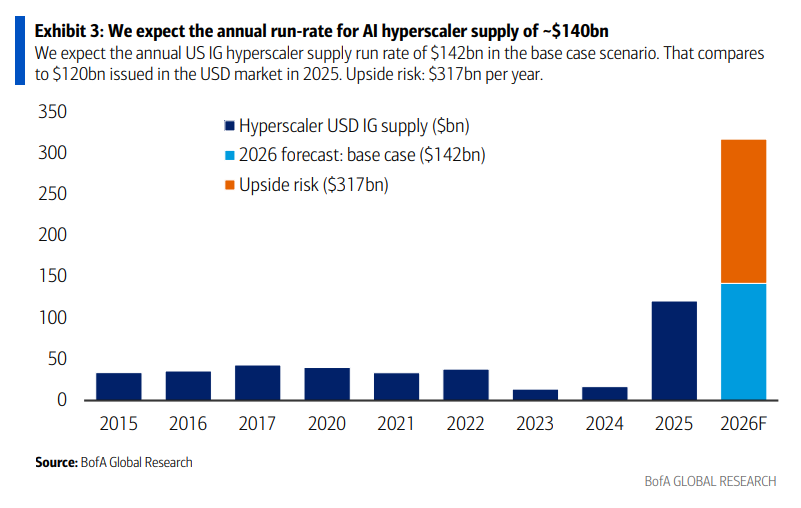
A good chart from Henry McVey's team on how hyperscaler debt measures up to past spending cycles in Shale and Telecom...
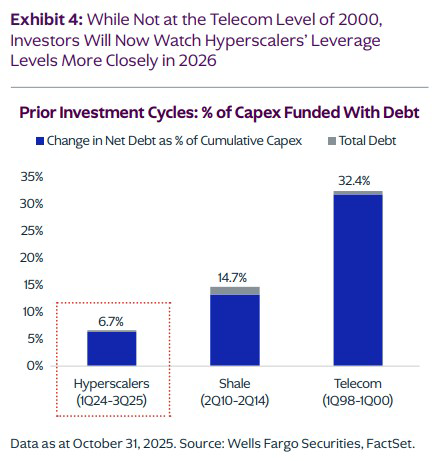
You can probably expect 1-2 data center bond deals to come to market every week if this chart is correct...
BofA Global
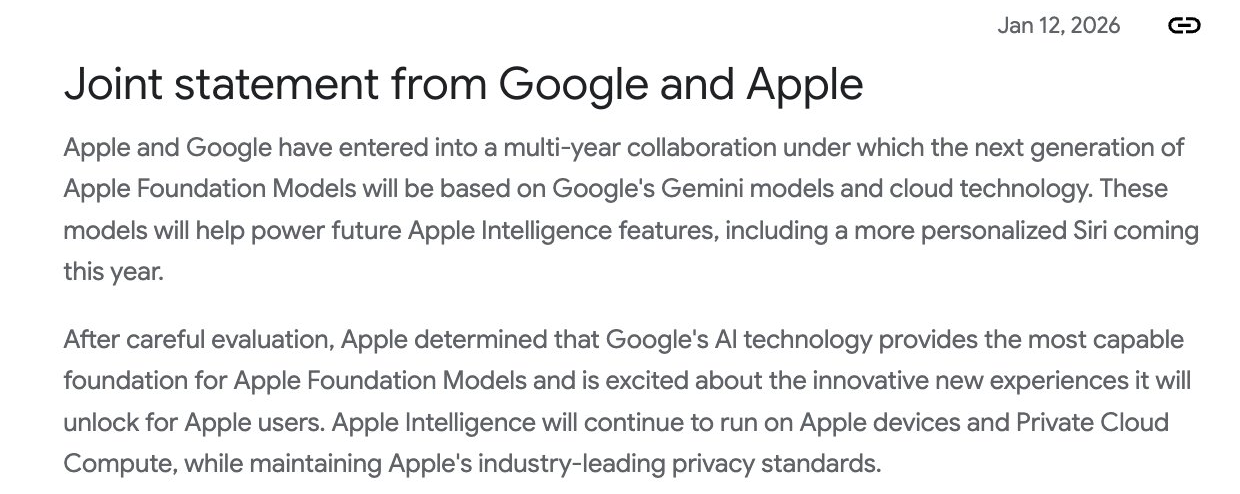
Speaking of AI, Apple just picked a partner for its 1.5 billion iPhone users...
Did you really think that it would be anyone different?
With new private company numbers being released publicly, xAI makes Tesla look like a value stock...
$230 billion divided by $277 million in annualized revenues = 830x. This versus Tesla at 15x sales. Maybe the backup plan for the Colossus data center is to hire The Boring Company to build a 359-mile tunnel east that terminates inside of Ft. Knox. That pile of gold bricks is now worth about $650 billion.
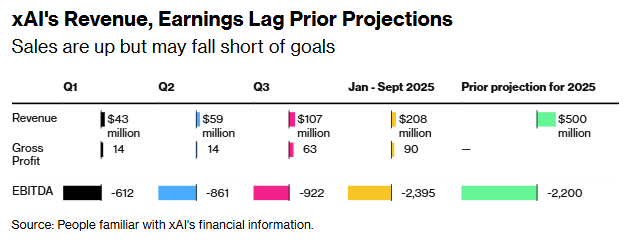
XAI reported a net loss of $1.46 billion for the September quarter, up from $1 billion in the first quarter, the documents reviewed by Bloomberg show. In the first nine months of the year, it spent $7.8 billion in cash...
XAI revenue nearly doubled quarter-over-quarter to $107 million for the three month period ended Sept. 30, 2025, according to financial documents shared with investors and reviewed by Bloomberg...
For now, xAI Holdings, the parent company of both xAI and X, is focused on raising money to keep up with its large expenses. It recently closed a $20 billion equity round from investors, including Nvidia Corp., Valor Equity Partners and the Qatar Investment Authority, which valued the company at $230 billion. That cash will presumably power the company for the next year or more, as it is still spending under $1 billion per month on investments, according to people familiar with the firm’s finances. XAI used almost $8 billion in cash on investments through the first nine months of 2025, financial documents show.
XAI has been raising both equity and debt. The firm has worked with Valor and Apollo Global Management on a special purpose vehicle to buy Nvidia Corp. chips, and it expects to do more deals soon to keep building out its Colossus data center site in Memphis, Tennessee. The firm is already planning an expansion of the Memphis complex, and recently purchased a third building in the area that will bring the company’s computing capacity to almost 2 gigawatts, Musk said late last year...
On the investor call, xAI executives were optimistic about the firm’s results, highlighting the revenue growth. Still, it may not meet its annual goal. In June, the firm told investors it hoped for $500 million in revenue for the year. Through September, xAI reported over $200 million in sales. The company’s gross profit has increased, though, and xAI reported $63 million in gross profit during the third quarter, up from just $14 million in the prior quarter, the documents show.
Despite this, xAI’s losses continue to grow. Ebitda — earnings before interest, taxes, depreciation and amortization — were negative. The company reported an ebitda loss of $2.4 billion through September, indicating its earnings have yet to make up for its expenses. That’s not uncommon for startups, which often require a lot of cash to grow and take time to turn a profit. Still, xAI’s losses were more than initially expected; the firm previously projected an ebitda loss of $2.2 billion for the full year, Bloomberg previously reported.
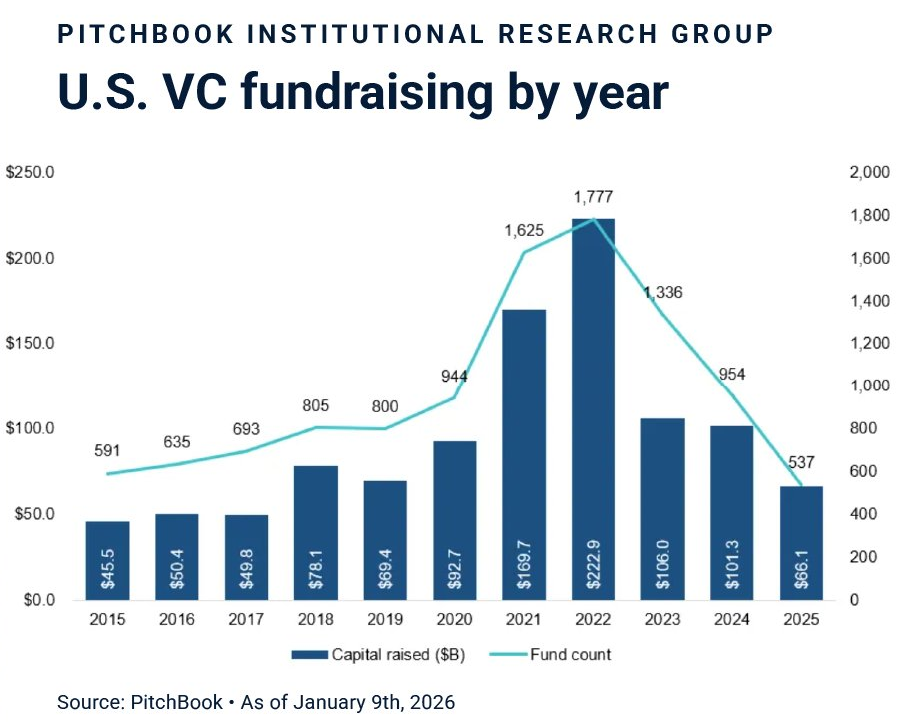
In other private company news, AH just raised VC funding that amounts to almost a 1/4 of what the entire space raised in 2025...
@PitchBook: Andreessen Horowitz has raised over $15 billion for a group of new funds, including $6.75 billion for its fifth growth equity fund. This is a major boost to the U.S. venture capital market, which just experienced its weakest year for fundraising since 2017.
J.P. Morgan continues to bet on a big M&A year in 2026...
Heading into 2026, absent any major market shocks, the pieces are in place for one of the strongest years for North American M&A and IPO activity we have ever seen. Favorable economic conditions, an increasingly permissive antitrust agenda in Washington and cheaper financing costs should make it easier to facilitate transactions, with companies now operating in one of the most pro-business deal-making environments in years.
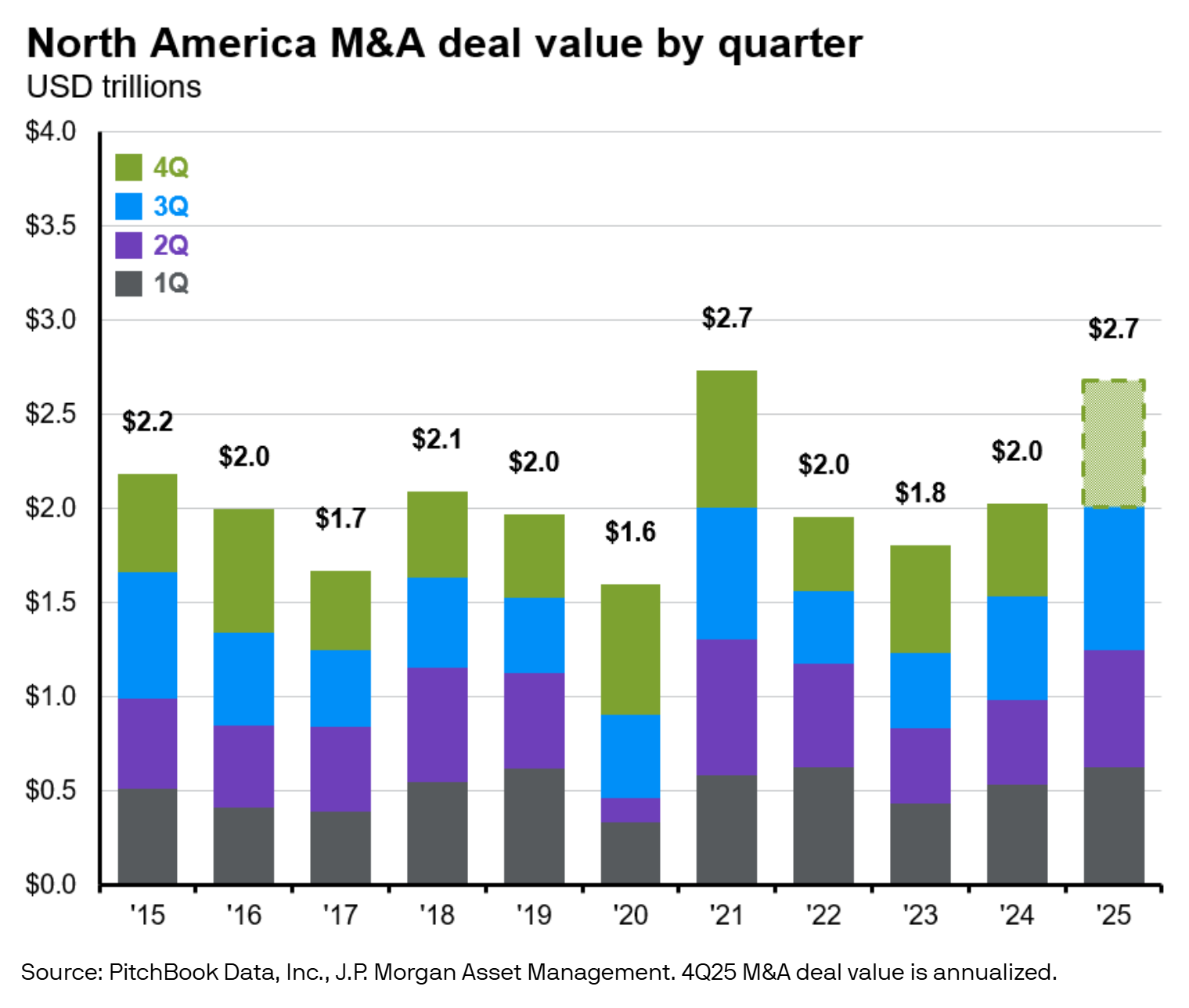
Speaking of M&A deal activity, it was another active week:
- OneStream announced that it has entered into a definitive agreement to be acquired by Hg Capital, with minority investments from General Atlantic and Tidemark, in an all-cash transaction for $6.4B ($24 per share) or a 31% premium. The proposed deal implies 8X FY26E EV/Sales.
- Vistra (VST) announced the acquisition of Cogentrix, which includes 5.5 GW of natural gas generation across 10 natural gas-fired power plants in the US Northeast and Texas to expand its generation capacity in fast-growing energy markets. The net purchase price of $4 bn or about $730/kW implies a 7.25x adjusted 2027 EBITDA multiple.
- Anheuser-Busch InBev SA/NV (BUD) reacquires 49.9% stake in its US metal container plants from a consortium of institutional investors led and advised by Apollo Global Management Inc. in a deal estimated to be around $3 billion. The company previously sold the stake to Apollo for $3 billion in 2020 to help pay down debt, and will fund the purchase with cash on hand.
- I Squared Capital has agreed to acquire Ramudden Global, an infrastructure safety company, from European buyout firm Triton. The deal is set to value Ramudden Global at nearly €2.5 billion ($2.9 billion) including debt, people familiar with the matter said. Ramudden Global provides temporary traffic management services for infrastructure projects and has 5,000 employees in 13 countries. It was formed by Triton through multiple acquisitions in the road safety industry.
- Hisamitsu Pharmaceutical Co. (4350.jp) said it expects to be taken private in a management buyout that values the Japanese maker of pain-relief patches at about ¥457 billion ($2.9 billion). The offer price of ¥6,082 a share is a roughly 35% premium to Hisamitsu’s unaffected closing price. An entity controlled by Chief Executive Officer Kazuhide Nakatomi, a member of Hisamitsu’s founding family, is behind the buyout, according to people familiar with the situation.
- Eli Lilly (LLY) is in advanced talks to acquire Ventyx Biosciences (VTYX) for more than $1 billion, according to people familiar with the matter. A deal for Ventyx, which specializes in developing pills that can treat inflammatory diseases, could be announced imminently, the people said. Ventyx, of San Diego, had a market value of a little over $500 million. Indianapolis-based Lilly has a market value of about $1 trillion.
- Allegiant Travel (ALGT) reached a roughly $1.1 billion deal to buy Sun Country Airlines (SNCY) as budget-focused U.S. airlines struggle with stiff competition from larger rivals. Allegiant said its deal values Sun Country at $18.89 a share, a roughly 20% premium to Sun Country’s closing price. Shareholders in Allegiant will own about two-thirds of the combined company if the deal is finalized, with Sun Country shareholders owning the remaining third. Allegiant will also absorb $400 million of Sun Country’s debt, the companies said.
- Snowflake (SNOW) announced the acquisition of Observe Inc. for approximately $1 billion. The acquisition will expand Snowflake’s capabilities in a $50+ billion IT operations management software market, positioning it to deliver next generation AI-powered observability based on open standards.
- KKR has agreed to acquire Arctos Partners in a transaction valuing the sports and secondaries investor at about $1bn. The deal includes performance-based incentives that could lift the valuation to as much as $1.5bn. Arctos’ senior management team, led by co-founder Ian Charles, will remain in place and retain their existing carried interest, while also receiving shares in KKR. Arctos manages around $15bn in assets and holds minority stakes across major US sports franchises, including teams in the NBA, NFL, MLB, and NHL.
- Accenture has agreed to buy artificial intelligence company Faculty in a deal valuing the UK start-up at more than $1bn, as the consulting group attempts to adapt to disruption from AI. Accenture said acquiring Faculty, which has more than 400 staff, would improve its ability to help clients “reinvent core and critical business processes” by adopting AI. The companies did not disclose the terms of the transaction, but two of Faculty’s investors, Apax Digital and Mercuri, said the deal granted the company “unicorn” status, shorthand for private tech companies valued at more than $1bn (£740mn).
- Self-driving car systems company Mobileye Global Inc. (MBLY) is acquiring Israeli startup Mentee Robotics in a cash-and-stock deal valued at $900 million, as it looks to develop humanoid robots. The deal comprises $612 million in cash and as many as 26,229,714 shares of Mobileye Class A common stock, according to the company. Mentee, formed in 2022, has raised $50 million to date at an undisclosed valuation.
- Amgen Inc. (AMGN) has acquired cancer drug developer Dark Blue Therapeutics Ltd. in a deal worth as much as $840 million, expanding its portfolio of oncology treatments. Based in the UK, closely held Dark Blue is testing a class of drugs known as protein degraders, which have become a hot target for companies including Novartis AG and Gilead Sciences Inc. Its most advanced compound, which has yet to enter clinical trials, could offer a new type of treatment for acute myeloid leukemia, a fast-growing blood cancer.
Various News Sources
Ben Affleck and Matt Damon are taking a page out of the "Ownership Works" playbook by including the entire production team in the upside financial incentive...
So check out 'The Rip' on Netflix this Friday and spread the word if you enjoy it.
But under the contract Artists Equity reached with Netflix, all 1,200 people involved in the nearly $100 million production, whether Mr. Affleck or a production assistant, will get a one-time bonus if the show performs well on the streaming service.
“We wanted to institute fairness and address some of the real issues that are present and urgent for our business,” Mr. Affleck said in an interview. He said he and Mr. Damon formed Artists Equity in late 2022 with an investment from RedBird Capital for this very reason. “This deal is fundamental, philosophically, to the ideas we had in starting this company.”...
For “The Rip,” according to Mr. Affleck, no member of the cast or crew received the upfront bonus. Instead the bonuses will be judged on the film’s performance over 90 days on Netflix and will be rated against other films on the service. The idea is that there could be a bigger potential payout for the whole crew.
“Everybody who’s in this movie, from top to bottom, or worked on the crew, will be bonused according to metrics which we’ve already defined and they’ve shared with us,” he said. Mr. Affleck declined to share what those performance metrics were, but said a movie could reach different levels. The top one, he said — the “grand slam” — would require viewership similar to that of “KPop Demon Hunters,” which, with 325 million views by August, is the most watched movie on the service. (He said he had no expectation that “The Rip” would hit that.)

Learn more about the Hamilton Lane Strategies
DISCLOSURES
The author has current equity ownership in: Alphabet Inc. and Albertsons Inc.
The information presented here is for informational purposes only, and this document is not to be construed as an offer to sell, or the solicitation of an offer to buy, securities. Some investments are not suitable for all investors, and there can be no assurance that any investment strategy will be successful. The hyperlinks included in this message provide direct access to other Internet resources, including Web sites. While we believe this information to be from reliable sources, Hamilton Lane is not responsible for the accuracy or content of information contained in these sites. Although we make every effort to ensure these links are accurate, up to date and relevant, we cannot take responsibility for pages maintained by external providers. The views expressed by these external providers on their own Web pages or on external sites they link to are not necessarily those of Hamilton Lane.