
Weekly Research Briefing: Enjoy The Silence

This should be a relatively quiet week for the markets. The news flow will be significantly reduced and many Wall Street professionals are off the desk. You can see this reflected in Monday's trading volumes, which should be among the lowest for 2026. Friday's VIX also posted its lowest close of the year reflecting reduced concerns among equity portfolio managers. At the same time, large, mid, and small-cap US equity indexes achieved record highs last week. The ex-US equity index also joined them.
Financial conditions for the US markets remain near perfect and highly accommodating to all forms of capital raising. The hyperscalers and neoclouds have open windows to issue debt for building their AI data centers. And companies have plenty of options in the public and private markets to pull off that strategic M&A decision. Just look at last week's news of Silver Lake entering talks with Workday, a company with a $50 billion market cap. And privately held Stripe is looking to pay $7 billion for OpenRouter, which just raised funding three months ago at a $1.3 billion valuation. These are good times.
While AI fundraising and capex continue to drive the US economy higher, the sky is not free of grey clouds. Energy prices remain high due to the closure of the Strait of Hormuz. Gasoline prices are the highest ever recorded for an August, and you don't even want to look at diesel prices. Consumers continue to eye energy and other prices while rising interest rates make financing decisions more difficult. And someday this month, the US federal debt will surpass the $40 trillion mark, which comes at a bad time for the US Treasury.
Retail analysts and traders will be about the only ones at their desks this week as the big box stores Walmart, Home Depot, Lowe's, Target, TJ Maxx and Ross Stores report earnings. Analog Devices will report on semiconductors, and John Deere will offer insight into the agricultural environment. Among economic numbers, we will get housing data, industrial/manufacturing figures and the Philly Fed update. Other than that, it will be a good time to tackle a couple of projects and build some AI agents to make my life easier and more efficient. Have a great week and let us know if you need anything.
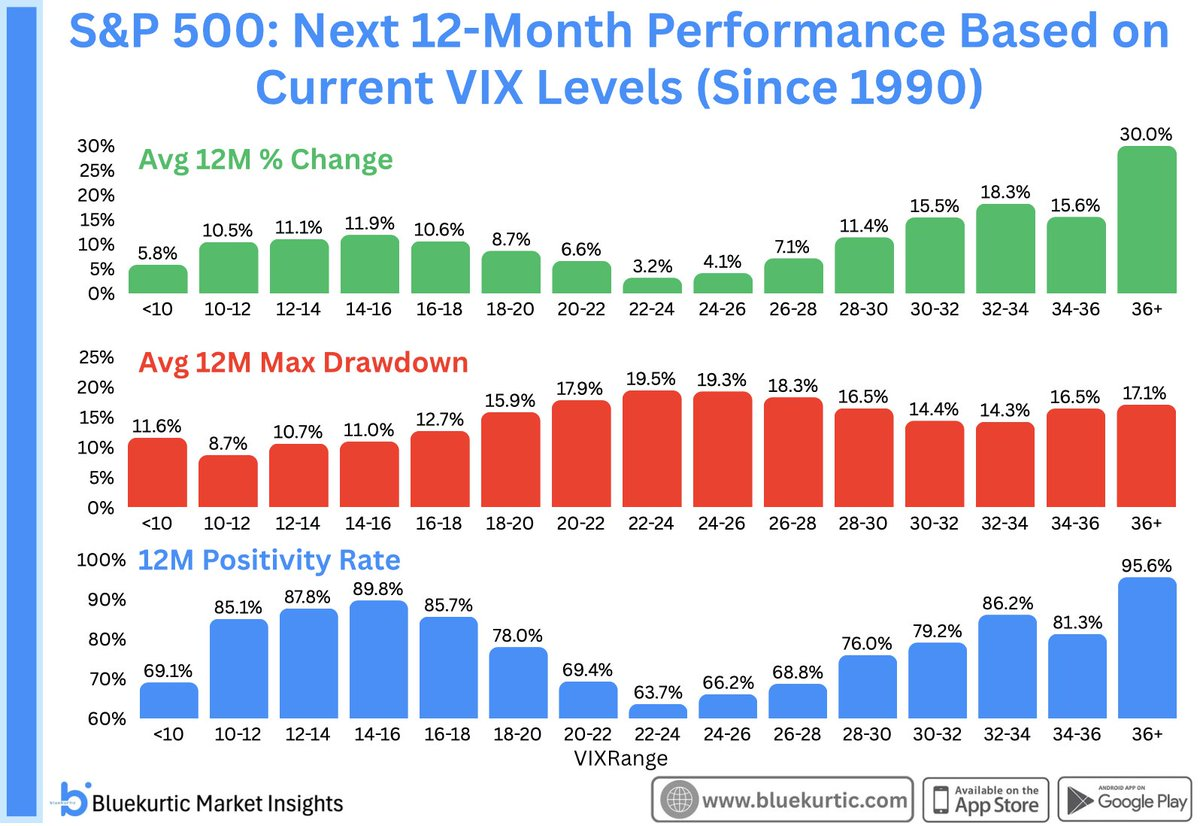
The S&P 500 volatility index is 'in the zone' which is good for all investors…
@Bluekurtic: Current $VIX level of 14ish doesn't mean complacency. It's actually at a sweet spot. Boring, but sweet. Since 1990, the S&P 500 $SPX 12M forward returns and positivity rate have been the strongest of any VIX range below the not so calm 30 mark.
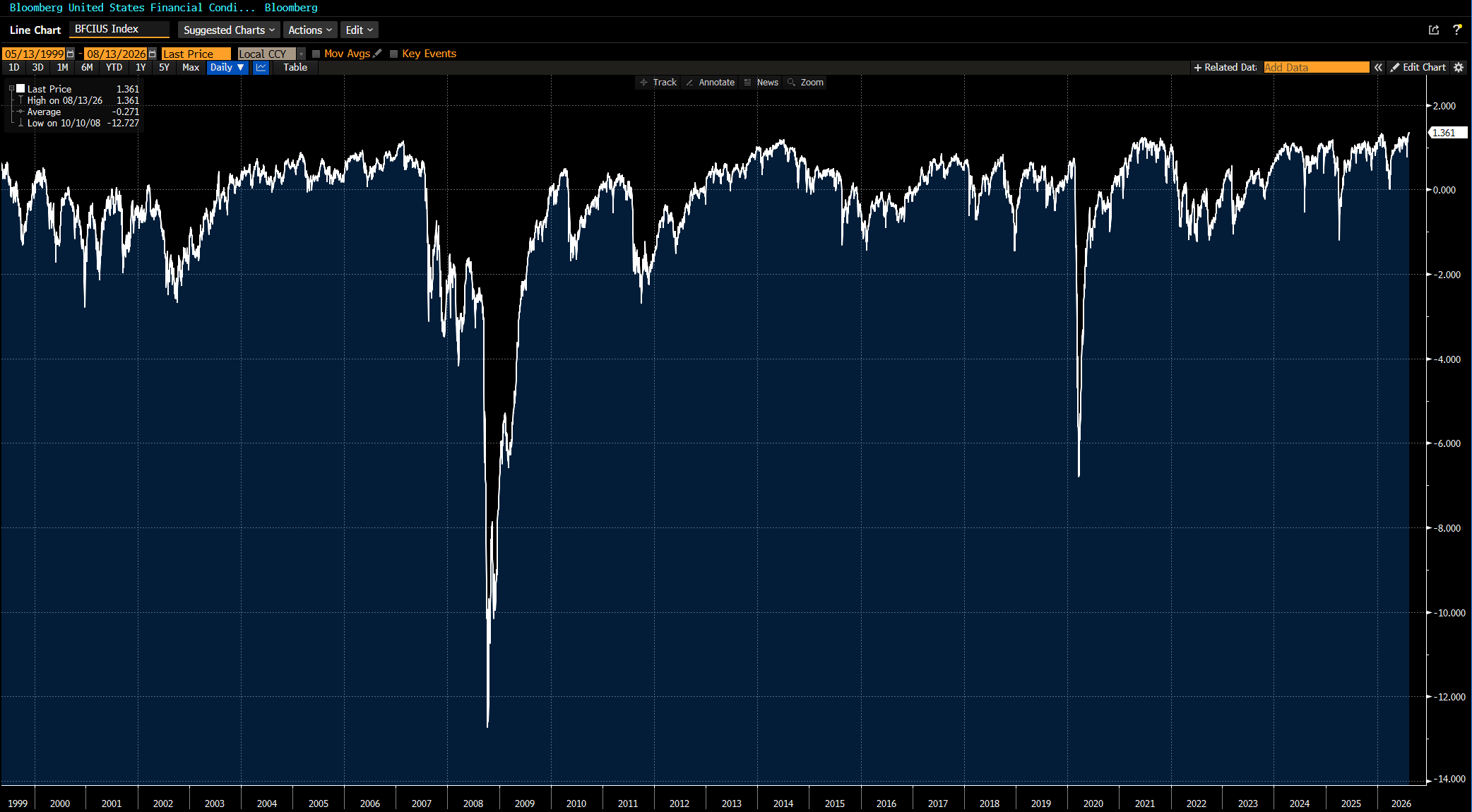
Financial conditions are among the best ever for nearly all capital market activities…
Bloomberg's US Financial Conditions index has loosened to its most accommodative since the 1990s. This measure accounts for money market, corporate and muni spreads, stock values and implied stock and bond volatility.
@lisaabramowicz1
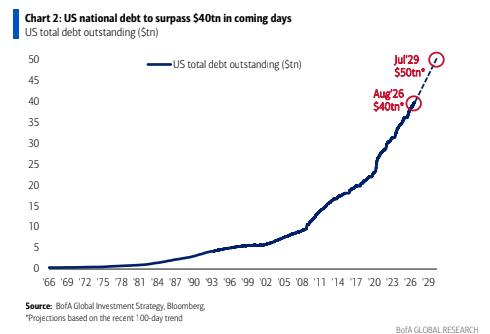
Now if only Washington could get its finances in order…
The Biggest Picture: US national debt set to surpass $40tn in coming days, on course for $50tn by ’29 (Chart 2); cost of servicing debt $1.4tn in past 12 months, will keep rising until 5-year UST yields drop below 31⁄4%, reinforcing Anything But Bonds asset allocation; US stocks storming to new highs same day government selling 30-year USTs at highest yield (5.126%) in 25 years “tracks” as the kids say.
BofA Global
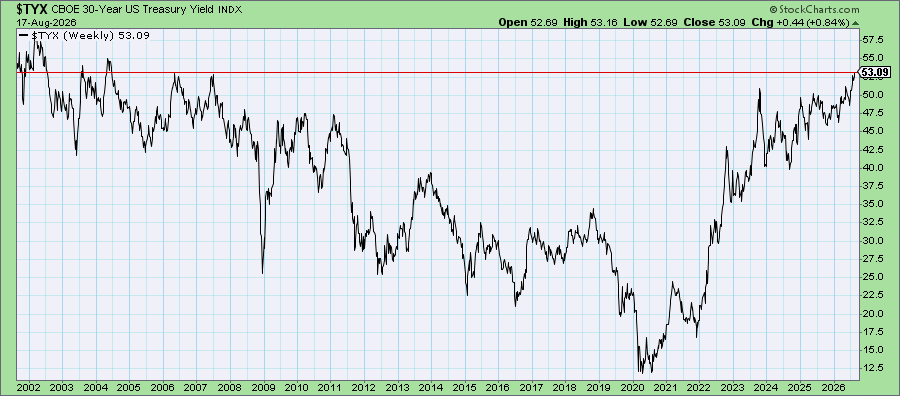
Worries about US debt levels, fiscal irresponsibility, the U.S. dollar and energy prices have pushed the 30-year Treasury yield above twenty year highs…
StockCharts
Equity investors who have looked away from the US are outperforming…
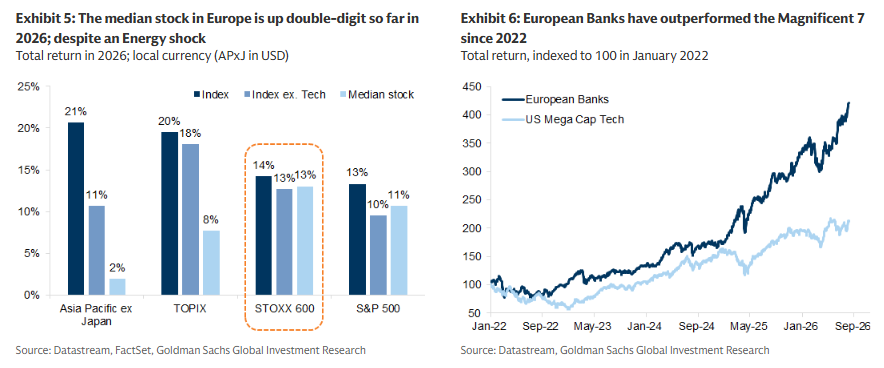
It’s true the longer term track record of Europe on performance and EPS – especially the decade post the GFC – has been considerably weaker than the US. The US stock market has achieved much stronger and persistent returns than both Asia and Europe. But, in more recent years, and especially since the Pandemic, performance has been far more mixed than the market-narrative or most investors realise (Exhibit 5). Since 2022 European Banks (SX7P) have considerably outperformed the Magnificent 7, (Exhibit 6). In addition, since the start of 2025 – and despite both the tariff shock and an energy supply crisis Europe STOXX has outperformed S&P 500. The high starting valuation for the US market, higher interest rates (which hit longer duration stocks such as US tech but helped European banks), the sharp rise in capex by the hyperscalers and the questions over ROI and funding, and the shift in focus to HALO stocks (heavy assets, low obsolescence) have all supported Europe. In addition, European stocks have been supported by Germany’s sharp rise in fiscal spend and the absence of large political shocks in Europe has helped to ensure a falling risk premium.
Goldman Sachs
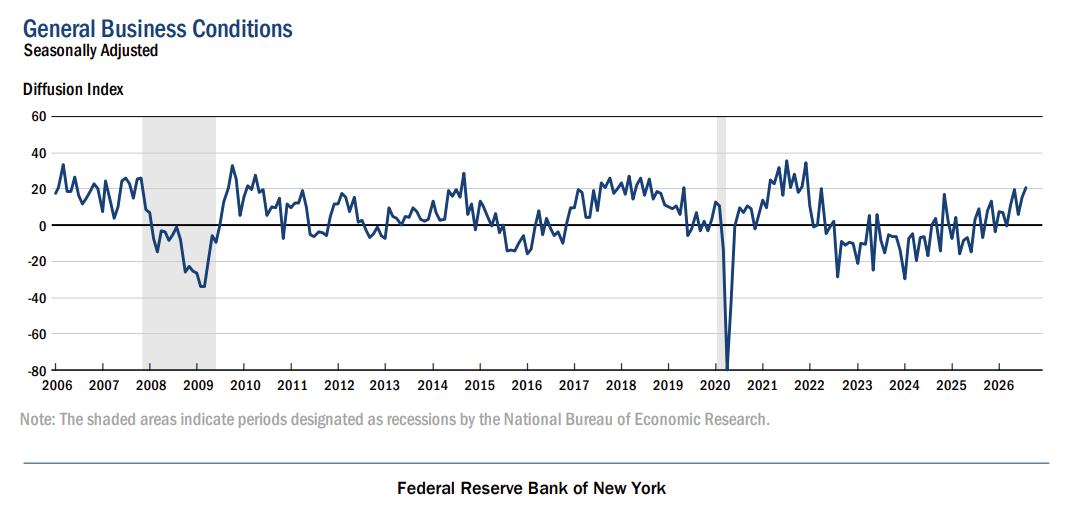
Monday's New York Fed manufacturing data shows activity accelerating higher…
Business activity grew strongly in New York State in August, according to firms responding to the Empire State Manufacturing Survey. The headline general business conditions index rose five points to 20.6, its highest reading in more than four years. New orders and shipments posted solid gains. Unfilled orders increased notably, delivery times lengthened substantially, and inventories declined. Supply availability continued to worsen. Employment levels and the average workweek rose modestly. The pace of input price increases picked up, and selling price increases remained elevated but eased for a second consecutive month. Looking ahead, firms maintained an optimistic outlook for business activity.
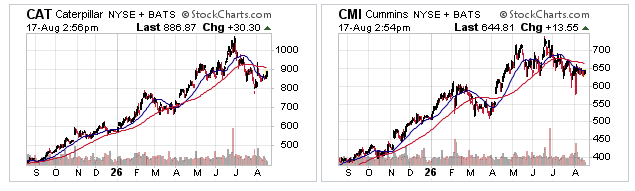
With AI driving 1/3 of current US GDP growth, it is some big manufacturers even more…
Power-hungry data-center developers have turned Caterpillar’s once-prosaic business of electricity generators into the equipment maker’s leading source of profit. The company is investing $725 million to expand generator production at an Indiana plant.
Caterpillar converted another plant in Kansas to produce turbine engines popular with data centers. The company is also resuming production of 10-megawatt generators that were last made in 2022.
“If we can get more units out, they’re asking us to give them more,” Caterpillar Chief Executive Joe Creed said of data centers during the company’s second-quarter earnings call with analysts.
Engine maker Cummins is also leaning in to its existing generator business. The company is investing $450 million to increase generator production, following a $200 million investment in expanding production completed last year. Cummins expects its data-center-related sales to rise by 80% to $9 billion in 2030 from 2026.
Cummins’s generators are now mostly used for standby power in data centers. Data centers’ voracious power consumption is pushing developers toward on-site power generation and storage. Cummins this spring said it plans to offer new larger generators starting in 2028 that can be grouped at data centers as a primary power source. The generator’s 130-liter engine—roughly 65 times the average size of a U.S. car engine—will be powered by natural gas and produce four megawatts of electricity.
StockCharts
US consumers were less excited about spending in July however…
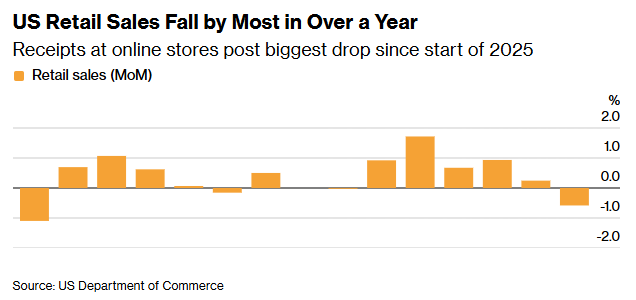
US retail sales fell in July by the most in more than a year as consumers pulled back on purchases at online stores and auto dealers.
The value of retail purchases, which isn’t adjusted for inflation, decreased 0.6%, the most since May 2025, according to data published Friday by the Census Bureau. Excluding autos and gasoline, sales fell 0.2%.
The report suggests consumers took a breather last month after a stronger first half of 2026, though some analysts also warned the numbers could be affected by spending pulled forward after Amazon.com Inc. moved its Prime Day sales event to June this year from July the year before.
Five of 13 categories in the report from the Census bureau, part of the Commerce Department, posted declines, led by a 2.2% drop in sales at non-store retailers such as Amazon. Sales at motor vehicles and parts dealers fell 1.8%. Meanwhile receipts at restaurants and bars, the only service-sector category in the retail report, rose 0.5%.
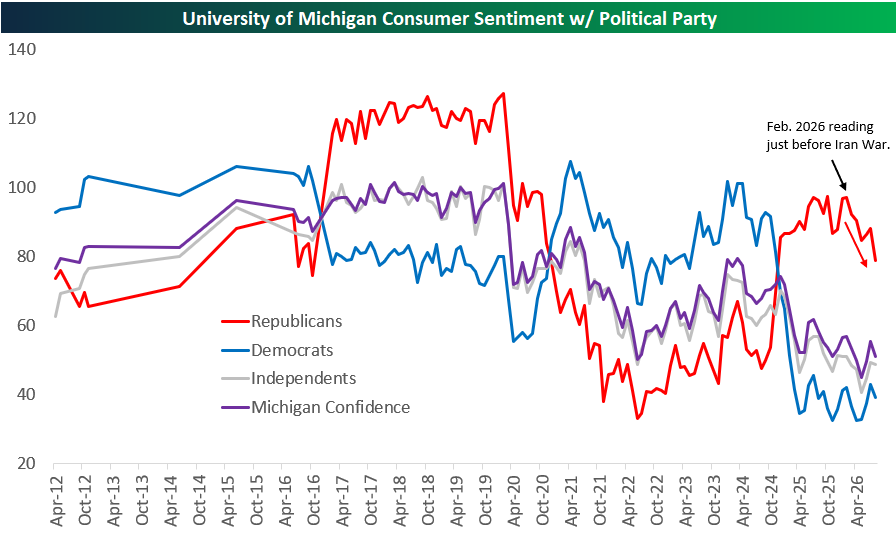
Maybe fuel costs are beginning to hit the red states harder as the war in the Middle East drags on…
"Republican consumer sentiment fell 9.5 points in August from July, per the University of Michigan monthly survey out Friday — one of the largest declines the decades-old project has ever recorded. The Republican decline was more than double the overall headline number."
@bespokeinvest
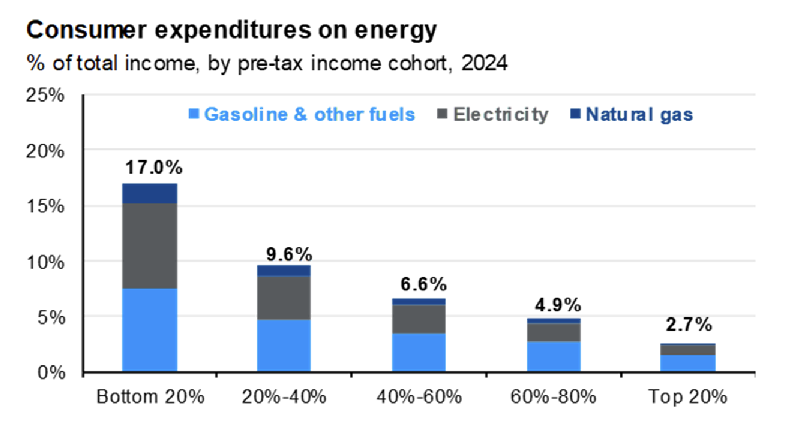
A reminder of just how big energy prices are to those in the lower quintiles of income…
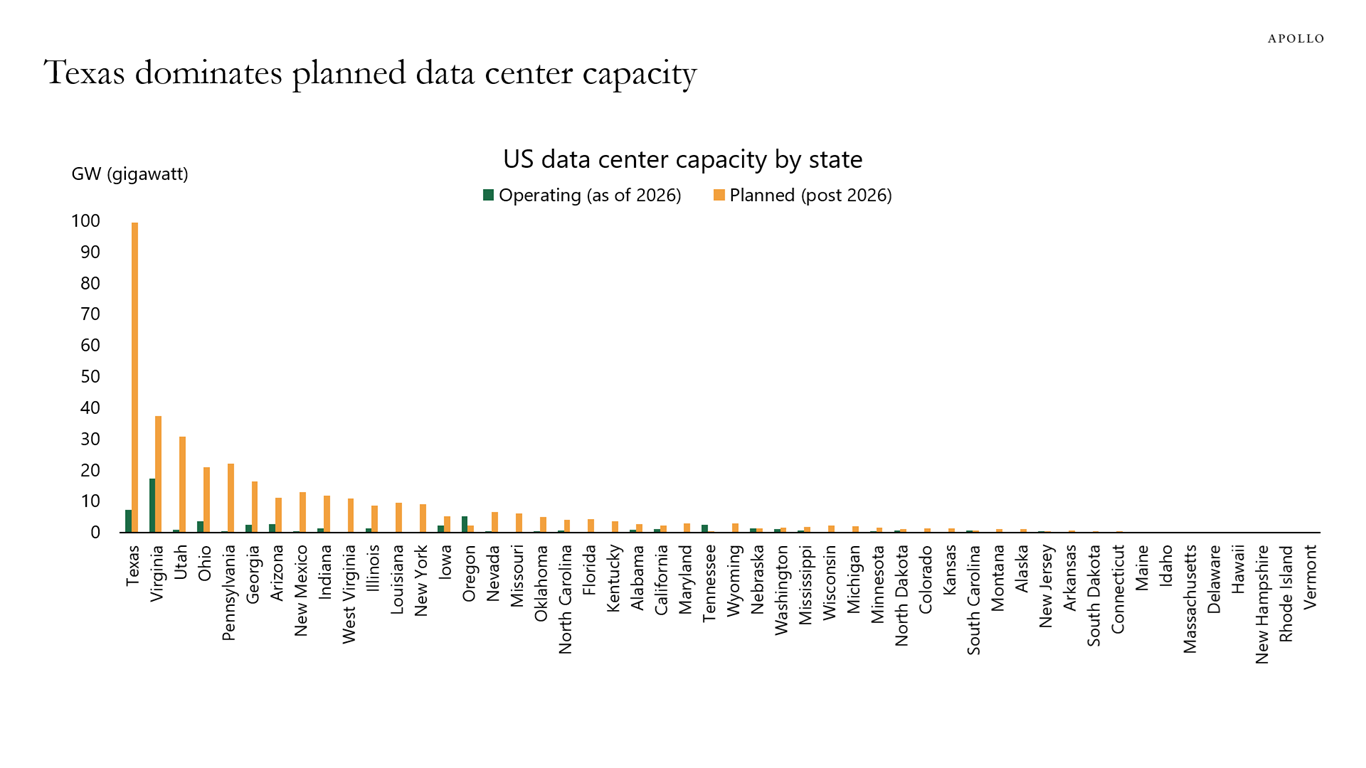
Speaking of red states, the biggest one is pushing all of its chips into the middle of the pot for AI datacenters…
Cleanview data shows that Texas alone accounts for roughly 100 GW of planned data center capacity, more than the next two states, Virginia and Utah, combined, see chart below. Virginia, by contrast, still leads on operating capacity at 17 GW.
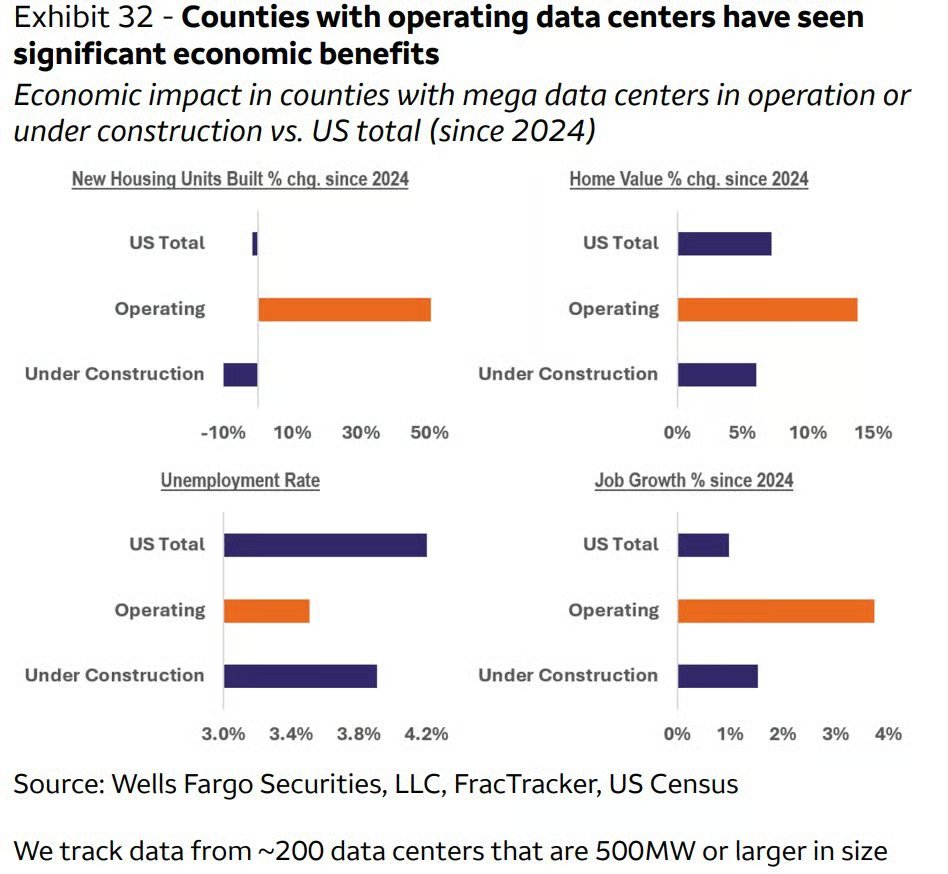
"Counties that build data centers are seeing new housing, higher home values, lower unemployment and more job growth..."
And so Texas, Virginia and Utah will lead the US states in job and housing growth for the next several years?
Wells Fargo
The rise in AI is a positive for GDP growth, but the US Treasury now has a new major competitor for its future bond sales…
Already this year, investment-grade companies have sold nearly $1.5 trillion of bonds, a 36% jump from a year earlier. The accelerating AI borrowing spree is taxing the market’s ability to absorb so much debt and adding to the pressures that have pushed the Treasury’s long-term borrowing costs to a 25-year-high…
But the surge in new AI debt — much of which is also long-dated — has more than filled the breach: According to Barclays, the net supply of corporate bonds is expected to swell by $474 billion, much of it because of sales by the tech giants…
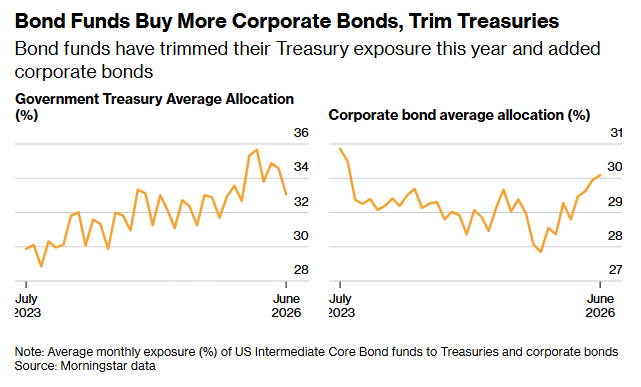
According to Morningstar Inc., bond funds that are limited to investment-grade US debt dialed back their Treasury holdings this year and increased their average allocations to corporate bonds to 30%, a three-year high. A similar shift has been seen among overseas investors, long a key source of funding for the federal government.
That’s complicating the Trump administration’s effort to ease the pressure on the Treasury market and, in turn, pull down the rates on mortgages and consumer loans. While Treasury Secretary Scott Bessent once expressed confidence that Trump’s fiscal policies would do that by taming the deficit, the government has continued to spend nearly $2 trillion more than it brings in each year, keeping the national debt growing far faster than the economy.
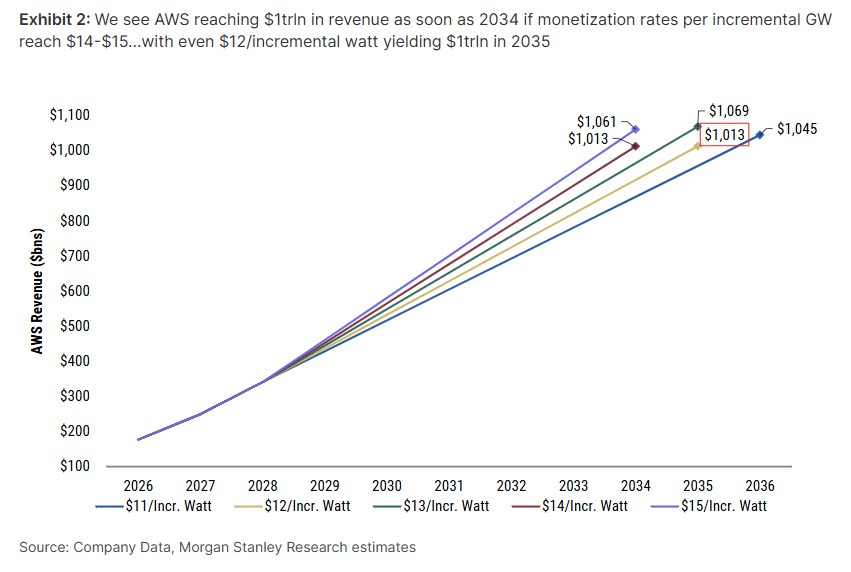
Amazon is the largest company in the S&P 500 by revenues today at $800b. Morgan Stanley makes the case for that figure to double as AWS grows profitably…
“We long believed AWS could become a few hundred billion dollar revenue business and now believe it'll be at least double that, and very possibly be $1 trillion annual revenue business for us in time with very appealing accompanying free cash flow and return on invested capital.”… AWS is currently monetizing at $8/incremental watt (full year '26 estimate) and we expect this to rise...and consider that if AWS could monetize at $12/incremental watt (on average) it would yield $1trln of revenue as early as 2035. Monetization of $14-$15/incremental watt could bring it even earlier in 2034.
Morgan Stanley
Some interesting comments from the big NeoCloud which reported last week…
“Demand now extends beyond our infrastructure as well. Through CoreWeave Omni, we are seeing significant interest from sovereign enterprise and cloud customers alike. In the past few weeks we signed our first deal, which will begin to scale in 2027. These examples differ by industry and use case, but the pattern is consistent. AI is moving from experimentation into core operations, and the organizations that act decisively are creating an advantage. Deployment is no longer the finish line.”
“Pricing and margins for our Blackwell and Vera Rubin SKUs are setting new highs while pricing for prior generation SKUs is at or above where it was years ago. Our near-term capacity remains effectively sold out. That is translating into signed commitments on increasingly favorable terms from a broadening set of customers and is positioning CoreWeave to gain market share for years to come.”
“We will have generated an attractive return even before the prospect of further monetizing the cloud infrastructure. Every resale or renewal is incremental on top of the returns already earned within the initial term. What we are seeing today is that the upside of re-contracting is real as we remain largely sold out of prior generations of NVIDIA GPUs in addition to the current SKUs. So as our earlier generation fleets roll off their original contracts, they offer the potential to deliver strong returns in the subsequent years. We are seeing this across our Ampere and Hopper fleet. As an example, we recently signed an A100 contract that extends into 2029 at an attractive price. As a reminder, this SKU was introduced in 2020.”
CoreWeave conference call
Many of your frequently used websites are getting more helpful and efficient…
There are increasingly some very additive AI engines being integrated into the websites that I use on a daily/weekly basis. Definitely give them all a try at least once to see if they help your project or search.
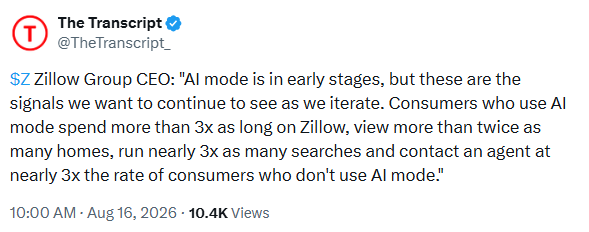
What happens when the frontier models are cheaper to use than the Chinese models…
AlphaSense released a study that found proprietary models from OpenAI and Anthropic are actually cheaper for performing some tasks, compared to open-weight models from leading Chinese developers. Looking just at the price of the tokens—the units of text or images that AI ingests and generates—can give the misleading impression that open-source or open-weight models are always cheaper; but the study echoes contentions from some American AI executives, who argue that greater intelligence can make the U.S. models more cost-effective despite their higher prices per token.
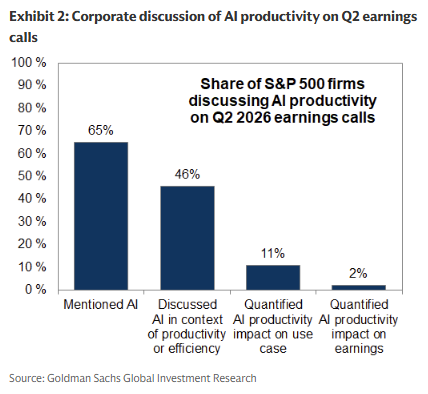
Goldman Sachs had a good summary of Q2 earnings discussions about AI mentions and productivity…
During the Q2 earnings season, 11% of S&P 500 companies quantified the impact of AI productivity on a specific use case, such as coding or customer support, and 2% quantified the impact of AI productivity on earnings. Both of these were similar to the shares in Q1 2026.
Some companies talk about using AI…
But if you want some idea of how hard we are running at Hamilton Lane, just check out this screenshot I captured last week on our internal Slack network:
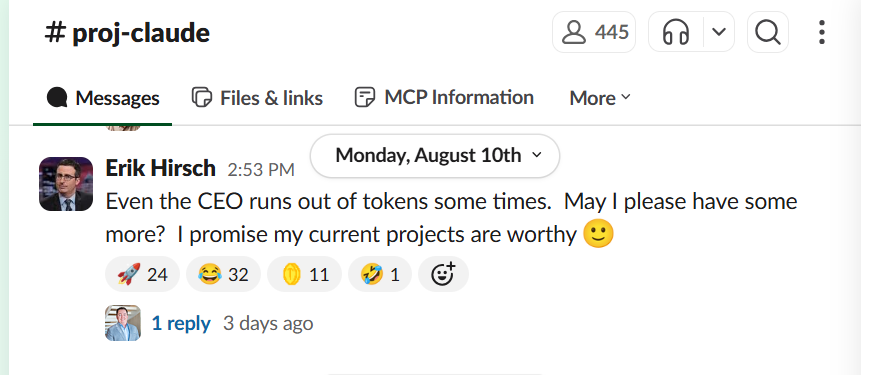
HL Slack
Finally, here is a good piece of trivia to challenge your kids or Mouse-eared friends…
Fascinating that The Lion King musical is the highest-grossing piece of entertainment ever.
(As mentioned by @djrosent, @gilbert in @AcquiredFM.)
$11 bill in revenue since its 1997 Broadway debut - more than any film, video game, etc.
Here's how it stacks up vs. top 5 films:
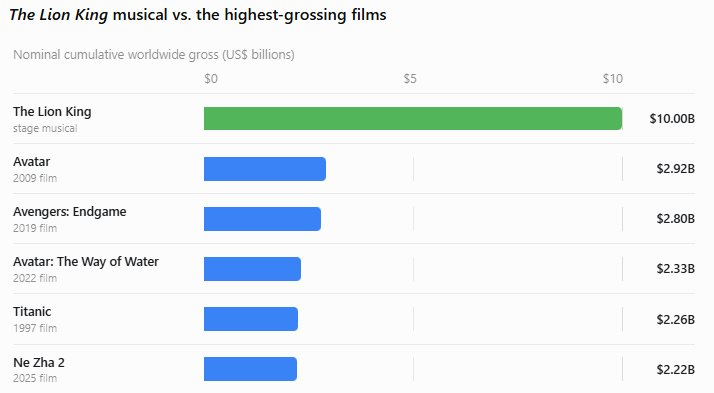
@APNavaratnam
Learn more about the Hamilton Lane Strategies
DISCLOSURES
The author has current equity ownership in: Caterpillar Inc. and Hamilton Lane Inc.
The information presented here is for informational purposes only, and this document is not to be construed as an offer to sell, or the solicitation of an offer to buy, securities. Some investments are not suitable for all investors, and there can be no assurance that any investment strategy will be successful. The hyperlinks included in this message provide direct access to other Internet resources, including Web sites. While we believe this information to be from reliable sources, Hamilton Lane is not responsible for the accuracy or content of information contained in these sites. Although we make every effort to ensure these links are accurate, up to date and relevant, we cannot take responsibility for pages maintained by external providers. The views expressed by these external providers on their own Web pages or on external sites they link to are not necessarily those of Hamilton Lane.