
Weekly Research Briefing: Coffee is for Closers

We knew there would be speedbumps on the road to AI nirvana. After moving past the initial worries of 'The Matrix,' 'The Terminator,' and other end-of-world risks, the software needed to be written and the datacenters had to be constructed. Building datacenters is no easy feat: find a site, get permits, pay up for chips, secure power, hire workers, etc. While all the plans looked great in the power point presentation, execution can be tricky as some of the newer entrants have discovered. If the data center cannot be built on time, the customer will threaten to exit. Meanwhile, risk-free rates have only moved higher and all the competition is tapping the market for capital equally fast, causing the cost of capital for all neocloud builders to rise significantly higher than when that first site plan was dreamed up.
So no coffee breaks for the AI builders who haven't been able to get their datacenters online and connected to their waiting customers. Last week Microsoft pulled back from an Nscale data center in the UK because of delays. Other neoclouds are seeing their projects pushed back due to permitting, power or both. Debt markets have reacted to the delays by pushing affected companies' bond prices lower causing publicly traded stocks to fall much further. The ripple effect has even led to the halting of two neoclouds that were about to go public. This is all happening when the two largest pure-play AI model companies are looking to go public.
The good news is that the hyperscalers with very strong balance sheets are still in the market's good graces and have little problem raising any amount of capital they need to grow. While the hyperscalers hoped to build their AI businesses with lower capital needs by letting others build and own the data centers, that may no longer be possible. Especially if interest rates and neocloud debt spreads continue to rise. If necessary, look for the hyperscalers to raise capital and buy the entire data center asset, or at least the highly valuable and difficult to obtain semiconductor chips inside it. Hyperscaler investors may not like the capital dilution, but most would swallow it to participate in the long term AI business upside. If only oil prices were back in the $60s and interest rates toying with a 3-handle like a year ago, this speedbump might be much easier to drive over.
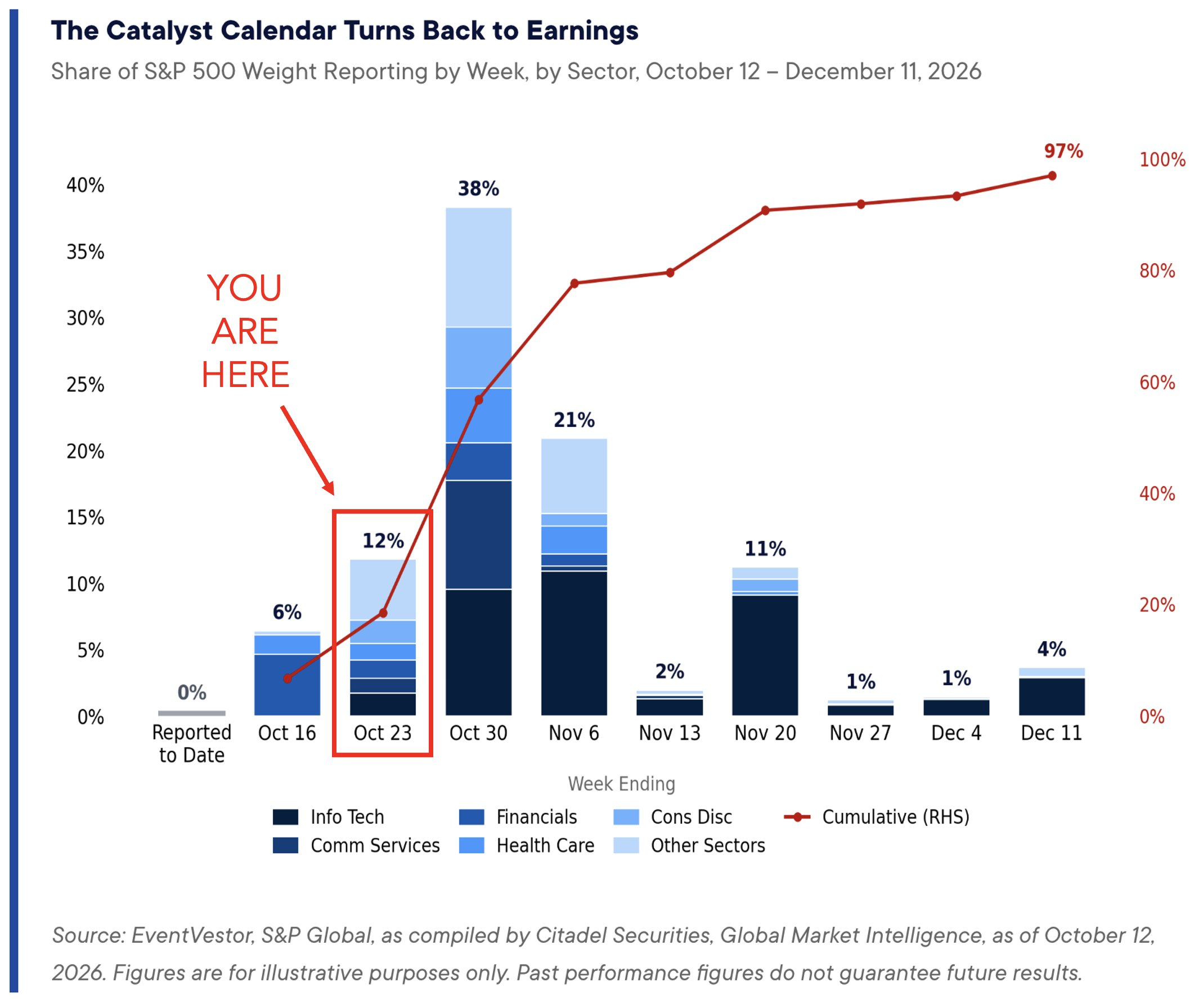
For the second week in a row, US Treasury rates have fallen. This occurred even with a hotter-than-expected set of CPI and PPI data last week. The fall in rates is good for equities, but not if it is a reaction from the bond market anticipating a pullback in economic growth due to the AI rollout retreat. As Q3 earnings are reported, there is little sign of a slowdown in AI activities, but there is a sign of increased cautiousness due to rising rates. The big banks all acknowledged that while reported results were solid, many noted some increased uncertainty given the 1% jump in interest rates. This led to a volatile week of financial stock performance, which was a disappointing way to start the earnings season. This week will see earnings releases widen out across multiple industries while next week will see almost 40% of the S&P 500 report including most all of the mega cap technology names. Little on deck for economic data and the Fed will move into the quiet period ahead of the FOMC meeting on the 27th and 28th. Enjoy the week.
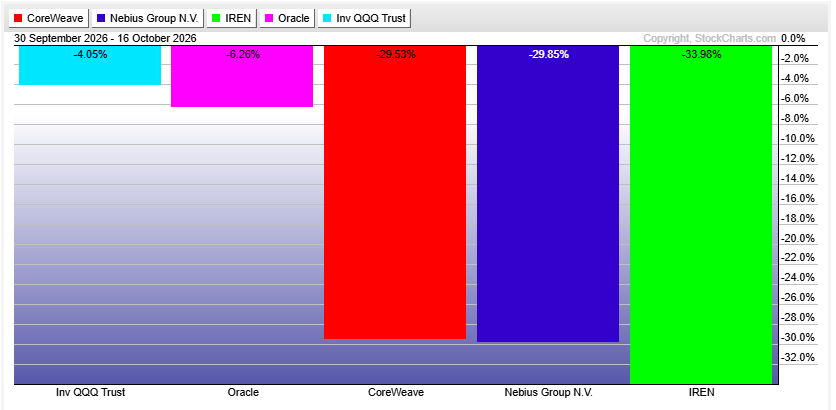
It has been a tough October for the 'NeoClouds'…
The three big public neoclouds have seen one-third of their market caps disappear. Even Oracle remains on the defensive with a stock price near two year lows.
StockCharts
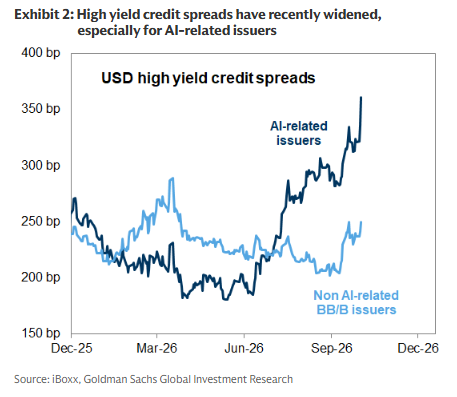
High yield AI credits have really taken it on the chin as debt investors become much more disciplined…
Goldman Sachs
Not helping the neocloud news flow last week was Microsoft's retreat from a project in the UK…
Microsoft Corp. has pulled out of a UK data center deal with Nscale, the British neocloud firm said, marking a setback for the startup’s initial public offering hopes.
Nscale didn’t provide a specific reason for why the US tech giant had pulled the plug on the deal in Loughton, Essex, which has been contending with delays due to power constraints. Nscale’s flagship site in Norway is also six months behind schedule, Bloomberg has reported, with only 6.4 megawatts of the intended 30-megawatt data center up and running.
Microsoft’s withdrawal marks a fresh setback for Nscale as it seeks to raise as much as $3 billion in an IPO as soon as this month. It has already been contending with investor jitters over the risks of the wider artificial intelligence buildout…
A Microsoft spokesperson said the company remains committed to its partnership with Nscale. “This decision relates to a single site,” the spokesperson said in an emailed statement.
Nscale relies on Microsoft and Anthropic for around 85% of its contracts, according to an IPO filing, and the former had been set to become the anchor tenant at Nscale’s first British data center in Essex.
CoreWeave was also on the defensive as bond investors began to worry abouts its future ability to raise capital…
Junk bond buyers are increasingly freezing out tech startups looking for financing, as CoreWeave Inc.'s pain raises bigger questions about how artificial intelligence companies will fund themselves.
Yields on CoreWeave's junk bonds surged to 15% this week, a level usually signaling distress, after the company's co-founder said the data center operator was exploring ways to borrow in investment-grade debt markets.
The upshot for lenders is that picking strong credits is unusually important now, particularly in companies tied to AI, strategists wrote in a note, and companies may find markets shut at various times…
Companies have sold $106 billion of high-grade and high-yield bonds to finance projects so far this year in the US dollar market, often to help fund AI investments like data centers, according to Goldman Sachs. That’s almost triple the $37 billion raised for all of 2025.
Next year, there could be more than $300 billion of project finance issuance for high-grade and high-yield bonds worldwide, the strategists wrote. While higher capital costs may slow the pace of investment a little, it’s unlikely they will be completely derailed, according to the report…
If the companies can’t borrow in the junk bond market, they’ll have to find other ways to fund their expansion. That could include convertible securities or equity, in addition to secured debt financing and securitization.
Then there was this research report suggesting that 80% of the neoclouds would not make it on their own…
In a new report, analysts at Gartner predicted that more than 80 percent of neoclouds would “cease independent operations” by 2030. A.I. data center operators would need a combined $8.5 trillion in revenue to cover capital spending, financing costs and an adequate return on investment, Gartner analysts wrote, but they are forecast to collect “no more than $3.6 trillion.”
From the week's earnings, there was little sign from ASML that a slowdown in semiconductor demand is anywhere near…
$ASML CEO: "As customers shift focus to their needs beyond 2027, our order momentum continues to build. We are increasingly receiving orders for 2028 and customers are also expressing interest in placing orders for 2029 and even 2030."
@TheTranscript_
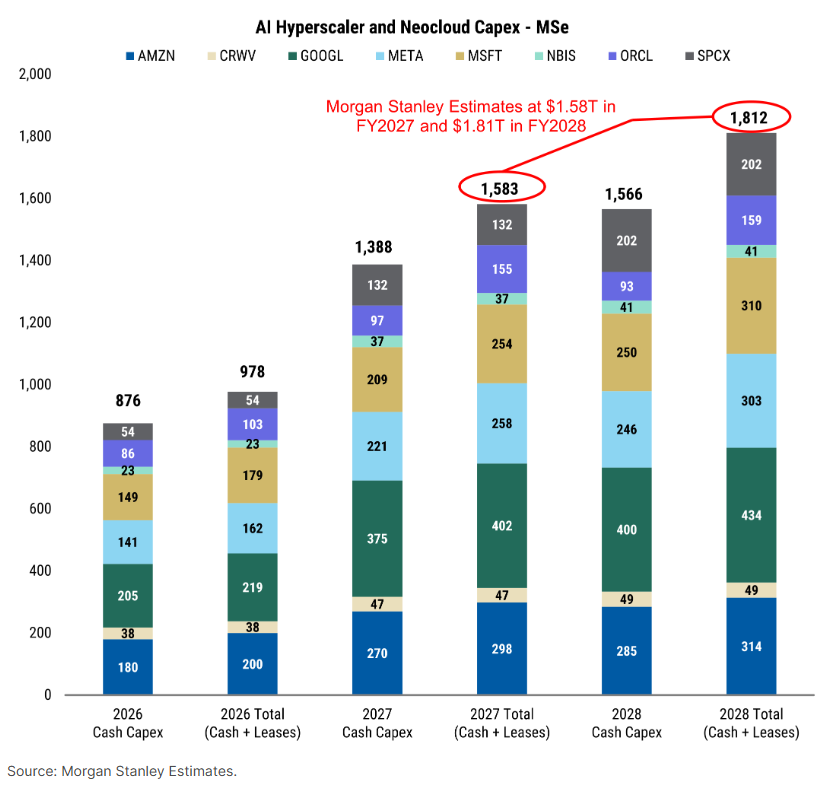
And Morgan Stanley increased their AI Capex estimates ahead of the upcoming quarterly releases…
New estimates from our sector teams map $1.6 trillion of 2027 compute investment from hyperscaler and neocloud end customers to single-stock revenues.
A growing portion of capex is being financed through leases. Our new lease capex estimates add $195 bn in 2027 and $246 bn in 2028 to headline capex, increasing total 2027 investment by ~14%.
With the cash-flow deficit among hyperscalers and neoclouds expected to widen next year, we anticipate financing needs to rise in 2027. We continue to see capacity for the higher-rated hyperscalers to fund their investment plans, even at higher borrowing costs, while lower-rated borrowers are more exposed to financing constraints.
Morgan Stanley
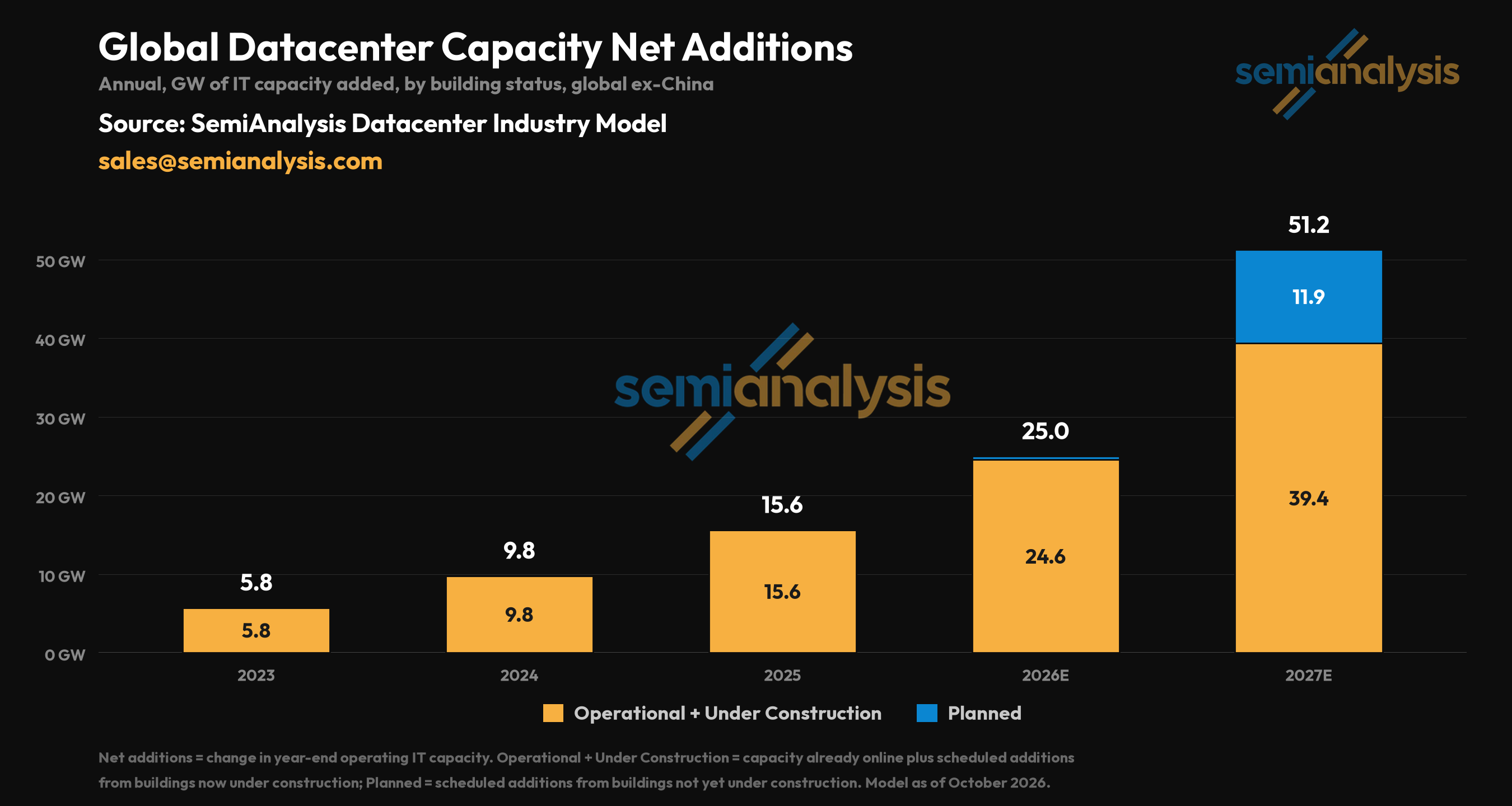
SemiAnalysis also updated their capacity addition forecasts with the help of their satellite imagery research…
If you ask any datacenter builder, they’ll tell you how hard it is, how some workers aren’t showing up, how vendors are delayed, and many other issues. All of this is accurate. And that’s why we’ve successfully called out countless datacenter delays and keep calling out developer timelines that appear overly aggressive in our Datacenter model, including the Oracle New Mexico Force Majure site delay in April. To be fair, +50GW is essentially the global cumulative datacenter market up through 2024 being built in one year! But our Datacenter Industry Model adjusts for all of that and still points to a material acceleration in datacenter capacity in 2027. So, what are we seeing that others can’t?...
The “real” question: are we going to face a datacenter oversupply? As we explained in The Great Silicon Shortage, datacenters & power may be the tip of the iceberg, with memory and logic possibly becoming the new #1 constraint in 2027-28.
Overall, we are very excited about 2027. The natural implication of the acceleration will be significantly more compute supply. That means cheaper and smarter AI, faster pace of AI model progress, and likely material revenue acceleration for leading AI labs and other token vendors. That also means unthinkable capex numbers. Reflexively rates will have to shoot up to enable the buildouts from a capital demand perspective.
Digital Realty thinks it has found one way to work with small towns to place a data center…
One data center developer has a unique plan to squash pushback from community residents in Kansas: Give them $1,000 a year for the next decade.
Digital Realty Trust Inc., which has partnered with tech companies like Microsoft Corp. and Nvidia Corp., is offering the payments to each household in De Soto, Kansas, near its planned 1,400-acre data center known as Astra Enterprise Park.
The money will come from Digital Realty’s $20 million community investment fund, according to Whitney Lange, communications director for De Soto. Currently the city, which has a population of about 7,000, is working with the company to finalize the details of how the proposal would be administered and distributed, potentially as credits for property taxes or utility bills…
During construction, the data center is expected to employ more than 1,000 workers, and once operational, it will support 250 full-time jobs. Construction is expected to start next year.
Just need more proof of AI value add to keep the revenues flowing to the industry so that the datacenters get built…
Bank of America expects annual AI efficiency benefits to increase from $250M–$300M in 2026 to $700M in 2027. "We're about 130 different projects implemented. All of them have a payback in the very detailed projects. None of them are huge contributors. Overall, the benefits are 2 to 3x over time of the expense you're giving out"
@TheTranscript_
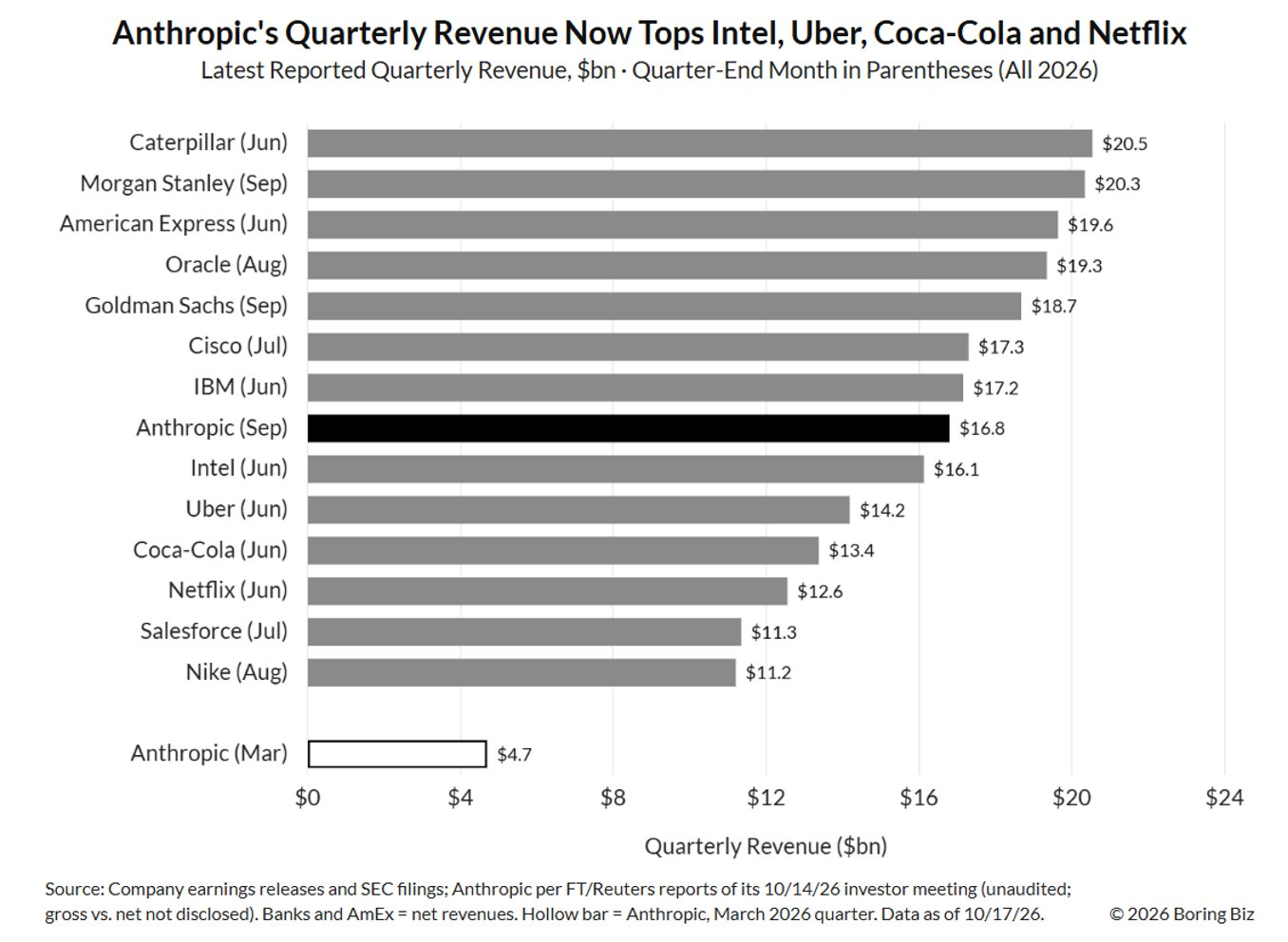
And if you were looking for proof that this is a fast growing industry…
@BoringBiz_: Reminder that Anthropic was founded just five years ago and their quarterly revenues are now above Intel, Uber, Coca-Cola, and Netflix
A key focus from bank earning last week was the reminder that higher rates tends to slow activity…
For the quarter, revenues did better than expected, costs were well controlled and credit was steady. But as investors look into the future, they all want to know how will customers banking needs change given that interest rates are +100 basis points.
“Does a move in interest rates of the magnitude that we saw impact transactional activity from our clients? Yes, that does happen...when rates go up 85 basis points in a quarter, that tends not to be good for those businesses. Clients tend to slow their activity. It’s not good for asset prices.” - Bank of America CFO Alastair Borthwick
“Intuitively, higher rates, as this goes forward, is going to crimp CapEx and otherwise slow borrowing, but we’re not seeing any instance of that yet, and our pipelines remain strong.” - PNC Financial Services Group CEO William Demchak
Also weighing on financial stocks was a hotter than expected CPI figure…
Core CPI increased by 0.33% in September, above expectations, the fastest increase in inflation since April, partially driven by firmer-than-expected readings in the shelter, travel (lodging and airfare), and recreation components. Based on details in the CPI report, we estimate that the core PCE price index rose 0.32% in September (vs. our expectation of 0.20% before the CPI release), corresponding to a yoy rate of +3.09%
Goldman Sachs
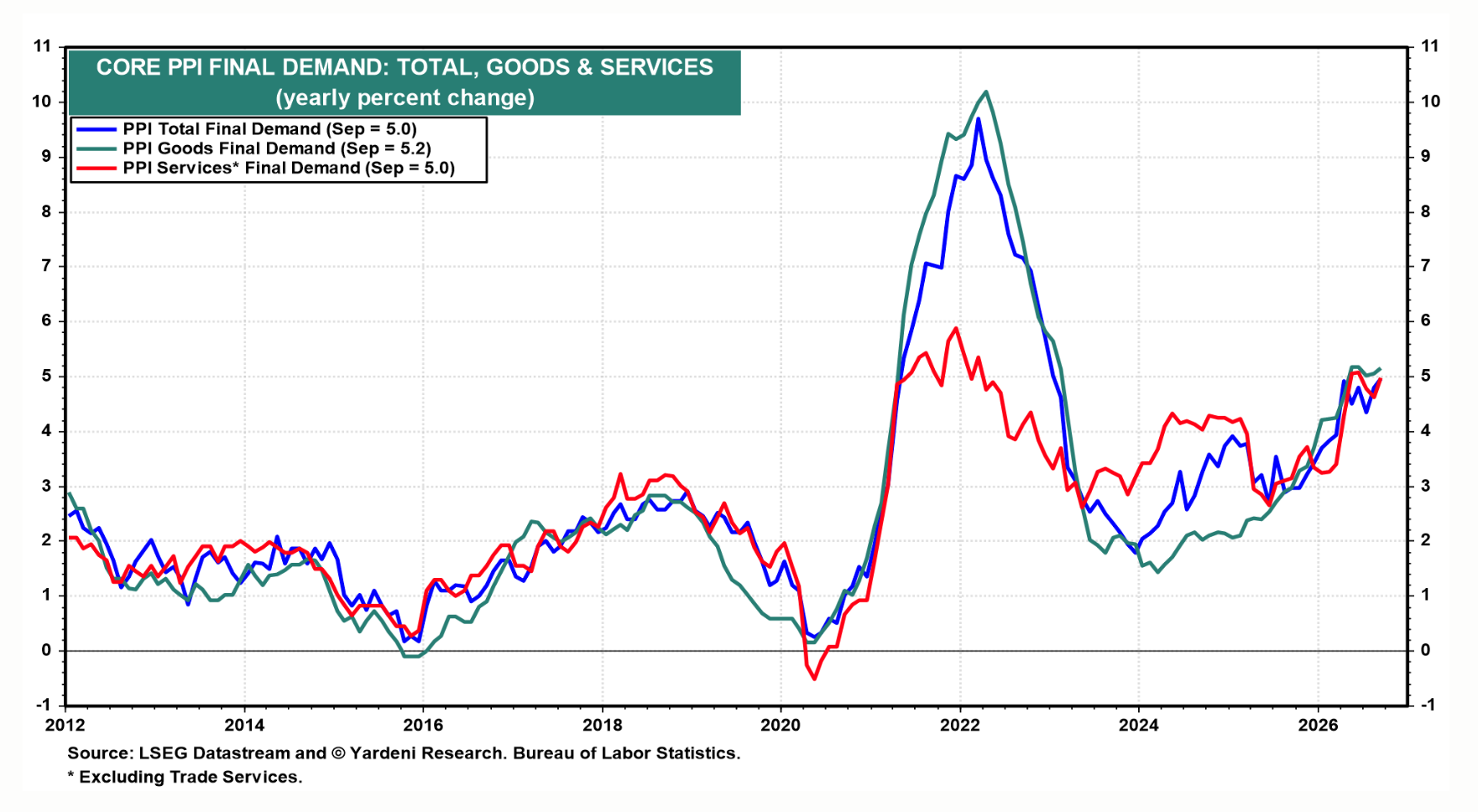
Ditto for the PPI…
September's PPI final demand surged 1.3% m/m, largely reflecting a 10.8% spike in energy prices. However, even excluding the volatile food, energy, and trade services components, producer prices still rose 0.5%, suggesting that inflationary pressures remain broad-based. On a y/y basis, core PPI final demand rose to 5.0%, with services and goods prices rising 5.0% and 5.2% respectively.
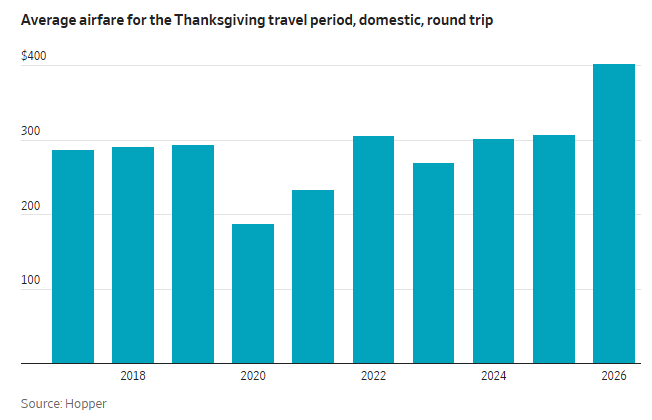
Speaking of inflation, get ready for your holiday travel costs…
Airfares this holiday season will be the highest they have been in at least a decade, according to data compiled by Hopper, a travel-booking company. So far, the average domestic round-trip ticket this Thanksgiving travel period is 31% more expensive than last year, while the price of a ticket for Christmas is 23% higher.
The stakes are high for airlines in one of the year’s busiest air-travel windows. Carriers have had to find ways to boost revenue to deal with rising energy costs since the Iran War began to disrupt global crude oil flows and production in the Middle East. Executives have said so far, they have been able to push fares higher without damaging demand, and they don’t expect the prices to keep holiday travelers away.
Jet fuel is one of the biggest single expenses for carriers and they expect to pay tens of billions of dollars more for it than last year. The average monthly spot price of jet fuel is around $4.50 a gallon, up 91% since February, according to data from Argus.
The US is not the only place seeing inflation. The poorest countries in the world are getting hit much worse…
The world's poorest consumers are being hit the hardest as food prices rise sharply in low- and middle-income countries across the Middle East, North Africa and Asia, where food accounts for a larger share of household spending.
According to the World Bank, food prices in the September quarter outpaced headline inflation in 22% of the 150 countries it analysed, up from 14% in the previous quarter.
The FAO Food Price Index, which tracks monthly changes in a basket of internationally traded commodities, averaged 136 points in September, the highest reading since November 2022.
Rising prices heighten the risk of social unrest and could prompt governments that are key suppliers to impose export bans, further exacerbating shortages.
Attacks on Black Sea grain infrastructure have disrupted wheat shipments, forcing top importers Egypt and Indonesia to seek alternative supplies, while Red Sea insecurity diverts vessels onto longer, costlier routes around Africa.
The US-Israeli war on Iran has raised fuel prices and disrupted fertiliser exports through the Strait of Hormuz, driving up farming costs even as dry El Nino weather reduces output in India and Southeast Asia.
Wheat prices are up more than 30% in 2026, while rice prices in key Asian exporting countries have risen 10% to 13% in spite of large inventories.
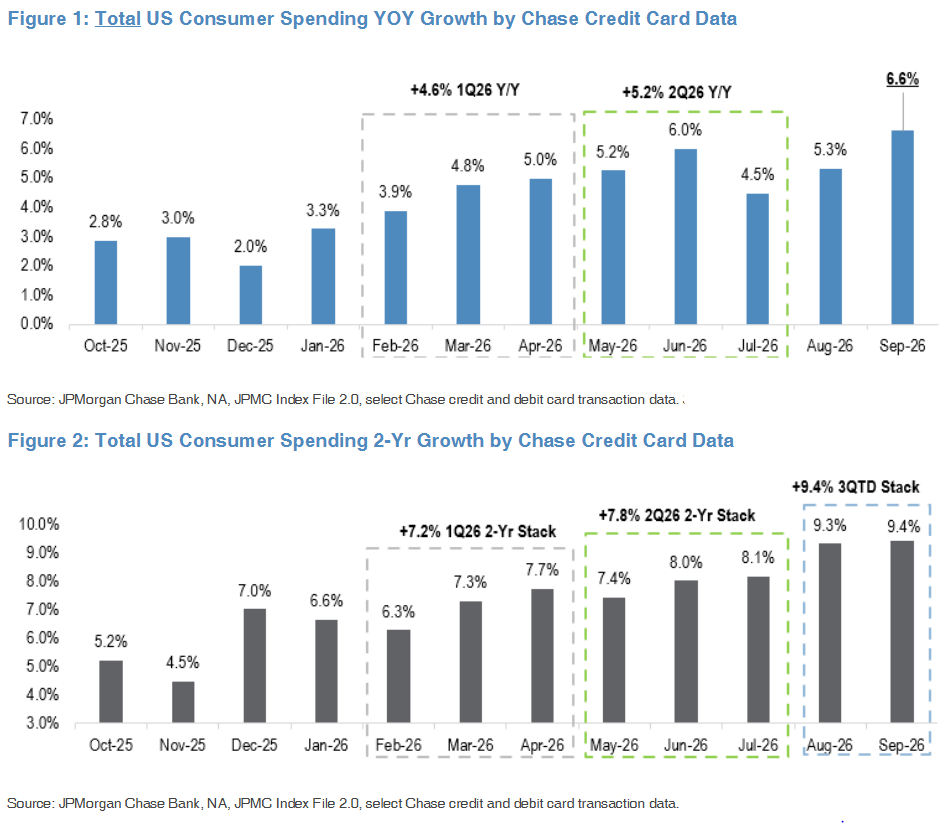
US consumers are not being held back by inflation right now as last week's card spending data showed…
September Spending Acceleration = 3Q-To-Date Strongest Since 2Q23: By our US Chase credit card data, total consumer spending (inclusive of non-discretionary and discretionary spending) for the month of September was +6.6% growth Y/Y, accelerating +130bps above August +5.3%, and relative to July 4.5%.
J.P. Morgan
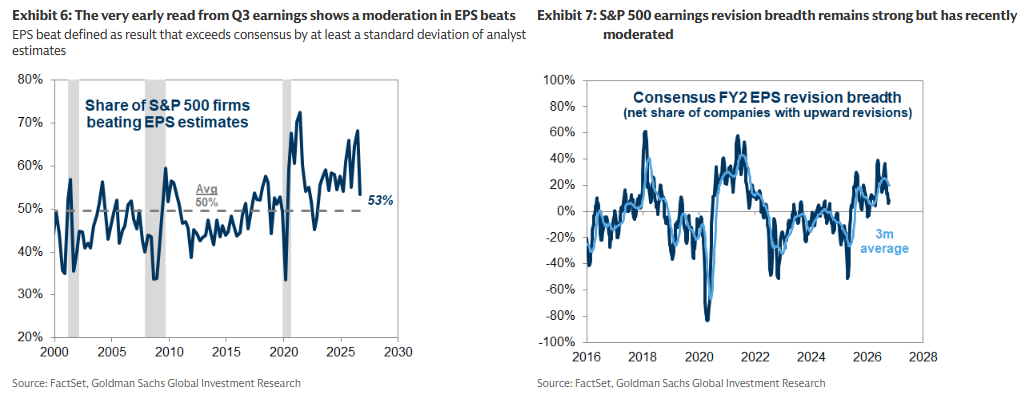
Earnings have begun. The early read is nothing to write home about…
The very early read from the Q3 earnings reporting season supports the view that the rates of earnings growth and estimate upgrades have peaked. With 10% of S&P 500 companies having reported results, 53% of firms have beaten consensus EPS by more than a standard deviation of analyst estimates. This remains above the 25-year average of 50% but a substantial step down from the average rate of 64% during the past four quarters. Similarly, while upgrades to analyst earnings estimates continue to outnumber downgrades, revision breadth has declined during the last several weeks alongside the underperformance of cyclical stocks.
Goldman Sachs
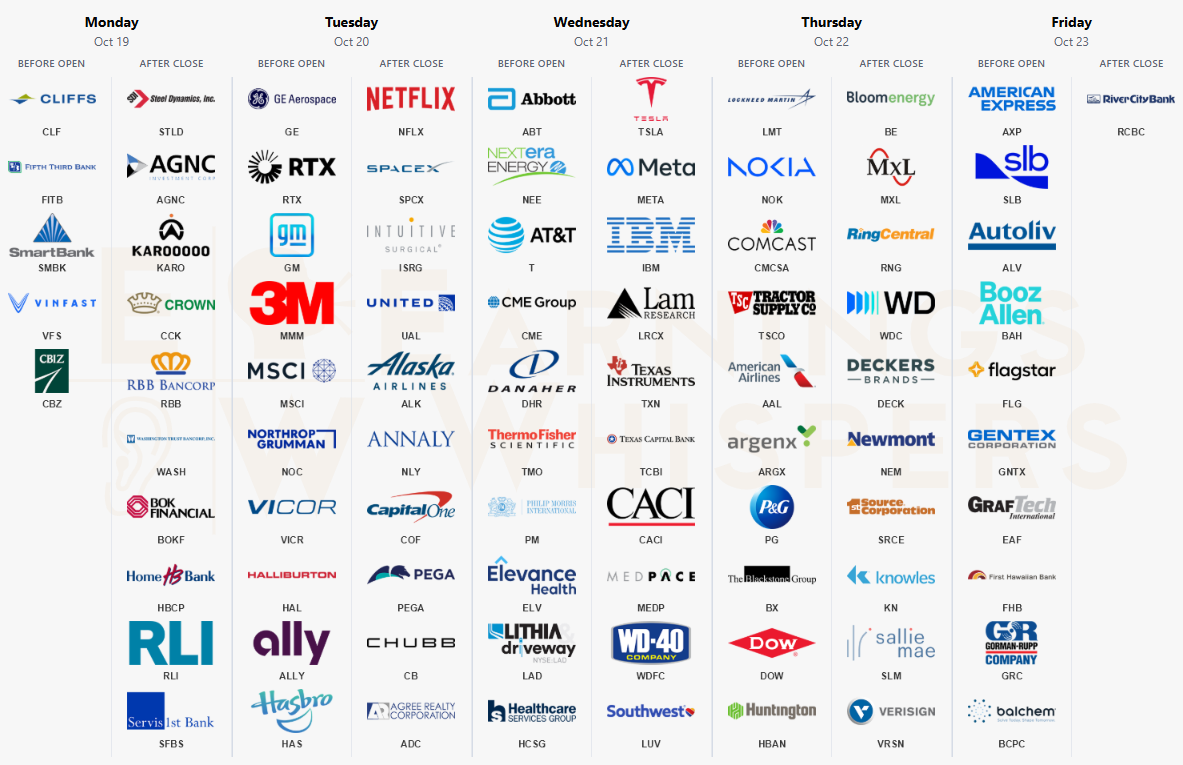
Here is this week's big list of earnings reports…
But next week will be the Godzilla of earnings weeks…
@dailychartbook
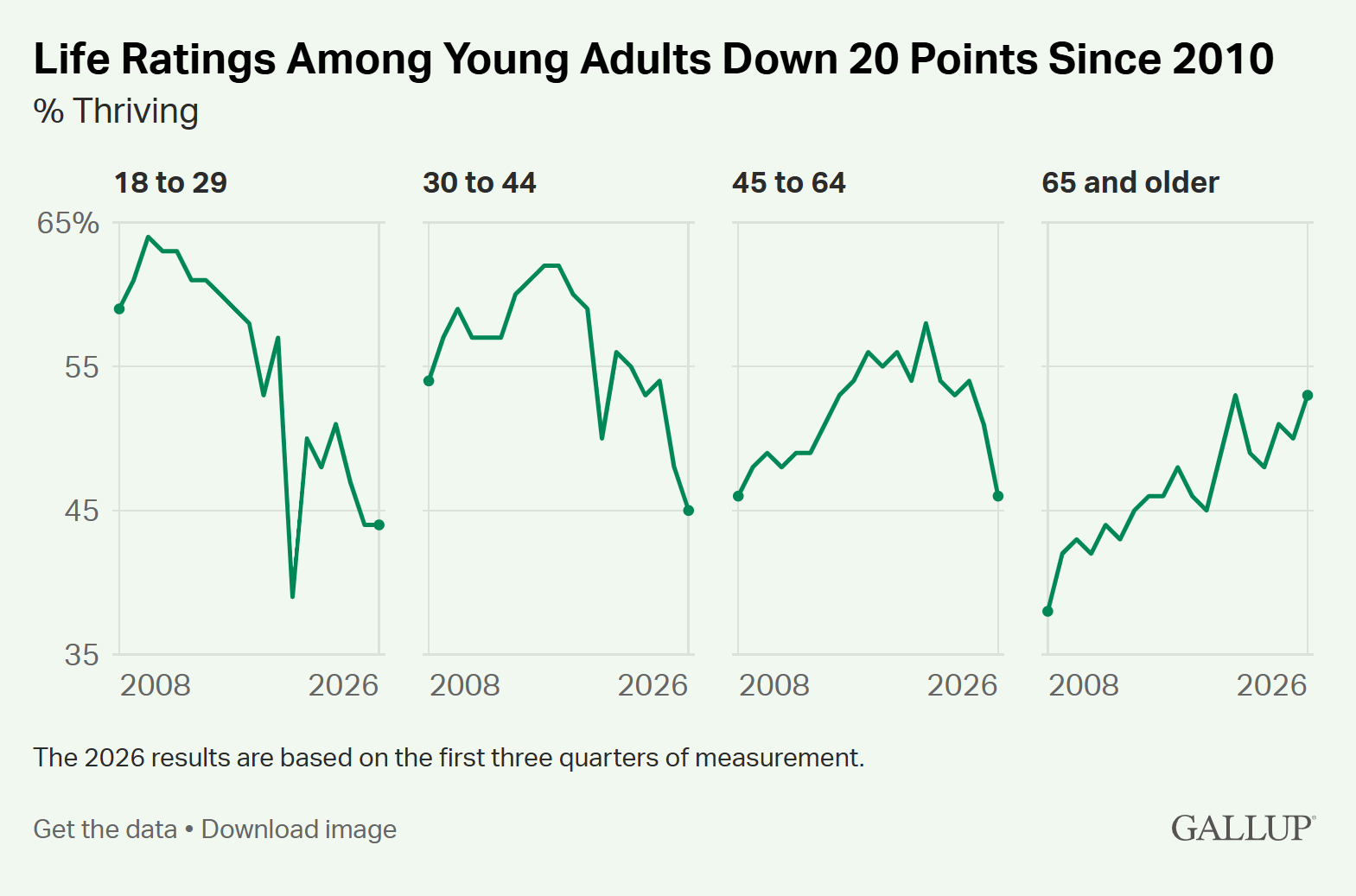
Give me whatever 'gray' is having…
The percentage of U.S. adults aged 18 to 29 who evaluate their lives well enough to be considered “thriving” in Gallup’s Life Evaluation Index is 44% thus far in 2026, which is on pace through the first three quarters of the year to be 20 percentage points lower than the high of 64% measured in 2010. Most of the erosion has occurred since 2019. Following a modest decline over the course of the 2010s to 57% in 2019, a major drop to 39% occurred amid the COVID-19 pandemic in 2020. After hitting that low point, the thriving rate for this group partially rebounded to 51% in 2023 before falling again.
Adults aged 30 to 44 show a similar decline. The percentage who are thriving among this group is 45% through the first three quarters of 2026, compared with a high of 62% in 2016 and 2017. Those aged 45 to 64 have not dropped as much as younger groups, but their 46% thriving rate to date in 2026 matches their low from 2008.
In contrast, Americans aged 65 and older show higher life evaluations than in the past, climbing fairly steadily from 38% in 2008 to 53% thus far in 2026, matching their record high from 2021…
For its Life Evaluation Index, Gallup classifies Americans as "thriving," "struggling" or "suffering" according to how they rate their current and future lives on a ladder scale with steps numbered from zero to 10, based on the Cantril Self-Anchoring Striving Scale. Those who rate their current life a 7 or higher and their anticipated life in five years an 8 or higher are classified as thriving.
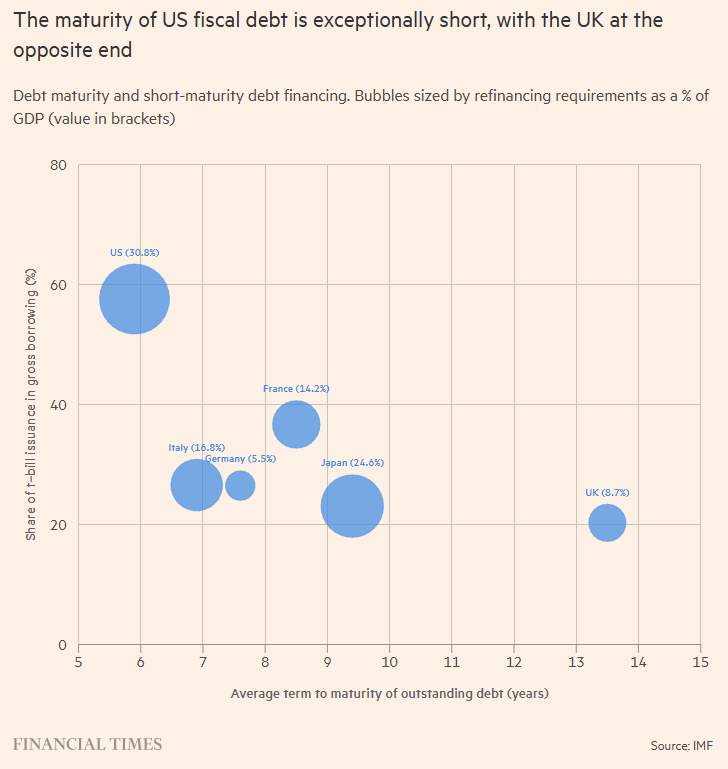
If you thought the kids were struggling in the last chart, just wait until they find out how much short funded debt was stacked on top of them into a rising interest rate environment…
Among major developed economies, the US has the shortest average government debt maturity, at 5.9 years, and the highest share of short-term issuance in gross borrowing.
Learn more about the Hamilton Lane Strategies
DISCLOSURES
The information presented here is for informational purposes only, and this document is not to be construed as an offer to sell, or the solicitation of an offer to buy, securities. Some investments are not suitable for all investors, and there can be no assurance that any investment strategy will be successful. The hyperlinks included in this message provide direct access to other Internet resources, including Web sites. While we believe this information to be from reliable sources, Hamilton Lane is not responsible for the accuracy or content of information contained in these sites. Although we make every effort to ensure these links are accurate, up to date and relevant, we cannot take responsibility for pages maintained by external providers. The views expressed by these external providers on their own Web pages or on external sites they link to are not necessarily those of Hamilton Lane.