
Weekly Research Briefing: The Flywheel Slows

Twenty-five years ago, the Microsoft Xbox was released. It was a massive hit leading to a multi-billion dollar business for Microsoft. It was around this time that I first met Jensen Huang, the CEO of Nvidia, whose company had designed the graphic chips for the first Xbox. Anyone who had spent time at the corporate headquarters could easily see that Jensen was the man and his employees loved him. The proof was in the low single digit headcount turnover, which was surprising given the many ups and downs of the GPU industry. But while gaming chips were cool, Nvidia's rocket ship launched when GPUs (along with CUDA software) became the default tool to accelerate the growth of the large language models. Hello higher growth rates and 70%+ margins. It was difficult not to be a fan of the CEO and his company over the last 25 years.
Unfortunately like Fonzie's black leather jacket, Jensen's also decided to 'jump the shark,' leading to his exit from the company last week. Now the world's largest investor in AI growth will enter a reset period that we can only conclude will result in fewer external investments, reduced chip sales to Asia, and an increase in Nvidia's legendary employee turnover rate. While Nvidia will still be a very strong company given its dominant position and margins, other companies in the Nvidia ecosphere with limited financial means could become challenged, especially if they required Nvidia's checkbook or prioritized chip supply. On the winning side of the fall of the Master Chief could be semiconductor chip competitors like Google, Amazon and Broadcom, who could benefit from any shift away from Nvidia chips. LLM companies and their AI data center buildout costs could also benefit from reduced demand (more supply, lower prices) for Nvidia chips. And you know that Apple is quietly cheering the potential hiccup in memory chip prices, which could decline from all the dislocation that could occur in the next twelve months.
And while the tragic fall of Nvidia's long time leader continues to play out in every facet of our news, media and internet memes, the AI tech world continues to move forward as business and consumer customer demand grows for the products. Last week CoreWeave reported strong numbers and guidance through the end of 2027, sending its shares sharply higher. On Monday, Blackstone and Amazon set a $5b benchmark reference point on a 12-year AI data center sale leaseback for 647 MW of capacity in Indiana and Mississippi. Mid-week, Nvidia will report its quarterly earnings. Expect this to be one of the most listened to and dissected earnings calls of all-time. And at the end of this week, Anthropic will go public in one of the largest IPOs on record.
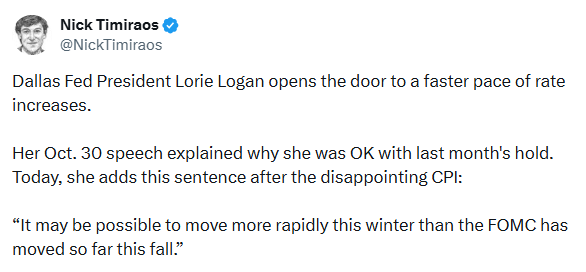
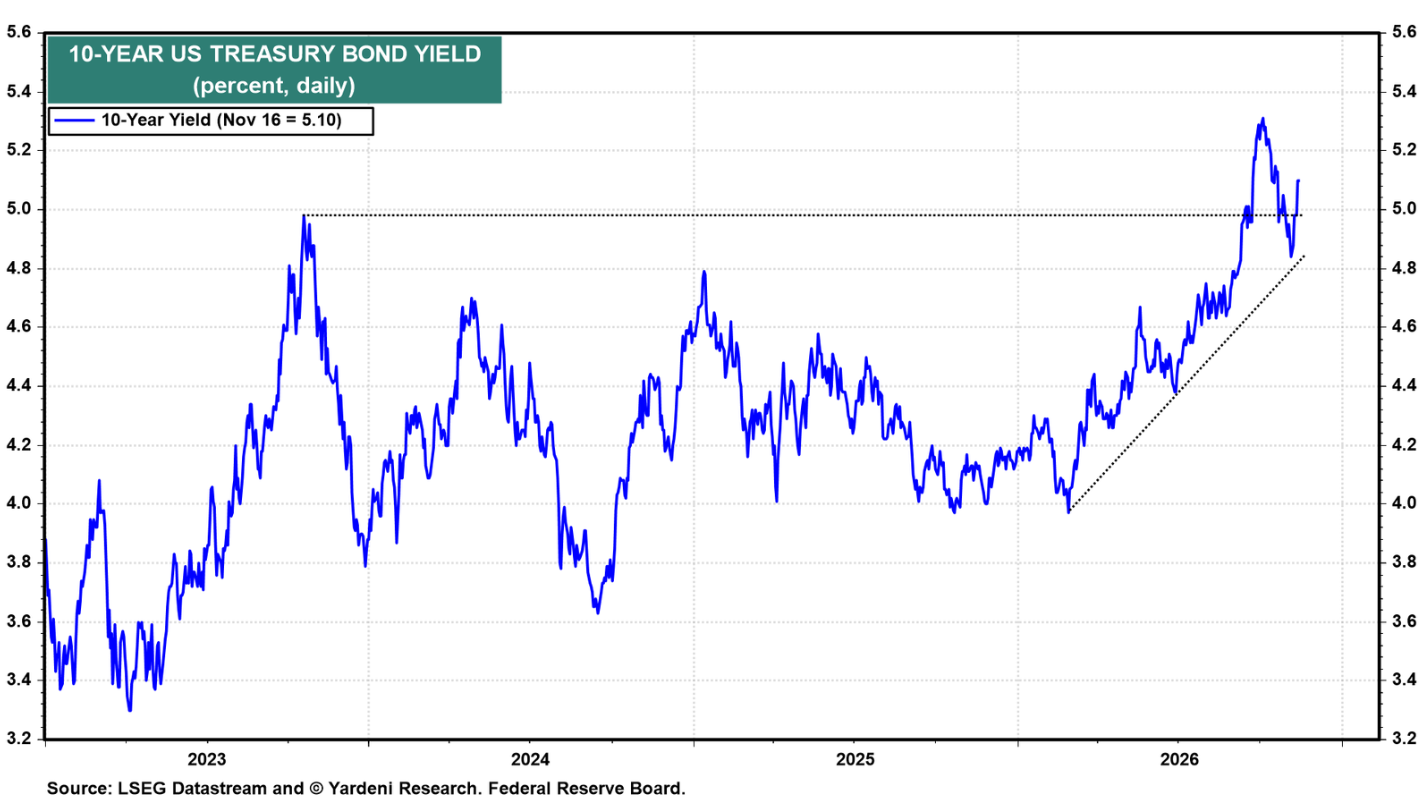
While AI dominates the tape, there is other news. Consumer Price inflation came in hot last week further igniting the odds of continued rate increases over the next few months. Treasury bond yields did not like the news, sending the 10-year rate back above 5% which was a discouraging change in trend. And Friday's air traffic shutdown was the worst in 35 years, causing 17,000 flight cancellations and begging the question as to why the US Government won't fund our current air travel needs. Will we all soon be actors in "Planes, Trains and Automobiles" as the busiest air travel week of the year begins?
Next week we see big retail earnings from Walmart, Home Depot, Lowes, Target, TJX, Ross Stores and Marvel Universe owner Disney. Lots of Fed speakers are on the agenda to discuss the recent moves in inflation. Affecting workforces, classroom attendance and military operations globally, the release of Grand Theft Auto 6 is scheduled for Thursday the 19th. Have a great week.
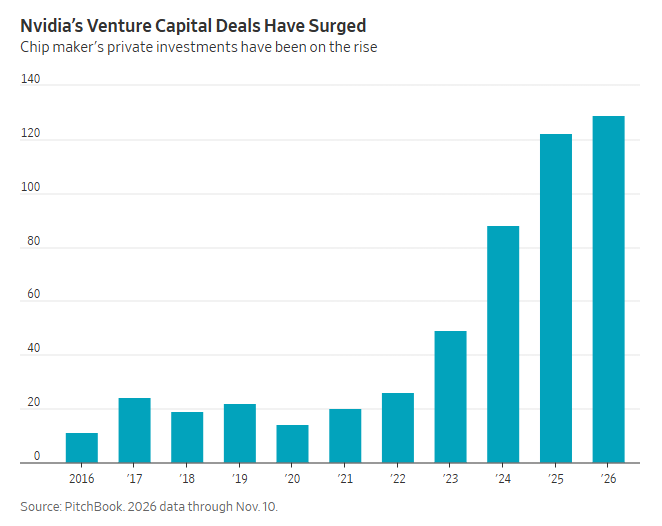
It is likely that Nvidia’s days as an open checkbook are over…
And oh, what a spending spree it has been.
In total, Nvidia has participated in a record 129 venture-capital deals this year, as of Nov. 10, accounting for 27% of global VC deal value, according to PitchBook, up from a total of 49 such deals in 2023.
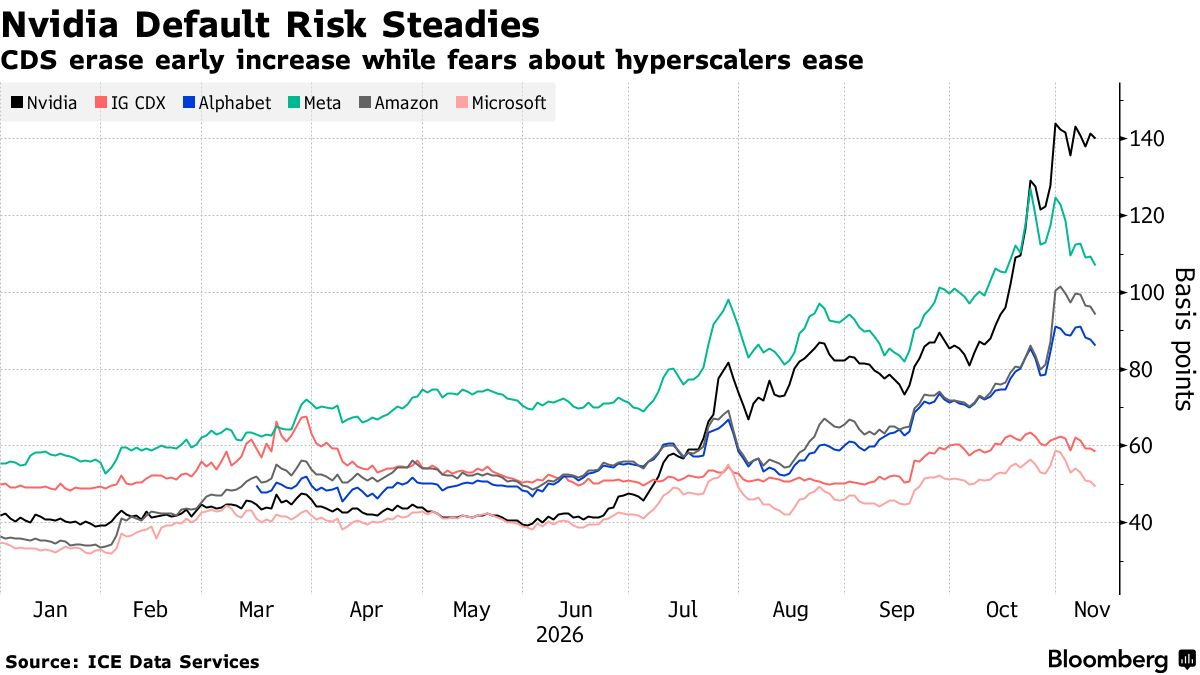
Given all of the turmoil with Nvidia, it is good to see that only its credit default spreads have been affected…
The cost of protecting Nvidia’s debt hit near-record levels on Thursday morning, as bond traders scrambled to price in the ouster of Jensen Huang, a core player in the AI infrastructure boom, following reports of multiple affairs, Caleb Mutua and Kevin Kingsbury report.
The price of protecting Nvidia debt against default for five years hit a session high of more than 144 basis points. By contrast, other hyperscaler default costs for companies including Meta Platforms, Broadcom and Advanced Micro Devices fell on expectations that they may benefit from the turmoil at Nvidia, traders said.
For AI data center investors, a big pricing event hit the market today…
Blackstone Digital Infrastructure Trust is buying 75% of 13 new AWS powered shells.
Live transaction comp; useful for anyone investing in the sector. Here are the relevant metrics:
Size: $5.0bn gross
Capacity: 647 MW
$/MW: $7.7mm
Cap rate: 7.0% (14.2x)
Tenant: AWS, 100% NNN, parent guaranteed
Locations: Indiana and Mississippi
Lease: 12 years initial, 32 years fully extended
Escalator: 2.75%/yr
Debt: $2.5bn non-recourse mortgage (50% LTV)
@junkbondinvest
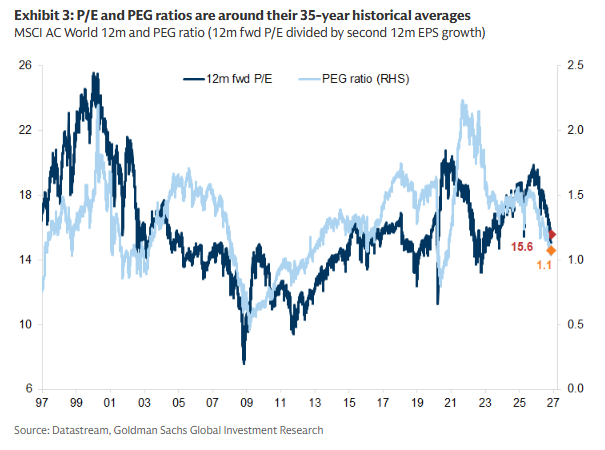
The global equity markets have de-rated since summer mostly due to the US Tech pullback…
Equity valuations have fallen across the board. While the US equity market remains the most expensive, it has moderated from close to its 100th percentile over 20 years to a P/E of 18.5x. Asian markets and EM are now trading at P/E ratios well below their historical averages. Overall, P/E ratios are around their average over the past 35 years, and a similar pattern is true of PEG ratios (adjusting valuations for expected growth). Of course, much of the fall in valuations, particularly in the Tech-concentrated US and North Asia equity markets, has been the principal driver of this de-rating.
Goldman Sachs
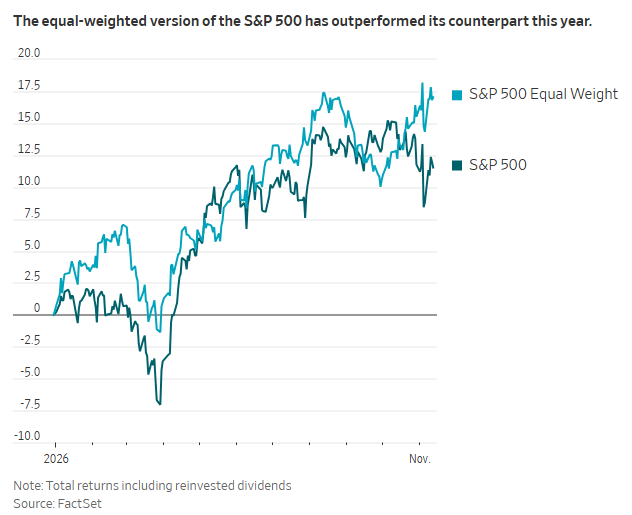
Of course the US Equal Weight indexes have stepped up during this mega-cap slowdown…
The past few weeks—marked by midterm elections and the Nvidia sex-and-espionage scandal—offer a quintessential example of the risks equal weighting is designed to hedge against.
As of Oct. 28, right before the scandal broke, the S&P 500 Equal Weight Index was up 15.0% year-to-date, slightly ahead of the main index’s 14.2% return. Since then, the gap has blown open. Equal-weight is up 17.0% year-to-date compared with 11.5% for the regular index (and 19.8% versus 13.6% over the past 12 months).
Equal-weighted Russell 1000 and Nasdaq-100 indexes also have bested their traditional counterparts over both stretches.
A big reason for the most recent outperformance: Nvidia’s stock has fallen 24% since Oct. 28. That has dragged down the S&P 500 yet barely dented the equal-weight version. Notably, Nvidia didn’t pull down every other megacap tech stock with it, either.
We knew that someday the market's concentration at the top would catch up to itself…
FEDWATCH: “.. It’s not a stock market; it’s a market of a few stocks: the S&P 500 has stopped behaving like the average stock in it, more than at any point since at least 1990.”
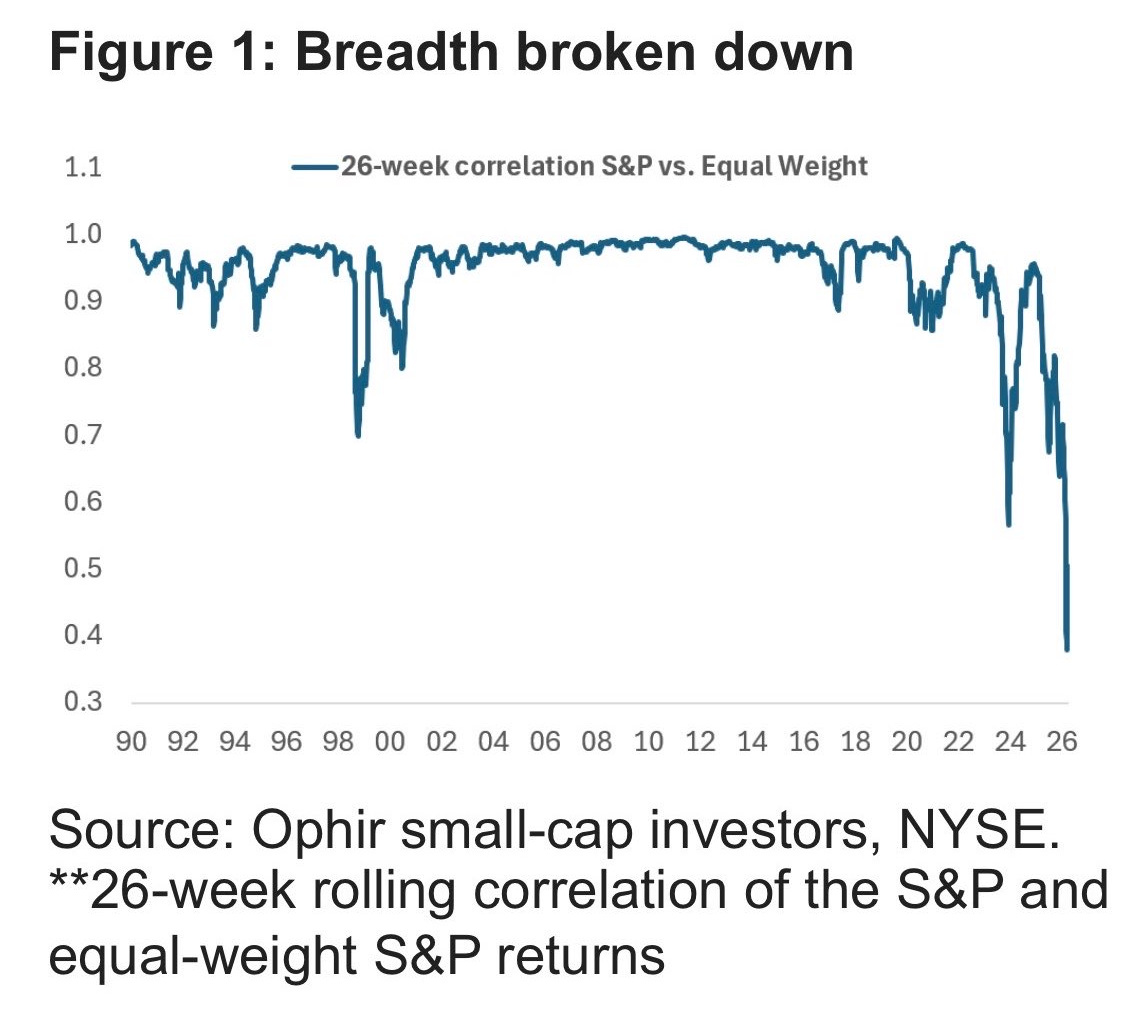
@carlquintanilla
But while Nvidia dropped the baton, these large caps have picked it up and ran to all-time new highs…
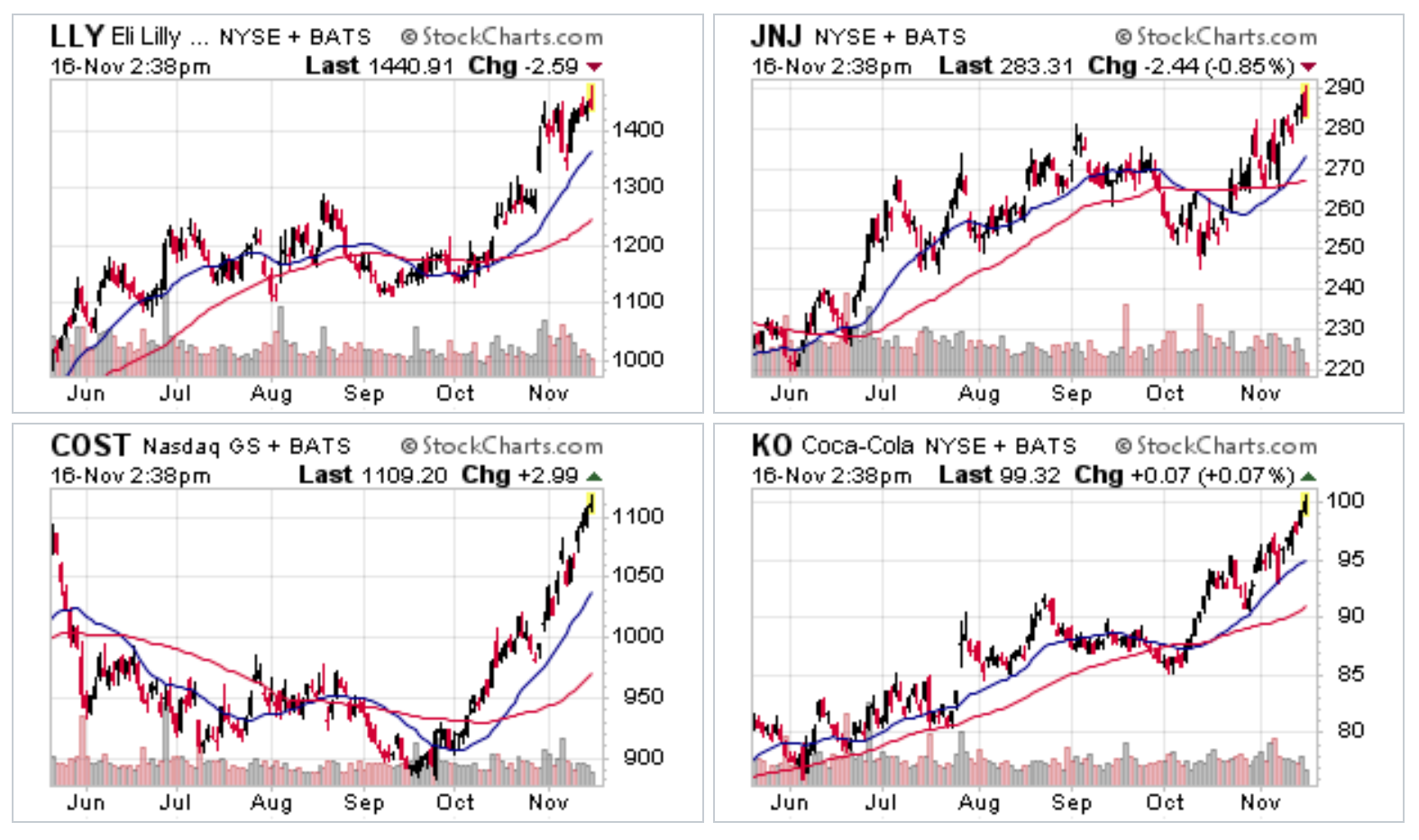
StockCharts
That was a tough inflation datapoint last week…
B of A: “.. The Fed’s inflation miss is worse than you think. .. Had inflation been above target for just a year or two, we think the Fed could have accepted 2-2.5% PCE inflation as “good enough” .. But with a large overshoot that’s coming up on six years ..”
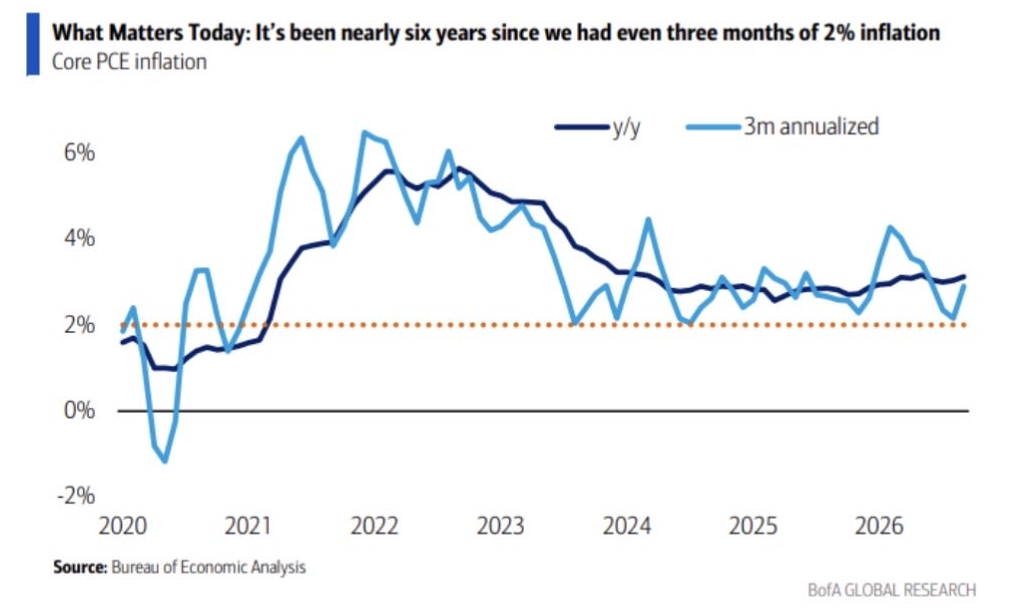
@carlquintanilla
Last week's surprise in the CPI data showed that grocery bills are accelerating higher…
Americans are straining under sky-high grocery prices. The pain might get worse.
Food costs rose at the fastest rate in six months in October, driven by snarled supply chains, unpredictable weather and, increasingly, high fuel prices because of the Iran war. The cost of restaurant meals rose at the fastest pace since December 2025.
And now, more farmers and big food manufacturers are preparing to pass higher energy costs on to consumers...
U.S. grocery prices in October rose 0.4% from the previous month, the Labor Department said Tuesday, ending several months of relatively benign food inflation. Prices of fresh food like fruit and vegetables increased at an even greater rate.
The sharpest hits landed on everyday dinner staples: Lettuce jumped 8% in October alone, while beef steaks climbed 1.7%, butter jumped 2% and cheese rose 1.3%.
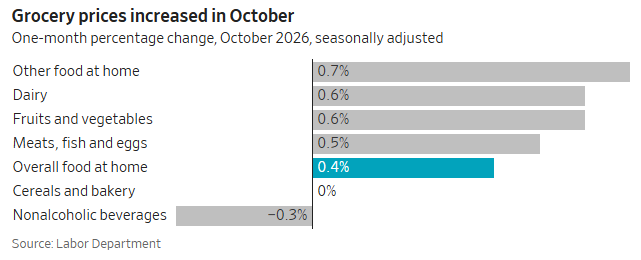
Increased talk of more hikes sooner by the Fed members. Stay tuned for this week's speaking engagements…
The disappointing but expected jump in interest rates after last week's October CPI report…
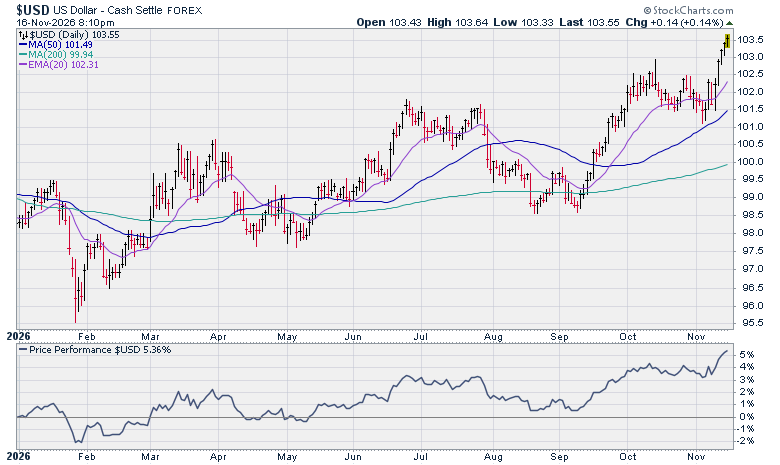
The bump up in rates even helped the US dollar to its best level for 2026…
So good news for foreign investors in US assets that aren't named Nvidia.
StockCharts
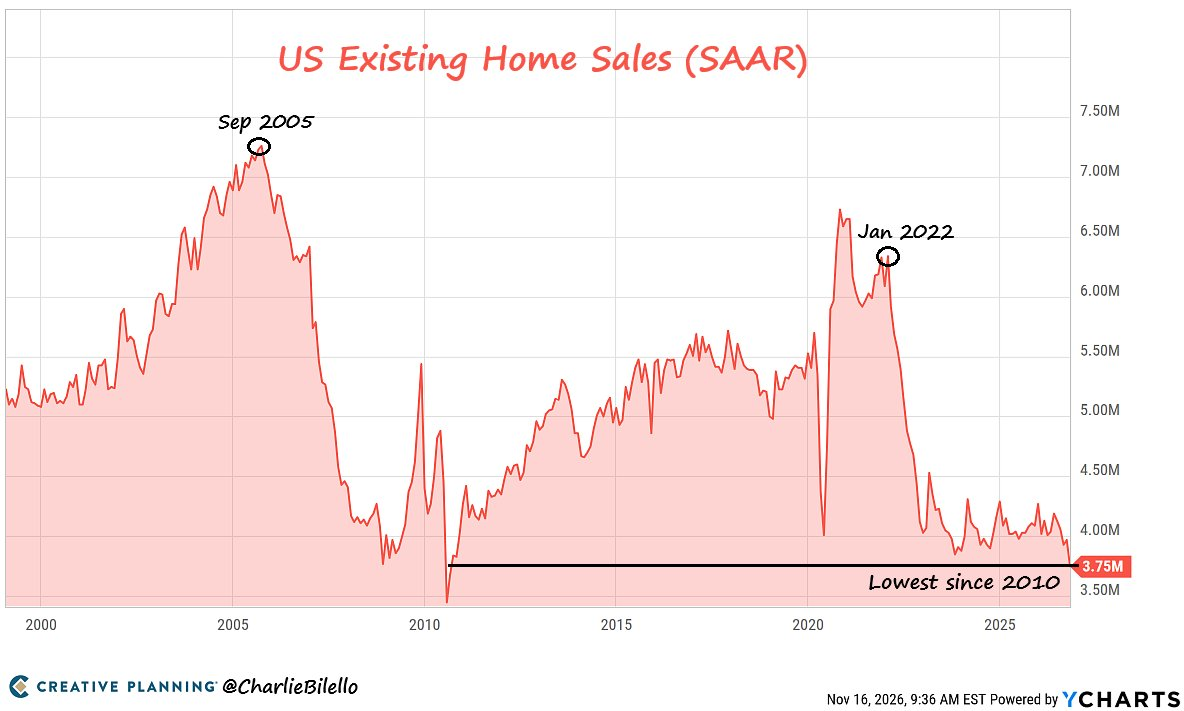
Beside the CPI, a tough release last week in US existing home sales showing the continuation of a weak trend…
@charliebilello: The US housing market is essentially frozen. Existing home sales have fallen to 3.75 million annually, the lowest level since 2010. High home prices coupled with high mortgage rates have crushed affordability, delaying the American Dream for a generation of young buyers.
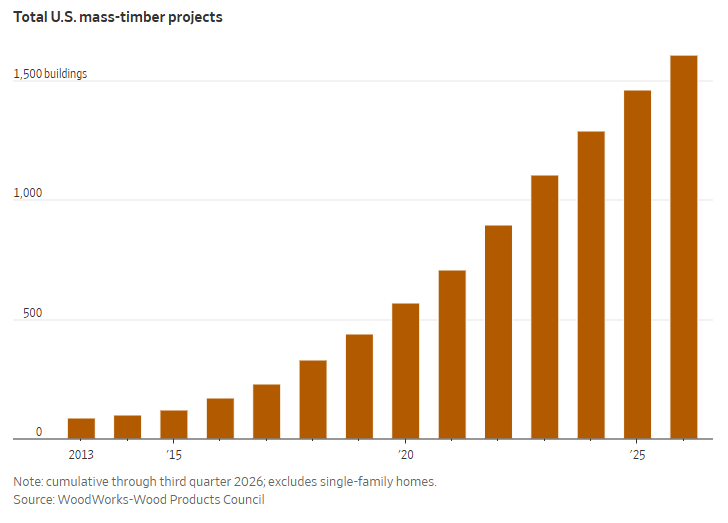
Finally, if you are thinking of a big new building project, try visiting the Portland Airport before you decide on the building materials that you will use. All the cool kids are using wood now…
Many choosing to build with mass timber are drawn to the cozy aesthetics and by the burgeoning research related to biophilia, which suggests that humans function and feel better in buildings that incorporate natural elements. Others are interested in smaller carbon footprints from using wood, which stores carbon dioxide absorbed by trees. Making metal and concrete emits greenhouse gases.
Meanwhile, the costs of traditional building materials have risen, driven by demand from data centers, supply disruptions from wars and President Trump’s tariffs.
Although the mass timber itself still usually costs more than steel-reinforced concrete, architects and developers say they save on finishes, including drywall and paint, as well as on labor and construction time…
A nine-acre mass-timber roof went up at Oregon’s Portland International Airport. Walmart built 2.4 million square feet of mass-timber office space in Bentonville, Ark.
The U.S.’s latest mass-timber projects include college dormitories in Michigan and Maine, a riverfront pavilion in Philadelphia, an amphitheater in New York’s Hudson Valley, a private school north of Dallas, a public school in Seattle, New Jersey’s Bruce Springsteen Center for American Music, and a library in the East New York neighborhood of Brooklyn.
Learn more about the Hamilton Lane Strategies
DISCLOSURES
The author has current equity ownership in: Apple Inc., Alphabet Inc., The Home Depot Inc., Costco Wholesale Corp., and The TJX Companies
The information presented here is for informational purposes only, and this document is not to be construed as an offer to sell, or the solicitation of an offer to buy, securities. Some investments are not suitable for all investors, and there can be no assurance that any investment strategy will be successful. The hyperlinks included in this message provide direct access to other Internet resources, including Web sites. While we believe this information to be from reliable sources, Hamilton Lane is not responsible for the accuracy or content of information contained in these sites. Although we make every effort to ensure these links are accurate, up to date and relevant, we cannot take responsibility for pages maintained by external providers. The views expressed by these external providers on their own Web pages or on external sites they link to are not necessarily those of Hamilton Lane.