
Weekly Research Briefing: Bluebonnets in November

Bluebonnets are typically an April event in Texas, but last week the official state flower's color made a rare appearance across statewide ballots. While I knew several Texas Republicans who were unhappy with their midterm election choices, I had not talked to one who expected a complete rejection of the party. Immigration, food and energy prices, AI data centers and distrust in current leadership drove TX voters to the polls across the state. Now the GOP needs to figure out how to reconnect with the second-largest state's voters or prepare for future losses. As Florida Governor Ron DeSantis highlighted after the election, "If the Republican Party doesn't have Texas as an anchor, then we are not going to be viable nationally."
While investors should not let politics influence their investment decisions, the surprise results caused many technology investors to hit the 'SELL' button. The punch bowl for AI investors had already run dry in recent weeks but after Tuesday, they flipped the table and sent the glass container flying onto the floor. Leveraged investors holding underperforming positions were forced to sell causing one of the largest downdrafts in technology stocks over the last six years.
So has the selling finished and have valuations corrected enough? Keep an eye on the S&P 500 VIX. Watch the retrace of the QQQ off of Thursday's low. Monitor the neocloud companies this week, especially since two of the largest are reporting earnings. And of course, always listen to credit spreads. A short-term rebound looks likely, but have the decks been cleared enough for a longer term floor to be put in place? The valuations look low enough, but with the new uncertainty in Washington and the State Capitols, it will be up to the new Democratic leadership to help us find the answer.
The US economy is good, but it heavily depends on AI growth. The Democrats know that now is not the time to slow down the 'golden goose'. New political leaders and AI companies should be talking today to compare notes and get on the same page. If municipalities don't want data centers in their backyard, new locations should be found for them ASAP. Plenty of open locations exist around the US where energy, water and land are plentiful, and where a local town or county would appreciate a fire hydrant of tax revenues and job creation. North Dakota has already raised its hand. If enough US locations do not open up, expect foreign countries to line up with offers to host. Let's hope Tuesday's winners continue to keep the AI data line moving up and to the right for our economy.
The landslide election results should also accelerate a deal to open the Strait of Hormuz. The morning after the election, the VPOTUS blamed the wipeout on the war with Iran giving the green light to other Republicans who would like to speak up about exiting the war. And over the weekend, the POTUS even suggested it was "unlikely" that the US would pursue further bombing. All of this talk has pulled Brent crude oil down to nearly $90 which is a good start as Congress resumes and discusses other ways to help end the war. Also on deck this week is the release of the CPI and PPI inflation series for those keeping an eye on prices. Tech investors will watch the CoreWeave, Nebius and SoftBank results for any and all comments about AI and datacenter buildouts. Enjoy your (hopefully less volatile) week.
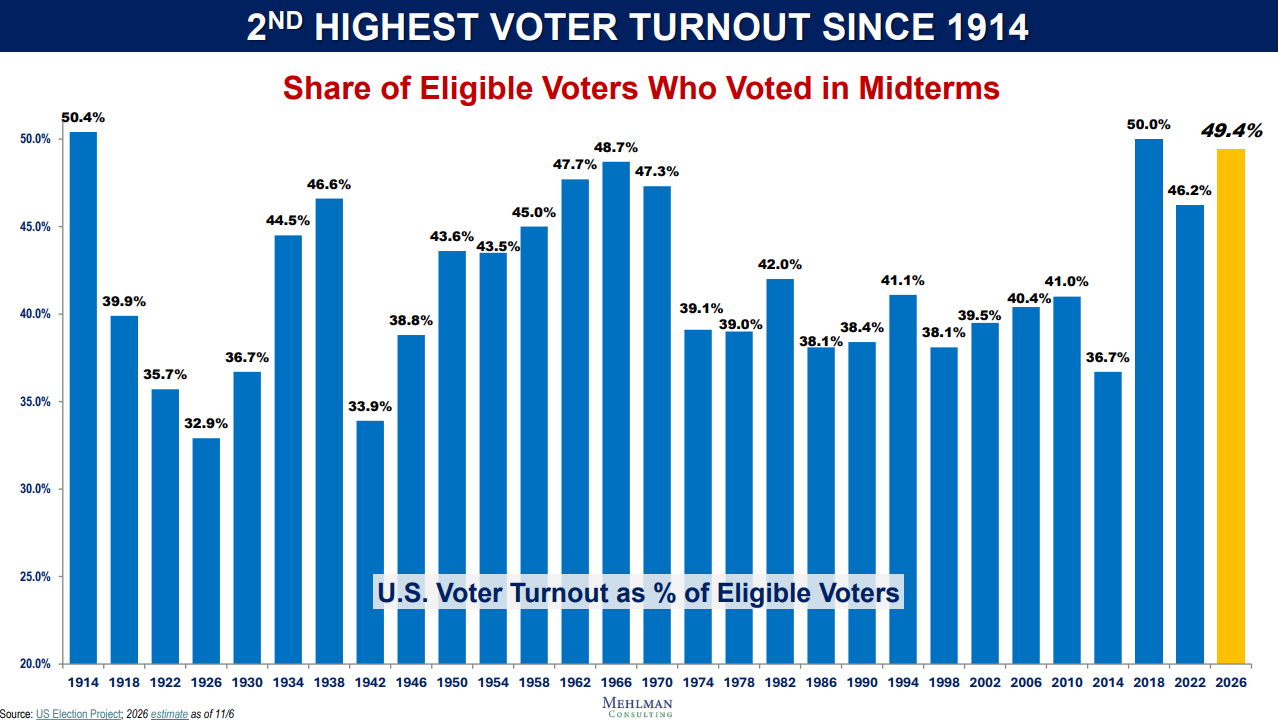
Voter turnout was the second-highest of any midterm in a century…
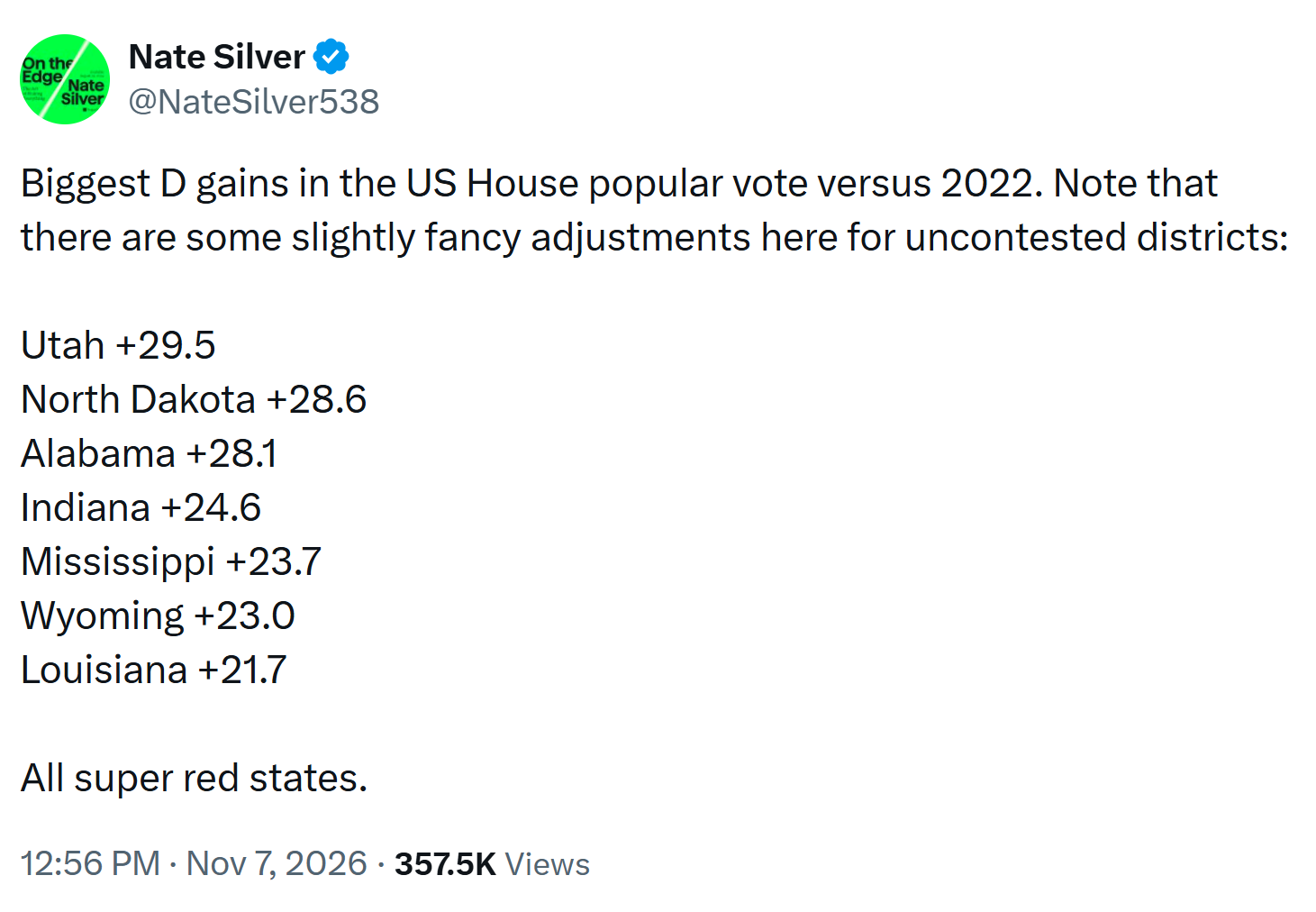
The biggest shifts to blue were in the most red states…
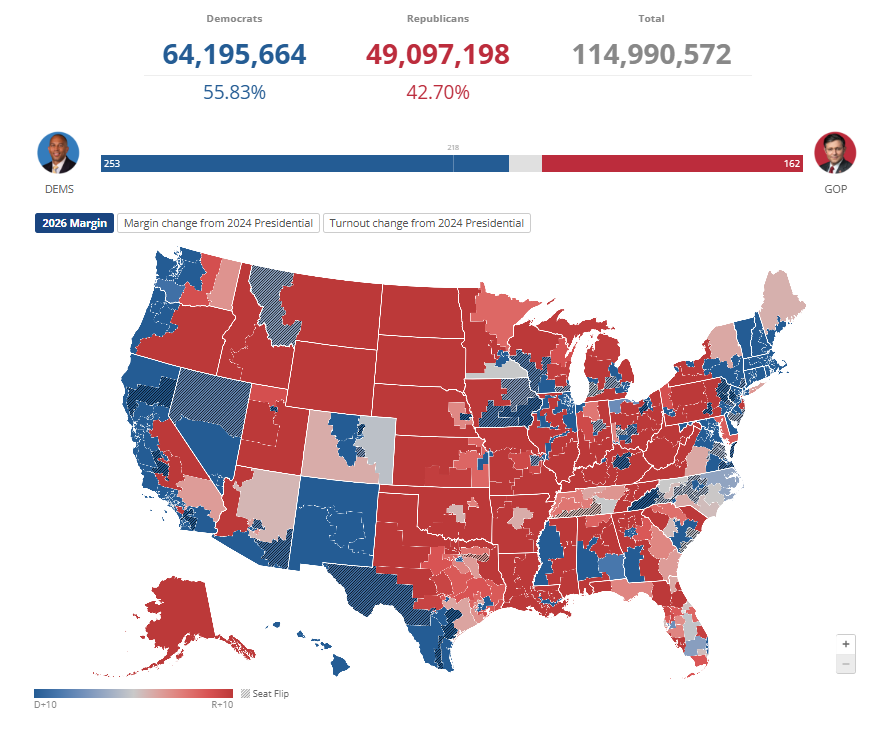
As the 2026 US House Vote Tracker shows, the Democrats had 15 million votes over the Republicans in this election…
Also important to highlight that the entire southern border voted Democrat this election which should say something about the current White House immigration policies.
The Cook Political Report’s 2026 House Vote Tracker follows the national House popular vote as ballots are counted after the November 3 midterms. Counting can take weeks, especially in states that count mail ballots late. To give the most accurate picture of the 2026 results, the tracker runs until all 50 states certify.
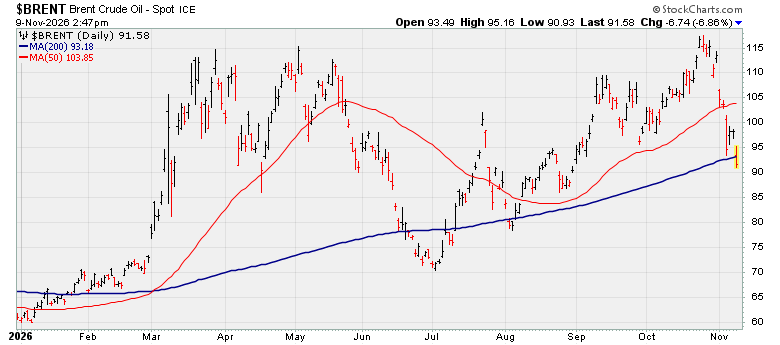
The oil price decline through its 200-day moving average shows how expectations are building for an end to the war with Iran…
StockCharts
The former chair of the US Council of Economic Advisors, Glenn Hubbard, has good some thoughts on where our government's new economic agenda should move toward…
First, federal support for basic scientific research is critical for expanding the economy and generates high rates of return. The government should also support applied research centres around the country to encourage commercial applications of new ideas. AI-assisted research will be important in driving future productivity growth, so reforms that allow modernisation and the expansion of electricity transmission will be vital.
Second, a renewal of support for open markets is needed. While present policy can justify exceptions to openness for reasons of national security or to protect critical supply chains, broad interference in trade is counter-productive. Across-the-board tariffs raise the cost of important intermediate goods for US industry, and studies conclude that American consumers and firms have borne most of the costs…
Third, while acting aggressively against illegal immigration is warranted, broad limits on high-skilled immigration — as evidenced in recent attacks on H-1B visas for skilled workers or optional practical training authorisation for non-US students to gain work experience in technical jobs — are inimical to growth.
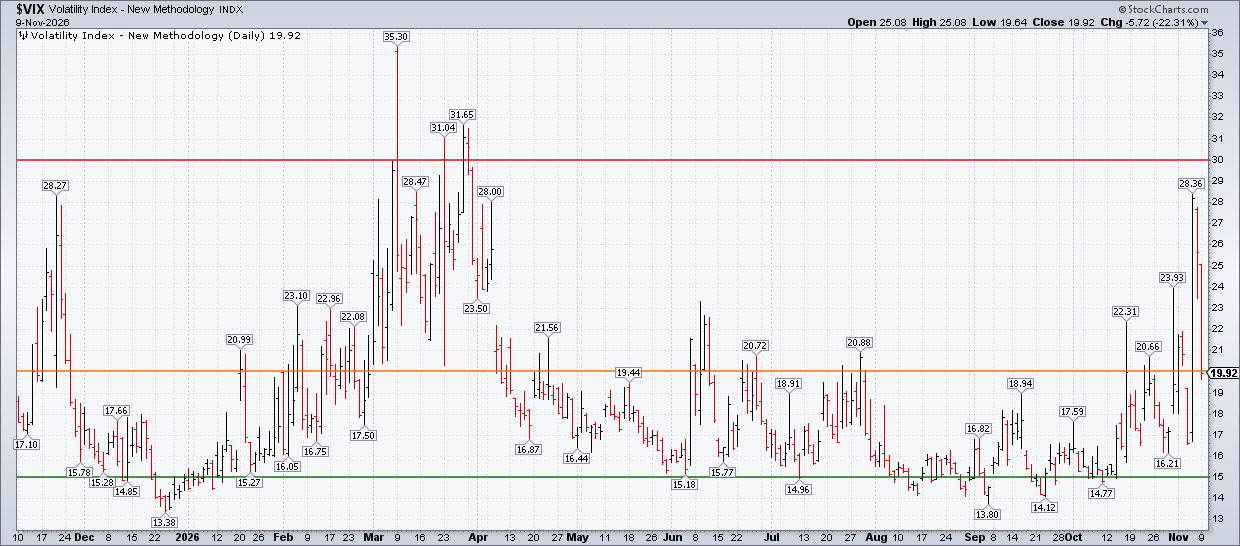
Now for a visual on last week's crazy volatility in the S&P 500…
We didn't quite make it to the Iran war craziness of 30+, but a spike to 28 on Thursday left a mark on the chart. Now let's see if we can return to the mid-teens with some good headlines and calmer heads.
StockCharts
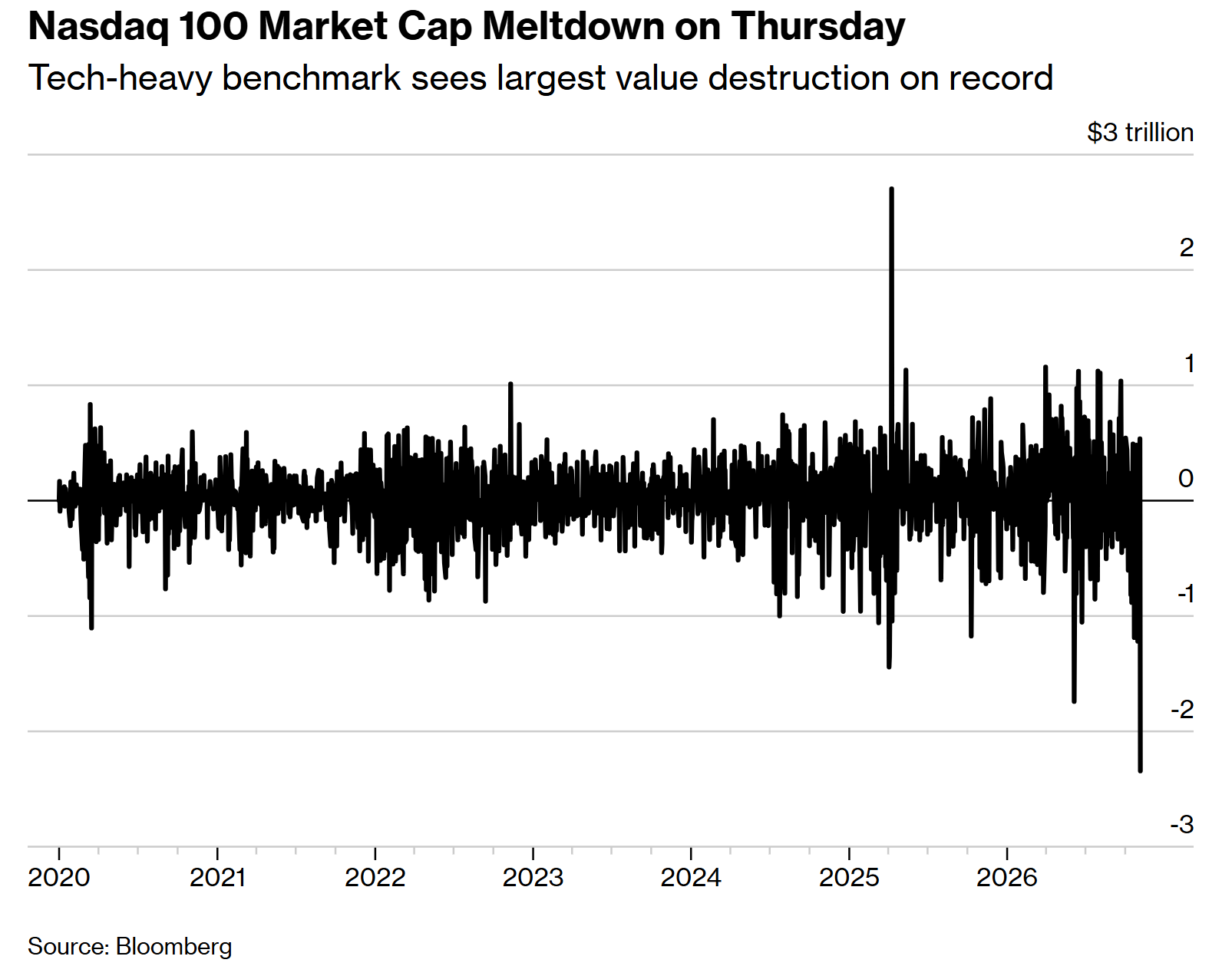
The hedge fund meltdown last week was widely reported and very visible in the markets…
Hedge funds dumped technology stocks at one of the fastest paces on record last week, and the momentum crash that followed was the biggest in about 40 years. Even so, few on Wall Street are ready to call time on the AI boom.
Goldman Sachs Group Inc. noted that hedge fund disposals of global technology stocks roughly matched the highest on record in figures going back to 2016. Tech was by far the most heavily net-sold sector globally and in the US, driving the biggest wave of single-stock net selling in four months, according to the bank’s prime brokerage data as of Nov. 6.
The trigger was the Democratic sweep in the US midterm elections, which raised concerns about tighter AI regulation and about how much data center capacity will actually get built. The Nasdaq 100 posted the deepest plunge since the Covid pandemic on Thursday, wiping $2.3 trillion off its value in a day. The S&P 500 notched its heaviest weekly loss since April 2025.
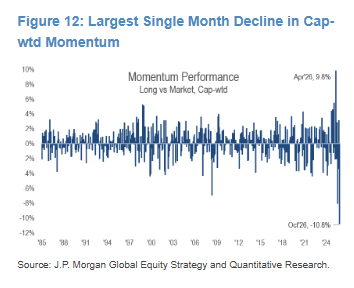
A momentum crash combined with rapid deleveraging left a mark…
After a brief reprieve in September, Momentum-factor performance deteriorated sharply in October, triggering its largest single-month underperformance in over 40 yrs (see Figure 12, Long vs market, cap-wtd), and precipitated by two +6 sigma unwind days over the latter half of the month. This rapid unwind has compounded the sharp losses from July’s Asia-led Tech deleveraging, bringing the cumulative drawdown to the largest since ChatGPT’s launch, or -38.4% from the June peak. As a result, Momentum crowding has retreated from 100%ile to 76%ile vs. 40 yr history (breaching the same level as the Feb–Mar 2025 unwind and now at the same level as the 2024 tech selloff). This marks the steepest decline in our crowding metric since the GFC recovery.
J.P. Morgan
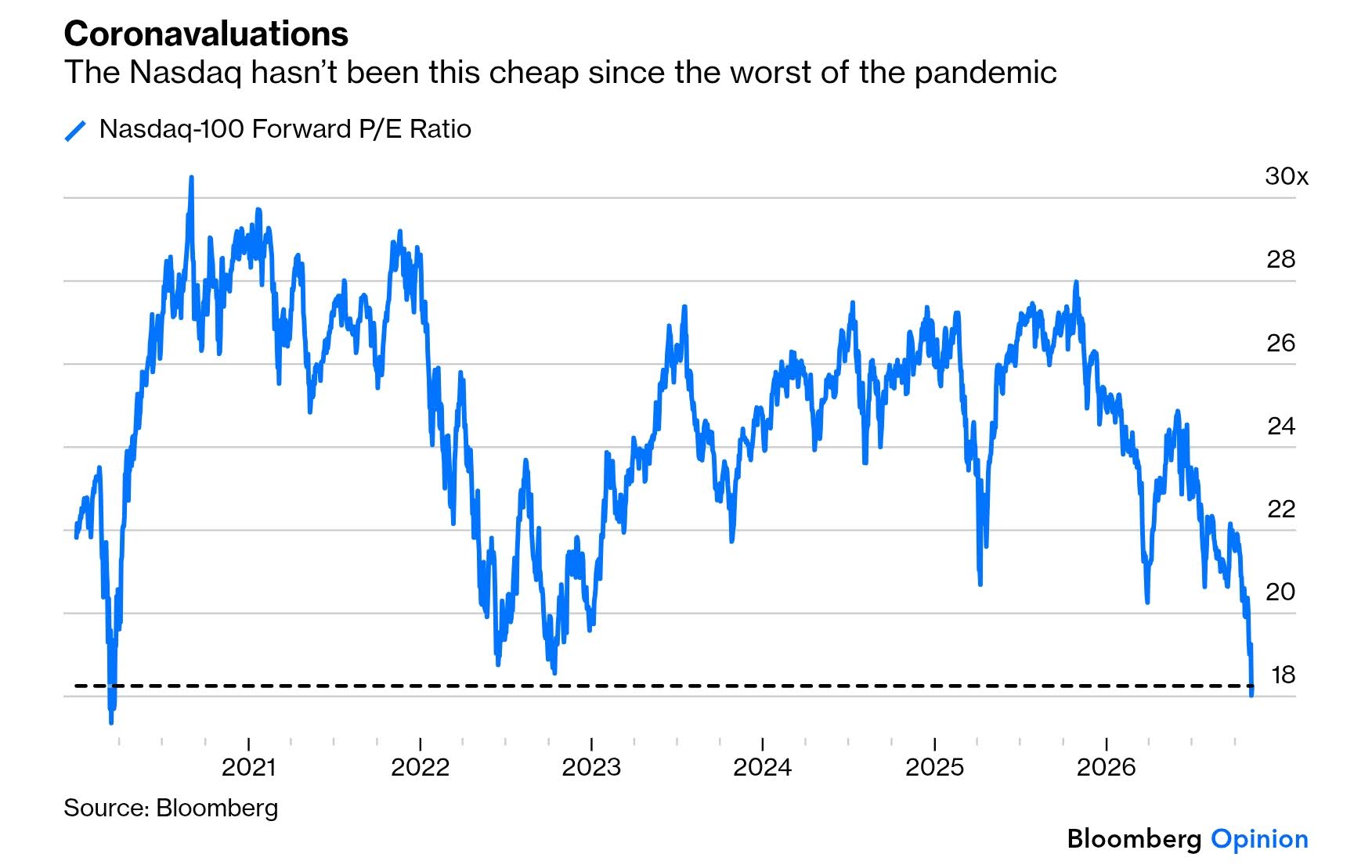
The Nasdaq 100 now trades at a multiple of blended 12-month forward projected earnings that it hasn’t seen since Covid’s worst days…
So hopefully time for a valuation floor among tech and growth stocks.
Morgan Stanley sees room for a bounce here…
What are the potential positives coming out of the midterms? For one, oil prices have come down sharply, aided by comments from the White House that markets interpreted as a sign that a deal with Iran could come together, though this remains uncertain. Second, our policy strategists have flagged the potential for a reversal of the SNAP and Medicaid cuts given the midterms outcome, which could be a tailwind for consumers. Third, we may see a pull-forward of business activity and M&A before the 2028 presidential election. Once again, the markets traded poorly into the midterms, as they typically do. This is one reason why they generally trade well in the 6–12 months after the midterms—buy the rumor, sell the news.
Morgan Stanley
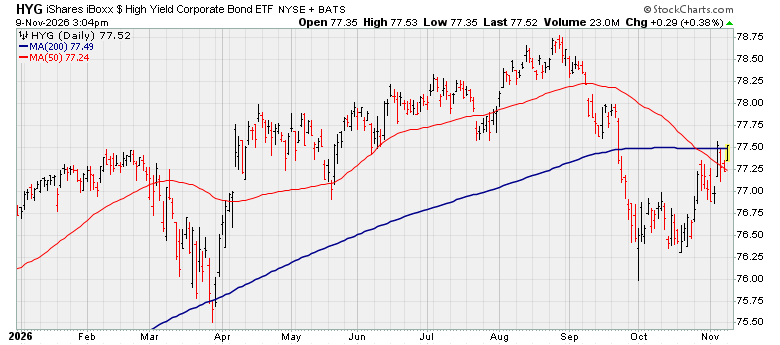
Checking in on credit shows junk bonds not suffering new lows…
StockCharts
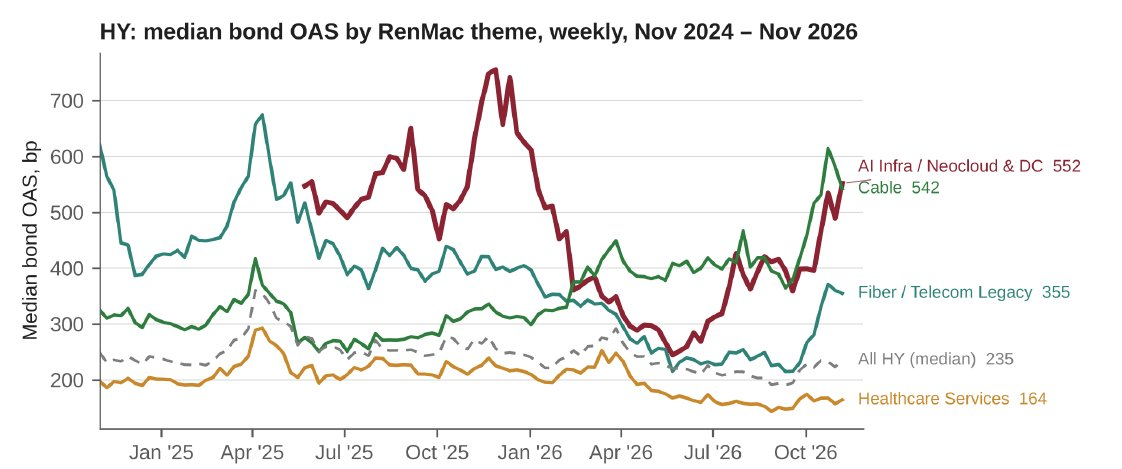
Looking deeper within high yield reveals most of the spread widening occurring in data center and fiber related industries…
Inside HY the median bond is at the 39th percentile of its own 2-year range while 14% of bonds sit at 2yr wides (a tail repricing, not a broad one). The widening is concentrated in Hyperscalers / Mega-cap Tech, Semiconductors.
@RenMacLLC
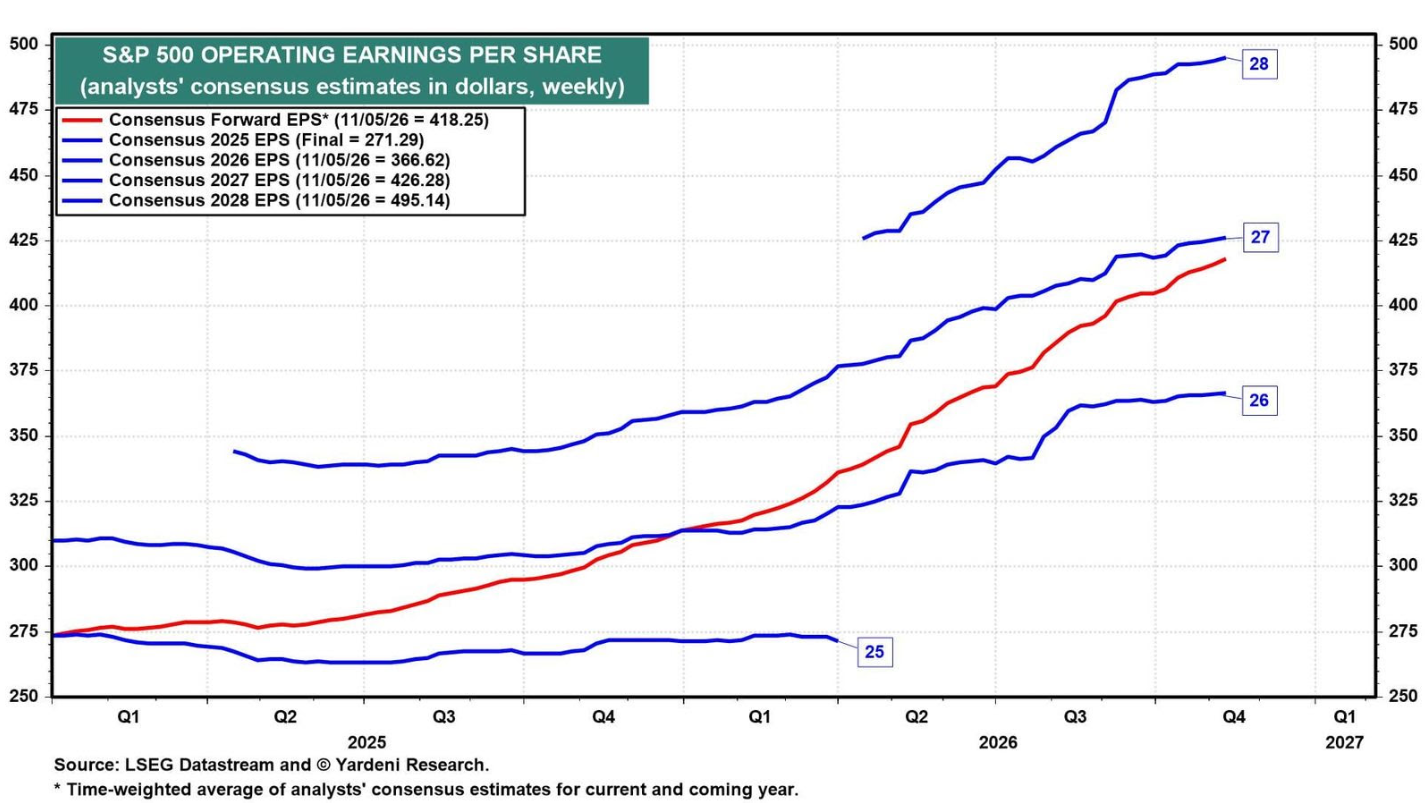
Analyst earnings growth expectations now have 2028 estimates nearing $500 for the S&P 500…
So the market is trading 15x that figure if the estimates are to be trusted.
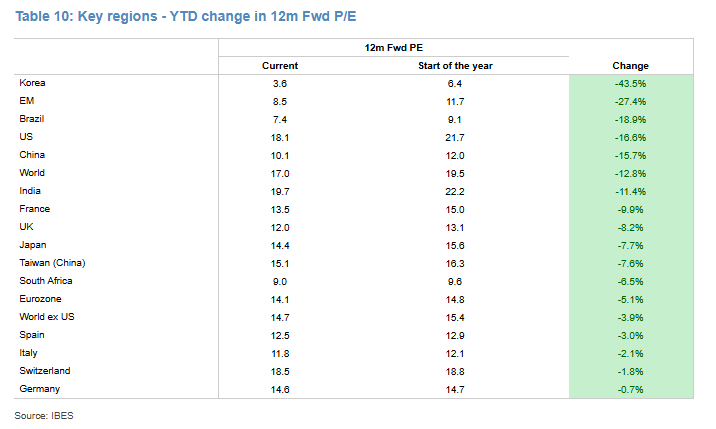
Now looking at which countries have seen the most multiple compression…
J.P. Morgan
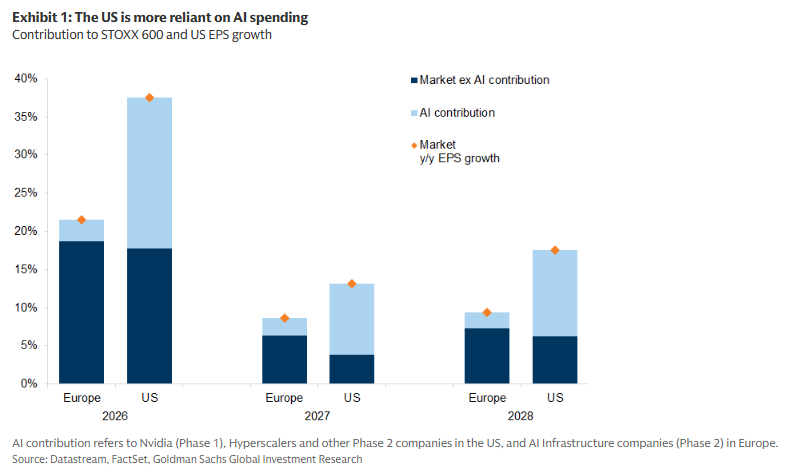
If you are still weary of the AI growth outlook, the European equities markets would like a word…
AI Infrastructure represents c.15% of the STOXX 600 and only 2pp of its expected 9% earnings growth in 2027, making the region a better place to find diversified stock performance than the more AI-sensitive S&P 500.
Goldman Sachs
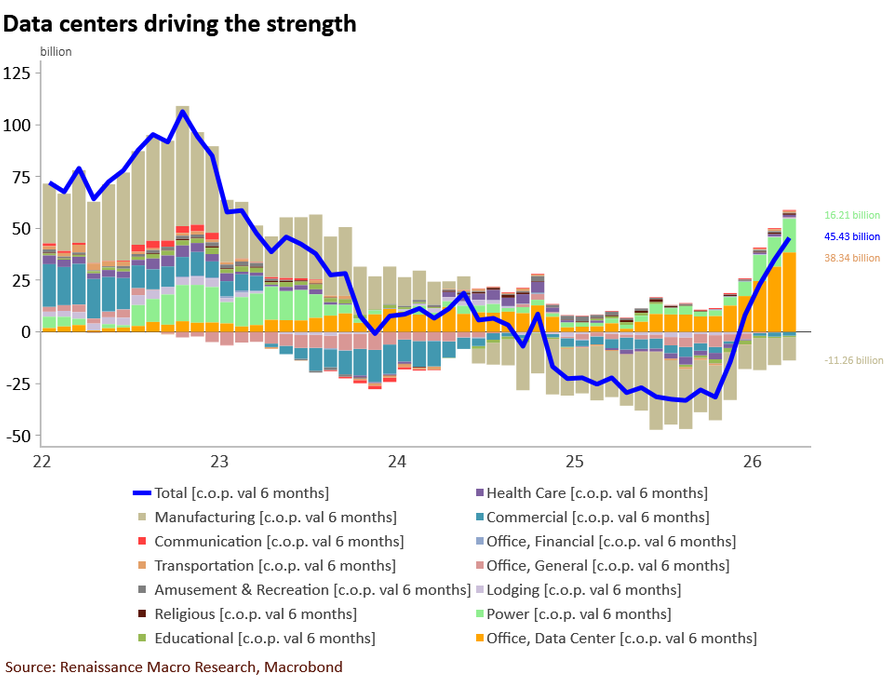
Hopefully a top chart on the wall for any new Democrat taking State or Federal office…
Nonresidential construction spending has been rising for the last six-months, up 12.6% SAAR over this period. Data centers have been responsible for much of the growth but growth outside of data center construction appears to have stabilized somewhat.
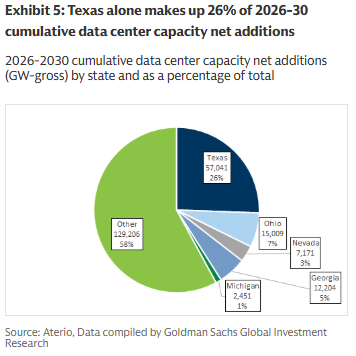
And more specifically, for new Texas legislators…
"The states where Democrats are likely to further restrict data centers account for roughly 45% of planned US data center capacity, with Texas alone accounting for roughly 25%. However, since data centers are low on the list of priorities for voters this election, we expect that the issue will fade somewhat in importance in the ensuing months and that these moratoria will not be long-lived if they are enacted.” - Jan Hatzius, Goldman Sachs
Goldman Sachs
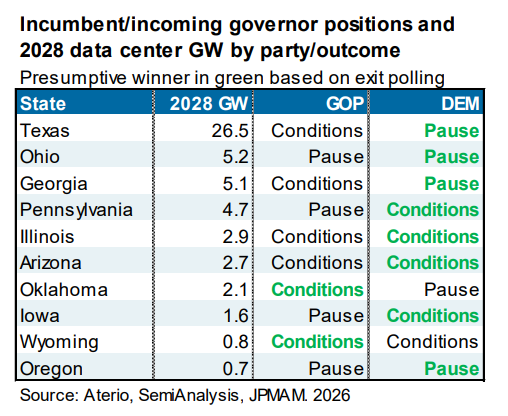
Fingers crossed for fewer 'Pauses'…
The biggest market issue may be AI over the medium term; nearly every major local ballot measure opposing data centers won or is winning, with only exception in North Dakota. What we’re now watching: governor imposed constraints on new builds. This is not an issue for the 37 GW expected to be delivered in 2027, 75% of which is under construction. It’s more an issue for the 96 GW expected in 2028. Based on election results, 37.5 GW may be subject to a “pause” with another 15 GW subject to “conditions”. While pauses are the more impactful outcome, conditions can be onerous: requiring data centers to pay grid costs to protect ratepayers, ending tax incentives, imposing water limits, setting requirements for onsite backup power, mandating labor requirements and banning non-disclosure agreements during permitting (most of which seem sensible to me). If the data center buildout starts to slow at some point, upgrading to better NVIDIA chips might be the only way to generate more tokens.
The AI buildout is important. Last week showed that if one builder stumbles on a good project, it is likely that others are standing on the sidelines ready to play…
Alphabet Inc.’s Google will spend $17 billion to build a data center in Wyoming, formally putting a price tag on the proposal two days after voters across the US delivered a broad rebuke to the development of such massive projects for artificial intelligence work…
Google said Thursday in a blog post that the facility in Laramie County, Wyoming, will be its first in the state. The company said it will pay for all the power the data center uses. Last month, American Electric Power Co. said it planned to invest $4 billion in the project, which will draw electricity in part from a 702-megawatt natural gas fuel cell development built with Bloom Energy Corp. fuel cells, and will be air-cooled to limit water use…
Google also said it expects to generate hundreds of millions of dollars in local property taxes and will form a Community Council with its partners to address growth concerns in Cheyenne, Wyoming.
Bloomberg reported in June that data center developer Crusoe had been pushed aside at the site after Google raised concerns about the costs and timetable, according to people familiar with the situation. Energy utility Black Hills Corp., which had been working to line up agreements to power the project, said it was moving forward without Crusoe. Google on Thursday named Black Hills Energy as a partner in the Wyoming project.
Will AI infrastructure move overseas?
“I can also tell you that every hyperscaler is now thinking about ‘Do we need to build outside the United States?’ Because they’re enormous investments, hedging those investments is a wise thing to do” - Meta President Dina McCormick
“I do believe strongly that if the US hesitates in any way, shape, or form in terms of data center build-out, the rest of the world is ready and willing. There is just huge demand for this capacity” - Arm CEO Rene Haas
Election results have put a pause on lenders into AI until they can see the dust settle…
Banks and credit investors are upping their scrutiny of AI-related debt deals while showing reluctance to increase exposure to borrowers, jolted by the recent market selloff and changing sentiment toward the technology's growth trajectory.
Some banks, which just a few weeks ago were lining up to fund AI deals, are now telling market participants they would be reluctant to finance additional deals even when they involve guarantees from the sector's marquee technology companies, according to several banking and credit sources.
The lending pullback has been exacerbated by a recent drop in the stock market, which erased $2.5 trillion in market value on Thursday from the Nasdaq 100, and sent the index into a correction. The US midterm election results are also adding anxiety about more oversight of data centers.
A potential slowdown in AI data center construction could curb loan growth and dent investment banking fees from the loans, bond sales and stock offerings that have helped finance the sector's rapid expansion.
The change, according to two sources, has come in just the past few days. Some lenders have shown reluctance to finance deals even if they are backstopped by names such as Anthropic and Google, the sources said, without specifying names of the lenders.
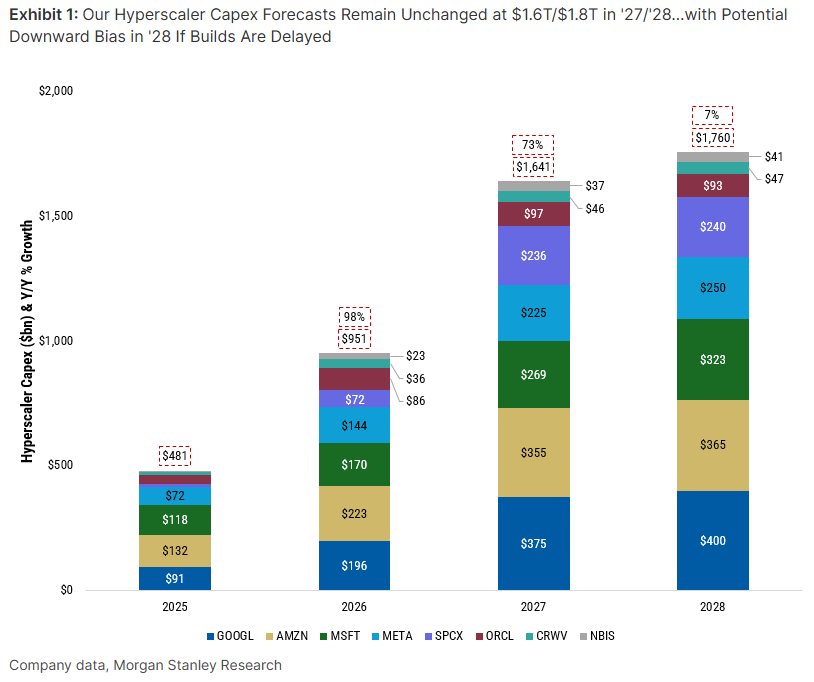
So what if the pause causes delays? How could it hurt the AI buildouts?
Impact to data center builds & capex: expect a ~20% delay of US projects from '28 to '29, but remain constructive on the overall build-out. We believe newly elected Governors are unlikely to disrupt projects under construction, leaving 2027 projects unchanged. However, we believe some 2028 TX/OH projects will be delayed to 2029, as governors work with legislators to put in place new requirements for data center developers. We shift 5GW of US projects from '28 to '29 (representing 20% of US projects, 10% of global projects), which implies US data center GW additions down 4% Y/Y in 2028 and up 38% Y/Y in '29. Globally, this implies data center additions up 9% Y/Y in '28 and 20% Y/Y in '29…
For now, we keep our hyperscaler capex forecasts unchanged (in aggregate $1.6T/$1.8T in '27/'28) as we still expect the hyperscalers to spend and build as much capacity as they can to create and scale new products to billions of users enabled by large language models that are increasingly compute-intensive but still carry high 30%+ ROIC (see here). We also expect hyperscalers to attempt to adjust their build locations to other states that are more data center friendly (like Tennessee, Louisiana, and others).
Morgan Stanley
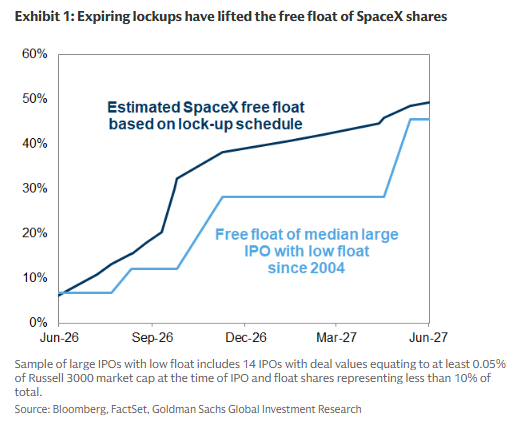
Finally, for those watching for the SpaceX index addition…
Once SpaceX crosses 50% of its shares floating, expect the S&P 500 to start giving it a close look.
Roughly a third of SpaceX shares are now part of the company's public float, up from 5% at IPO. Based on SpaceX's lockup schedule, about half of its shares should be part of the public float by the middle of 2027, consistent with the historical precedent from large IPOs with low initial floats.
Goldman Sachs
Learn more about the Hamilton Lane Strategies
DISCLOSURES
The information presented here is for informational purposes only, and this document is not to be construed as an offer to sell, or the solicitation of an offer to buy, securities. Some investments are not suitable for all investors, and there can be no assurance that any investment strategy will be successful. The hyperlinks included in this message provide direct access to other Internet resources, including Web sites. While we believe this information to be from reliable sources, Hamilton Lane is not responsible for the accuracy or content of information contained in these sites. Although we make every effort to ensure these links are accurate, up to date and relevant, we cannot take responsibility for pages maintained by external providers. The views expressed by these external providers on their own Web pages or on external sites they link to are not necessarily those of Hamilton Lane.