Building Resilient Portfolios in the AI Era
Key Takeaways
- AI’s strength has bolstered public markets. Public markets defied economic pressures through 2025, with AI-driven growth acting as the primary support.
- Concentration risk is real. Seven stocks continue to dominate global equity capitalization, and all are deeply embedded in AI.
- Private markets offer balance. Diversified private market strategies offer broad AI exposure and a hedge against volatility.
As 2026 unfolds, artificial intelligence (AI) continues to shape the investment landscape in both public and private markets.
For investors, the challenge is clear: Build portfolios that can thrive whether AI delivers on its promise or falls short. The key is understanding where AI exposure is most concentrated and where diversification opportunities lie. Here’s what you need to know.
1. AI’s Strength Has Bolstered Public Markets
Recent macro conditions have been challenging, but they haven’t derailed equity markets. Instead, major indices delivered double-digit gains in 2025, supported in large part by AI-related strength. Key macro headwinds include:
- US inflation: Still above the Fed’s 2% target — expected to be persistent, but not extreme.
- Interest rates: Short-term rates may ease globally, while long-term yields remain “higher for longer” amid fiscal uncertainty.
- Gold and currencies: Rising gold prices and strength in safe-haven currencies like the Swiss franc signal growing flight-to-safety and currency risk concerns.
Despite these pressures, equities have remained resilient. The dominant driver through most of 2025 was clearly AI. However, more recently, performance has improved across sectors outside of AI and the U.S., as optimism has spread.
2. A Few Stocks Are Driving Gains
AI is powering public market outperformance, but that strength remains highly concentrated. Despite broader market gains in late 2025, a handful of AI‑driven mega-caps still accounted for a disproportionate share of index earnings and market sentiment. Together, the “Magnificent Seven” (Nvidia, Microsoft, Alphabet, Meta, Amazon, Apple, Tesla) represent about 35% of the market capitalization of the top 100 global companies. This concentration creates two key risks:
- Diversification risk. Even broad benchmarks like the S&P 500 or MSCI World are dominated by these names. A stumble by any of these stocks could significantly impact indexes. As a result, owning the market no longer guarantees diversification.
- Valuation sensitivity. Elevated valuations among AI leaders have increased vulnerability to earnings disappointments or shifts in sentiment.
The big question: Are we in an AI bubble?
- The case for “yes”: Valuations are elevated, and volatility remains a clear risk.
- The case for “no”: Leading AI players are already generating substantial revenue and monetizing faster than previous tech cycles.
As always, diversification is the best defense against bubble risk. With AI exposure concentrated in public equities, private markets are essential for achieving balance and resilience.
3. Private Markets Offer Access and Diversification
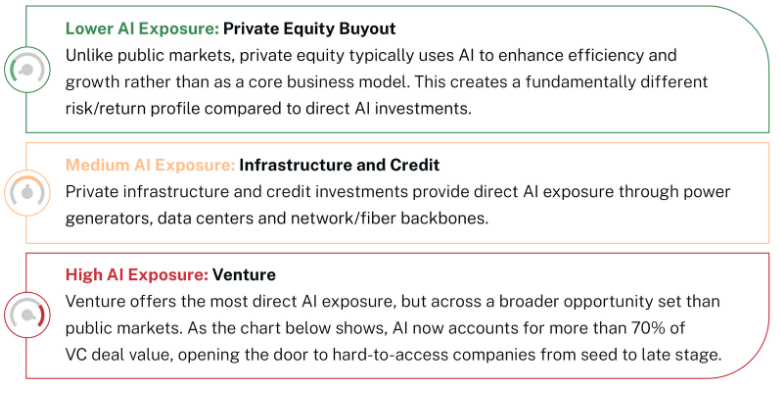
Private markets open doors to strategies and sectors that public markets can’t match, offering broader opportunity sets and different risk profiles. But they’re not immune to AI. Understanding AI exposure across strategies is essential for smart allocation. Here’s a simple guide:
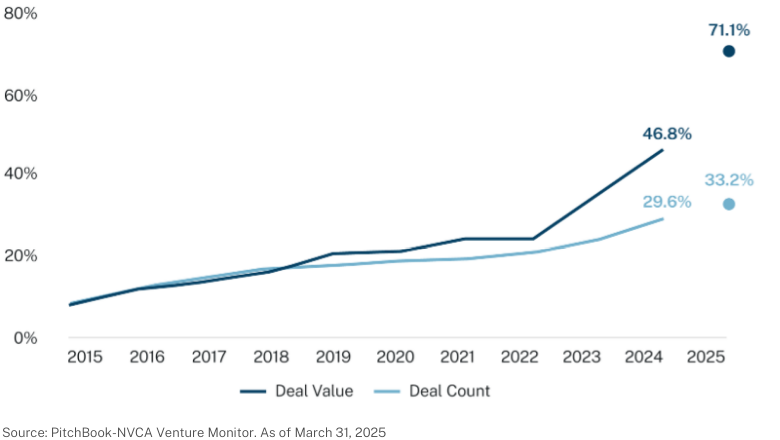
AI Represents 71% of Venture Capital
AI and machine learning as a share of VC deal activity
Conclusion
Public equities are riding the AI wave, but concentration risk and valuation sensitivity are creating risks that touch all index investors.
Private markets provide access to broader AI opportunities while offering a hedge against potential corrections. Diversifying across private market strategies can help build portfolio resilience — whether AI fulfills its promise or not.
1Source: PWC (May 2025)