
Weekly Research Briefing: In Need of Some Four-Leafs

The world could use a bit of extra luck and good fortune this St. Patrick's Day. A major de-escalation of the war in the Persian Gulf would significantly improve the mood of consumers, businesses, and investors. Humanity and the environment would also benefit. It is time for Iran, Israel and the US to get together and find an exit path. No one wants 'boots on the ground', months of drone warfare, or a closed Persian Gulf.
Crude Oil continues to toy with the triple digits. With each passing day, more Middle East production shut-ins occur. As the above ground oil is consumed and transportation bottlenecks accelerate, crude oil prices will inevitably surpass $120 on their way to higher levels. We can ask other countries for help reopening the Strait of Hormuz, but how safe will ships be along an Iranian coastline stretching 1,000 miles when they can produce 2,000 drones per week?
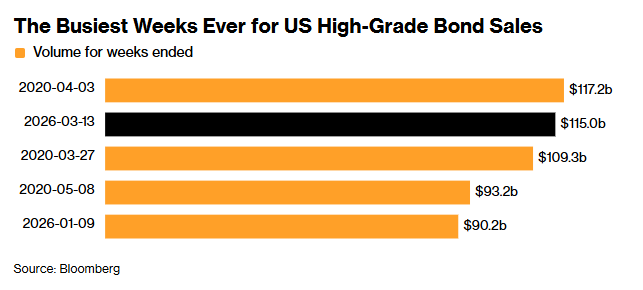
Oil price uncertainty continues to worry the global stock and bond markets. The declines even paused last week's M&A activity and cancelled this week's IPO calendar. Fortunately, the corporate bond markets continue at a ravenous pace with last week's volume hitting #2 on the all-time list. Corporate bond activity might look different if oil prices reach the $120 level.
This week is busy, highlighted by the March FOMC meeting where the Fed is expected to hold rates steady. Chairman Powell's press conference could be an interesting one, especially given the recent moves by the Justice Department. It looks as if the Chairman will keep his tie-dyed gavel for a few more FOMC meetings. Ahead of us for new economic data are the PPI, the Philly Fed and New Home Sales which will no doubt be impacted by the winter storms. Speaking of storms, what is happening this week? It looks like 3 standard deviation activity is hitting all over the US this week. Be safe everyone, and have a great week.
Very high oil prices are not good for the US or its energy companies…
American oil executives delivered a bleak message to Trump officials in recent days: The energy crisis the Iran war has unleashed is likely to get worse.
In a series of White House meetings Wednesday and recent conversations with Energy Secretary Chris Wright and Interior Secretary Doug Burgum, the CEOs of Exxon Mobil, Chevron, and ConocoPhillips warned that the disruption to energy flows out of the vital Strait of Hormuz waterway would continue to create volatility in global energy markets, according to people familiar with the matter…
“The world does not need $120 oil,” said Steven Pruett, chief executive of Midland, Texas-based oil producer Elevation Resources. “It’s going to cause economic destruction.”
A senior administration official said that the administration knows prices are going to continue to rise but there isn’t a lot it can do at the moment. The Pentagon has told the administration that options exist to open the strait, and the administration wants that to happen in a matter of weeks, not months, the person said.
Javier Blas has thoughts on what could happen if ships do not start moving out of the Gulf and through the Strait…
If oil continues to rise, the market will resolve the problem the hard way: demand destruction, with prices high enough to drive consumption down. Here, the key is where that demand destruction happens. At risk of sounding unkind, it matters less for the global economy if it occurs in a small country such as Bangladesh — where there are signs it’s already happening — than if a major nation such as Germany starts to curb its appetite, as happened in 2022 during the European energy crisis.
Initially, Trump aimed for a war lasting four to five weeks. With the third week about to commence, the expense in energy terms will continue to increase, but I think it remains manageable. Beyond that, though, every day the conflict continues, the inflation and economic risks mount. The White House surely knows the power of the oil market — just listen the parade of cabinet members doing live television interviews trying to talk down the market.
If the war goes on for months, extending into April and May, the scenario would be grim. The cost of oil would reach stratospheric levels, stoking inflation. But the bigger issue would be growth. Extend the war from days and weeks into months, and economists will need to start reducing their forecasts for gross domestic product — and not in a linear fashion. Stagflation could become a real risk.
Why the Strait of Hormuz is so hard to secure…
Imagine a coastline from the tip of Florida to the North Carolina border. Now how do you protect ships from 10,000 drones a month launching from anywhere on that coastline?
Shipping lanes are just two nautical miles wide and ships must make a turn opposite Iranian islands and a mountainous coast that provides cover for Iranian forces, according to shipping broker SSY Global.
Iran's conventional navy has largely been destroyed but the Guards still have plenty of options including fast-attack craft, mini submarines, mines and even jet skis packed with explosives, said Tom Sharpe, a retired Royal Navy commander.
Tehran has the capacity to produce around 10,000 drones a month, according to the Centre for Information Resilience, a non-profit research group.
Escorting three or four ships a day through the strait would be feasible in the short-term using seven or eight destroyers providing air cover, and would depend on whether the risk from mini submarines has been reduced, but doing so sustainably for months would require more resources, Sharpe said.
Even if Iran's capacity to deploy ballistic missiles, drones and floating mines were destroyed, ships would still face a threat from suicide operations, said Adel Bakawan, Director of the European Institute for Middle East and North African Studies.
If the war does continue for weeks, some kind of escort will come together, said Kevin Rowlands, Editor of the RUSI Journal at the Royal United Services Institute.
"The world needs oil to flow through from the Gulf, and so there is planning ongoing to put protection measures in place,” he said.
Boots on the ground to seize Kharg Island will be dangerous and it may not end this conflict…
The geography of the strait favours Iran; so does the low risk tolerance of shippers and insurers. Yet Iran has a dilemma as well: so far, closing the strait has been a tactical win that has not achieved its strategic goal of ending the war. The battle for Hormuz may push both sides towards risky escalation.
Just 54km (34 miles) wide at its narrowest point, flanked by mountains on both sides, the strait will be extremely hard for America to reopen. Iran does not have to hit every ship transiting through, merely to convince their owners and sailors that it might hit them. Sending American troops to secure the coastline is a non-starter, given the size of the force required; Iran could also just continue shooting from inland. Mr Trump is pleading with China, France and other rich countries to send warships to escort commercial vessels. None seems eager to help, unsurprising given how likely such escorts are to become targets.
If Mr Trump cannot wrench the route open, he may escalate elsewhere. For decades he has had a fixation with Kharg Island, a rocky wedge of land in the Persian Gulf that is home to Iran’s main oil-export terminal. He told an interviewer in 1988 that were he president he would “do a number” on it. On March 13th he got his chance: America bombed dozens of Iranian military targets there, hitting storage depots for missiles and naval mines. The oil terminal was left untouched, for what Mr Trump calls “reasons of decency” (bombing it would cause an environmental disaster).
He may hope to seize it. Commentators on Fox News, who often tailor their remarks for an audience of one, have urged him on. So has Lindsey Graham, a hawkish Republican senator who has the president’s ear. “He who controls Kharg Island, controls the destiny of this war,” he wrote on social media. Mr Graham signed his tweet with the words semper fi (always faithful), a shortened form of the motto of America’s marines. That was a noteworthy flourish: he wrote the post hours after the Pentagon announced that a marine expeditionary unit, which trains for this sort of mission, was being redeployed from Japan to the Middle East.
America could probably seize the island. What would happen next is less clear. It would have to hold territory within easy range of Iranian missiles and drones. It may hope to use Kharg to press Iran to make a deal, but the regime is stubborn. Oil markets would be spooked by a further loss of supply—Iran is still shipping more than 1m barrels per day (b/d) to China—and the prospect of a longer ground war.
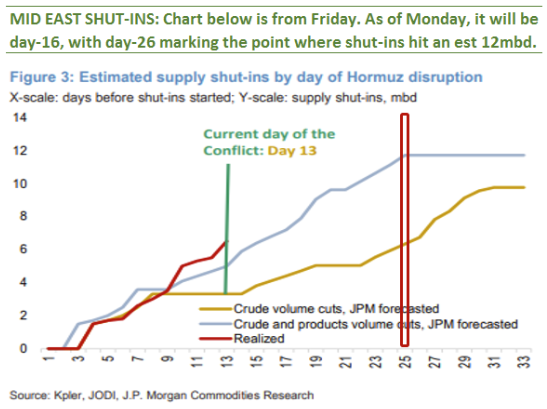
J.P. Morgan has your current crude oil shut-in chart…
By this Friday, assuming no change to the current state of the strait, we estimate the supply cuts will approach 12mbpd. Just how impactful will that be for prices? Estimates vary but many see a $3-$4 impact per every 1mm worth of production cuts. Said differently, even assuming no further escalations or attacks on gulf infrastructure, this back of the envelope math and the dynamics in the strait alone give line of sight to $120/bbl by Friday ($3.5/bbl * ~5.5mm incremental production cuts).
J.P. Morgan
Morgan Stanley calculates the impact of a transitory and a persistent oil price shock…
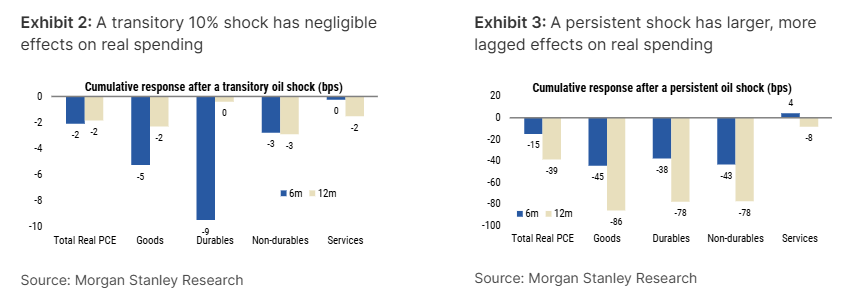
We consider two types of shock to quantify the effects to real consumer spending: a transitory shock, in which oil prices rise by 10% at the end of the month and then dissipate over the year. And for longer-lasting shock, we consider the case where oil prices rise by 50% by the end of the quarter, plateau there for about 2 quarters, and then decay. This is a larger and more persistent shock.
In the case of transitory oil shocks, the effect on real consumer spending is very small. Because they soon reverse, households adjust only marginally. Our model suggests that a short-lived 10% increase in oil prices would have a negligible impact on real PCE. In such a scenario, consumers might dip into savings or short-term credit to smooth spending through the price spike, anticipating relief in gas prices before making major changes to consumption. Businesses, too, may absorb temporary energy cost increases in profit margins rather than immediately hiking all prices.
Exhibit 2 shows the cumulative response of real PCE and major components to a 10% oil supply news shock. The key message is a negligible decline in real consumption, with the drag concentrated in goods, especially durables. The cumulative decline in durable goods spending is ~10bp after six months, and that is almost entirely reversed by the end of 12 months.
Morgan Stanley
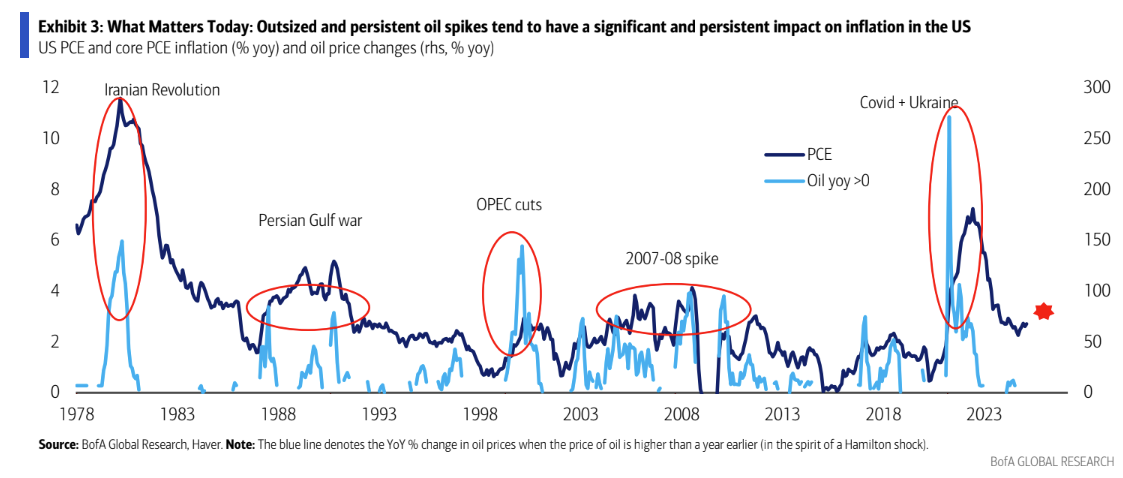
BofA Global shows you the risks of $100+ oil…
BofA Global Research’s US Rates team offers a rule of thumb: every $10 sustained increase in the oil price implies a 0.1% increase in inflation and a 0.1% reduction in GDP. Our commodities team expect that an extended closure of the Strait of Hormuz could see sustained oil prices of $110-$150/bbl. (Exhibit 3).
Based on the heuristic above from the US Rates team, investors could expect US inflation of 3.2% or more (vs. our 2.8% forecast) and GDP growth of only 2.0% to 2.4% (vs. our 2.8% forecast).
BofA Chief Economist Claudio Irigoyen writes that “only marked and persistent spikes in the price of crude trigger persistent inflationary cycles.” The economics team sees risks to the US economy with a persistent spike in crude prices from tightening financial conditions, spending power erosion, and capex delays.
BofA Global
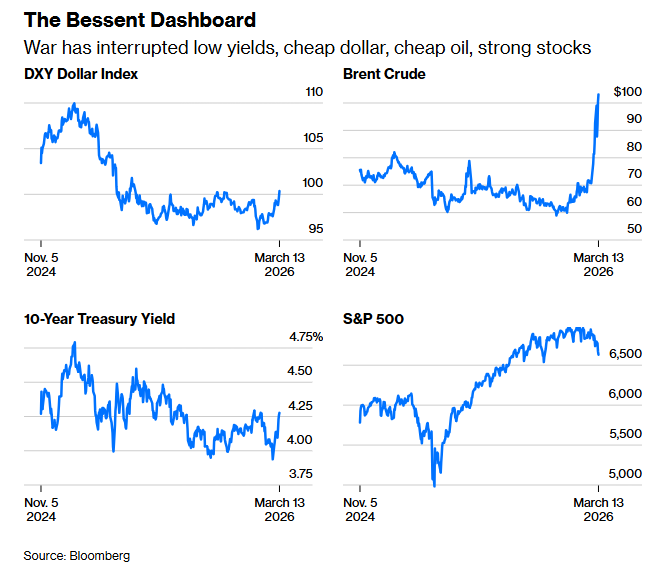
Financial aftershocks of the war on Iran has blown holes in the Treasury Secretary's near term price charts…
Even if the blow is less than catastrophic, it is startling how few benefit. The direction of travel is inimical for the Trump administration. Treasury Secretary Scott Bessent’s strategy has involved a weak dollar, lower yields and cheaper oil, combined with a strong stock market, and it was going very well until the last few weeks. The war has thrown that into reverse:
Little safety in Consumer Staple stocks which are highly sensitive to rising oil prices…
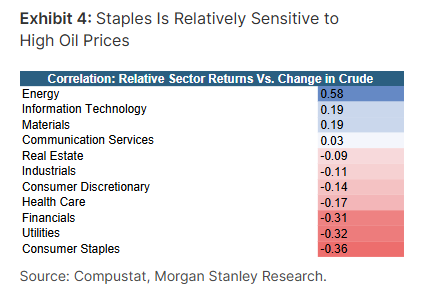
Morgan Stanley
Companies exposed to jet fuel or bunker fuel are having a difficult March with their stock prices down 20-40%…
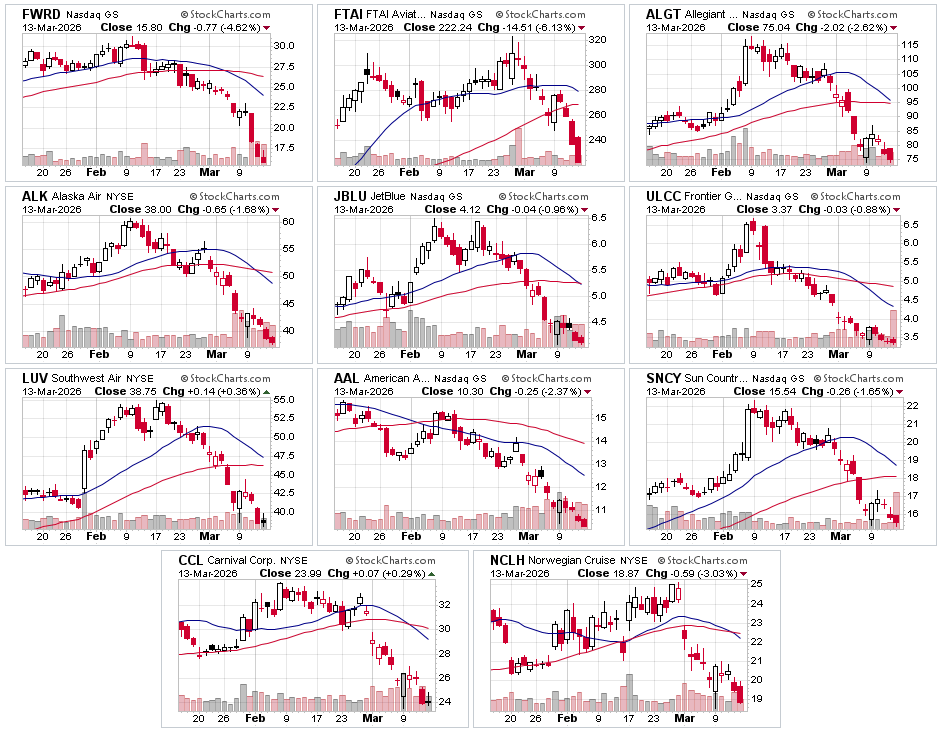
StockCharts
Inflation worries has caused the 2-year Treasury yield to jump to 6-month highs…
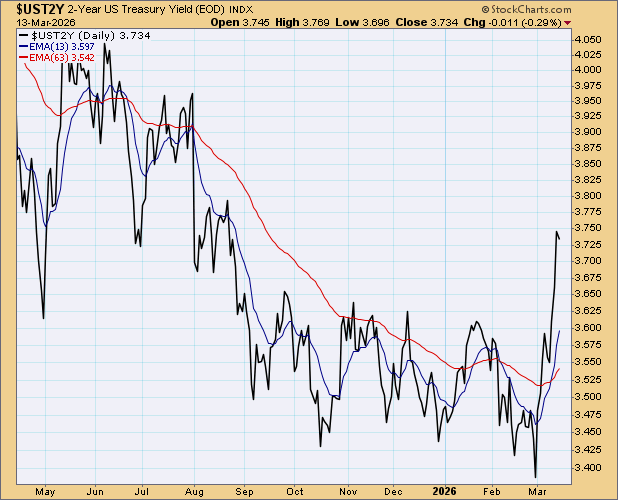
StockCharts
It has also shifted out expectations for future Fed Funds rate cuts…
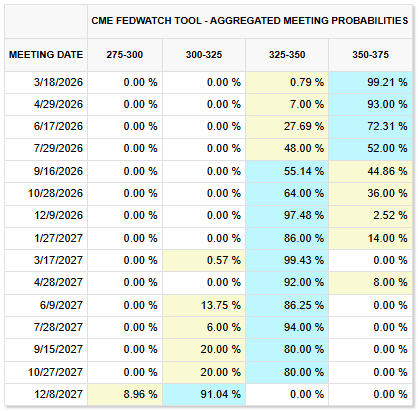
Falling stock prices would cut off one big leg of the economic stool…
Neil Dutta @RenMacLLC: "The two core pillars of Trumpnomics are rising equity prices and low energy prices. You kind of cover all the bases there: rising stock prices help the wealthy while low energy prices help everyone else. No President in recent memory has touted energy dominance and record high equity prices as much as DJT. So, high stock prices and low energy prices: we're at risk of losing both."
@annmarie
The quickest way to help all US businesses and consumers with triple digit oil prices would be to end all tariff collections today…
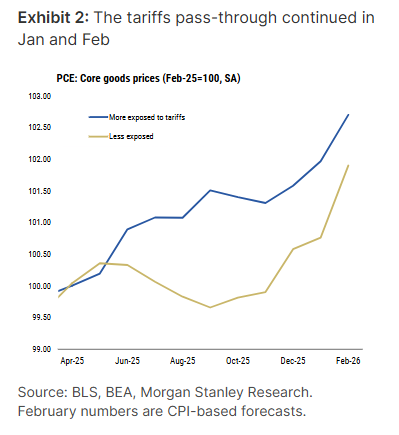
Tariff pass-through has been uneven, but it appears firms used the typical annual price reset at the beginning of the year to pass through cost pressures stemming from trade policy. Goods more exposed to tariffs continued to increase in January and are expected to continue that trend in February (see chart below). Goods less exposed to tariffs also increased recently, but we think that the strength in that group was mostly driven by noise in software and jewelry.
Morgan Stanley
Just another reminder that American's blame tariffs for raising their prices…
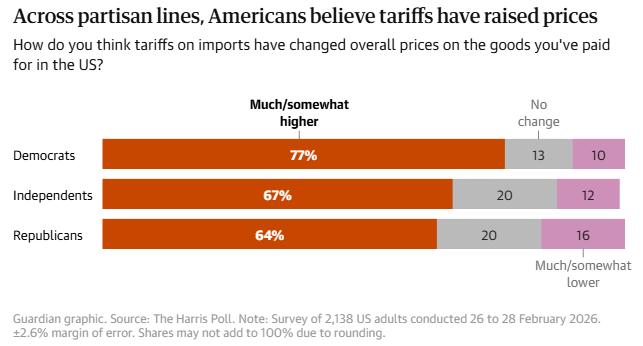
Seven in 10 Americans say Donald Trump’s tariffs have led to them paying higher prices, according to an exclusive new poll for the Guardian.
The Harris Poll survey presents Republicans with a major problem in the battle for the upcoming midterm elections. The majority of all voters (72%) believe Trump’s tariffs have had a negative rather than a positive impact and 67% said tariffs aren’t the right solution for improving the economy.
Yet Trump has made clear he wants to press ahead with more tariffs even after a supreme court ruling curbed many of the levies he introduced last year…
The survey was conducted by Harris Poll at the end of February, before the US and Israel started a war with Iran, increasing oil prices.
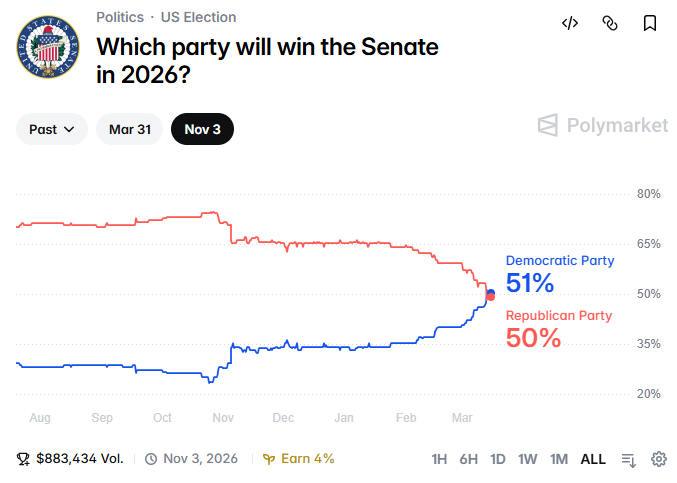
The prediction markets now see a blue wave hitting Congress in November…
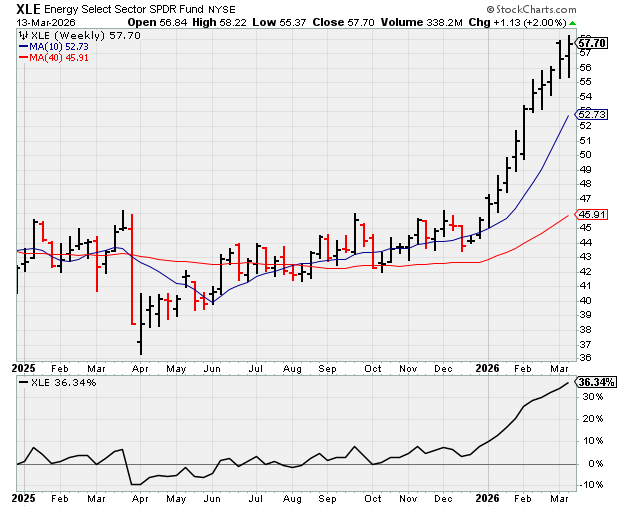
Back to stocks, the Energy Sector ETF is now up twelve weeks in a row…
StockCharts
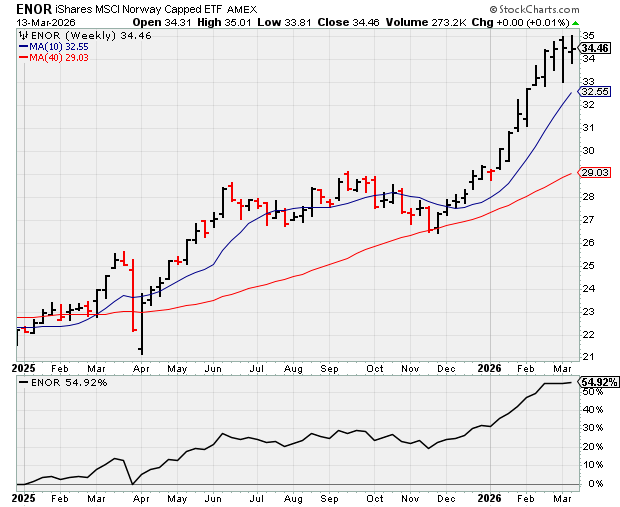
Tough to find many geographies green this month, but the Norway Index ETF is now up nine weeks in a row thanks to their energy company overweighting…
StockCharts
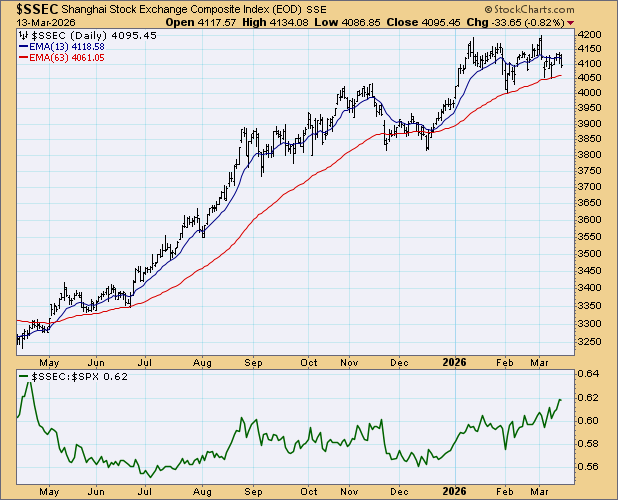
Chinese equities are holding up very well…
StockCharts
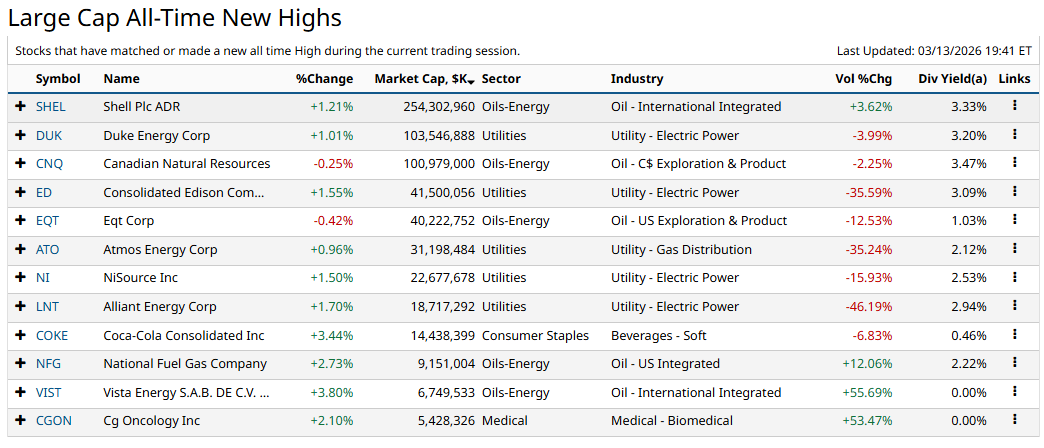
A glance at Friday's new all-time highs shows a list dominated by Energy and Power companies…
Barchart
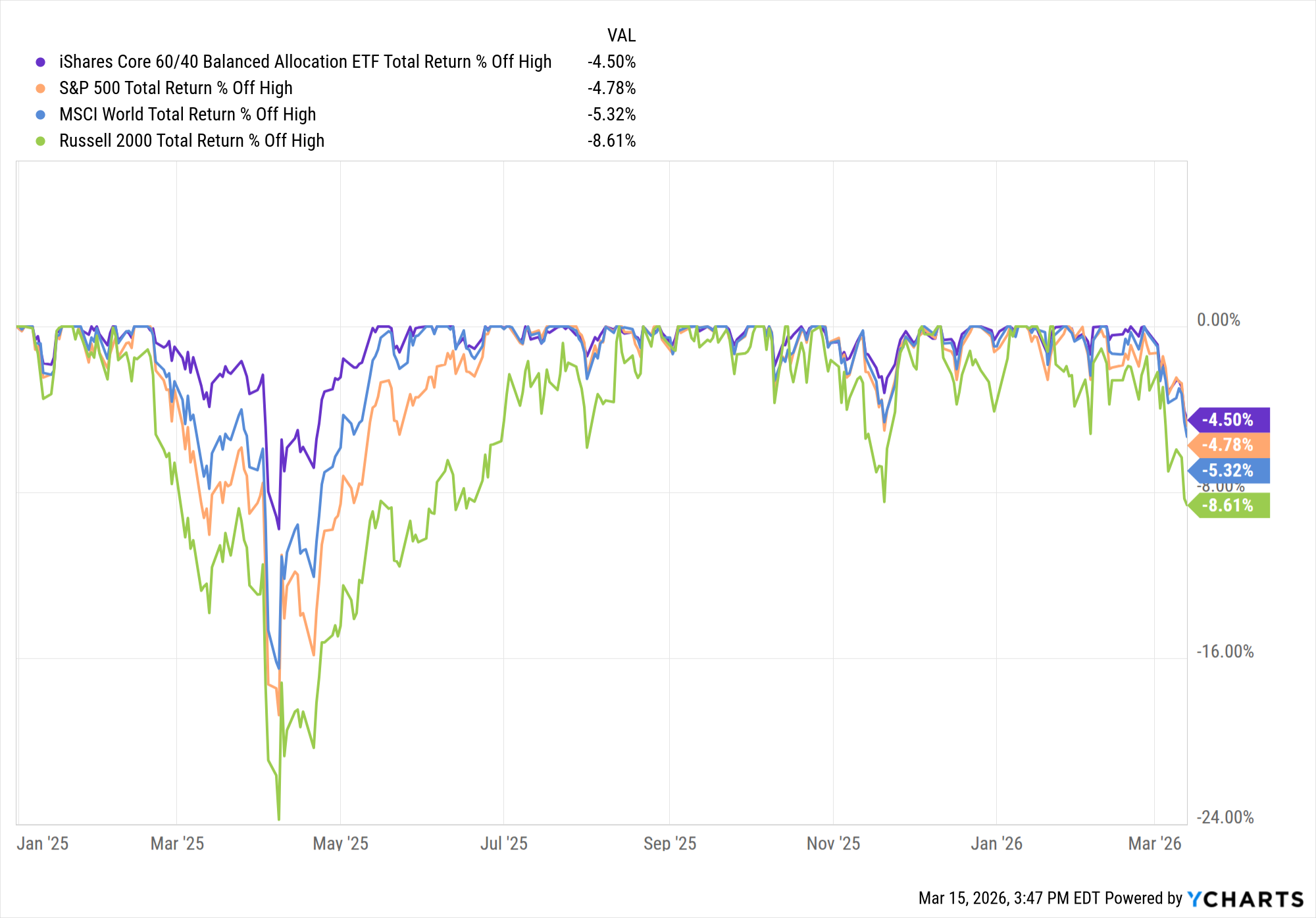
Drawdowns through Friday's close show 4-8% pullbacks among the major equity index and balanced ETFs…
YCharts
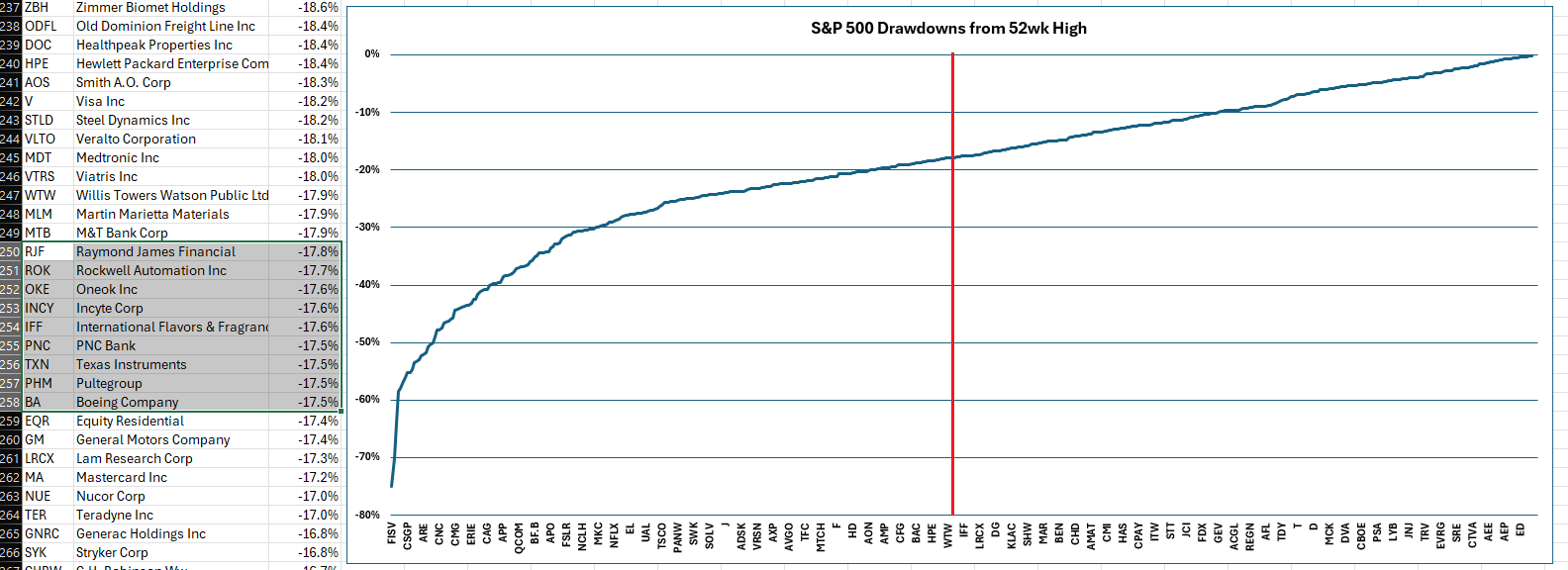
Among individual components in the S&P 500, the median stock is in a 18% drawdown…
@MikeZaccardi: The median S&P 500 stock drawdown is -18% (from 52wk high)
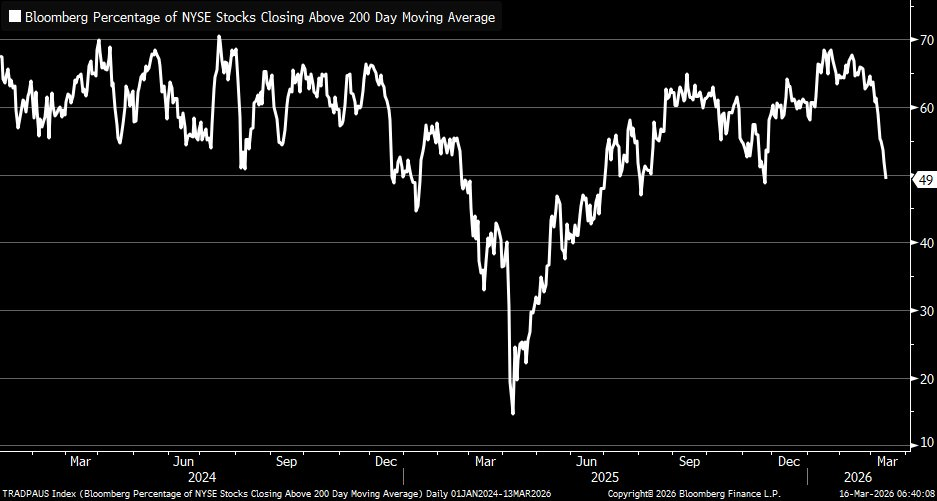
And the majority of stocks are now trading below their 200 day moving average…
@KevRGordon: % of NYSE stocks trading above their 200d moving average is now sub-50% ... nearly matching the November low
The most unsettling chart in my deck is the recent performance of the Bank Stock Index…
Sure the index is concerned about higher interest rates and a flatter yield curve. And also a slowdown in capital markets activities. But the high-teens percentage pullback is such a short time also suggests that an increasing number of investors are beginning to worry about bank loan books. While our nation's banks can handle a few cockroaches, it will have a more difficult time if their customers are wrestling with $120 crude oil. Keep a close eye on the bank stocks.
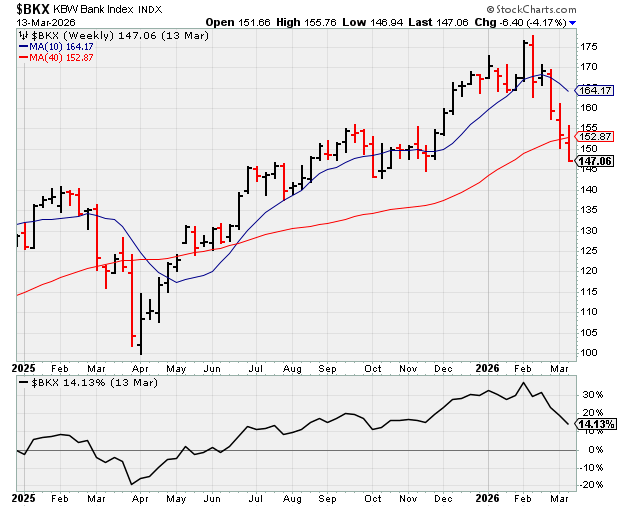
StockCharts
Here is the first of many price increases that are about to hit businesses all around the world...
I would be hard pressed to find a company or person who doesn't interact with Ecolab on a daily basis. Restaurants, retailers, food processors, cruise ships, hospitals, dry cleaners, manufacturers, industrial service companies, and on and on. You name the company and Ecolab probably has a monthly invoice going to it or one of its direct vendors. Typical price increases are 2-3% per year so this 10-14% surcharge is a zinger. And no way to AI cost save your way out of this one so it will hit margins, force price increases or lead to dirtier environments.
Ecolab Announces Global 10-14% Energy Surcharge
March 12, 2026
"Ecolab today reaffirmed its long-term commitment to secure supply and ensure service to any customer, anywhere in the world, amid sharply rising global energy costs and sourcing challenges. As part of our ongoing efforts to manage extraordinary cost pressures while continuing to deliver incremental total value to customers, we will implement a global 10-14% energy surcharge, depending on local market conditions, on all our products and services, effective April 1, 2026, applicable to all businesses and countries.
Due to the war in the Middle East, global energy markets have experienced significant price volatility in recent weeks driven by supply disruptions, transportation constraints, and geopolitical developments. Since the end of 2025, oil prices have increased close to 60%, while natural gas prices have risen sharply across global markets, including nearly 80% in Europe, contributing to major cost increases for raw materials, manufacturing, and logistics throughout our global supply chain. This energy surcharge will be monitored closely and might be adjusted as market conditions evolve."
Along with higher energy costs, fertilizer and aluminum price increases will soon ripple through many global supply chains…
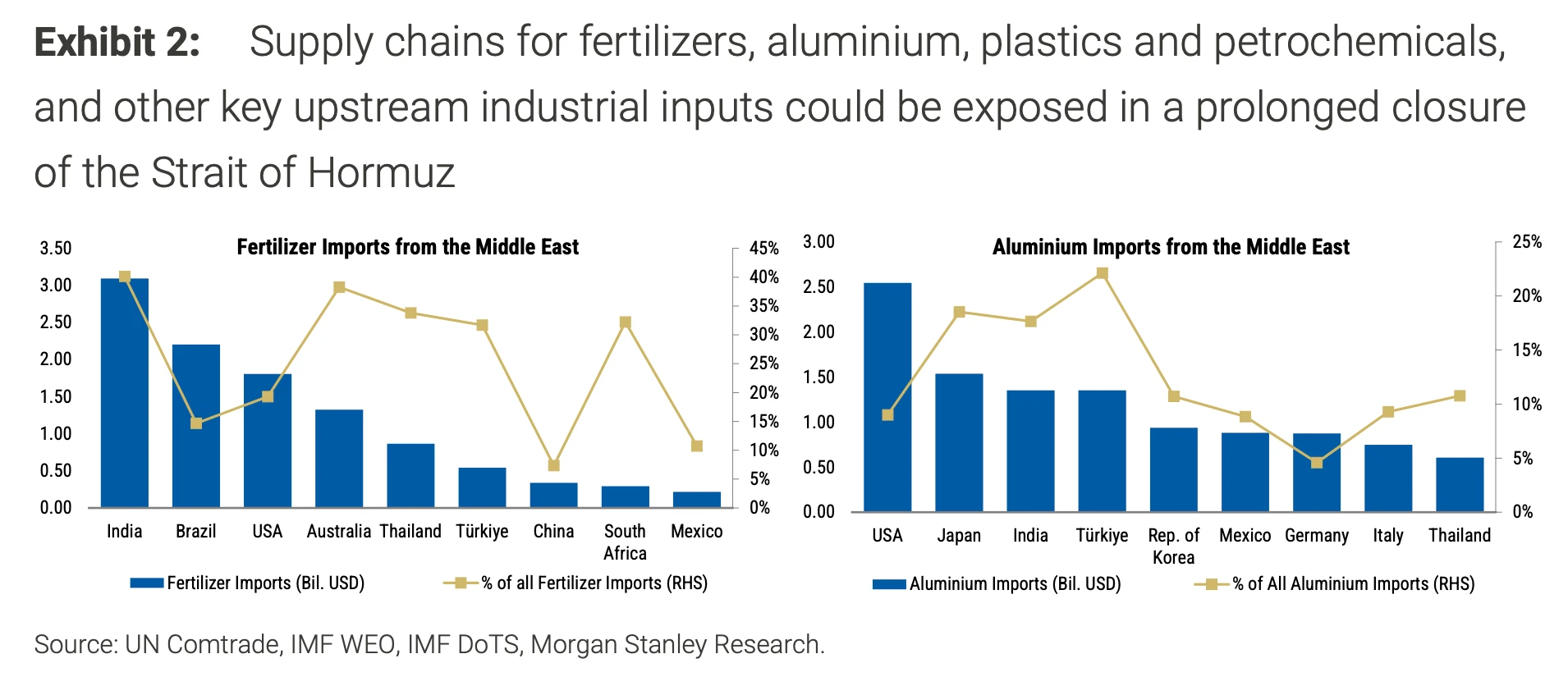
Morgan Stanley
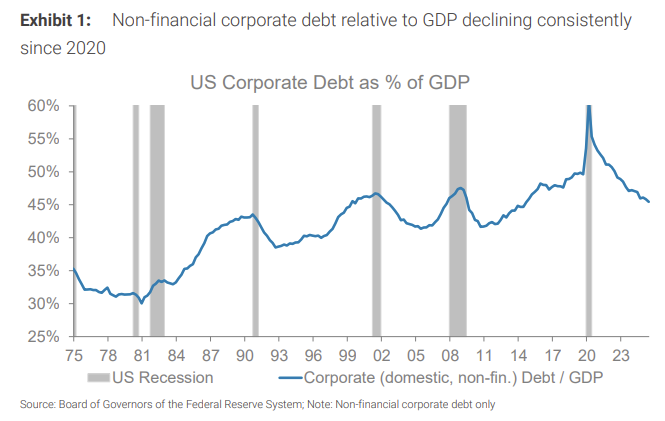
Credit cockroaches, YES. Systemic credit risk meltdown, NO…
The first question in assessing systemic risk is straightforward: has leverage in the system increased? The short answer is no. Historically, a sustained rise in aggregate corporate debt relative to GDP has been a reliable signal of mounting systemic stress. By that metric, the evidence is not compelling. The overall scale of sub investment grade lending relative to the economy remains contained. Even after accounting for the growth of private credit, total non-investment grade corporate lending as a share of GDP is broadly unchanged from a decade ago. In fact, aggregate corporate debt to GDP ratios have declined in recent years. (Exhibit 1). These trends suggest that the stock of riskier corporate borrowing has not expanded to levels consistent with broad based systemic vulnerability.
Morgan Stanley
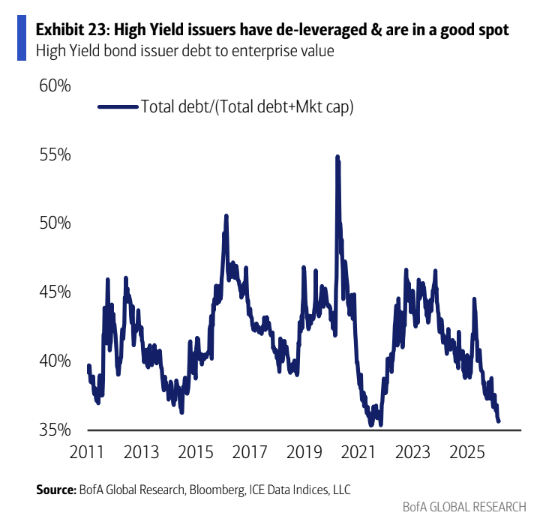
Even high yield issuers have cleaned up their balance sheets taking risk away from their borrowers…
BofA Global
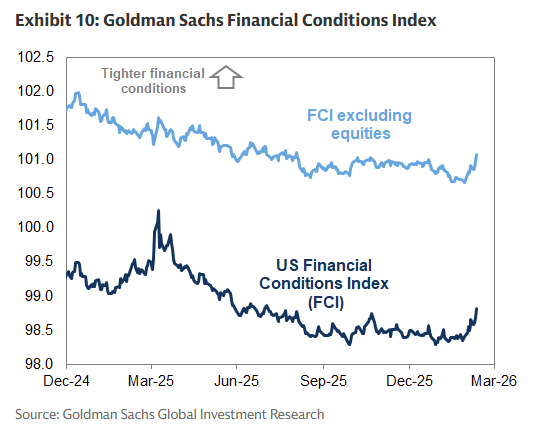
Falling stocks, rising risk-free yields and wider credit spreads have pushed financial conditions off of their lows…
But while stocks have fallen and credit spreads have widened, bond issuance remains in fifth gear…
Middle East war. Rising yields and oil prices. Private credit distress. It barely seemed to matter for corporate borrowers this week as US investment-grade bond sales came close to yet another record.
Volumes reached $115 billion, just shy of the record weekly high of around $117 billion notched in 2020 when pandemic-related shutdowns and unprecedented measures by the Federal Reserve fueled a rush of capital raising by companies staring into the unknown…
The borrowing frenzy was driven by three blockbuster deals from Amazon.com Inc., software company Salesforce Inc. and Honeywell Aerospace Inc. The biggest of those, Amazon’s $37 billion transaction, was the fourth-largest dollar bond ever. Home-rental firm Airbnb Inc. also made a debut appearance to refinance debt.
In all, 23 firms sold bonds, about half the number of issuers in the 2020 week.
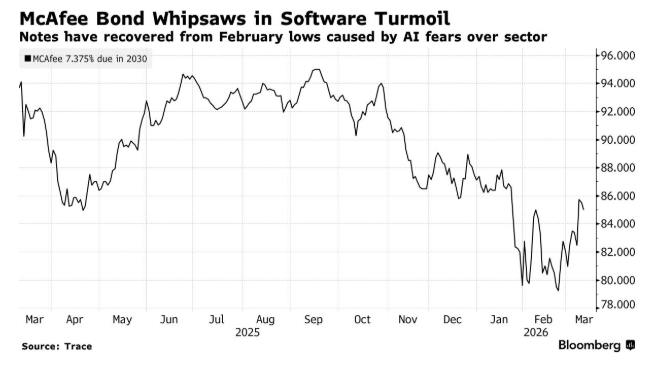
This cash flowing private company has taken advantage of the widening in credit spreads to buy back 15% of its traded debt…
McAfee bought back about $287 million of unsecured notes at a discount, taking advantage of a software rout that hit its debt stack, according to people familiar with the situation.
The privately-held firm acquired the debt in the open market between January and March 6, spending about $239 million of cash plus accrued interest for the transactions, said the people, who asked not to be identified discussing a private matter.
McAfee viewed the bonds as undervalued amid elevated volatility in the debt markets, said one of the people familiar with the situation. Such repurchases allow the company to cut its debt burden and lower interest expense…
The company’s roughly $2 billion unsecured bond due in 2030 has whipsawed since January. It traded at about 85 cents on the dollar Wednesday, up from a 79 cents low on Feb. 24, according to pricing firm Trace.
While M&A activity slows due to the war & oil uncertainty, two more Russell 1000 tickers were gobbled up by two S&P 500 companies in the last week…
- Cintas (CTAS), a maker of workplace products, agreed to acquire UniFirst (UNF) in a deal with an enterprise value of $5.5 billion, more than four years after it first bid for the smaller uniform supplier. UniFirst shareholders would receive $155 in cash and 0.7720 shares of Cintas stock for each UniFirst share they own, for a total value of $310 a share. Cintas has been trying to buy UniFirst since as far back as February 2022, when it offered $255 a share, a 43% premium to where the stock had been trading.
- Public Storage (PSA) agreed to acquire National Storage Affiliates (NSA) in a $5.63 billion all-stock deal, creating a storage-unit company with a combined market capitalization of about $57 billion and enterprise value of $77 billion. The deal is valued at $10.5 billion including debt and will combine the #1 and #5 self-storage owners and operators.
- Agero Enters into Agreement to Acquire Urgently (ULY), for $5.50/shr cash. Urgent.ly is a U.S.-based technology focused provider of roadside and mobility assistance with innovative, tailored solutions within the automotive, fleet, and rental markets.
- Amplifon SpA (AMP.it) agreed to buy the hearing-aid business of GN Store Nord A/S (GN.dn) in a deal valued at 17 billion Danish kroner ($2.6 billion). Milan-based Amplifon will pay 12.6 billion kroner in cash and issue 56 million shares for the business. Shares of GN Store Nord jumped as much as 42%.
Various News Sources
And in the event that you missed it last week, here is a link to our annual report on the private markets…
The 2026 Hamilton Lane Market Overview is here! Our annual report offers a deep dive into the global private markets landscape, breaking down key performance trends, evolving liquidity dynamics, and the growing influence of AI.
From all of the reviews that I have read, Apple has a big hit on their hands with the Neo…
This review is good one for digging into the weeds, trees and forest of what you are considering.
My three-device lifestyle for the last decade has been a MacBook Pro (anchored to a Studio Display at my desk at home, and in my briefcase when travelling); my iPhone; and an iPad Pro with a Magic Keyboard for use around the rest of the house. This last week testing the MacBook Neo, I haven’t touched my iPad once, and I haven’t once wished this Neo were an iPad. And there were many times when I was very happy that it was a Mac.
And I can buy one, just like this one, for $700. That’s $170 less than an 11-inch iPad Air and Magic Keyboard. And the Neo comes with a full-size keyboard and runs MacOS, not a version of iOS with a limited imitation of MacOS’s windowing UI. I am in no way arguing that the MacBook Neo is an iPad killer, but it’s a splendid iPad alternative for people like me, who don’t draw with a Pencil, do type with a keyboard, and just want a small, simple, highly portable and highly capable computer to use around the house. The MacBook Neo is going to be a great first Macintosh for a lot of people switching from PCs. But it’s also going to be a great secondary Mac for a lot of longtime Mac users with expensive desktop setups for their main workstations — like me.
The Neo crystallizes the post-Jony Ive Apple. The MacBook “One” was a design statement, and a much-beloved semi-premium product for a relatively small audience. The Neo is a mass-market device that was conceived of, designed, and engineered to expand the Mac user base to a larger audience. It’s a design statement too, but of a different sort — emphasizing practicality above all else. It’s just a goddamn lovely tool, and fun too.
I’ll just say it: I think I’m done with iPads. Why bother when Apple is now making a crackerjack Mac laptop that starts at just $600? May the MacBook Neo live so long that its name becomes inapt.
A tough year for US water as new ink on Corpus Christie and the Colorado River detail…
Corpus Christi, Texas, is about to run dangerously short of water, a development nobody saw coming aside from all the people who have seen it coming for decades.
The Gulf Coast city is a case study in how not to anticipate and adjust to a hotter world, a cautionary tale for municipalities across the country and the world. Even as the city struggled to meet its booming water needs, it invited fossil-fuel companies to guzzle its water as the industry helped to heat the planet, making reservoirs run dry even faster. Ironically, some of that same fossil-fuel industry risks grinding to a halt as a result. Winners are scarce in battles over dwindling resources.
Two of Corpus Christi’s main water sources, the Choke Canyon Reservoir and Lake Corpus Christi, are both below 10% capacity. The city has projected that the two, which together supply about a quarter of the city’s 104 million gallons of average daily demand, will be bone-dry before mid-2027. That means the city won’t be able to fully serve its 500,000 residential and many commercial and industrial users, the number of which has boomed in recent years.
About six months before that happens, probably this November, the city will enact emergency water restrictions to slash use by 25%. It has already targeted a 15% reduction in demand, the second-most-drastic step it can take.
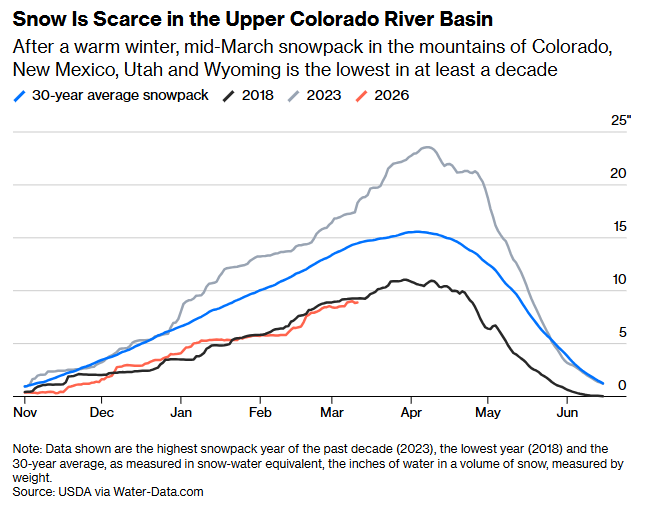
And in Colorado, this year's snowpack is currently in danger of evaporation rather than melting into the streams…
Lake Powell, the main reservoir near the border between the upper and lower basins, will get just 52% of its usual inflow from snowmelt this year, the Bureau of Reclamation forecast last month.
Lake Powell can’t afford an off year. It recently stood at just 24% of its capacity, 170 feet below “full pool” and just 160 feet from going “dead pool,” when water can no longer escape from the Glen Canyon Dam. That would be a catastrophe for the lower-basin states of Arizona, California and Nevada.
More immediately, the reservoir is just 40 feet away from “minimum power pool,” below which it will be unable to move the turbines on Glen Canyon Dam’s hydropower plant, which serves seven Western states. It generates 5 billion kilowatt-hours of electricity each year, enough to power 500,000 homes. A West filling up with data centers desperately needs this power supply…
After some dry winters in the past, heavy snowfalls in the spring saved the Colorado’s day by topping off the snowpack. It may not get so lucky this year. A freakish heat wave that has settled over the region in recent days will intensify and linger in the days ahead, likely smashing record temperatures for March.
“We’re talking potentially a week to two weeks of 80-plus degree (Fahrenheit) temperatures at 6,000 feet in the Rocky Mountains in March, with some places getting up to 90,” Daniel Swain, a climate scientist with the University of California Agriculture and Natural Resources, said in a recent video.
That heat will evaporate and melt what little snow there is, not just in the upper Colorado basin but across the West. Snowpack in some places could disappear as early as April 1, far earlier than usual, Swain warned.
This is a must read for any teenage boy who thinks that they can beat their online sports betting app…
Sucker - My year as a degenerate gambler - By McKay Coppins
On a Thursday evening in September, I excused myself from the family dinner table and slipped into my bedroom. I didn’t want my kids to see what I was about to do.
With the door locked behind me, I pulled out my phone and downloaded the DraftKings betting app. I felt a certain thrill as I typed in my debit-card information and deposited $500. The first game of the NFL season was a few minutes away. Anything seemed possible.
I am not, by temperament, a gambling man. As a suburban dad with four kids, a mortgage, and a minivan, I’m more likely to be found wrestling a toddler into a car seat than scouring moneylines or consulting betting touts. And as a practicing Mormon, I am prohibited from indulging in games of chance. Besides, I had always thought of gambling as a waste of time. This makes me an outlier among my generational peers: Since 2018, Americans have wagered more than half a trillion dollars on sports, and roughly half of men ages 18 to 49 have an active account with an online sportsbook.
When I set out to report on the sports-betting industry—its explosive growth, its sudden cultural ubiquity, and what it’s doing to America—my editors thought I should experience the phenomenon firsthand. Mindful of my religious constraints, they proposed a work-around: The Atlantic would stake me $10,000 to gamble with over the course of the upcoming NFL season. The magazine would cover any losses, and—to ensure my ongoing emotional investment—split any winnings with me, 50–50. Surely God would approve of such an arrangement, my editors reasoned, because I wouldn’t be risking my own hard-earned money.
Finally, congrats to all the winners and nominees on Sunday night. What a great year in film…
@culturecrave.co: Michael B. Jordan with his In-N-Out after winning his Oscar

Learn more about the Hamilton Lane Strategies
DISCLOSURES
The information presented here is for informational purposes only, and this document is not to be construed as an offer to sell, or the solicitation of an offer to buy, securities. Some investments are not suitable for all investors, and there can be no assurance that any investment strategy will be successful. The hyperlinks included in this message provide direct access to other Internet resources, including Web sites. While we believe this information to be from reliable sources, Hamilton Lane is not responsible for the accuracy or content of information contained in these sites. Although we make every effort to ensure these links are accurate, up to date and relevant, we cannot take responsibility for pages maintained by external providers. The views expressed by these external providers on their own Web pages or on external sites they link to are not necessarily those of Hamilton Lane.