
Weekly Research Briefing: The Shifting Sands of Diplomacy

You knew the road to a peaceful agreement and the reopening of the Strait of Hormuz would not happen overnight. Last week's ceasefire and Friday's reopening of the Strait capped a solid 'risk-on' week in the financial markets. While Sunday's US capture of an Iranian containership was a setback, it remains clear that both Iran and the US want a deal. Each day that passes means a lengthening window of $4+ gasoline for US consumers and shortages of jet fuel leading to sky-high airfares this summer. Oil flows are not controlled by a water faucet and each day of lost production and transportation leads to a longer delay in getting back toward normal. For now, the markets are continuing to position for future de-escalation and remain in a 'risk-on' position. Iran is feeling pressure from its Gulf neighbors and its oil production customers to return to normal. And the White House is feeling pressure from political polls suggesting a complete flip of the US Senate. Time for both sides to reach an agreement and end this.
The global equity markets are looking past the current conflict in the Middle East for many reasons. Economic data continues to be resilient to the energy price shocks. Corporate earnings are coming in strong at the top and bottom lines. AI data points only seem to be improving everywhere as both AI user demand and advanced chip shortages suggest. After being a dumpster fire for months on AI fears, software stocks roared back to post their best weekly gain in 25 years. The IPO market fired up last week with five companies rocketing between 25-90% from their offering price. This was followed by several more companies filing their paperwork with the SEC. And in the last week, the M&A market printed $60 billion in deal value across 14 transactions leading to 8 public company tickers disappearing and 5 private companies being acquired.
The banking sector kicked off earnings last week and the results were noteworthy:
- Good loan growth and expense control led to improved margins
- Consumer spending solid and credit trends better
- Market activities strong for capital markets and wealth management business activities
- Everyone talking about AI investments
- Credit quality strong with no mentions of fear surrounding private credit exposures
Over in the semiconductor industry, both TSMC and ASML raised guidance and discussed how demand was accelerating. TSMC talked about a 30% growth outlook and gross margins rising to 67% while ASML raised guidance on 'very strong' customer orders. Bottom line, if these two global chip companies are seeing strength, it is being seen by many customers and suppliers in the semi food chain. And if AI is driving this industry higher, keep in mind that it is also pushing many other industries that touch the growth of AI data centers. It also seems impervious to $100 crude oil prices.
Next week's earnings reporting calendar broadens out, with a much more diversified sector mix across Industrials, Technology, Health Care, and Consumer Discretionary. The final week of the month will have the biggest tech companies reporting, amounting to nearly half of the S&P 500 market cap. In other data, we will receive the March US Retail Sales figures which could show how consumers are responding to the energy price spike. Have a great week.
Last week's new all-time new highs was very broad based…

StockCharts
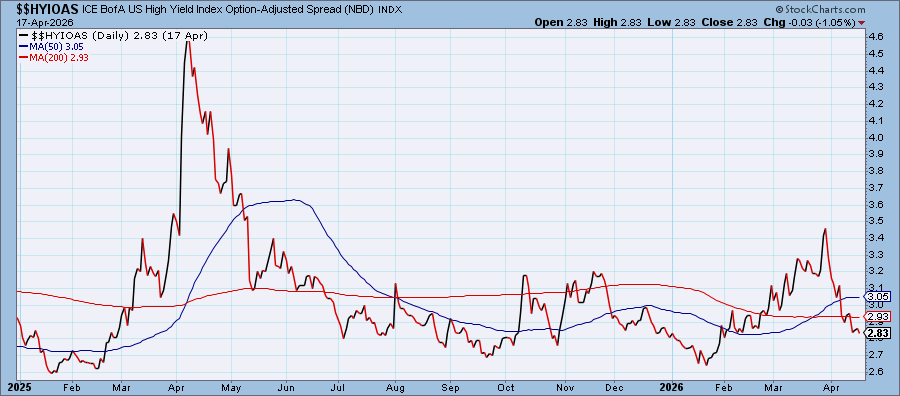
The all-important High Yield credit spreads also contracted along with the sprint higher in equities…
StockCharts
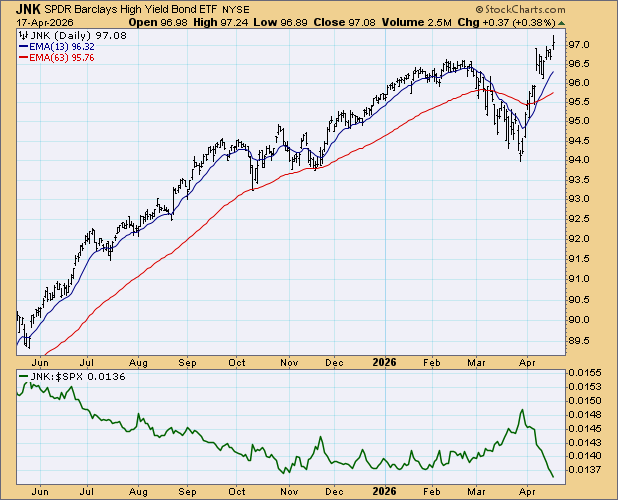
And the Junk Bond ETF jumped to a new high showing 'risk-on' sentiment hitting the credit markets…
StockCharts
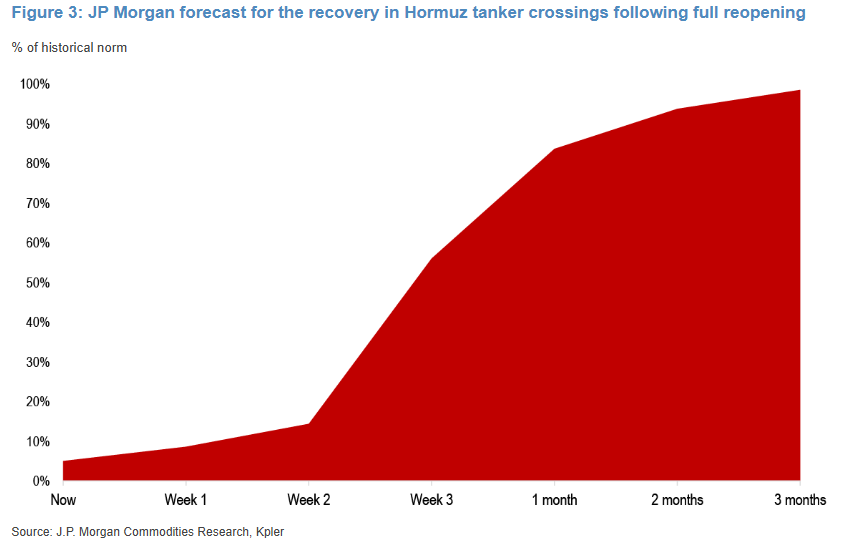
While the Strait of Hormuz was only open for a few hours on Friday, here is the timeline of how J.P. Morgan's energy team sees a full reopening happening once the peace agreement is signed…
Until now significant demand destruction has been forestalled by drawdowns in global inventories, but the race is on - OECD commercial crude inventories could fall toward operational limits by early May, and even once a deal is reached to reopen Hormuz fully it will take another 2-3 weeks for crossings to meaningfully recover and then a further 2-5 weeks for those cargoes to reach Asia, Africa and Europe.
We see a three-stage process for flows through Hormuz to ramp back up again:
Stage 1 (weeks 1-3) Cautious Reopening. We estimate 6.3 mbd of production will be restored over the first three weeks leaving supply at 6.7m bpd below pre-war.
Stage 2 (weeks 4-8) System Normalization. We assume it will take about two months for port activity to fully normalize. By end of Month 2 from reopening we expect supply still 3.4 mbd below pre-war levels
Stage 3 (months 3-4) Closing the Production Gap. By Month 3 we expect supply to have reached 1.7m bpd below pre-war, and by Month 4 we expect supply at 99% of pre-war levels.
J.P. Morgan
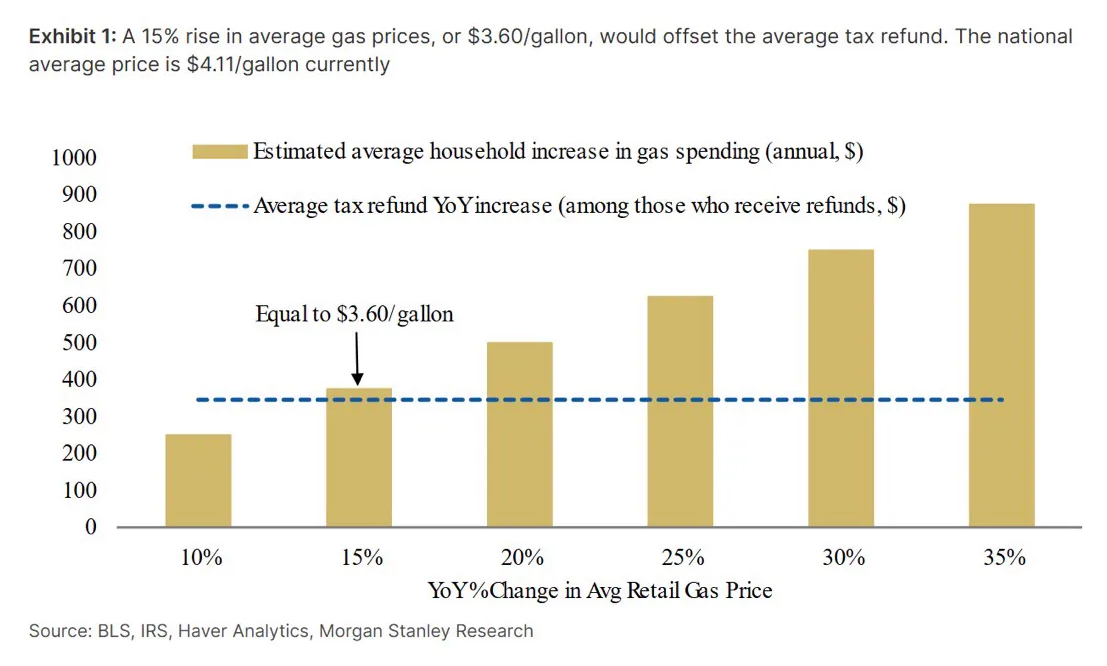
Here is how Morgan Stanley pencils the average US tax refund versus the rise in gasoline prices…
MORGAN STANLEY: “.. The rise in gasoline prices, when viewed against data on tax refunds, keeps us comfortable with our prior downward revisions to our outlook for US GDP growth.”
@carlquintanilla.bsky.social
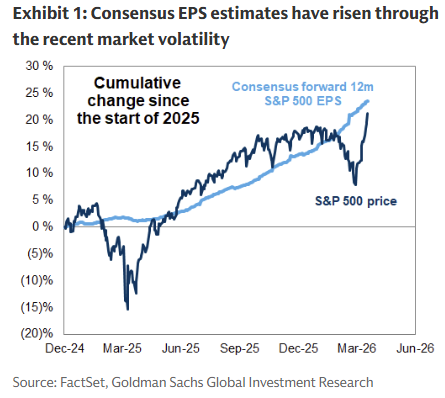
Corporate earnings growth has been a major factor in the continued interest of US equities…
Since the start of the war, consensus estimates for S&P 500 EPS in 2026 and 2027 have each risen by 3%. As a result, while the S&P 500 ended the week 2% above its pre-war January high, the current P/E multiple of 21x is 5% lower than it was in January.
Goldman Sachs
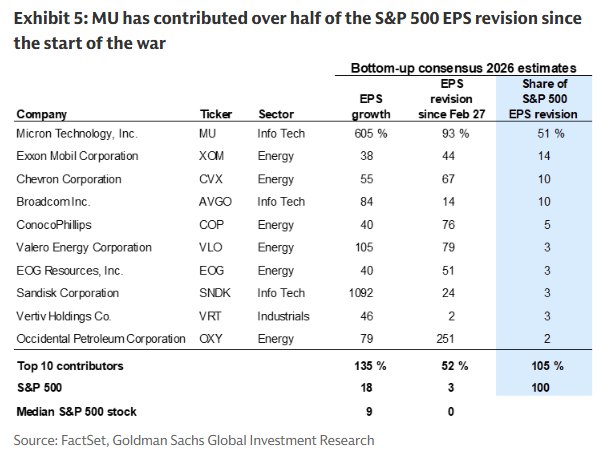
Although something to keep an eye on is the narrowness of those earnings revisions…
The increase in consensus S&P 500 earnings estimates has been driven by narrow pockets of strength. The Energy and Information Technology sectors have accounted for nearly the entire positive revision, with the median S&P 500 company experiencing no revision to 2026 EPS estimates during the past few months. Micron (MU) and Exxon Mobil (XOM) have together accounted for more than 60% of the consensus revision to S&P 500 2026 EPS estimates since the start of the war.
Goldman Sachs
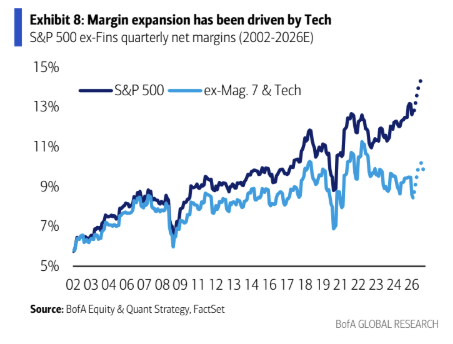
Without the Mag-7 and the Technology sector, the S&P 500 has seen little margin expansion…
Hopefully future usage of AI can change this dynamic.
BofA Global
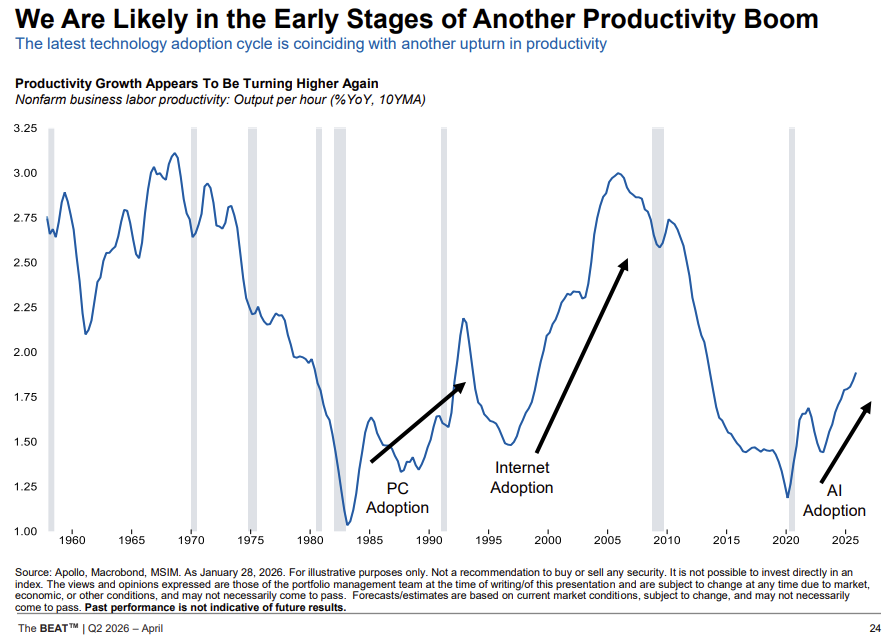
Economic data suggests that higher productivity should be occurring…
As mentioned above, very positive detail out of TSMC and ASML in last week's earnings…
Demand vs supply comments this week:
TSMC CEO: “Demand is continue to increase… still our supply is very tight… we expect it continues to be very tight"
ASML CEO: "Demand for chips is outpacing supply"
@TheTranscript_
A very good time to be in the semiconductor business, even if you do not have the leading edge chips…
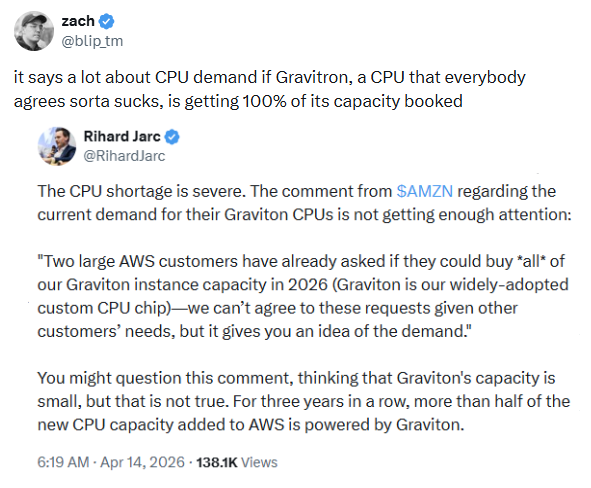
If you do make the top chips, like Nvidia and Google then you are in a position to pick who will likely win the AI race…
Nvidia’s graphics processing units, or GPUs, remain the gold standard for AI, particularly for training more advanced models. But a growing number of up-and-comers are vying to take on the chipmaker for inference uses, including by offering chips meant to cut down response times for chatbots and AI agents. Last month, Nvidia began selling a chip intended for faster inference based on technology it acquired from Groq as part of a reported $20 billion licensing deal.
Google brings unique strengths to that competitive landscape, including a decade of experience designing chips, vast resources from its online search profits and firsthand insights on AI models. Among the top AI developers, only Google makes its own chips at significant scale, allowing it to share vital feedback between teams to better customize hardware. (OpenAI is only now starting to design its own.)…
As Google’s chips become more popular, the company risks supply constraints, not unlike Nvidia. One startup executive, who spoke on condition of anonymity to discuss internal matters, said their company’s use of TPUs has been limited by availability and complained that Google had effectively given all its chips to Anthropic.
“Mostly we’re sort of favoring what supply we do have to the more elite teams who obviously are the ones that could maybe take the most advantage out of what the TPUs do best,” Hassabis said, referring to top AI firms. Going forward, Google will also need to decide how to allocate TPUs between its own growing slate of competitive AI services and its burgeoning roster of customers.
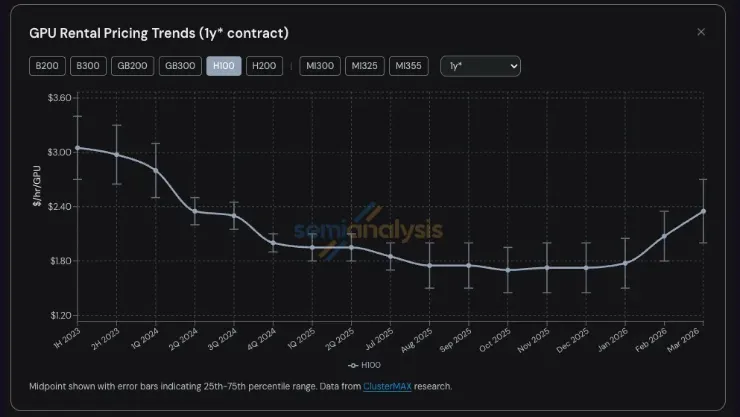
In another sign of just how tight the current market is for processing power, even older chips are seeing rising prices…
One of the biggest stories among industry experts who nerd out about the guts of artificial intelligence is the news that AI companies are scrambling to pay for more inference, which has led to a run on GPUs…
Last year, several market analysts I respect pointed out that the hyperscalers were forking over lots of cash for computer chips, or GPUs, that might rapidly lose their value as superior chips came on the market in subsequent years. As Paul Kedrosky put it memorably, these companies were filing financial reports as if these chips would retain their value for decades, like a bar of steel; but if companies had to buy new chips every two or three years, then the value of the hardware was closer to a banana, a fruit that begins browning almost the second I take it out of the grocery bag. If GPUs were more bananas than steel, then the AI hyperscalers would have a big problem: They’d have to replenish their data centers with new expensive chips faster than their depreciation schedules anticipated, which would eventually eat into earnings and destroy operating income.
Except, the opposite is happening. “There’s been a run on GPUs,” the folks at SemiAnalysis reported last week. “Trying to find GPU compute in early 2026 has been like trying to book airplane tickets on the last flight out, high prices, and almost no availability.” Old chips don’t look like bananas, and they might be even better than a steel bar. Demand for legacy chips—the graph below shows the Nvidia H100s, released in 2022—is growing as knowledge workers gobble up tokens to write code, make PowerPoints, and do research.
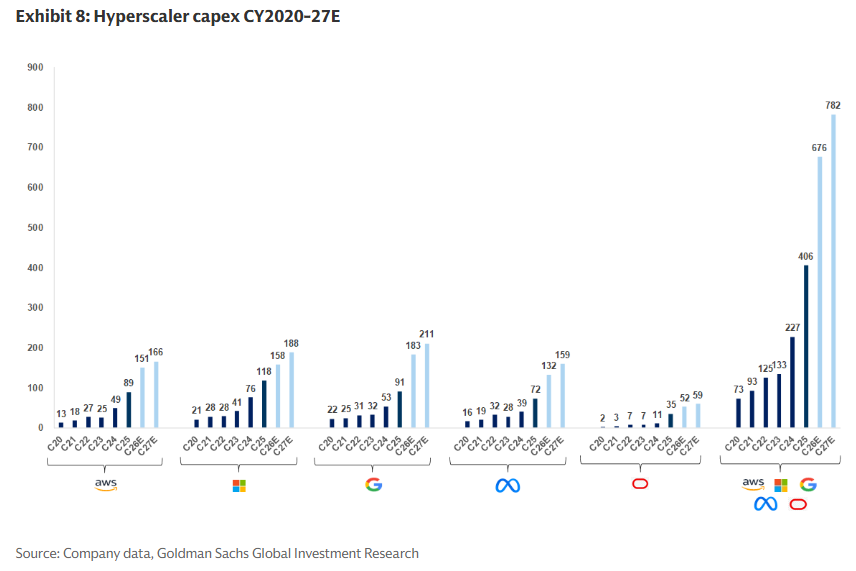
Here is an updated hyperscaler capex chart…
I will pick the over on the 2027 figure. And not just because I built my first agent last week.
Datacenter capex from leading public hyperscalers is now approaching ~$700 bn USD, roughly 10X the level in 2020. In fact, consensus capex estimates were revised higher yet again with the most recent set of earnings reports, with the bottom-up aggregation of 2026 GS capex estimates for the leading hyperscalers now 14% higher relative to the start of 4Q25 earnings. GS analysts now expect 67% yoy growth in capex in 2026, and 16% in 2027 (Exhibit 8).
Goldman Sachs
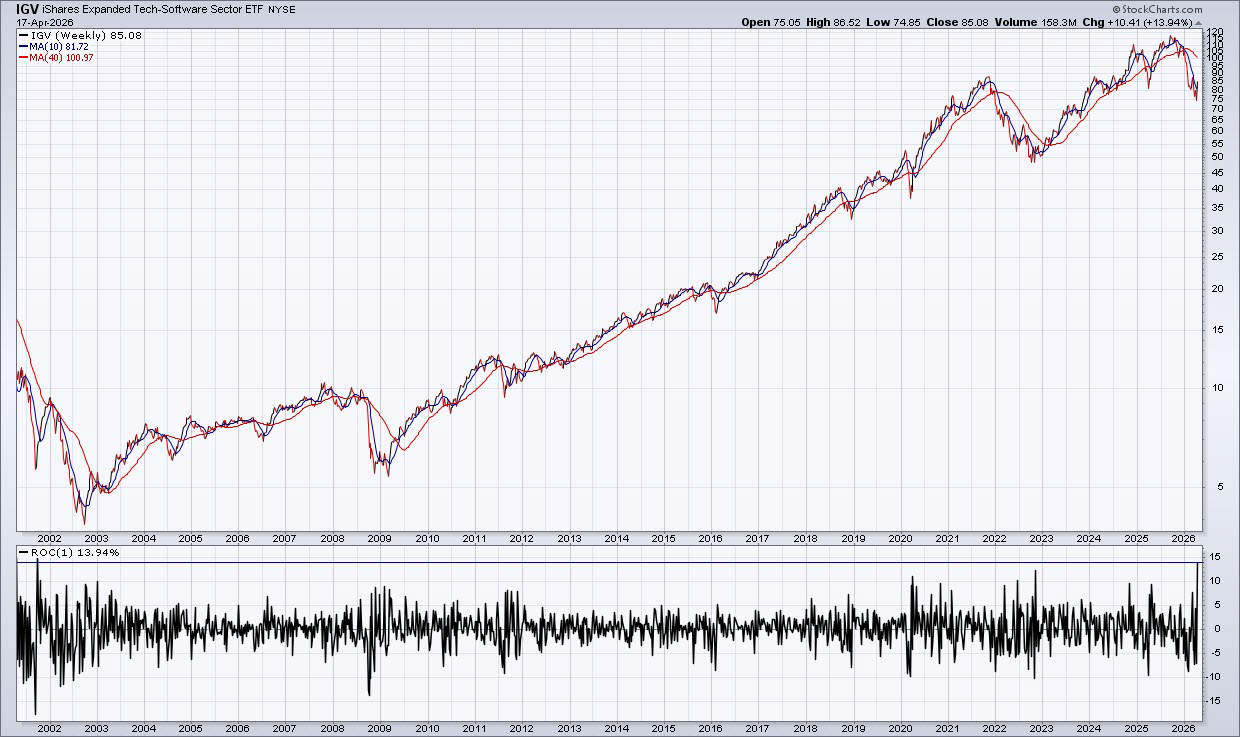
The biggest weekly move in 25 years…
Software company valuations have been under pressure from the threat of AI. Investors drew a line in the sand last week as the selling paused and the buying accelerated. Maybe all of those software tools will retain their value in a world of AI agents?
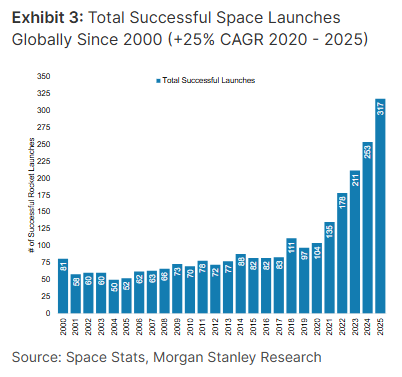
Space: the final frontier…
Space tech continues to be hot as SpaceX's Starlink and Amazon/Globalstar race to launch 10,000+ broadband satellites to communicate with your cellphone and other devices. Expect to see many versions of this chart in a certain future IPO roadshow deck.
Morgan Stanley
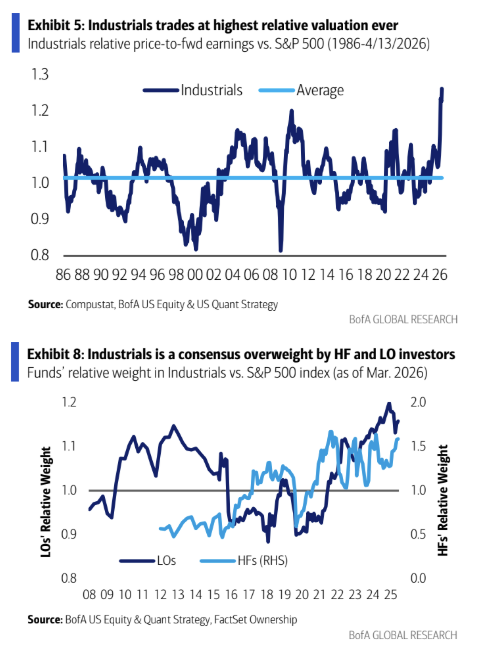
If you have an industrial company in your portfolio that you are not married to, then now is the time to explore your options for it…
BofA Global
In related news, Madison Air becomes the largest Industrial company IPO in 27 years…
Madison Air Solutions Corp. raised $2.23 billion in the biggest US listing of an industrial company in close to three decades.
The Chicago-based provider of ventilation and filtration systems sold 82.7 million shares at $27 each after marketing them for $25 to $27, according to a statement Wednesday. The offering was multiple times oversubscribed, people familiar have said.
The pricing gives the company a market value of $13.2 billion based on the number of outstanding shares listed in its filings…
The IPO is the biggest by an industrial company in the US since United Parcel Service Inc. went public in a $5.5 billion listing in 1999, according to data compiled by Bloomberg. It’s the latest, and largest, in a series of debuts from companies in the sector with a tie to the data-center boom.
Other IPOs which launched last week had equally good, if not better receptions than Madison Air…
Aevex Corp (AVEX) +90% after IPO at $20 (defense technology systems)
Alamar Biosciences (ALMR) +30% after IPO at $17 (protein biomarker detection)
Arxis Inc (ARXS) +30% after IPO at $28 (aerospace and defense supply chain components)
Kailera (KLRA) +60% after IPO at $16 (obesity biotech)
Madison Air Solutions (MAIR) +25% after IPO at $27 (HVAC product manufacturer)
The warm receptions to last week's slate and the bounce in the markets sent many other companies to join in and file their IPOs…
Cerebras Systems - AI chip startup
Fervo Energy - geothermal energy
GMR Solutions - emergency medical services
Inspire Brands - Dunkin' Donuts, Arby's & Jimmy John's
Suja Life - Cold pressed juices
And over the last week in $1b+ M&A news: the markets saw $60 billion plus in deals over 14 transactions which will remove 8 public tickers from the global stock exchanges and put 5 private companies into other hands…
- U.S. construction supplies distributor QXO (QXO) will acquire commercial roofing firm TopBuild (BLD) for about $17 billion. QXO said TopBuild's shareholders can elect to receive $505 in cash or 20.2 shares of QXO common stock for each TopBuild share held on the condition that the total transaction is paid as about 45% in cash and 55% in shares of QXO common stock. The $505 cash consideration represents a premium of 23.1% over TopBuild's last close. QXO has market capitalization of around $18.08 billion, while TopBuild has a market capitalization of around $11.54 billion.
- Amazon.com (AMZN) is buying satellite operator Globalstar (GSAT) in a deal the companies estimated at about $10.8 billion, seeking to build a business connecting consumer smartphones with satellite internet connections. The deal would give Amazon’s Leo satellite venture a boost as it vies with SpaceX’s dominant Starlink network. Globalstar stockholders will choose to receive either $90 a share in cash or 0.3210 share of Amazon common stock per Globalstar share with a value capped at $90 a share.
- Eli Lilly (LLY) to acquire Kelonia (private) for up to $7B in cash, including $3.25B upfront and additional payments tied to clinical, regulatory and commercial milestones. Kelonia aims to treat patients with a form of blood cancer called multiple myeloma who aren’t responding to treatment or saw their cancer return.
- Real estate investment trust Choice Properties (CHP/Canada) and private-equity firm KingSett Capital will acquire First Capital REIT (FCR/Canada) in a cash-and-stock deal worth about C$9.4 billion ($6.85 billion) including debt. This represents an 11.7% premium to First Capital's closing price.
- USA Rare Earth (USAR) agreed to buy Brazilian rare earths miner Serra Verde for $2.8 billion, adding another company to its expanding mining, processing and magnet-making portfolio. USA Rare Earth will pay $300 million in cash and 126.9 million in its own newly issued shares for Serra Verde.
- Agnico Eagle Mines Ltd. (AEM) plans to spend C$3.7 billion ($2.7 billion) to acquire three gold projects in northern Finland, expanding the Canadian miner’s footprint in the Scandinavian country. The Toronto-based company will buy Rupert Resources Ltd. (RUP/Canada) and Aurion Resources Ltd. (AU/Canada), and separately purchase B2Gold Corp.’s (BTO/Canada) 70% stake in an exploration joint venture with Aurion. The transactions are aimed at consolidating Agnico’s position Finland, where it already owns Kittila — Europe’s largest primary gold mine.
- Sila Realty Trust (SILA) to be acquired by affiliates of Blue Owl in $2.4B cash deal at $30.38/shr. Price represents a 19.0% premium to last close. Sila Realty is a Triple Net Lease REIT focused on healthcare. Following the deal’s close, Sila will become a private company. Cancel the Q1 earnings call.
- ESCO Tech (ESE) agreed to acquire Megger from TBG for $2.35B, consisting of $0.9B cash and about $1.4B in equity. Valuation is about 14x projected 2026 EBITDA including synergies. Megger provides testing, monitoring, software, analytics, and data-driven solutions for utilities and critical electric infrastructure. Expected 2026 revenue is about $590M.
- Austrian bank Bawag (BG/Austria) and Permanent TSB (PTSB/Ireland) have agreed on a takeover deal that values the Irish retail lender at 1.62 billion euros ($1.90 billion). PTSB, which is majority owned by the Irish government and competes with larger peers AIB Group and Bank of Ireland, put itself up for sale last year to allow the finance ministry to exit its remaining 57.5% position.
- Nippon Express Holdings Inc. (9147/Japan) will acquire Canada-based Metro Supply Chain Group for as much as C$2.2 billion ($1.6 billion) to strengthen its logistics presence in North America. The agreement includes the purchase of the company at an enterprise value of C$1.8 billion, plus a payment of as much as C$400 million in cash.
- Diginex Ltd (DGNX) will acquire Resulticks Global Companies Pte Limited in an all-share transaction valued at $1.5 billion. The deal will be paid entirely in Diginex shares at $1.32 per share. Resulticks, described as a provider of real-time, AI-driven customer intelligence solutions.
- Brady Corp. (BRC) agreed to acquire Honeywell International’s (HON) productivity solutions and services business for $1.4 billion. The all-cash transaction would include Honeywell’s hardware, software and services for high-volume, automated data collection and tracking in mobile computers, barcode scanners and printing, the companies said Monday.
- Uranium Royalty Corp. (UCO/Canada) agreed to buy Sweetwater Royalties for about $1.1 billion in a deal that would create a new US-listed company to capitalize on growing demand for nuclear fuel. Including debt, the acquisition implies an enterprise value of $1.9 billion for Sweetwater. Sweetwater owns roughly 4.5 million mineral acres across Wyoming, Utah and Colorado, including a major position in trona, a key input for soda ash used in glass, chemicals and batteries.
- Avanos Medical (AVNS) acquired by American Industrial Partners for $25/shr at ~$1.272B enterprise value. Stockholders to receive $25.00 per share in cash, a 72.1% premium to the April 13, 2026 closing price.
Various News Sources
Three cheers for Holland, Michigan's blooming tulips and battery factory…
Batteries were always crucial for the effort to scale up renewable energy production, but they have taken on even more significance as AI leaders look for quick-to-build power sources to supply their headlong data center expansion.
That’s why batteries will account for some 28 percent of new U.S. power plant capacity built this year. For the first time, the country will be able to produce enough grid batteries to meet that surging demand on its own, according to new data from the U.S. Energy Storage Coalition, an industry group…
By the end of 2025, U.S. factories had mustered the capacity to produce about 70 gigawatt-hours of finished grid storage systems each year, according to the coalition’s survey. Roberts expects that number to rise to 145 gigawatt-hours by year’s end. U.S. storage developers are likely to install about 60 gigawatt-hours annually this year and next, he noted, so the country will actually have a sizable surplus in manufacturing capacity.
As for the underlying cells, it’s a similar story with a slight delay. By the end of 2025, 20 gigawatt-hours of dedicated storage cell lines had opened, and the industry is on pace to hit 96 gigawatt-hours by the end of this year…
The development of U.S. grid-battery manufacturing has happened at a dizzying pace. Roberts called it “one of the fastest industrial scale-ups in recent American history.”
At the close of 2024, the U.S. had “effectively zero” factory capacity for battery cells designed for grid usage, which have different specifications than those in electric vehicles and which typically use the lithium iron phosphate chemistry.
LG Energy Solution Vertech, the grid-storage subsidiary of the Korean industrial giant, started turning things around last summer when it completed a dedicated cell production line for grid storage in Holland, Michigan. The company originally envisioned four gigawatt-hours of production, but quickly expanded that to 16.5 gigawatt-hours, said Chief Product Officer Tristan Doherty. Now LG plans to hit 50 gigawatt-hours of cell production capacity across North America this year.
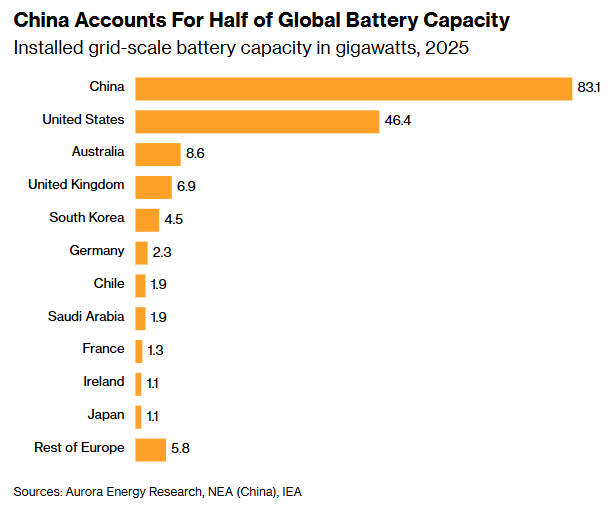
And not just in the US, but global grid battery deployments are surging worldwide…
Around the world, a wave of mega installations batteries are lining up to be connected to the grid this year — from solar hubs in Texas to grasslands in Inner Mongolia and the site of a former coal plant north of Sydney.
Falling costs and soaring energy demand from data centers had already set the stage for rapid growth. The war in the Middle East has helped accelerate the trend by lifting demand for alternatives to expensive fossil fuels, setting 2026 up to be the year batteries become influential in the global energy system…
“We’ve now crossed into a point where anytime anyone is looking at investing in the power system, batteries are one of the most attractive options,” said Brent Wanner, head of the power sector unit at the International Energy Agency. “Battery storage systems will continue to grow for the foreseeable future.”
In markets flooded with solar and wind — technologies that have been built out significantly since the last energy crisis in 2022 — battery operators can buy electricity when it’s cheap and sell it when demand peaks. Where grids once relied on coal and gas when renewable output dipped, storage technology is now becoming cheap and fast enough to make a difference in how the grid functions. Average costs have dropped by around 75% from 2018 to 2025, according to BNEF, and are expected to tumble another 25% through 2035.
It feels like the void to bring Chinese EVs into the US is growing exponentially…
Can Ford find a way to make it happen or will it be another global car brand that does it?
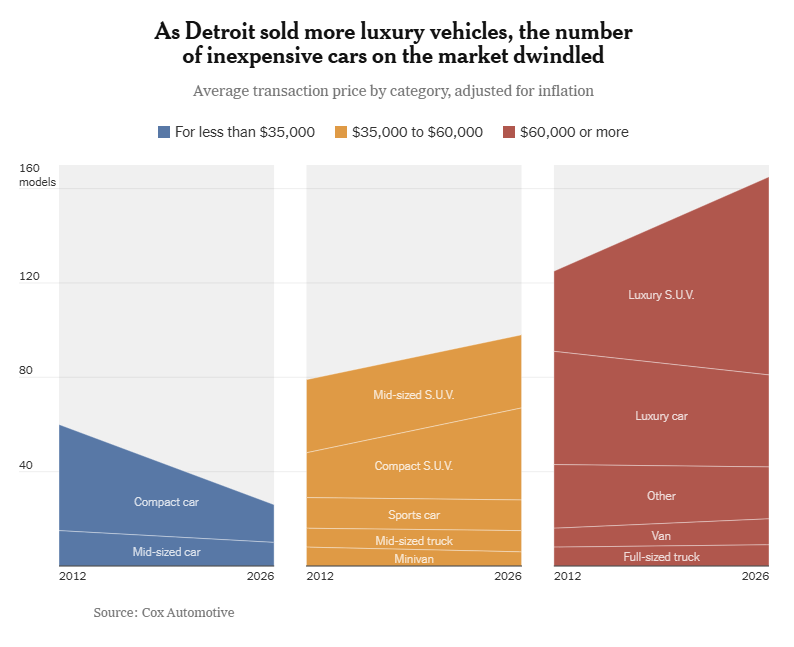
The average transaction price for a new car now sits around $50,000. In December it became just about impossible to find one for less than $20,000.
A Honda Civic Hatchback? Most start at $28,000. The Civic Hatchback Sport Touring Hybrid costs more than $33,000. How about the Chevy Trailblazer? On most lots, its price tag approaches $25,000. The Toyota Corolla? The Hybrid trims start around $26,000. Forget the Chevy Malibu; it was discontinued last year.
While politicians and economists scratch their heads at voters upset about affordability in a decent economy, they seem to somehow miss the fact that for most Americans, the purchase of a car has become a debt sentence…
What happened? How did a basic necessity of American life become a luxury good? We have to start with a transformation of the economy itself, beginning in the late 1970s. While hourly compensation for the typical worker remained nearly stagnant, huge stock market bull runs and rising home equity have enriched the most affluent households. Today there are so many wealthy people who can afford luxury cars that it simply isn’t that profitable for companies to produce cars for the bottom 40 percent of Americans by income…
There is one obvious way to bring more inexpensive cars into the American market: If the Trump administration lifts the embargo on EVs and hybrids made by Chinese automakers and sold worldwide, the number could rise to 11.
Those Chinese cars aren’t just cheaper than the American alternatives. They’re often better. Take BYD’s slightly more upscale Seal sedan. It’s similar to Tesla’s Model 3, introduced nine years ago. But the Seal costs roughly $20,000 less than the Model 3. The Seal’s premium model offers substantially more horsepower, and its battery not only lasts longer but can also be 80 percent charged in just 37 minutes. The Seal isn’t just a budget alternative; it is a more advanced machine.
We have just passed peak high school graduation numbers. Many implications for this new trend moving forward…
The “demographic cliff” is upon us. The number of teenagers graduating from American high schools peaked last year. It will begin declining this spring and keep falling steadily through at least 2041. The trend is more of a downward slope than an abrupt falloff, but the gradient is steep and represents a crisis to colleges dependent on filling classroom seats and dorm beds. The United States currently has about 4,000 colleges. According to a recent study from the Federal Reserve Bank of Philadelphia, about 60 are closing on average each year; that number could double in any given year if the bottom falls out of enrollment.
If the harm were only to the institutions forced to close because they’re running out of customers, that would be unfortunate but not tragic. But the causality runs in the other direction too, as students who otherwise would have gone to college find themselves with no viable option in the place where they live. American higher education has long consisted of two markets: one where high-achieving, typically affluent students compete for seats at national universities, and one where mostly middle- and lower-income students stay closer to home. Members of the first group will be fine even as college closures accelerate. The second group will suffer. After many decades of democratization, higher education could once again become a luxury good…
When enrollment falls, campuses shut down. And when campuses disappear, enrollment falls further, because the local students most likely to attend those institutions lose a nearby option. A vicious cycle emerges, and the worry is that the demographic cliff combined with campus closures will drive the number of college-going students only further downward. “When you close the campus, you lose the students who would have gone there,” Hillman said.
Learn more about the Hamilton Lane Strategies
DISCLOSURES
The author has current equity ownership in: Nvidia Corp. and Alphabet Inc.
The information presented here is for informational purposes only, and this document is not to be construed as an offer to sell, or the solicitation of an offer to buy, securities. Some investments are not suitable for all investors, and there can be no assurance that any investment strategy will be successful. The hyperlinks included in this message provide direct access to other Internet resources, including Web sites. While we believe this information to be from reliable sources, Hamilton Lane is not responsible for the accuracy or content of information contained in these sites. Although we make every effort to ensure these links are accurate, up to date and relevant, we cannot take responsibility for pages maintained by external providers. The views expressed by these external providers on their own Web pages or on external sites they link to are not necessarily those of Hamilton Lane.