
Weekly Research Briefing: Summer's Last Call

This Labor Day weekend will close out the summer of 2026. Time to exchange the swim trunks and hiking boots for lunch pails and stadium seats. For the markets, this is the final stretch of the year for portfolio managers to beat their performance targets and for bankers to close their M&A deals and launch their IPOs. The year-end holidays will be here in no time helped by a midterm election landing right in the middle followed soon after by Thanksgiving. Bottom line, expect an incredible amount of corporate finance activity in September and October.
Last week was an interesting one highlighted by Nvidia's blowout earnings which drove much of the AI tech universe higher. Even software stocks jumped, pushing their indexes back into the green for 2026. There was some further intrigue in the Treasury markets as Stan Druckenmiller called out his former co-worker regarding poor decision-making at the US Treasury. And then on Friday in Wyoming, Fed Chairman Kevin Warsh spent some time at the microphone shooting a few doves which sent the 2-year yield sprinting higher. But with only one FOMC meeting before the November midterm elections, do you really think that he will favor a rate hike? We will have to see what this week's jobs data and the next inflation reads have in store.
While the temperatures and morning sky still suggest summer, it sure didn't feel that way when I completed my analysis of private market monetization activity over the weekend. While not scientific in anyway, my month-end internal look at all of the M&A, IPO and new funding round activity across our multiple evergreen portfolios ran to an all-time high. It was surprising to me given that August is usually a slow time on the calendar. If the geopolitical and macro markets hold steady, the next four months of 2026 should easily set some corporate finance records. Even today we saw AON plc bulk up by buying a top 10 insurance broker and SLB Limited expand its oilfield services and drilling business further into the data center cooling business. Both the equity and credit markets remain in a perfect environment for corporations to make strategic moves or raise capital.
Enjoy your last summer holiday weekend. The WRB team will also take a break next week to enjoy that final sunset. See you in a couple weeks.
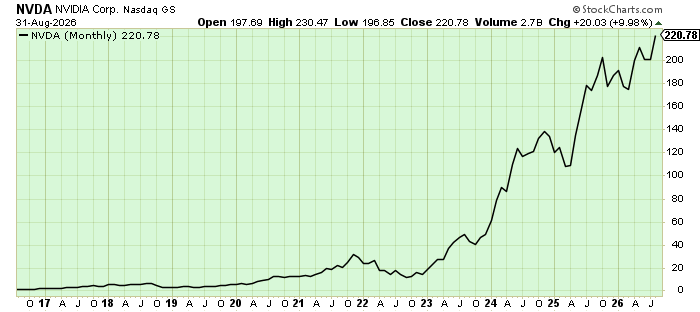
Just a $5 trillion market cap company guiding to 70% forward revenue growth versus the 45% that Wall Street was expecting…
The main current constraint to growth is memory chip supply. But if there is one company that is going to get the largest allocation, you can guess which one that will be.
StockCharts
As Nvidia said on the call, there are now twenty AI services companies with revenues >$1B…
“Nearly 20 companies, including Cursor, owned by SpaceX, Figma, and Together AI, now exceed $1 billion in annualized run rate revenue, up from 13 companies in Q4 of last year, with vertical enterprise software logging the fastest growth” - NVIDIA CFO Colette Kress
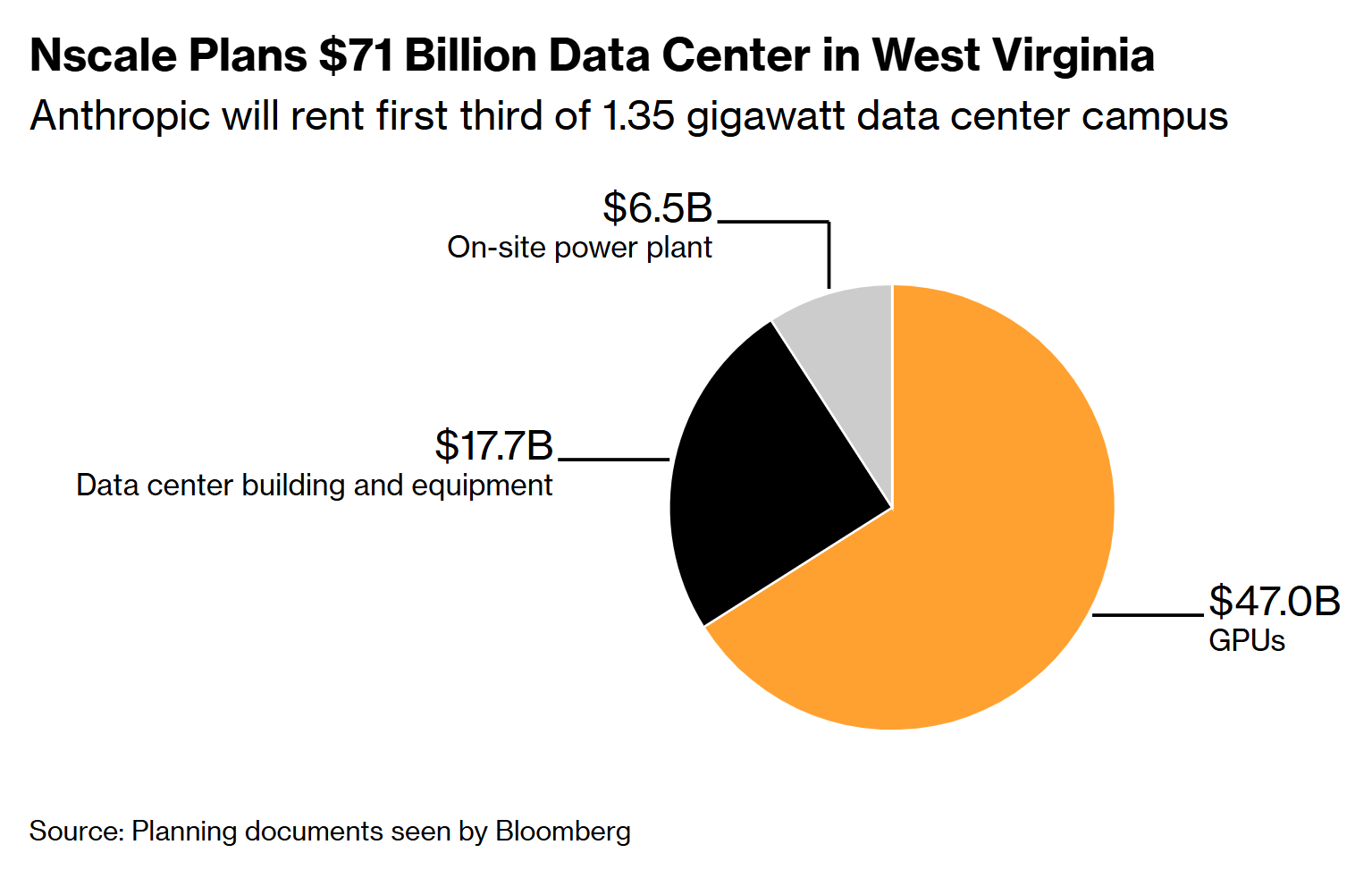
Some good insight into one of the biggest new data centers planned for West Virginia…
Nscale will use Nvidia Corp.’s Vera Rubin chips, which will start to come online late next year, to meet Anthropic’s needs, according to people familiar with the agreement. The commitment is over six years, and represents about 460 megawatts of power, said the people, who asked not to be named discussing a private deal. That amount of electricity is enough for about 345,000 US homes at any one time…
The deal with Anthropic is for the first of three buildings at Nscale’s Monarch campus in West Virginia, which will total about 1.35 gigawatts when complete. Developing the full campus and on-site power plant will cost the company about $71 billion, according to planning documents. The largest chunk of that, $47 billion, comes from the AI chips. Servers at the other buildings will begin providing power in 2028, the people said…
Once operational, the full data center complex will directly employ about 645 people at the site and create about 3,600 more jobs across the state indirectly, according to the planning documents. Construction at the site will directly employ 4,375 people.
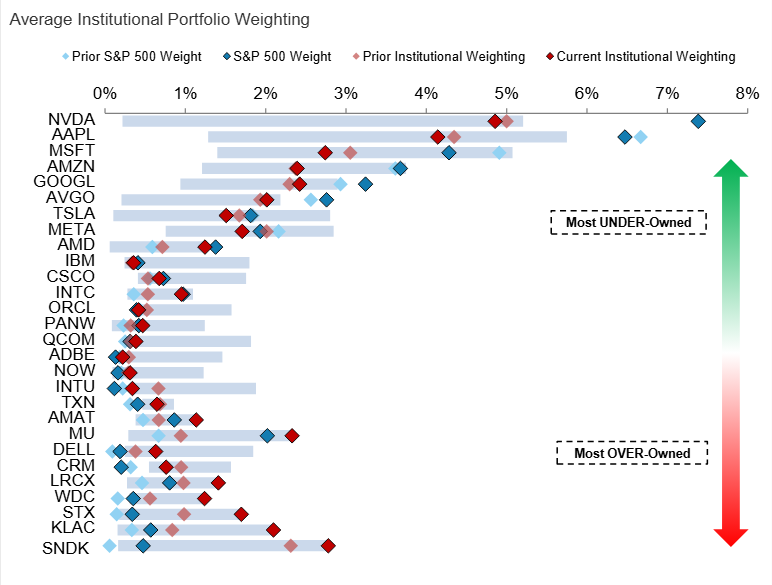
With Nvidia EPS of $30 possible in 2029, it could be a career defining move for a large cap portfolio manager to underweight the shares versus their index? But many are doing it.
Mega-cap Tech remains under-owned relative to its S&P 500 weighting, with under-ownership widening modestly during the quarter. (Source: Factset, Morgan Stanley Research, Note: Based on 13-F filings for the period from 1Q09 to 2Q26.)
Morgan Stanley
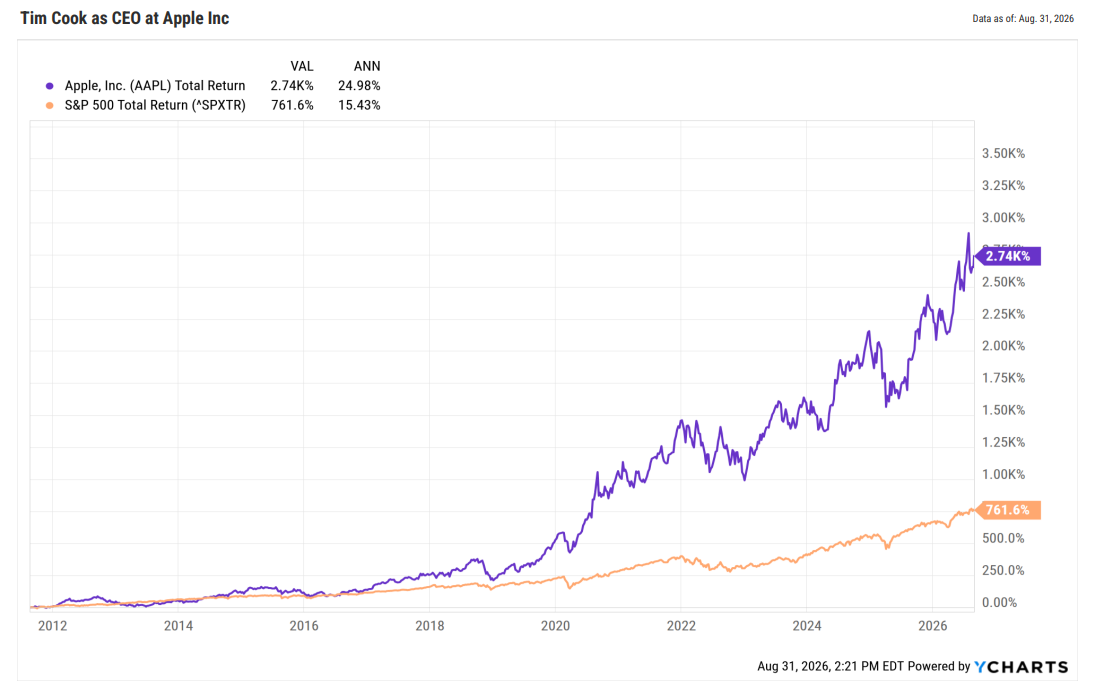
Speaking of big cap tech moves, Tim Cook clocks out with a near 25% annual total return rate…
Ycharts
After a 30% drawdown to start the year, the big Software index is back into positive territory for 2026…
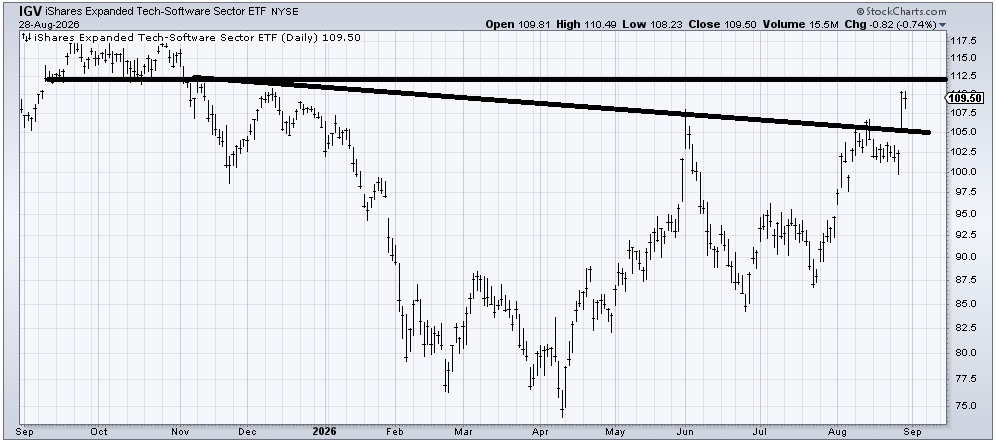
@hmeisler.bsky.social
Speaking of big moves, did you see what the South Korean NPS posted for their H1?
South Korea’s National Pension Service reported a 27.2% return in the first half of the year, its best performance for the period since at least 2022, as a powerful domestic equity rally boosted performance at one of the world’s biggest pensions.
The asset class breakdown for the H1:
Domestic Korean stocks: +107.4%
Overseas stocks: +17.8%
Alternatives: +9.6%
Foreign bonds: +9.2%
Domestic bonds: -3%
Fed Chair Kevin Warsh didn't say that a rate hike was in the cards at Jackson Hole, but the market did increase the odds that it would happen…
Now the question is timing. Do you really think that he will argue for it ahead of the midterm elections? The November or December meeting seems like an easier move.
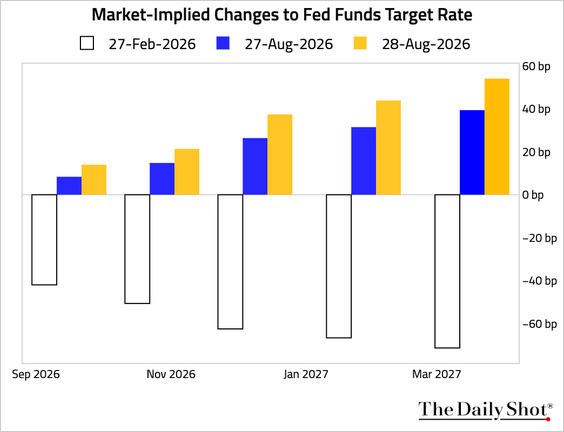
Two-year Treasury yield tells us that a rate hike (or hikes) is coming…
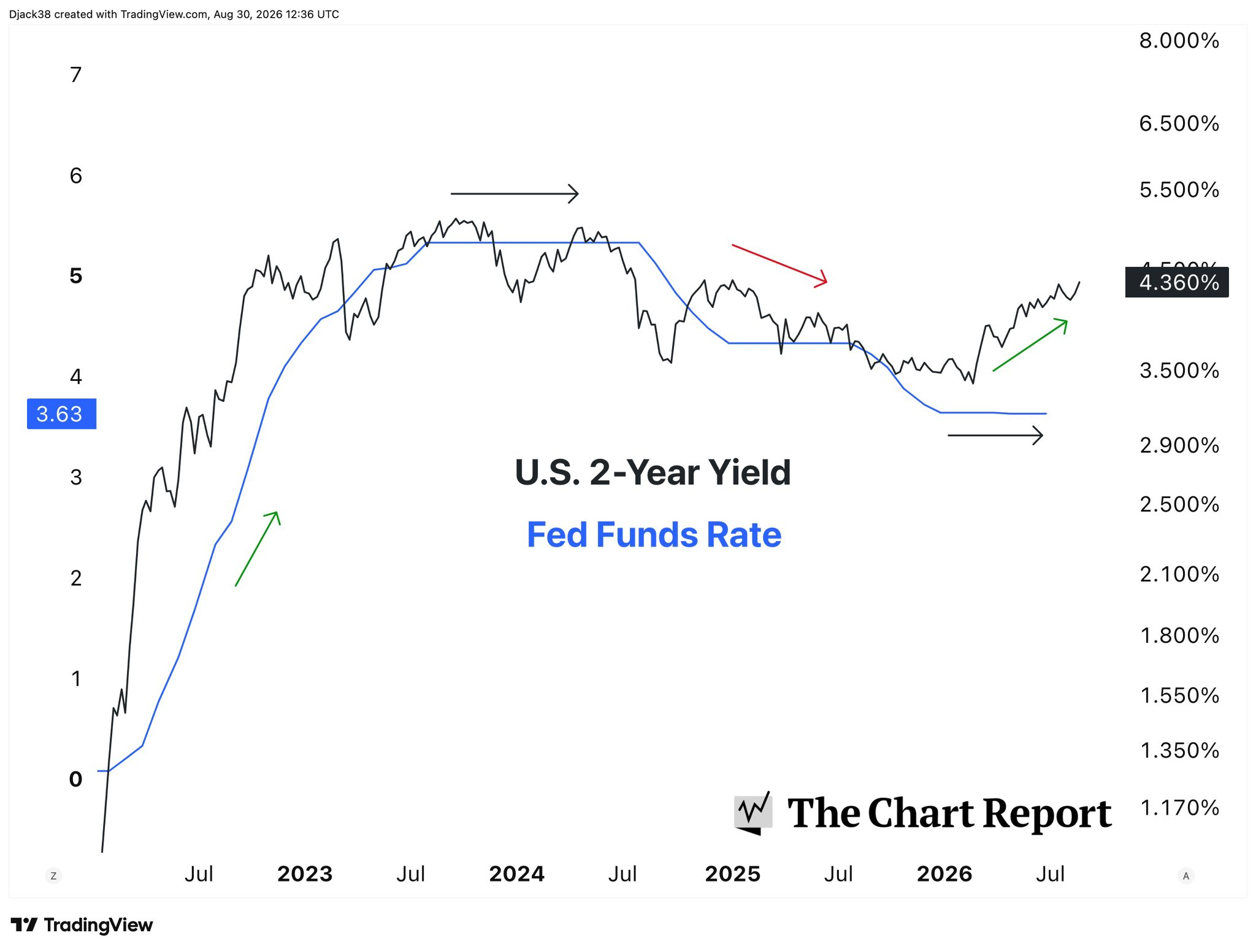
@TheDonInvesting
Legendary investor and concerned US citizen, Stan Druckenmiller, has some strong opinions on the US Treasury's new short-sightedness…
"If the 30-year must trade at 5.5% to clear, that isn’t a crisis. It is an invoice. Then do the only thing that durably lowers long-term yields: address the primary deficit. Reform entitlements gradually and honestly, through means testing, indexing changes, eligibility adjustments phased in over decades—so that the burden is shared across generations instead of dumped on the youngest.
The reward is enormous: A credible fiscal package would do more for the long end of the curve than a buyback program 1,000 times this size.
Governments defending prices against fundamentals always lose. The only variable is how much they spend before conceding. The U.S. shouldn’t put itself on the wrong side of that trade, not with the most important price in the world, and not when that price is trying to say the one thing Washington most needs to hear: Let the bond market speak.
Duquesne Capital Founder Stanley Druckenmiller
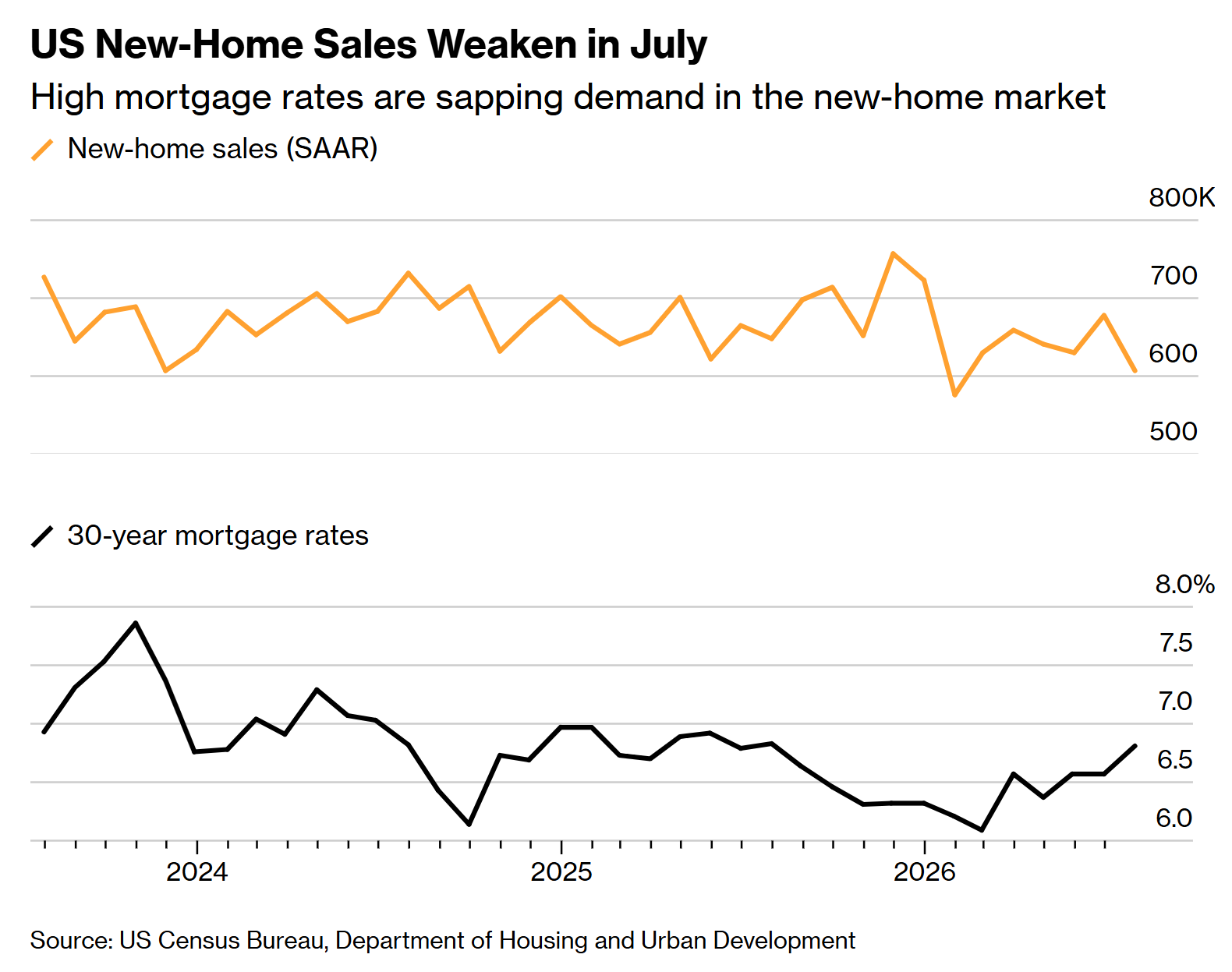
Higher interest rates continue to show themselves in the weakening US housing market…
US new-home sales declined in July to a six-month low, indicating higher mortgage rates are curbing demand even as builders trim prices and offer incentives.
Contract signings on new single-family homes decreased 10.5% last month to a 607,000 annual rate, according to government figures released Tuesday…
Sales have fallen in three of the last four months, adding to evidence of a housing market burdened by elevated finance costs and prices. While builders have had some success bolstering demand with free upgrades, mortgage rate buydowns and price reductions, the entry-level market remains affordability-constrained.
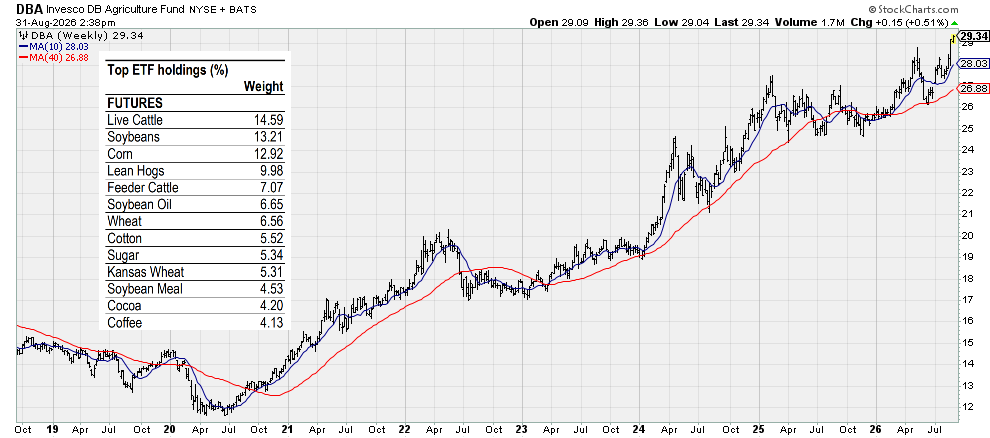
Meanwhile, grain and agriculture prices are popping like corn…
Crop prices are set to cap their biggest monthly jump in more than a decade as wars and extreme weather disrupt supplies, raising concerns about food inflation.
The Bloomberg Agriculture Spot Index, which tracks 10 major products, is up more than 13% in August as of Friday, heading for the steepest gain since July 2012. Wheat has been one of the biggest drivers, with prices recently reaching a three-year high as Black Sea port attacks slash shipments from a major growing region. Sugar and cocoa are also up about 20% as a strengthening El Niño fuels weather worries.
While it can take time for pricier crops to feed through to supermarket shelves, the gains come on top of rising energy and transport bills driven by the war in Iran. That’s fueling worries about the cost of everyday pantry staples from bread to meat and dairy…
Poor weather has been an additional headache, with US and European corn harvests both hit by summer heat waves. A powerful El Niño is also set to pose risks to crops into next year. That has boosted commodities like cocoa, with concerns over how the weather phenomenon will impact crop development in the top growing region of West Africa.
The entire agricultural index looks to be on the run according to the top ETF in the space…
StockCharts
But recently rising grain prices will not be enough to help US farmers get profitable anytime soon…
“This is the worst financial downturn in the sector since the 1980s,” said John Hansen, president of Nebraska Farmers Union.
A recent study by the American Farm Bureau Federation, an industry group, found that, without government assistance, farmers growing nine principal crops — including corn — will lose $31bn this year and $32bn in 2027.
Faith Parum, an economist with the AFBF, said losses for corn producers would stand at $131 per acre this year, rising to $167 in 2027. For soyabeans, the figure is $80 per acre in losses this year and $138 next year. She said 2027 would mark the sixth year of negative returns for most major row crops in the US…
“The [Iran] war has made so much uncertainty for us as farmers,” said Pam Johnson, who farms in northern Iowa and is a former president of the National Corn Growers Association. “It’s projected that farmers aren’t going to make any money for the next two years.”
The average cost for diesel — widely used to power agricultural equipment — has shot up to $5.45 a gallon nationwide, compared with $3.81 before the war, according to the US Energy Information Administration.
Interest payments, labour costs and the price of farm machinery had also increased, said Brad Lubben, a professor of agricultural economics at the University of Nebraska-Lincoln.
“If you look at all the components of the production budget, most of them have gone up substantially over the past few years,” he said.
Drought and hot, dry conditions across the US corn belt have compounded some farmers’ woes.
John Dittrich, who grows corn and soyabeans near Meadow Grove, Nebraska, said extreme weather was a growing problem.
“Our droughts are worse, our heavy rainfall events are worse, our winds are worse.”
Dittrich said the risk to his business from weather events and rising costs was “higher than it’s ever been in my 44-year career”.
“Our costs of production are very high and then the instability and the unknowns of every variable that affects both our production and the prices we receive for our commodities are just unprecedented.”
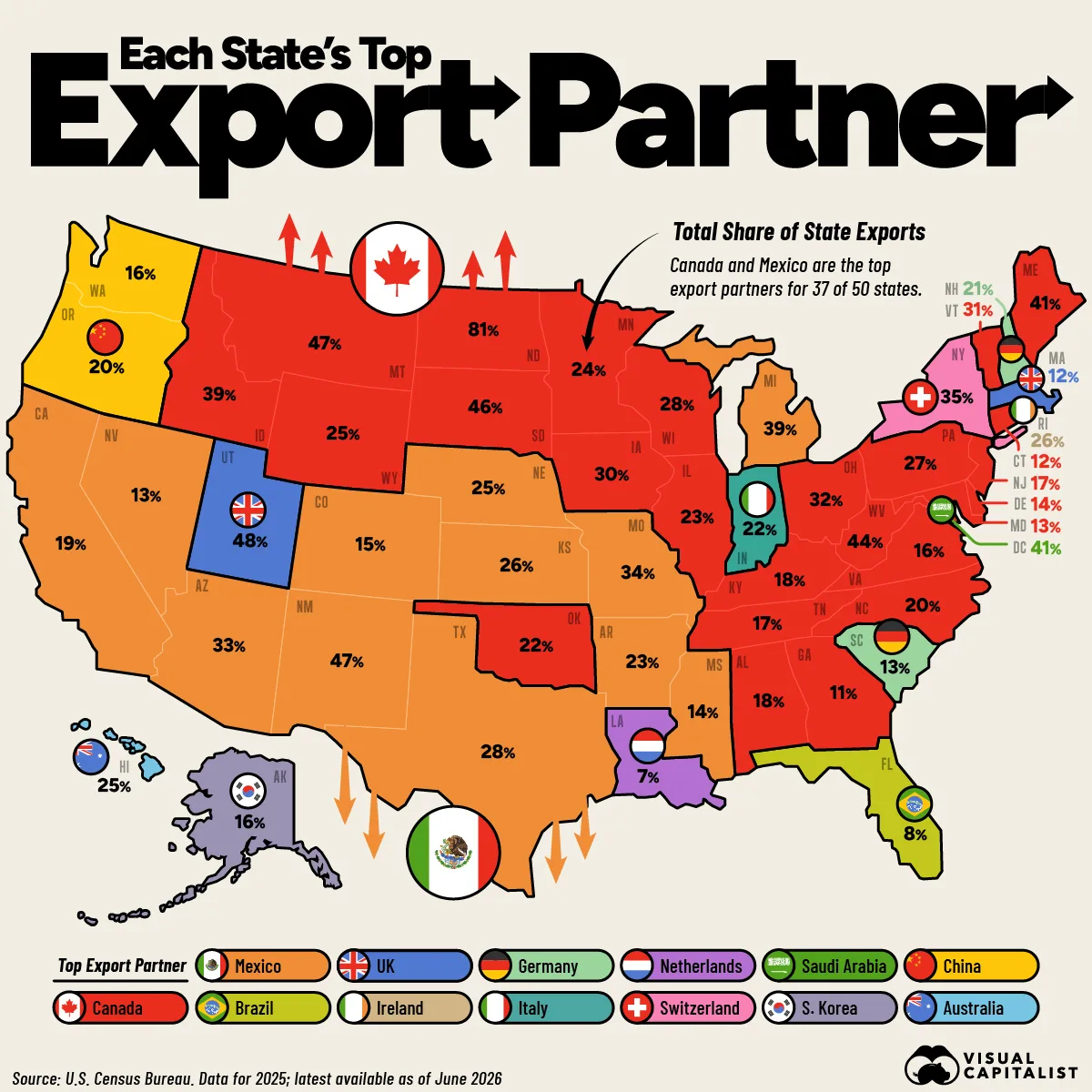
With US & Canada trade relations damaged, the red states below will be adversely affected…
Learn more about the Hamilton Lane Strategies
DISCLOSURES
The author has current equity ownership in: Nvidia Corp.
The information presented here is for informational purposes only, and this document is not to be construed as an offer to sell, or the solicitation of an offer to buy, securities. Some investments are not suitable for all investors, and there can be no assurance that any investment strategy will be successful. The hyperlinks included in this message provide direct access to other Internet resources, including Web sites. While we believe this information to be from reliable sources, Hamilton Lane is not responsible for the accuracy or content of information contained in these sites. Although we make every effort to ensure these links are accurate, up to date and relevant, we cannot take responsibility for pages maintained by external providers. The views expressed by these external providers on their own Web pages or on external sites they link to are not necessarily those of Hamilton Lane.