

Brian James Kirk
Both Odysseus and Spain showed us how to go home in style this weekend. One with a bow and a killer offense to get back to his wife and those Greek sunsets. The others with a ball and a killer defense to grab the trophy and become immortal soccer gods. Congrats to everyone who came, saw and enjoyed both the movie and the month of matches.
Away from the war, the most important thing in the market right now is the Q2 earnings season. It is early days, but so far nearly all of the major S&P 500 company reports have beaten estimates with IBM being a large exception. The biggest banks and several healthcare names have led us off to a good start. Across the banking names, consumer and commercial credit data looked solid and trended positively. Investment banking earnings crushed it thanks to the pickup in M&A and the continued acceleration in equity and debt syndication activities. This week, a slew of technology and industrial companies will begin reporting, which will help us manage investor expectations regarding AI data center capex.
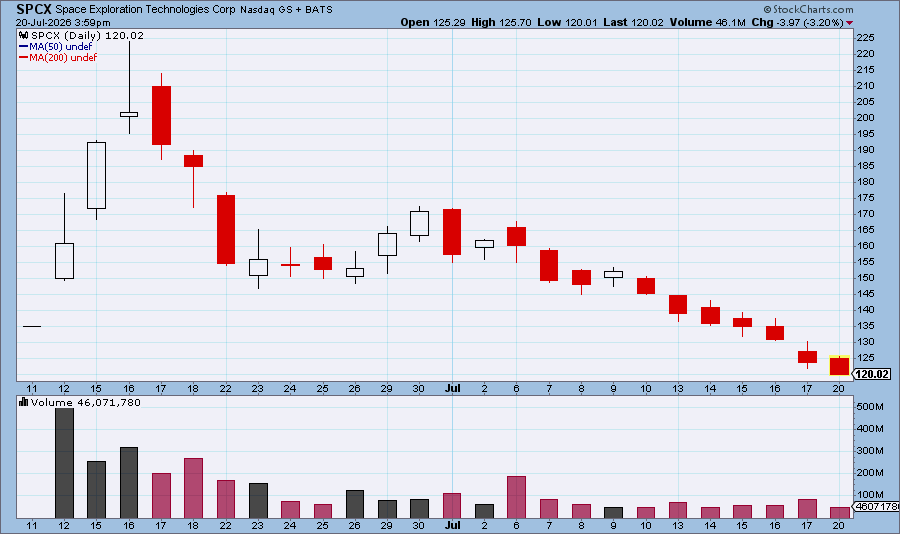
Any stock involved in the AI buildout has had a challenging month. Semiconductor indexes tapped the -20% bear market threshold on Friday while the semi-heavy Korean stock indexes hit a 25% drawdown. And on Monday, SpaceX returned to its IPO price while its newly issued debt continued to move to wider levels. Investors have moved further into the 'show me' camp as they continue to adjust their bets on who is best positioned. Will the hyperscaler capex bets pay off, or are they just giving all of their free cash flow to the semiconductor companies? Will the new Moonshot AI model, Kimi K3 be competitive if it performs close to the top models even though it might be capacity constrained? If Oracle's data center in New Mexico is delayed by two years in obtaining power, what will that do to the project's ROI and where will those customers go for computing power? Claude, which of the 3 host countries will win the 2030 World Cup?
So many questions with too many unknowns right now. We knew the path for capitalizing on AI gains wouldn't be a straight line up and to the right. Right now many past momentum beneficiaries are getting kicked in the shins while investors try to sort the winners from the losers. Of course, as we have seen from the memory semiconductor manufacturers, massive excess profits can arrive quickly when the world is caught short. But the market does not expect the profits to continue or else the same stocks would not be trading at 6-7x P/E multiples. The only certainty right now is that the volatility around AI-heavy names will continue. Good thing that there are plenty of other non-AI industries and companies to invest into.
With no Fed speak (we are in the pre-FOMC quiet period) and little economic data this week, the market will be completely absorbed by corporate earnings and commentaries. The ECB will also consider its rate positioning on Thursday but it is expected to hold rates steady. Enjoy your week.
As an investor in risk assets, you should like nothing better than hearing good things about bank credit quality trends…
[Consumer Resilience] WFC – "On the consumer side, it really is good. The delinquency trends are better than we modeled most months, really every month that we've seen now for all year across each of the portfolios. We're not seeing sign any -- we're not seeing any cohorts of clients, whether you break it by FICO or other ways to look at higher or lower income levels. We're not seeing any of the trends in any of the cohorts change really at all, certainly not anything meaningful."
[Lower-income Strength] JPM – “Delinquencies are a little lower than we expected…You see pretty much across the board by kind of FICO score…There's some of that economic heterogeneity data came out from the Fed recently which also, I think, doesn't give a lot of support to the K-shaped narrative essentially."
BofA Global
This week's slate of corporate earnings ramps up meaningfully. And Alphabet will set the early AI bar on Wednesday…
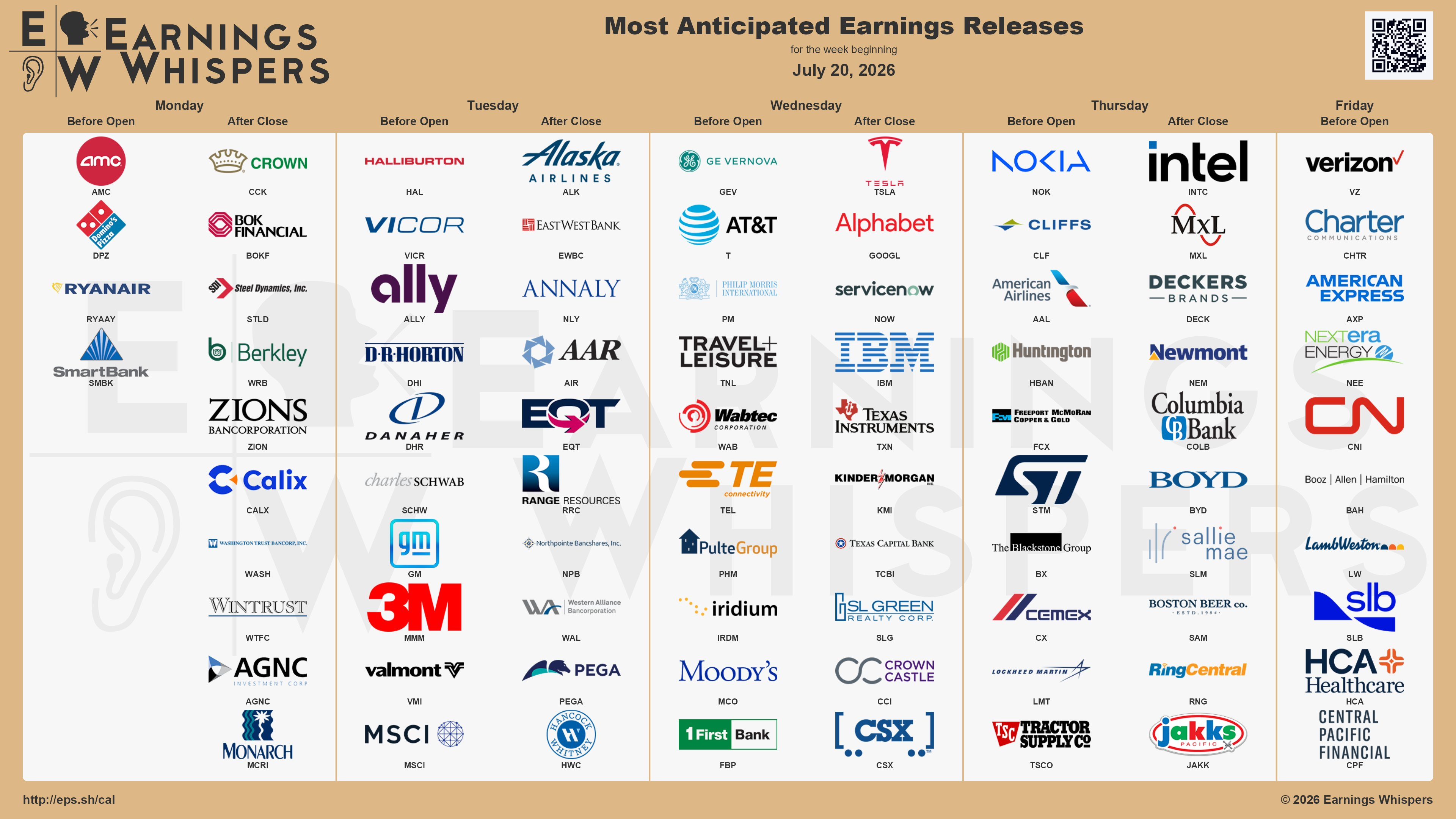
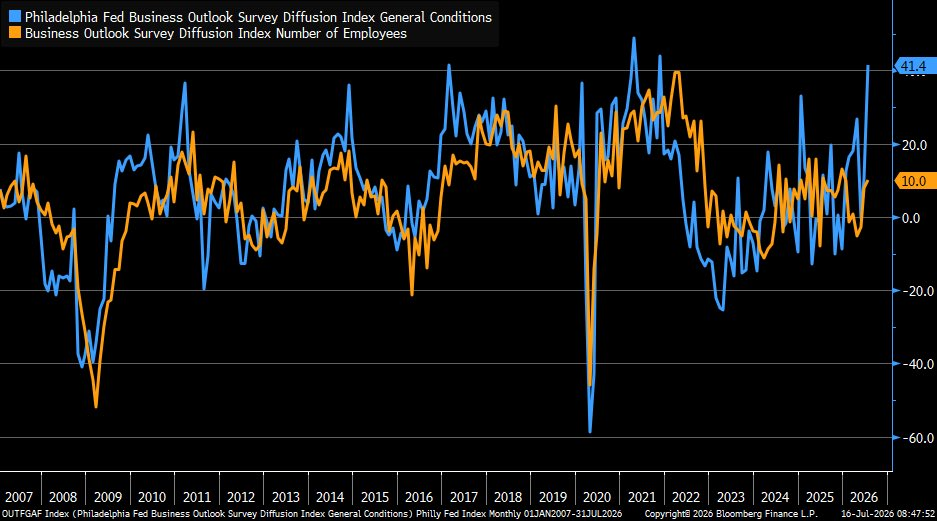
Away from earnings, last week's Philly Fed came in well above expectations last week and the highest in five years…
@LizAnnSonders: July @philadelphiafed Manufacturing Index up to +41.4 vs. +12.5 est. & +10.3 prior … highest headline reading since November 2021, with new orders surging to +37, shipments up to +33.7, and employment up to +10; prices paid edged a bit higher to +53.9
Some insightful bank comments on AI Capex last week…
“AI CapEx expectations continue to move up. The forecast for 2026 on data center CapEx that was taken late last year, around November of 2025, was that $575 billion would be spent this year, and it’s coming in at about $850 billion. That for 2027, the view was it would be around $700 billion, and now it’s projected at $1.3 trillion. 2028 could be at $1.5 trillion. Our excellent research team, led by Katy Huberty, would observe that each major tech cycle has produced a 10-fold increase in compute capacity. Applied to AI, that would suggest a progression from roughly the last transformation, I think we’d agree was cloud. Roughly $1 trillion of cloud compute times 10 is $10 trillion of AI compute. If you think about the numbers I reeled off before, the $575 billion feels like $850 billion, the $700 billion feels like $1.3 trillion for next year, and then maybe $1.5 trillion after that. You’re basically looking at us being around 10%-15% of the way through the investment cycle.” - Morgan Stanley CEO Ted Pick
“Just give you the big numbers. I think CapEx is about $4 trillion a year, and AI went from $400 billion last year to $700 billion this year. People project, which so do our people, it’ll be like a little over a trillion next year. Maybe a little reduction in the non-AI CapEx. That’s hard to figure out because that’s the same people, some of the same people doing the same.” - JPMorgan Chase CEO Jamie Dimon
“Now, we all know, because we’ve all been around for a long time, that these things don’t go in a straight line, they can ebb and flow. I’m not smart enough to tell you whether or not there can be resets or recalibrations in the short term, sometime in the next six months, the next 18 months. I will tell you that when you look over a three-year period or a five-year period, we’re investing in long-term growth to support this, and we’re going to continue to be very consistent about that...I think that’s one of the lessons that we can take when you have these accelerations. Ultimately, you will have a recalibration, a reset, a drawdown, and then a further acceleration. That’s what the path generally looks like.” - Goldman Sachs CEO David Solomon
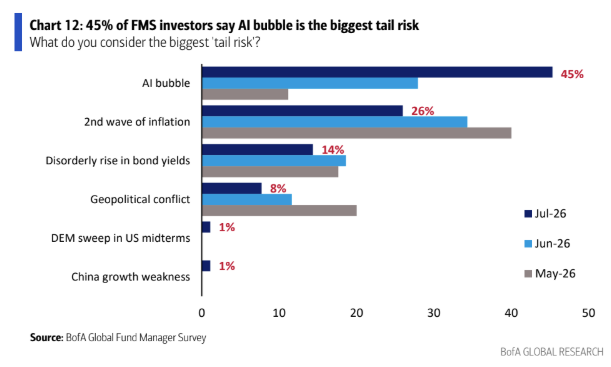
BofA Global's fund manager survey showed where investors see current risks…
"AI bubble" rose to the top spot for the biggest tail risk in July per 45% of FMS investors (up from 28% last month). In June, the #1 perceived tail risk was '2nd wave inflation'... this has dropped to #2 (26% of investors, from 34%).
BofA Global
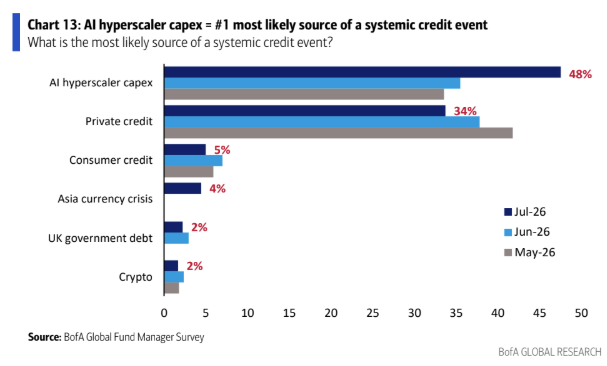
July also saw 48% of FMS investors say that 'AI hyperscaler capex' is the most likely source of a systemic credit event, followed by 34% 'private credit.'
BofA Global
Investors say long global semis is now the most crowded trade.
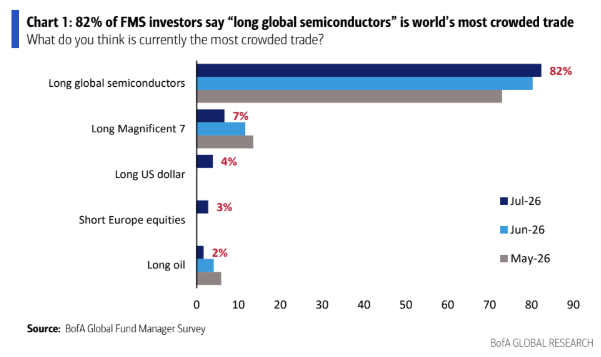
BofA Global
And you can see how the most crowded trade has rapidly gathered assets into its ETF buckets…
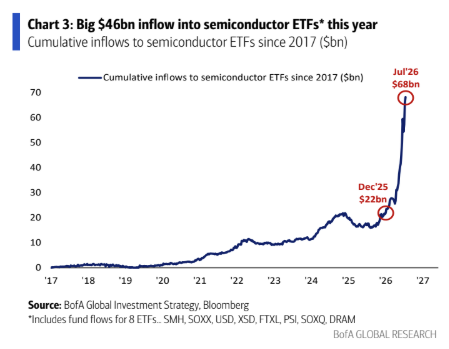
BofA Global
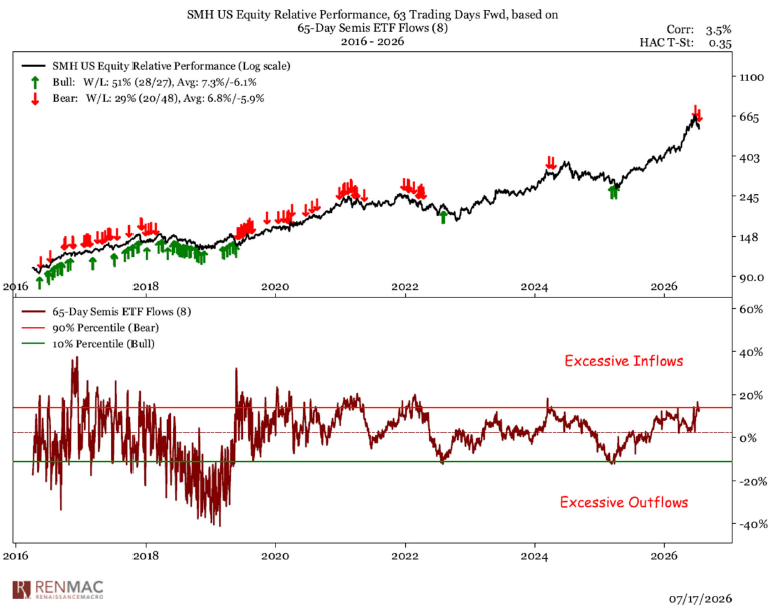
Will the 6-7x P/E multiples in memory semi stocks be like sneaking a glance at Medusa?
@RenMacLLC: As my friend @WalterDeemer says, "When it's time to buy, you won't want to". That's NOT what's happening in $SMH. Inflows are spiking as the stocks weaken; bottoms are historically built on fear, not greed.
Semiconductor buyers are betting that the AI Hyperscalers will continue to shovel money into their coffers…
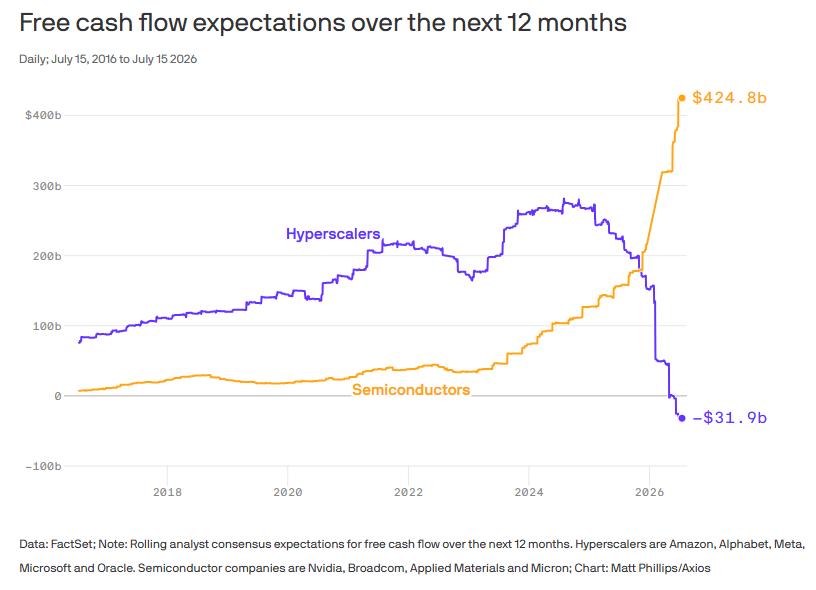
If it continues, one analyst thinks that Micron could repurchase 40% of its equity…
UBS: $MU COULD REPURCHASE MORE THAN 40% OF ITS SHARES BY THE END OF 2028
UBS expects Micron to generate over $40 billion in free cash flow through 2028. Once its buyback restriction expires on December 9, 2026, the company could potentially use that cash to repurchase more than 40% of its shares at the current price.
@wallstengine
One of the market's biggest rocket ships has returned to earth…
Now the question is will SpaceX's grounding affect future IPOs or is it just an isolated event?
StockCharts
Speaking of AI, it looks like Claude won the World Cup of LLMs in predicting the final results…
@venturetwins: Nine days ago, someone asked the LLMs to predict who would win the world cup. Fable was the only one that predicted France would get knocked out and correctly guessed the two finalists. ChatGPT, Qwen, and Kimi each got one of the finalists.

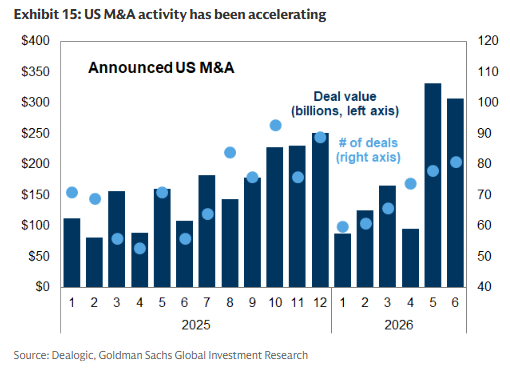
Deals, deals and even more deals as the M&A bullet train continues to accelerate…
We expect deal activity will remain strong in coming months. From a macro perspective, the combination of easy financial conditions, solid economic growth, healthy CEO confidence, and a friendly regulatory backdrop should support continued M&A activity.
Goldman Sachs
Manufactured housing design is about to get a lot more creative and affordable…
Perhaps the most consequential piece of the new landmark housing legislation involves an astonishingly simple change to a 50-year-old federal law: Manufactured houses, or mobile homes, no longer must have a permanent chassis, the steel under-frame used to transport the house and then left attached.
Shedding the bulky steel structure under a house opens up a whole new array of design opportunities for these often stigmatized homes. The change could make multi-story manufactured homes, lower-to-the-ground designs and basement installations easier and less costly — amping up their appeal.
Feel free to keep installing java…
There is good news for coffee drinkers: Up to five cups of the brew a day are safe for most adults and may even have benefits for heart health, according to a new scientific statement by the American Heart Association.
Downing between about three to five 8-ounce cups of joe daily, or around 400 milligrams of caffeine, is linked to a lower risk of heart disease, heart failure, stroke and Type 2 diabetes, according to the AHA’s statement, which was published Monday in the journal Circulation…
The scientific evidence for coffee’s safety and health benefits has been building over time, said Dr. Gregory M. Marcus, a cardiologist and professor of medicine at the University of California, San Francisco and the statement’s lead author. Most of the studies the authors analyzed are observational and can’t prove cause and effect. But there has been an increasing number of randomized, controlled trials—a more scientifically rigorous method—in recent years showing that coffee consumption can be beneficial for heart health, Marcus said.
Scientists are still trying to figure out why the caffeine in coffee might help the heart, Marcus said. People tend to exercise more on the days they have caffeinated coffee. Coffee acts as a diuretic and can lower blood pressure. Caffeine also blocks a substance that can cause atrial fibrillation, an arrhythmia that can lead to strokes.

Learn more about the Hamilton Lane Strategies
DISCLOSURES
The author has current equity ownership in: Alphabet Inc.
The information presented here is for informational purposes only, and this document is not to be construed as an offer to sell, or the solicitation of an offer to buy, securities. Some investments are not suitable for all investors, and there can be no assurance that any investment strategy will be successful. The hyperlinks included in this message provide direct access to other Internet resources, including Web sites. While we believe this information to be from reliable sources, Hamilton Lane is not responsible for the accuracy or content of information contained in these sites. Although we make every effort to ensure these links are accurate, up to date and relevant, we cannot take responsibility for pages maintained by external providers. The views expressed by these external providers on their own Web pages or on external sites they link to are not necessarily those of Hamilton Lane.