
Weekly Research Briefing: Escalate or De-escalate

As James Carville once reminded us, the bond market "can intimidate everybody." So with Friday's upward move in interest rates pushing all maturities on the curve toward a +50bp increase over three weeks, the cost of the Gulf War was just too much for the White House. Complicating the picture was the jump in gasoline, diesel and fertilizer price increases and their negative impact on consumers, businesses and farmers. Further, the Gulf War shifted the Federal Reserve's interest rate discussion last week from only cutting to possibly hiking. And then there is the continued pressure from GOP members of Congress who don't want to waste six months of their lives and tens or hundreds of millions of dollars on a losing effort to keep their seat.
Knowing it would be too much for the Oval Office to bear, they began pushing for an Iran off-ramp this weekend. First it was a Saturday escalation with a 48-hour warning of full Iranian power plant obliteration if the Strait was not opened. This was later described on the Sunday AM news shows as a threat toward de-escalation. Then on Monday, the POTUS said that talks with Iran were going well and the Monday deadline would be pushed to Friday. Some viewed this as a de-escalation before an escalation. We know that many troops are being moved into the region and many different sets of attack plans have been presented. But any military escalation will only push both energy prices and interest rates much higher than they were last week. It also risks significant damage to other Gulf nations energy, industrial and water de-salinization infrastructure.
The markets continue to hold up very well in my eyes. S&P 500 and Nasdaq are just 5% from their all-time highs and the EAFE and EM indexes are only 8-9% from theirs. Investors are continuing to bet that this Gulf war will end soon and that a ceasefire and re-opening of the Strait of Hormuz is in the cards. Given today's de-escalation, the markets appear correctly positioned, but we must wait to see if the Friday deadline is met and a deal is struck. If we are still talking about the Strait of Hormuz in a month, then today's investors will be poorly positioned. Let's hope some of the main decision makers will re-watch Matthew Broderick in 'WarGames' over spring break with their families.
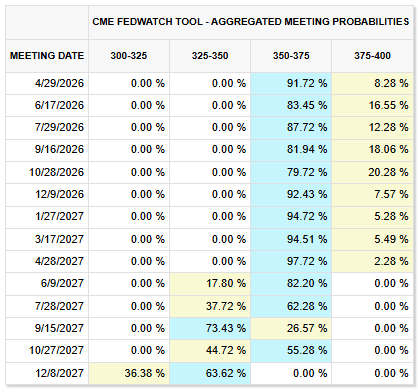
The FOMC meeting last week was somewhat anticlimactic, considering all the macroeconomic news, oil price movement, and interest rate changes. Only one dissented on the rate decision as the committee moved toward a more neutral position given the new inflation picture. Markets now anticipate no rate cuts until the end of 2027 with a chance for a rate hike sometime this year. Oh how the wind has shifted. There is little economic data this week, but a flood of Fed commentary as members take the microphone following last week's decision. The micro news flow will also be slow this week. Definitely a great time to be on spring break if not for that one 'war' item.
Whether or not there is a peace settlement this week, there still has been production damaged in the Gulf which will impact future energy prices…
Fatih Birol, whose role at the IEA has put him at the heart of efforts to keep energy flowing despite the loss of one-fifth of the world’s oil and gas, told the FT the conflict was “the greatest global energy security threat in history”…
More oil has been lost, he added, than during the twin shocks of the 1970s that triggered recessions and fuel rationing around the world…
But he said politicians and markets were still underestimating the scale of the crisis. The problem would grow bigger every day that flows of energy from the Middle East, which exports one-fifth of the world’s oil and liquefied natural gas, were trapped by Iran’s de facto blockade of the Strait of Hormuz.
“People understand that this is a major challenge, but I am not sure that the depth and the consequences of the situation are well understood,” he said in an interview.
Even if the conflict ended and the strait reopened, Birol said “it will take a long time” to bring oil and gasfields, many of which have been shut down or damaged, back online. “It will be six months for some [sites] to be operational, others much longer,” he said…
He also forecast that the energy crisis would trigger a wave of policy changes from governments around the world, comparing the situation to how politicians responded to the twin oil shocks in 1973 and 1979.
“There were three responses. Over 40 per cent of the nuclear power we have today was built in response to that crisis. The amount of fuel that the average car uses halved in the 10 years after the shock. And countries changed their trade routes,” he said.
Saudi Arabia is coming up with some big price forecasts if this war continues into April…
Saudi Arabia’s oil officials are working frantically to project how high oil prices might go if the Iran war and its disruption of energy supplies doesn’t end soon—and they don’t like what they are seeing.
The base case, several oil officials in the Gulf’s biggest producer said, is that prices could soar past $180 a barrel if the disruptions persist until late April.
While that would sound like a bonanza for a kingdom still heavily leveraged to oil revenue, it is deeply concerning. Prices that high could push consumers into habits that slash their oil use—potentially for the long term—or trigger a recession that also hurts demand. They also would risk casting Saudi Arabia in the role of profiteer in a war it didn’t start…
“$200 a barrel is not outside the realms of possibility in 2026,” analysts at energy consulting firm Wood Mackenzie said.
Gulf futures tied to Oman crude, which are less liquid but which quickly reflect local supply disruptions, shot past $166 a barrel. Oman is a benchmark for much of the oil sold by Middle East producers such as Saudi Arabia, with tankers of physical crude priced at a fixed spread to the benchmark, which floats up and down each day with the market.
Some Saudi customers are balking at using the benchmark given its volatility, the oil officials said. Aramco, however, is insisting it is a true reflection of supply in the market, they said.
The Bloomberg commodity expert thinks that time favors Iran. Does the White House?
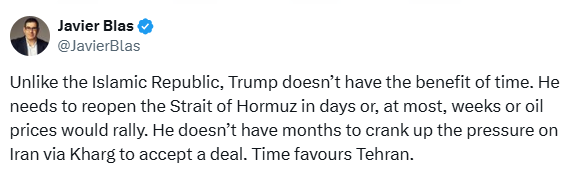
Of course high energy prices will lead to a shift in behavior and reduction in demand as J.P. Morgan notes below…
Oil Flash Note - Demand destruction has begun
Diesel has emerged as the region’s immediate choke point, with surging prices slowing both travel and freight. Governments are responding with a mix of demand management and emergency measures. Bangladesh brought forward the Eid-al-Fitr holiday and allowed universities to close early to save fuel. The Philippines and Sri Lanka instituted four-day workweeks to curb diesel use and stretch dwindling stocks. Pakistan closed schools and shifted universities online. Officials in Thailand and Vietnam have been urged to use stairs, work from home, and limit travel, while Myanmar introduced alternating driving days to reduce road fuel demand. In parallel, authorities are intervening directly into fuel markets to stabilize fuel prices.
Aviation shows the strain most visibly. As jet fuel approaches $200/bbl, carriers are shifting from cost management to outright service withdrawal, with many routes rendered uneconomic. As of March 18, several Asian airlines, including Qantas, Air India, Cathay Pacific, and IndiGo, have introduced phased fuel surcharges. Long-haul Air India tickets from Asia to Europe or North America now carry a $125-200 surcharge per passenger, with an additional $4.30 on domestic flights—effectively pricing out many leisure travelers for the upcoming summer season. Scandinavian Airlines (SAS) and Air New Zealand were among the first carriers to cancel or reduce flights due to soaring jet fuel prices.
J.P. Morgan
Expect days, weeks or months of articles like this one…
Costco Lines, Canceled Trips, Fuel Rewards: Americans Hunt for Cheap Gas
Americans are looking for ways to cut back as gas prices surge to nearly $4 a gallon due to the Iran war.
Krissy Corti filled up the gas tank of her Dodge Durango at a BJ’s Wholesale Club in Westchester County, New York on Monday. Even at $3.50 a gallon compared to over $4 at other gas stations across town, she said she paid $76 for three quarters of a tank, up from her usual $60 spend.
“I can’t imagine filling up two cars right now,” said the 43-year-old stay-at-home mom of three. “It’s like another car payment.”
Corti said her family’s grocery bills have gone from $200 per week in the past few months to now over $300. She’s recently started shopping more at Stop & Shop, where she receives points that could earn her a discount at gas stations.
The family has also cut back on eating out and ordering takeout, and Corti is finding herself looking at the food items on sale at the store and planning meals around them. With summer coming up, she’s not sure if the family can afford to take trips as usual.
“It’s a very scary time,” Corti said. “It starts with gas prices, but it’s going to trickle down to everything.”
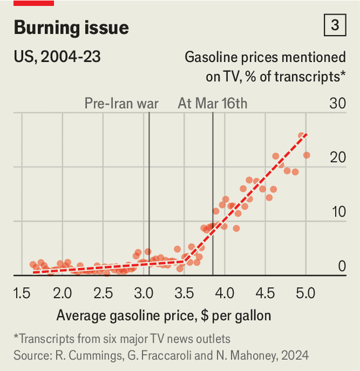
With gasoline prices going through $4/gallon this week in the US, the news flow surrounding its higher price will only increase…
Worse still, the oil shock is colliding with an economy that, fairly or not, Americans already hate. Although the country is nowhere near a recession, consumer confidence languished near record lows even before the energy crisis. The Democratic Party was already taking Mr Trump’s Republicans to task over the “affordability crisis” which has been angering voters despite the fact that their wages have been growing faster than prices. If the oil shock turns these misperceptions into reality, the backlash could be fiercer—especially if it is compounded by rises in interest rates by the Fed, should it fear that inflation was once again getting out of hand.
Least popular of all will be the rise in petrol prices, which glare down at Americans whenever they pass a service station. Neale Mahoney, Ryan Cummings and Giacomo Fraccaroli, a trio of economists at Stanford University, find that once prices pass $3.50 per gallon, media interest in the topic explodes (see chart 3). They are already nearly $4, up from less than $3 before the war. If the Strait of Hormuz stays shut and oil prices jump again, $5 is not out of the question.
In the past week Mr Trump and other Republicans have tried arguing that the energy shock is good for America now that the country is a net fuel exporter. Such assurances will do little to mollify voters if they are still paying through the nose before the midterms in November.
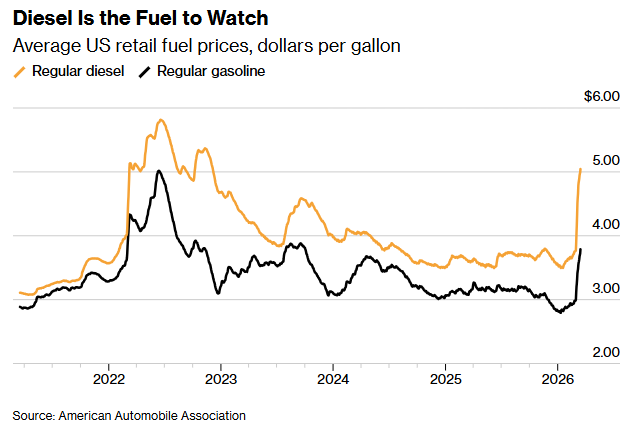
Maybe more important than gasoline prices is the increase in diesel prices which hits all supply chains…
The average gallon of diesel crossed $5.20 nationwide on Saturday, up around 40% from a month ago, according to the AAA. Eight of the 10 states where diesel prices have shot up most compared with a month ago are in the Southeast—led by South Carolina, where prices have risen 51% since Feb. 21 and where Caveda paid $853 alone for 161 gallons at a station in Columbia on Monday…
Higher diesel prices for a sustained period would, however, ripple throughout the broader supply chain and could lead companies to eventually increase the price of consumer goods, economists say.
The price of diesel and other oil derivatives affect the cost of “many, many things,” said Federal Reserve Chair Jerome Powell on Wednesday. The effects on core inflation, which excludes food and energy, are “real, and they’re material,” he added.
For most freight companies, a 40% surge in the price of diesel results in an overall cost increase of around 10%, said Erich Muehlegger, an economist at the University of California, Davis. The diesel price spike from Russia’s invasion of Ukraine in 2022, for instance, contributed to a significant increase in the cost of milk for consumers in California, according to UC Davis research.
Diesel is also used to power machinery used by the fishing, farming and construction industries, such as tractors and cranes. The higher costs those companies are beginning to pay won’t be felt by consumers immediately, but they have already begun to pass through the supply chain, Muehlegger said.
And diesel powers much more than just trucks…
Roger Conner sells firewood for a living, but he might know just as much about another energy source: diesel. The fuel powers every step of the supply chain for his company, RC Conner Enterprises: the megatrucks that carry the logs from suppliers to his facility in Exeter, New Hampshire; the machines that offload and process those logs into kiln-dried residential and restaurant-grade firewood; and the trucks that deliver the finished bundles and cords to customers across New England. In a normal year, Conner spends roughly $6,800 a month on diesel. Now it’s about $11,000. To absorb some of the cost, he’s added a 5% fuel surcharge; when customers saw that, several walked away.
If diesel keeps rising, “we’re going to have to keep going up on our pricing, but we probably won’t have any sales,” says Conner, 50. “This is going to cripple our economy. I don’t think people think about how much the economy rides on diesel fuel.”…
In one example of the fuel price’s impact, the cost of moving a barge up the river from New Orleans to Owensboro, Kentucky, jumped 27% from February to late March, says Anton Posner, chief executive officer of logistics-services provider Mercury Resources, “and that’s all diesel-related.” Diesel is even used in some places to generate electricity, including when the power goes down at sprawling data centers that employ backup generators.
Given its ubiquitousness, diesel’s rising costs create higher prices for just about anything further down the supply chain, be it lumber hauled on railway flatcars or green peppers shipped to your local grocery store. Joe Brusuelas, chief economist at accounting, tax and consultancy firm RSM US, says it has a real ripple effect. He estimates a 10% rise in diesel implies a 0.1% increase in the headline consumer price index. That means if today’s elevated prices hold, the inflation reading could climb as much as 0.4%.
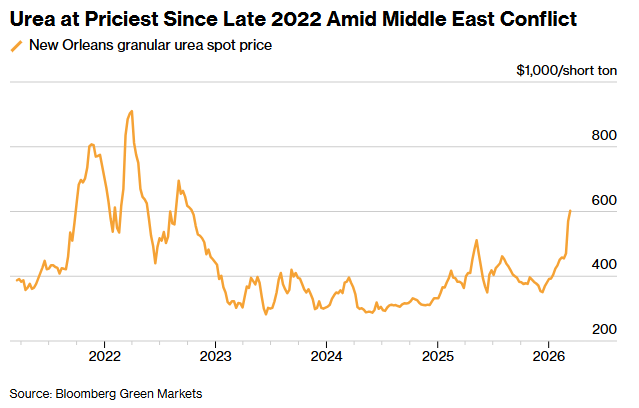
Farmers are getting hit by gasoline, diesel and fertilizer price spikes right now…
It's a good thing the Iowa, Nebraska and Illinois men's basketball teams are doing well in the tournament.
Fertilizer prices have surged, particularly for nitrogen-based urea that’s heavily used by corn growers concentrated in the Midwest. Spot urea prices climbed 28% in just two weeks, hitting the highest level since early in the Ukraine War. Attacks on Middle East shipping are threatening supplies, with a third of the world’s fertilizer shipments passing through the Strait of Hormuz, according to the United Nations. Diesel fuel, meanwhile, is up 33% since hostilities began through Sunday.
Farmers were souring on their situation before the price spike. In February, Purdue University’s Agricultural Economy Barometer, based on a monthly national survey of farmers, was down 24% from a year earlier.
In Iowa, the nation’s largest corn producer, an open US Senate seat being vacated by Republican Joni Ernst is up for grabs in November. Democrats are also targeting three of the state’s four US House seats.
Any shift in enthusiasm for Trump among farmers and rural residents also could play an important role in other competitive US Senate and House races across the country, including in Georgia, North Carolina, Ohio and Texas.
US Farmers can lose money over short periods of time, but tough to see the silver lining today…
“There is really no profit right now,” Bushmeyer said, later adding: “It’s not sustainable in the long term. We can do that for a few years, but eventually it’ll put us out of business.”
While Bushmeyer’s fight with fertilizer costs started several years ago, many US farmers are seeing themselves squeezed even more as prices for agricultural nutrients have jumped in recent weeks.
American farmers have become casualties in the US-Israel war against Iran. Iran closed the strait of Hormuz, cutting off a key fertilizer production and transportation route, and efforts to reopen this crucial trade route have stalled.
The closure has intensified pressure on farmers as it comes as during the US spring planting season. The price spike also comes as farmers are experiencing several years of losing money on growing crops…
Benchmark New Orleans nitrogen prices were at $350 a short ton in late December, and in late February, just before the conflict, had risen to $470, Yearsley says. As of 10 March, nitrogen prices were trading about $600, he says.
Fertilizer is the most volatile and significant non-land cost for most farmers. For corn, the US’s biggest production crop, it can account for 20% of total production expenses, according to the US Department of Agriculture (USDA).
The United Airlines CEO wrote over the weekend that they are going to plan for a $175/barrel oil price spike falling to $100/barrel in 2027 and cut capacity so that they can survive…
$UAL CEO: "The reality is, jet fuel prices have more than doubled in the last three weeks. If prices stayed at this level, it would mean an extra $11B in annual expense just for jet fuel. For perspective, in United’s best year ever, we made less than $5B"
@TheTranscript_
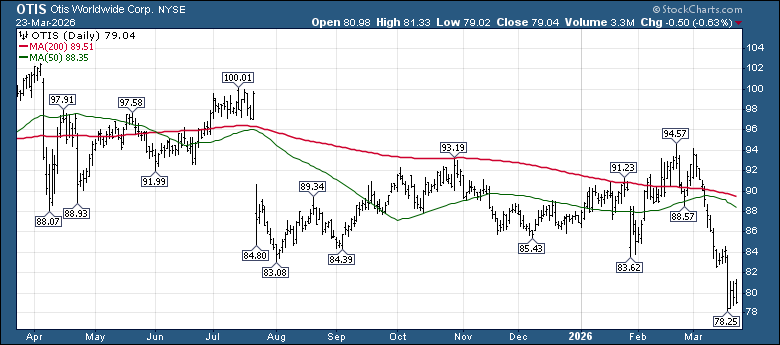
One of my favorite dominant global franchises lowered its earnings estimates yesterday...
Otis Elevator has a razor/razor blade-like business model with only a few competitors. Why they cut their revenue and earnings guidance:
- The Middle East accounts for only a low single digit % of revenues, but their new/modernization elevator and escalator business has stopped.
- Product shipments moving from Asia to Europe now must go around Africa rather than through the Suez Canal.
- The FX has swung to a stronger US$.
- Still a very large buyer of steel (affected by tariffs) and aluminum (affected by tariffs and war).
They are hopeful that the war will be over soon and business will return to normal. Expect other global multi-national manufacturers to feel some of the same effects.
StockCharts
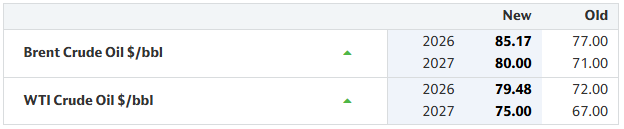
Goldman Sachs lifted their average price forecast for oil and then moved it through their inflation outlook…
We upgrade our price forecast for two reasons. First, we now assume that Hormuz flows remain at only 5% of normal levels for a longer 6-week period before a gradual 1-month recovery. Second, a recognition of the risks from the high concentration of production and spare capacity is likely to lead to structurally higher strategic stockpiling and long-dated prices.
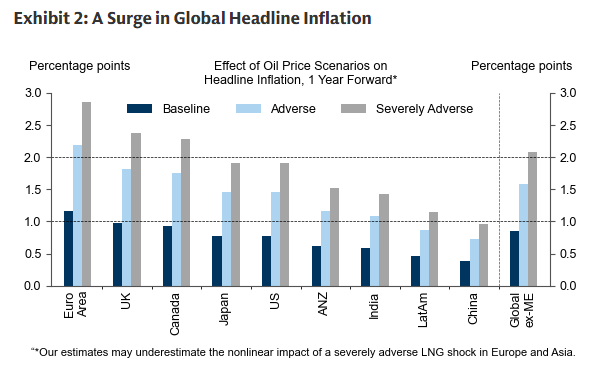
Higher energy prices will boost global headline inflation sharply in the next 1-2 months. Although the impact should partly reverse once the Strait does reopen, our country-specific rules of thumb imply that the shock will add 0.8pp to global headline inflation over the next year under our baseline and 2pp under our severely adverse scenario. Our estimates are biggest in Europe because of the added shock to home heating costs and power bills from higher natural gas prices, and smallest in China which relies more on coal and electricity than on oil and gas in transportation and home heating.
Goldman Sachs
As oil prices and inflation expectations have risen, the bond market is now betting on rate hikes rather than cuts…
Kevin Warsh might just want to stay away from the Fed building until the Middle East war is settled and oil prices cool down…
The oil shock could be particularly confounding because as a Fed governor when energy prices surged in 2008, Warsh argued for the opposite of what is now expected of him by Trump.
The central bank had cut aggressively early in the year to cushion the economy against a deepening financial crisis. That April, Warsh reluctantly supported a final quarter-point rate cut and said at the rate-setting meeting that officials needed to be “prepared to stomach the continued weakness in the real economy that is in many of our projections.” He warned against encouraging “the perception that the FOMC has a greater tolerance for inflation than is prudent.”
That June, as oil prices closed in on $140 a barrel and dragged inflation higher, Warsh approvingly cited market expectations that the Fed’s next move was more likely to be a rate increase.
Amid the unfolding global financial crisis, inflation risks “continue to predominate as the greater risk to the economy,” particularly given signs that inflation pressures reflected deeper forces than the temporary oil shock, Warsh said. The Fed cut rates to near zero months later after the collapse of Lehman Brothers intensified the crisis.
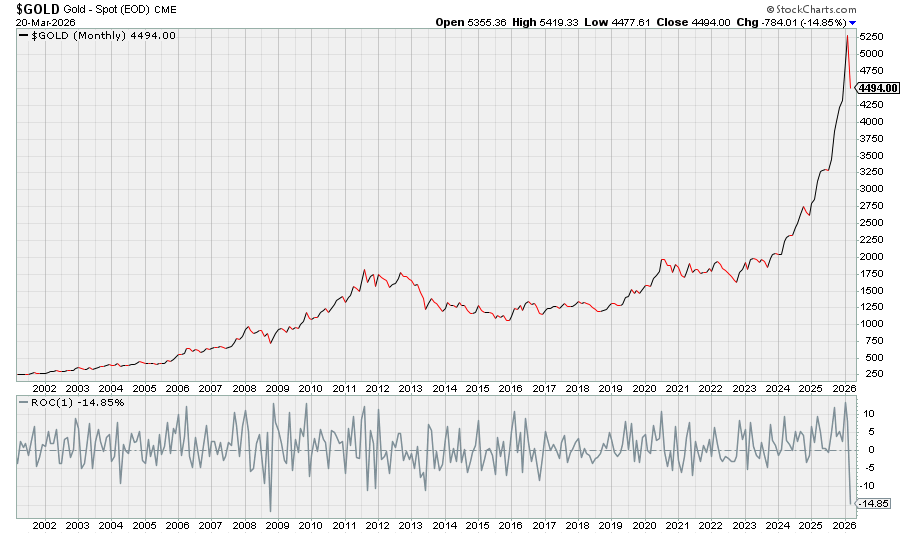
Even with the inflation spike, Gold prices had their worst week since 1983 (-10.5%) and are now working on their worst month since the GFC…
StockCharts
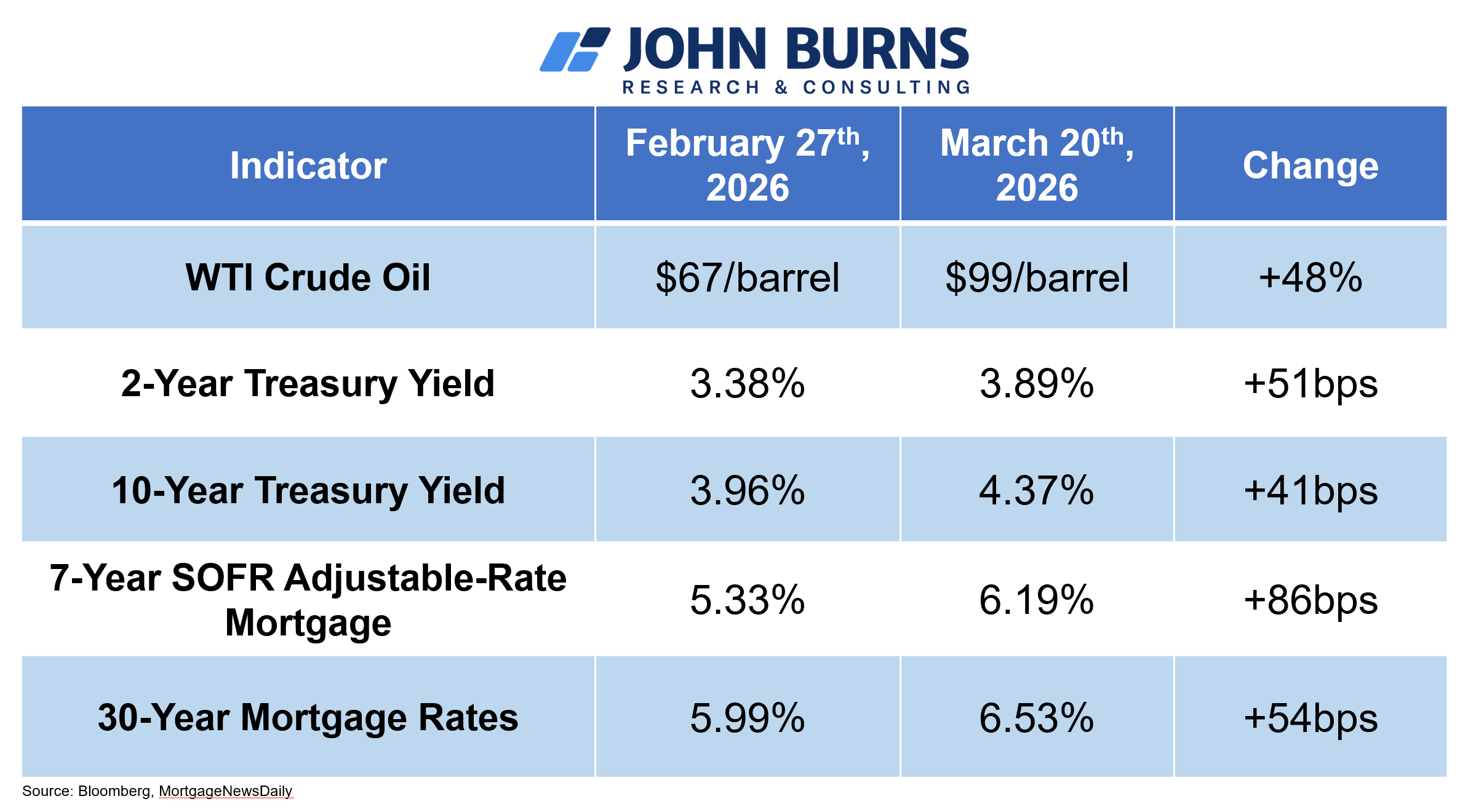
The war had terrible timing for the housing industry's spring selling season…
@RickPalaciosJr: In less than a month, hope for a decent spring selling season has all but vanished in housing as oil spikes, rates jump, and inflation expectations reset higher. Can’t even get an adjustable-rate mortgage below 6% anymore.
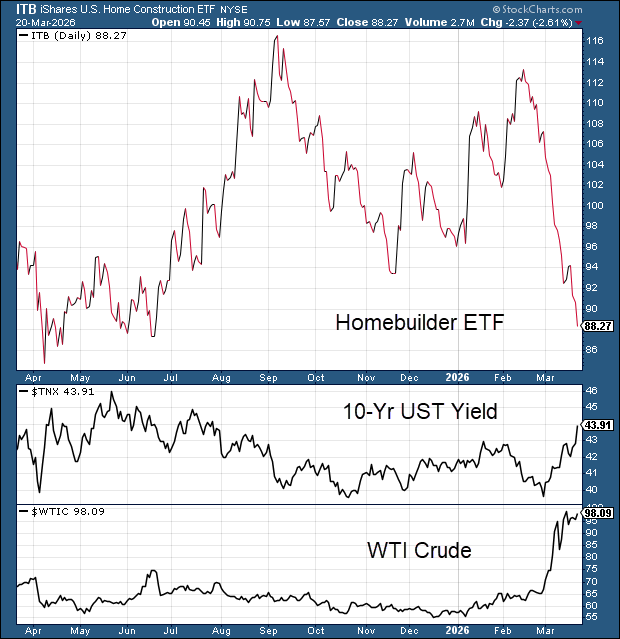
Rising construction costs and now rising interest rates is going to stop all new housing activity as the Homebuilder ETF implies…
StockCharts
Not all businesses are suffering from the rise in oil and gasoline prices…
At a BYD Co. car dealership in Manila’s financial district, demand for the Chinese company’s electric vehicles is so high that Matthew Dominique Poh said he’s seen a month’s worth of orders in just the past two weeks.
“Clients are replacing units in favor of EVs because of the oil price hikes,” said Poh, who’s been a salesman at the dealership for the past seven months.
About 1,100 miles (1,770 km) away in Hanoi, Nguyen Hoang Tu Anh said his VinFast showrooms had to hire more sales staff after customer visits quadrupled, resulting in the sale of 250 EVs in the three weeks since the Iran war started. That works out to more than 80 a week, or double the average rate in 2025…
China is set to reap most of the gains from a surge in EV demand as the world’s top producer of electric vehicles. Overseas shipments of electric cars and plug-in gas-electric hybrids in the first two months of this year — before the war began — had already more than doubled from a year ago, according to data from the China Association of Automobile Manufacturers.
Non-Chinese brands such as Hyundai Motor Co., Nissan Motor Co. and Tesla Inc. are also well-positioned for an uptick in Asia’s EV demand. But many legacy automakers aren’t, having been late to market with all-electric models and then quickly rolling back plans. General Motors Co., Honda Motor Co. and Ford Motor Co. are among those that have dialed down their EV ambitions, due in part to a shift in US policy under President Donald Trump that has stripped EVs of subsidies and other government support.
So at 10-12x leverage, the commercial banking industry could soon be soon looking to dial up to $2 trillion in new lending volumes?
After scoring a victory with regulators, lenders are preparing to put billions of dollars in potentially freed-up capital to use. Their top priorities aren’t complicated: make more loans, invest in their businesses, give money back to shareholders and strike deals.
A hotly anticipated series of regulatory rules proposed Thursday would, in totality, lower the amount of extra capital that banks must hold as safety buffers. The plans are subject to a 90-day comment period before they can be finalized, so they could still change…
Regulation requires banks to set aside money in case loans go sour or markets tank. But the more capital the banks set aside, the lower their profit on each individual loan or trade. Large banks have been sitting on some $175 billion in excess capital, according to analysts at Morgan Stanley.
Executives say the looser rules will allow them to compete more in corners of lending they have largely abdicated because of the capital costs, like to riskier companies or private-equity firms striking deals. Banks have been losing market share to private-credit firms, which are willing to make riskier loans in exchange for higher interest rates.
“Think of what an opportunity” the capital changes would be “for banks to retake market share” from private credit, said Anton Schutz, president of Mendon Capital, an investment firm focused on banks.
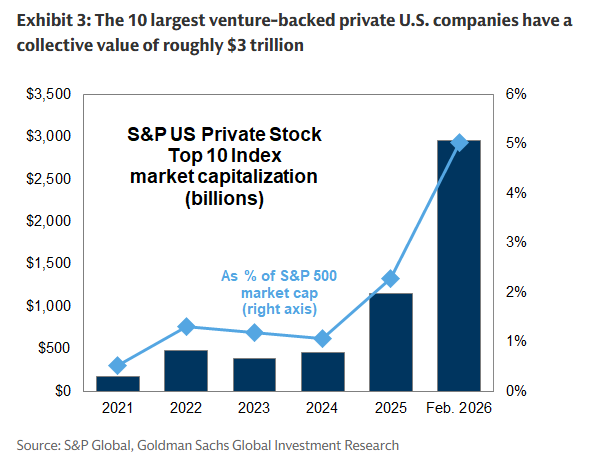
Some very large private companies are looking to go public and they would like to be a part of your equity index fund…
One factor motivating the potential changes to index inclusion rules is the unprecedented size of the private companies reportedly considering near-term IPOs. According to S&P, the constituents of the S&P U.S. Private Stock Top 10 Index have a collective equity value of nearly $3 trillion, equating to roughly 5% of market cap for the S&P 500. Prediction markets show substantial probabilities that several of those companies go public this year. Each of the three providers has noted the desire to maintain indices that represent the broad universe of relevant public US equities.
Goldman Sachs
A bit of a pickup in M&A activity last week with private companies doing most of the selling…
- Poste Italiane (PST.it) announced a voluntary public exchange offer for all the shares of Telecom Italia (TIM.it) for a total consideration of €10.8bn, with the aim of becoming one of the country's leading infrastructure platforms, with aggregate revenues expected at ~€26.9bn, aggregate pro-forma EBIT of ~€4.8bn (excl. synergies) and >150k employees. The overall consideration of the offer implies a 9% premium.
- China's ByteDance has agreed to sell Shanghai Moonton Technology, the studio behind popular mobile game Mobile Legends: Bang Bang, to a Riyadh-based gaming firm owned by Saudi Arabia's Public Investment Fund. It did not disclose any financial details of the deal, but a person with knowledge of the matter said the transaction values Moonton at more than $6 billion. Savvy, owned by Saudi Arabia's sovereign wealth fund the PIF, is a global games and e-sports company that according to its website is pursuing growth through acquisitions, investments and commercial ventures.
- Ecolab (ECL) said it would acquire CoolIT Systems from KKR for about $4.75 billion in cash, as the water solutions firm seeks to capitalize on surging demand for liquid cooling in artificial intelligence-driven data centers. CoolIT is likely to generate about $550 million in sales over the next 12 months, Ecolab said. The $4.75 billion price tag is 29 times CoolIT’s estimated earnings before interest, taxes, depreciation, and amortization over the next 12 months. The price tag is a jump from the company’s roughly $270 million valuation when KKR acquired a majority stake in 2023.
- 3M (MMM) is teaming up Bain Capital to buy Madison Fire & Rescue for $1.95 billion as part of a deal to form a new fire and safety venture. 3M said it will contribute its Scott Safety breathing-apparatus unit to the venture and receive $700 million in cash at closing, adding that it will own 50.1% of the new company, with private-equity firm Bain holding the rest. 3M and Bain are buying Madison Fire & Rescue, which sells a portfolio of rescue technology and fire-suppression products that includes Holmatro and Amkus extrication tools and Task Force Tips nozzles, from privately held Madison Industries.
- Novartis (NVS) acquires Pikavation Therapeutics for $2B upfront and up to $1B milestones. Pikavation Therapeutics is a Synnovation unit developing SNV4818 and related pan-mutant-selective PI3K inhibitor programs. SNV4818 is an oral PI3K inhibitor in Phase 1/2 for breast cancer and other advanced solid tumors. It is designed to target PIK3CA-mutant tumors while sparing wild-type PI3K, aiming to reduce side effects and improve tolerability. Targets HR+/HER2- breast cancer, where about 40% of patients have PIK3CA mutations.
- Mastercard Inc. (MA) said it will acquire the stablecoin infrastructure startup BVNK for as much as $1.8 billion, four months after negotiations between BVNK and Coinbase Global Inc. for a roughly $2 billion deal fell apart. The purchase price includes $300 million in contingent payments. They declined to comment on whether the deal was structured with cash or stock.
- Berkshire Hathaway (BRK.B) has agreed to invest $1.8bn in Tokio Marine (8766.jp) as the new chief executive at the US conglomerate expands a bet on Japan kicked off by Warren Buffett. As part of a wide-ranging deal, a subsidiary of Berkshire will buy a 2.5 per cent strategic stake in Tokio Marine, one of the “big three” Japanese non-life insurers. The US company will reinsure a percentage of all the business done by the Japanese group and the two groups said they would “collaborate on global strategic investment opportunities, including M&A”.
- Danone (BSN.fr) has agreed to buy nutrition startup Huel for about $1.2 billion, seeking to tap growing demand for meal-replacement shakes popular with gym-goers and late-night workers. Huel will report revenues of more than £250mn, compared with £214mn the year before, with an earnings before interest, tax, depreciation and amortisation margin of about 10 per cent for 2025. The UK company, which explored an initial public offering in 2021, was last valued at $560mn in a 2022 funding round.
- U.S. consumer health products maker Prestige Consumer Healthcare (PBH) said it would buy the Breathe Right brand and other assets from Foundation Consumer Healthcare in a deal valued at $1.045 billion. Acquired portfolio generated about $200M revenue and $95M EBITDA for the 12 months ended December 31, 2025. Breathe Right represents about two-thirds of portfolio revenue and profitability. Other brands include Dimetapp and Anbesol.
- Capitaland (CAPL.sg) to acquire Access self-storage for >£1.0B. Access Self Storage has 57 stores across the UK and has been up for sale for more than a year.
Various News Sources
What a great long read. Can't wait for the documentary…
A REUTERS INVESTIGATION - IN SEARCH OF BANKSY
The British street artist’s identity has been debated, and closely guarded, for decades. A quest to solve the riddle took Reuters from a bombed-out Ukrainian village to London and downtown Manhattan — and uncovered much more than a name.
BY SIMON GARDNER, JAMES PEARSON AND BLAKE MORRISON
This Banksy mural of a man scrubbing his back in a bathtub appeared in 2022 on a wall of a destroyed building in the Ukrainian village of Horenka. The mural piqued the interest of a Reuters journalist, setting off an effort to identify and understand the elusive artist. REUTERS/Gleb Garanich

Learn more about the Hamilton Lane Strategies
DISCLOSURES
The author has current equity ownership in: Berkshire Hathaway Inc. and Otis Worldwide Corp.
The information presented here is for informational purposes only, and this document is not to be construed as an offer to sell, or the solicitation of an offer to buy, securities. Some investments are not suitable for all investors, and there can be no assurance that any investment strategy will be successful. The hyperlinks included in this message provide direct access to other Internet resources, including Web sites. While we believe this information to be from reliable sources, Hamilton Lane is not responsible for the accuracy or content of information contained in these sites. Although we make every effort to ensure these links are accurate, up to date and relevant, we cannot take responsibility for pages maintained by external providers. The views expressed by these external providers on their own Web pages or on external sites they link to are not necessarily those of Hamilton Lane.