

Too many financial trends to mention have now snapped. Equities. Interest Rates. Oil. Investor confidence has been shaken and both professional and retail investors have backed away from their 'BUY' buttons. With no progress on Middle Eastern peace talks and many questions surrounding the end-game goals, there are few reasons to add risk if waiting another week or month will bring even lower prices. Even US Treasury instruments have failed to offer much risk-off support given the rise in inflation threats. Cold hard cash and energy stocks have been the winning hand for the last five weeks. And until something changes in the Middle East and there is a positive reset in the news flow, these two areas of the market might be the only ones to keep investors' attention.
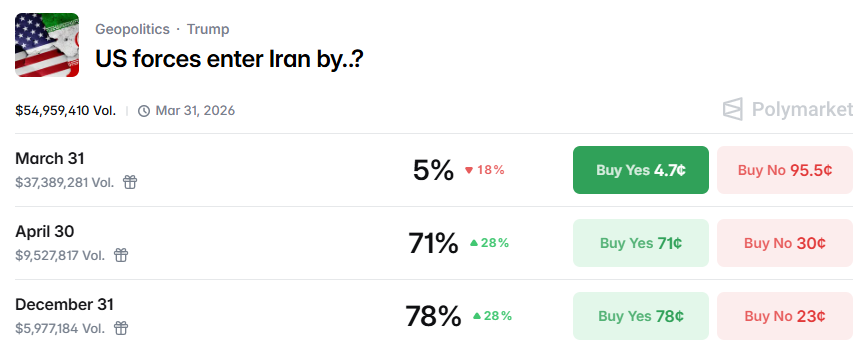
The prediction markets strongly anticipate that the US will have troops on the ground in Iran before the end of April. Given the number of people involved in a military operation of this size and the $55m wagered on this bet, I believe the US will soon be in a full military conflict with Iran. Global energy prices are likely to see even more volatility ahead which could have an even greater impact on all of our lives. As you already know, the longer prices stay higher, the more likely that a recession will occur in 2026. If companies are preparing for a slowdown, they will discuss it in their upcoming Q1 quarterly conference calls. It is unfortunate that the likely great earnings that will be reported will be mostly ignored because of interest in how management teams are planning for $100+ crude oil. Hopefully the July earnings calls will have a better backdrop.
Away from the Gulf, this will be a big week for monthly jobs data. The JOLTS job openings, the ADP employment change, Nonfarm payrolls, Average Hourly Earnings and the Unemployment Rate will all be in focus. March car sales will also be in focus as a bounce in the weather might have offset the 50% jump in fuel prices. But keep an eye out for the EV sales component which might really surprise to the upside. We will give the team an Easter break and return in a couple of weeks. Enjoy your holiday.
The prediction markets are anticipating US troops going into Iran this year. Likely by the end of April…
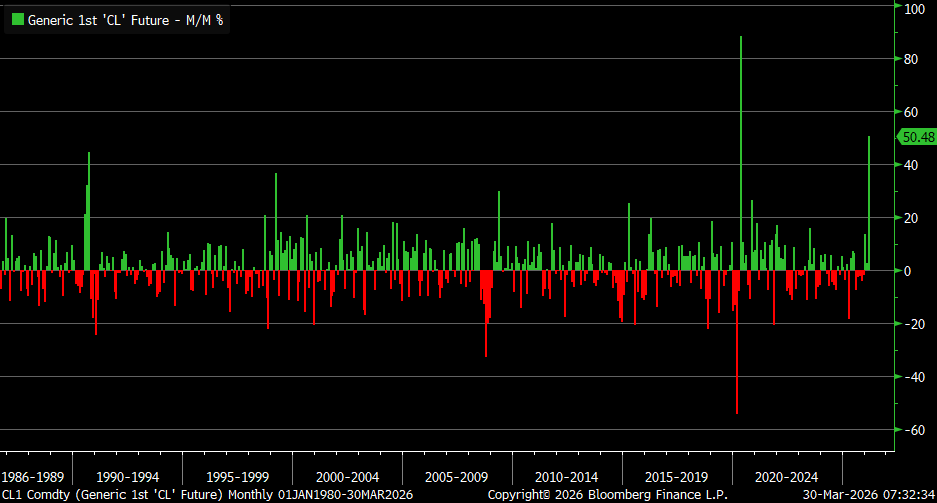
The Persian Gulf conflict is now responsible for the 2nd largest monthly increase in price for American crude oil…
@KevRGordon
The world's largest equity index is now broken…
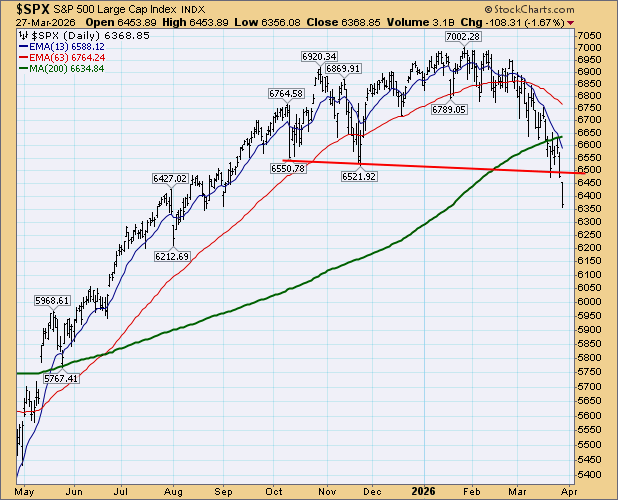
And it is feeling like a bad market…
Zeitgeist II: “In a good market when the index falls below its 200-day moving average investors cover their shorts, but in a bad market that’s when they sell their longs.”
BofA Global/Hartnett
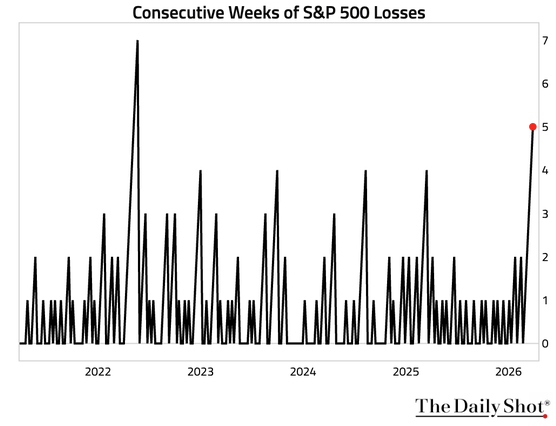
Broken II is the big index falling for five weeks in a row…
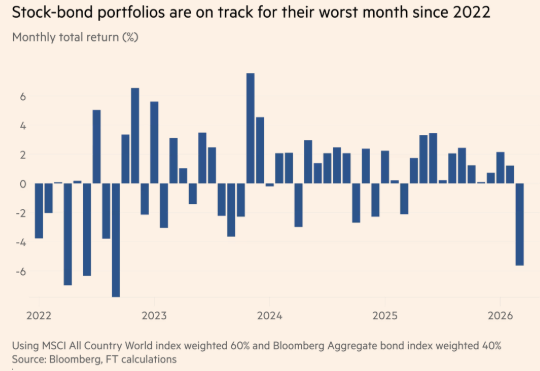
And not just stocks, but bonds are providing no cushion for investors…
Global stocks and bonds have this month suffered their biggest combined sell-off since 2022 as the energy shock unleashed by the Iran war leaves investors “nowhere to hide”.
The MSCI All Country World index, which tracks stocks across developed and emerging markets, has fallen more than 7 per cent in March as the outbreak of war in the Middle East and de facto closure of the crucial Strait of Hormuz has caused a surge in energy prices.
At the same time, a broad gauge of global government and corporate bonds has lost more than 3 per cent, as investors bet that central banks will need to raise borrowing costs to contain the inflationary fallout.
The combined moves have put a traditional “60-40” portfolio of equities and bonds on track for the worst month since September 2022, when a previous cycle of global interest rate rises hammered markets. Even gold has tumbled as investors rush to liquidate previously winning trades, underscoring a lack of safe havens in financial markets.
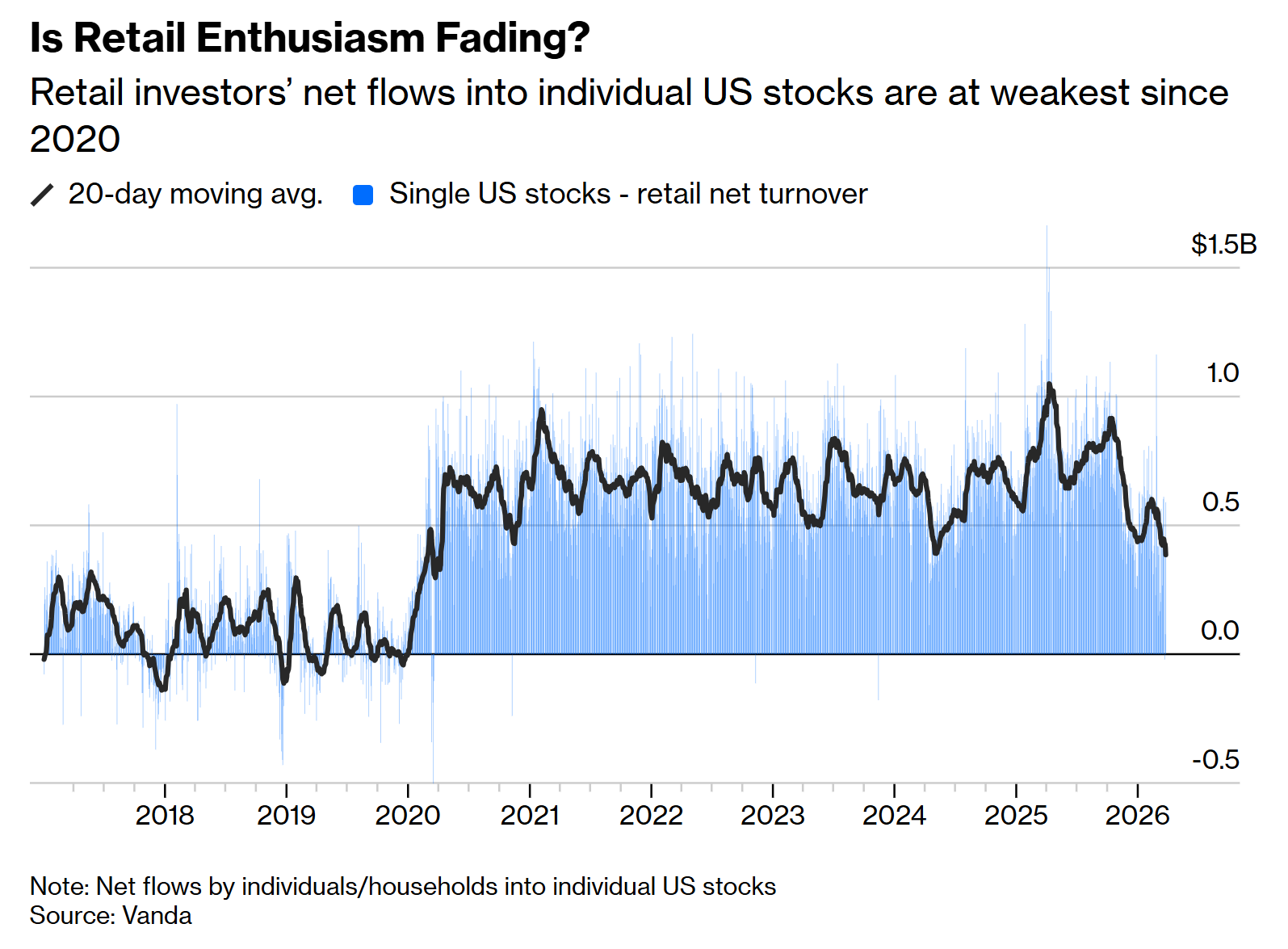
Retail traders have even closed their laptops and smart phone apps…
Where are the Robinhooders? Individual investors, many trading on their phones, have reliably stepped in since 2020 to buy any dip in stocks and push bull runs to extremes, driving valuations to levels previously seen as fanciful. Early evidence suggests that the retail crowd is now in retreat.
Even before the US-Israeli conflict with Iran broke out, net flows from individual investors into single-name US stocks were already slipping, according to Vanda Research data. Robinhood Markets Inc., a retail proxy popular with younger cohorts, reported that its average daily equities trading volume fell 11% in February from the previous month; its stock ended last month down by half from its October highs.
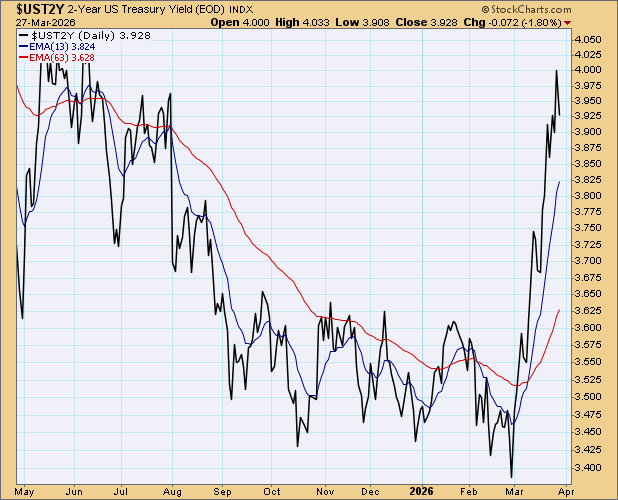
Who knew one could lose so much in short term US Treasuries in only a month?
Even the US Treasury auctions are getting a bit spicy…
The $30tn US Treasury market is showing growing signs of strain, as turmoil in the Middle East drives swings in bonds that underpin the financial system.
The ease of trading in the world’s biggest and most important financial market has deteriorated in recent weeks, even as dealing remains fluid, according to Wall Street banks and investors.
The pressure in markets suggests some investors are pulling back from trading Treasuries as the war in Iran prompts the most serious bout of volatility since President Donald Trump’s so-called liberation day tariff announcement shook Treasuries last April…
Investors and policymakers keep close tabs on the Treasury market’s functioning since it acts as vital benchmark for global borrowing costs…
US government auctions of new shorter-dated bonds have also gone poorly this week. At Tuesday’s sale of $69bn worth of two-year bonds, dealers — the big banks that are forced to mop up any bonds not purchased by investors — took the largest percentage of the offering since 2022.
The same pattern was seen at Wednesday’s auction of $70bn of five-year notes, where dealers purchased the most since 2024. An auction of seven-year notes on Thursday was moderately better, but still weak by historical standards.
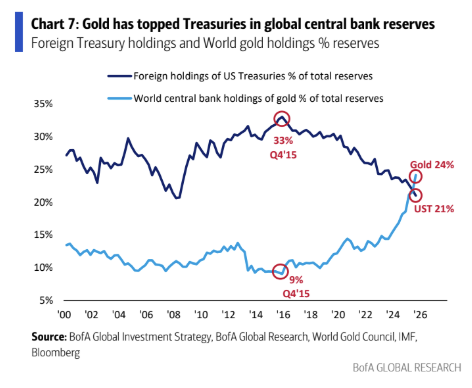
Not helping is that US Treasuries have become less relevant to global central banks…
BofA Global
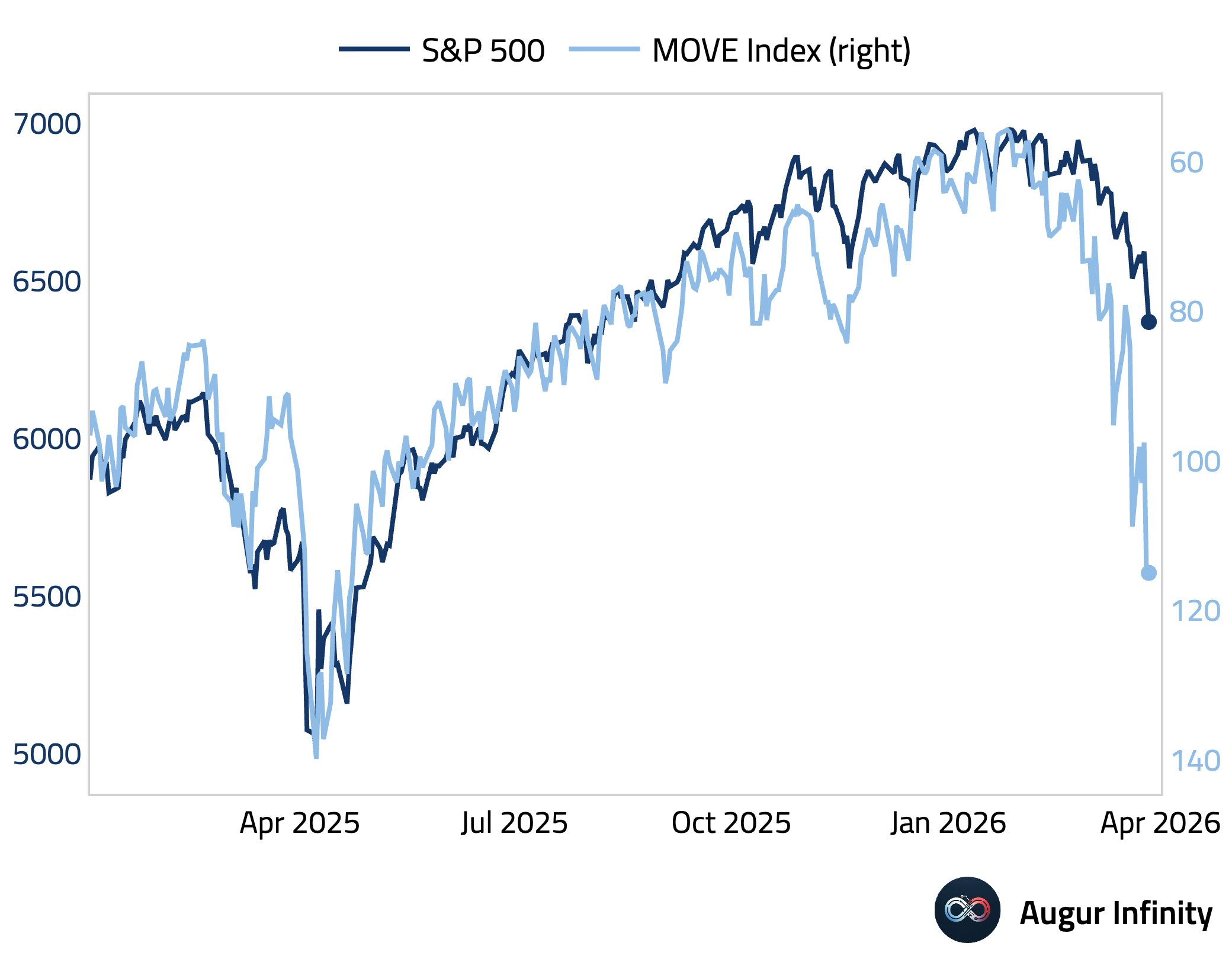
Is the MOVE Index (Treasury implied volatility) sending a more bearish signal for equities?
Rapid increases in Treasury bond volatility is how former US Treasury Secretaries kept their waistlines in check. Just ask Former Sec. Paulson or Geithner.
@AugurInfinity
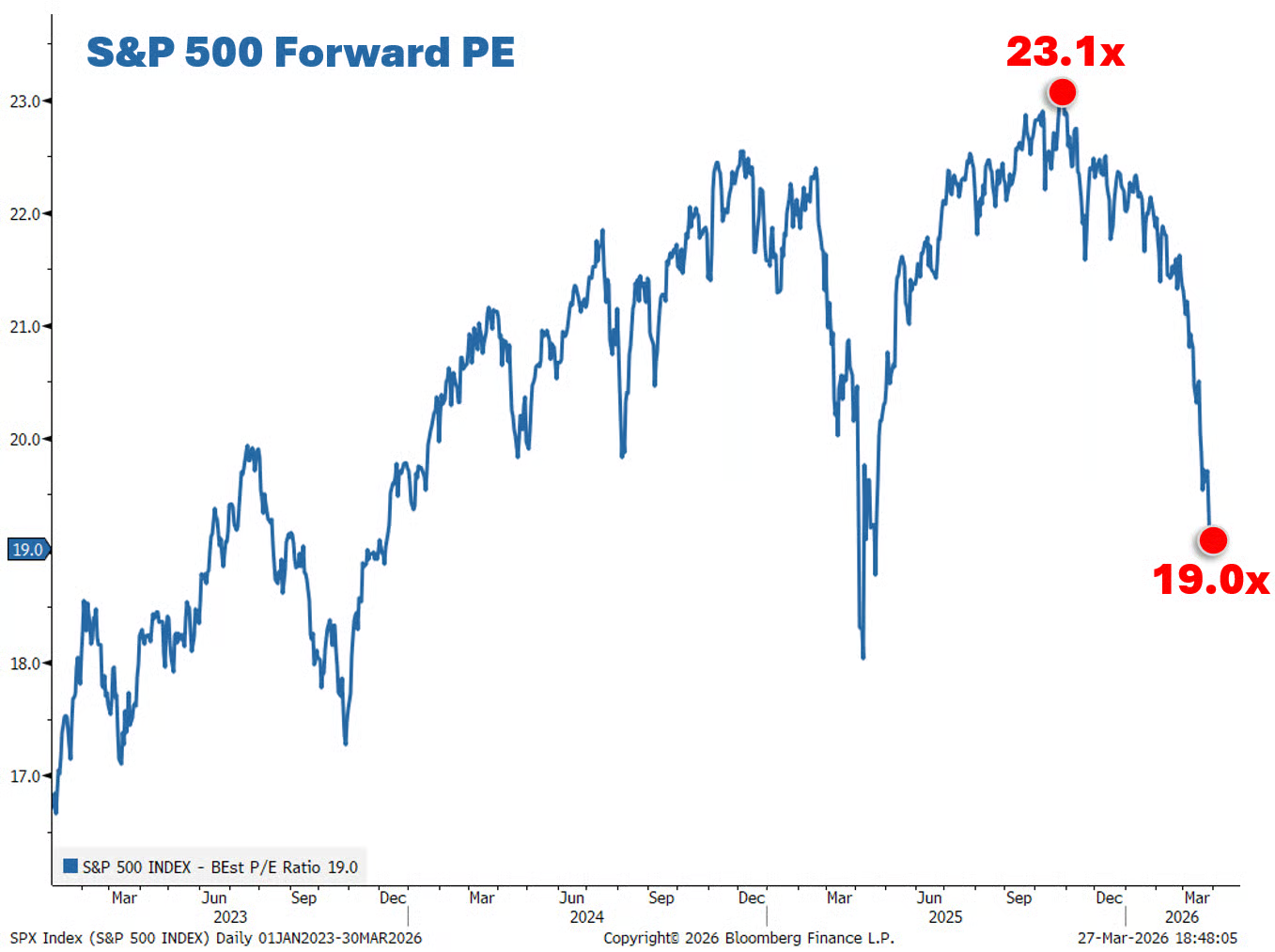
Stock prices move before earnings…
As the S&P 500 P/E multiple has collapsed by four points, the market is trying to tell us that the 'E' is likely incorrect. Companies have not yet told us what is happening to their future earnings. Wall Street analysts have not updated their models yet. And strategists have not updated their S&P 500 index targets. So many question marks around these 'have nots' has increased uncertainty and lowered risk appetites.
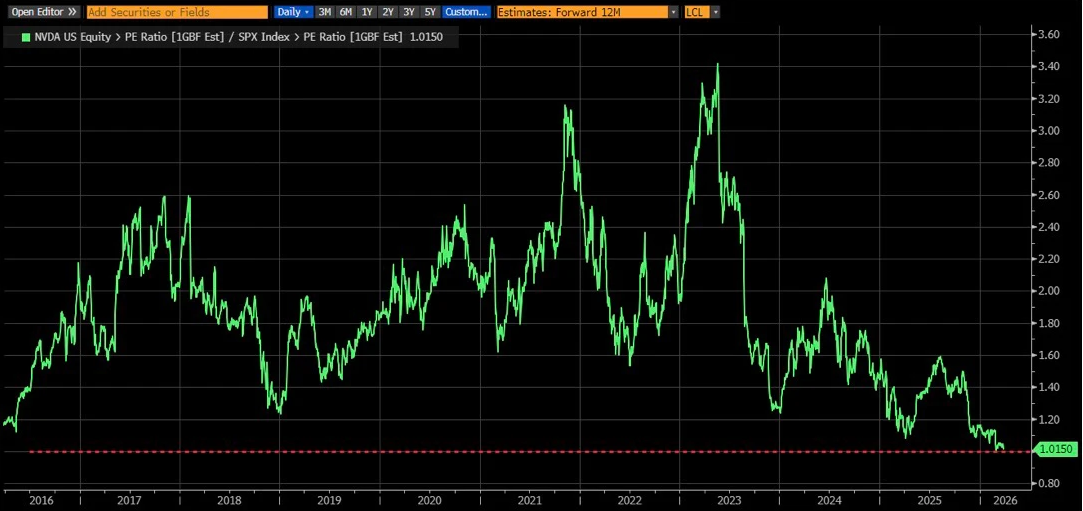
Even the Godzilla of the US stock market is now trading at the same P/E multiple of the S&P 500 index…
GOLDMAN DESK: “.. Nvidia now trades at par / slight discount to the S&P500 on fwd P/E for the first time in 10+ years... yes, Nvidia is now trading at par with the S&P500 on fwd P/E despite, Nvidia alone expected to contribute to ~21% of the indices growth in 2026."
@carlquintanilla.bsky.social
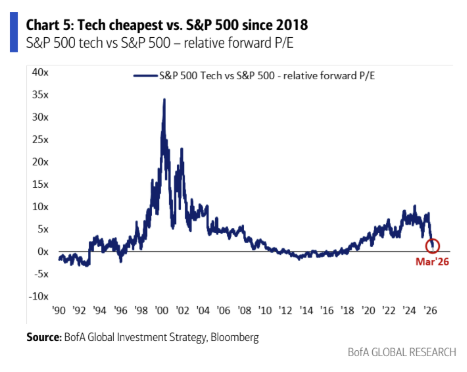
And not just Nvidia, but the entire Technology sector…
BofA Global
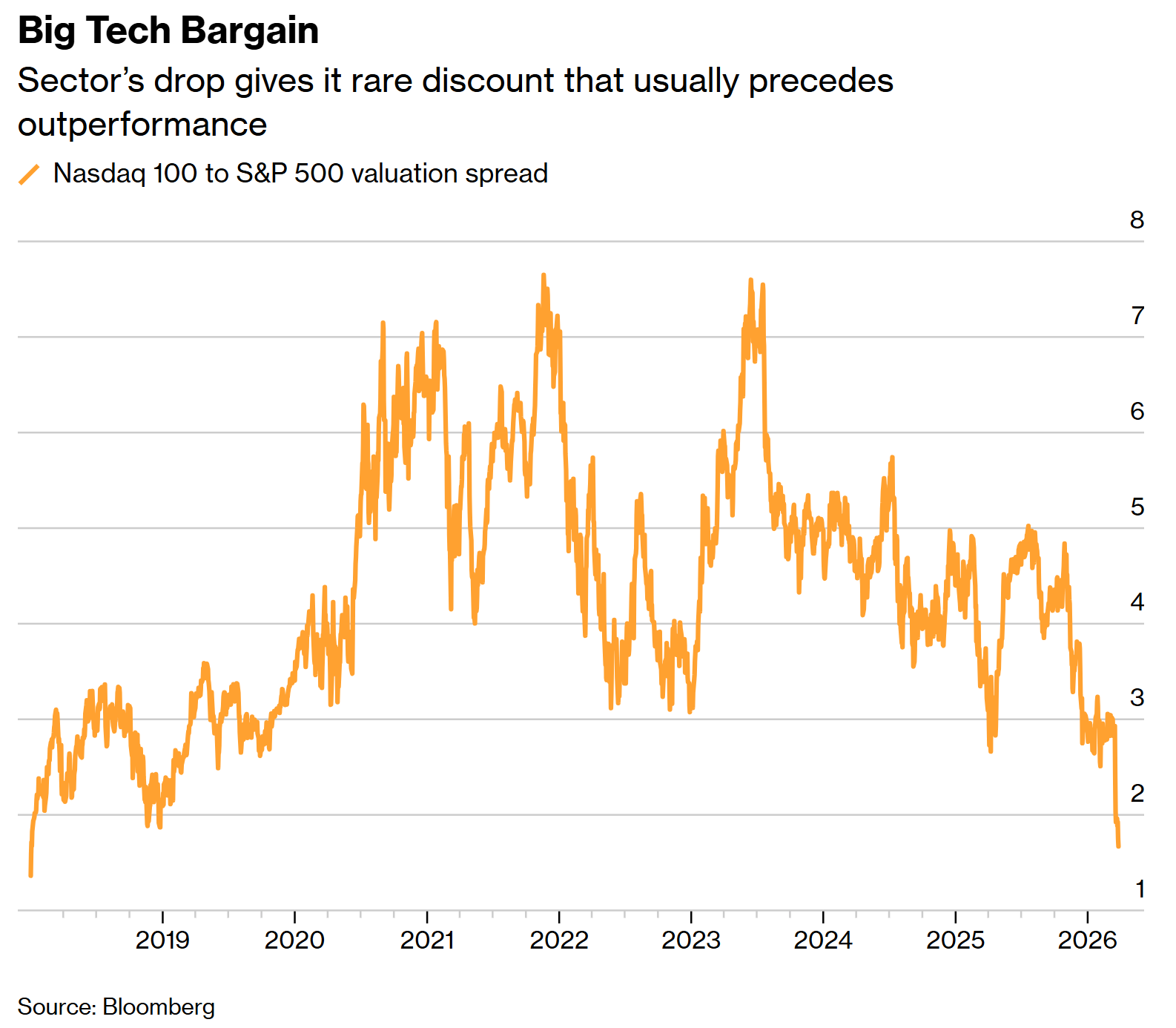
So when to go back to buying technology? Many on Wall Street think that you are close…
After an 11% slide from its last record in October, the tech-focused gauge now trades at 21 times projected 12-month earnings, just 1.7 points above that of the S&P 500 Index. A gap that narrow has appeared only a quarter of the time during the aftermath of the dot-com bust at the turn of the century, data compiled by Bloomberg show. The last time the index’s valuation premium to the broader market was this low, the Nasdaq 100 proceeded to outperform the S&P 500 by the most in a year.
Of course, the economic uncertainty created by the Iran war is threatening to render mute many trusted market signals of the past, and only time will tell if that’s the case with this one. Still, Big Tech’s time-honored history of leading the market and being its profit engine has many Wall Street strategists studying the oversold signals piling up and recommending the sector as the best place to be.
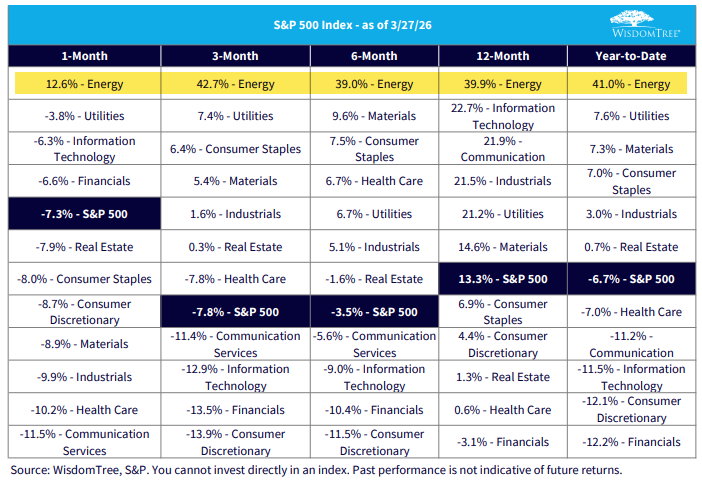
But for now, there is only one industry sector on top of all of the performance mountains…
But the longer the Strait of Hormuz stays closed, the more the world will move away from oil and gas…
If the strait stays closed, the world will have to significantly reduce its oil and gas consumption — but not before prices spike to a level that forces consumers and businesses to fly, drive and spend much less. Already, demand has begun to drop, and some countries in Asia are hoarding and rationing fuel. US government officials and Wall Street analysts are starting to consider the prospect that oil prices might surge to an unprecedented $200 a barrel…
For the global economy, the shock from the Iran war has already begun. Bloomberg Economics’ big data price tracker puts the US CPI for March at 3.4% year on year – a marked increase from 2.4% in February, and with rising fuel prices the main culprit…
If the strait remains closed for a second month, traders and analysts say they expect global energy markets will quickly evolve into a fight for supplies, driving up prices and benefiting buyers and countries that are able to outbid others…
But if the Strait of Hormuz stays closed too far into the second quarter, the risk is that oil prices move sharply higher. At $170 a barrel, the impact on inflation and growth roughly doubles — a stagflationary shock that could shift everything from the path ahead for central banks to the outcome of the US midterm elections…
“If you think about the magnitude of the shock coming out of the Gulf right now, you could lose between 5-10 million barrels a day of demand, which will have a significant impact similar to the seventies,” said Jeff Currie, chief strategy officer of energy pathways at Carlyle Group Inc. “The main message is that we’re going to get the energy transition forced on us in a very painful way that’s going to happen very quickly.”
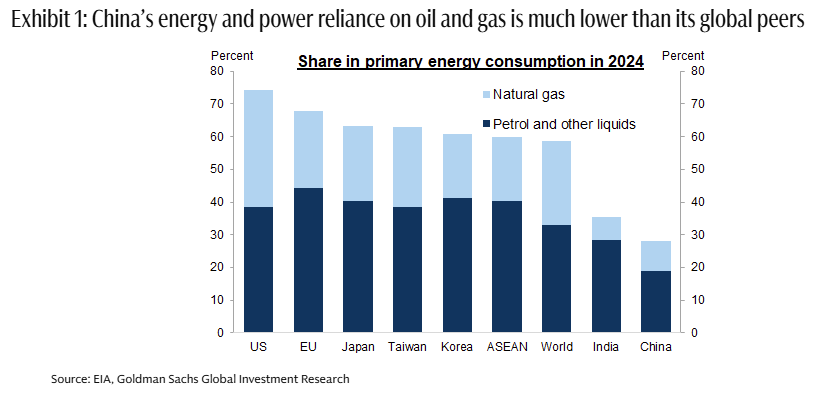
High Oil and Gas prices affect China the least among the world economies…
The Chinese economy appears better positioned amid the oil supply shock than its global peers, owing to its: a) strategic energy diversification efforts, with crude oil and LNG accounting for 28% of China's primary energy consumption in 2024, one of the lowest in the world. On the flip-side, alternative/renewable energy, notably nuclear, wind, solar, and hydro, now represents 40% of China's electricity generation, up from 26% a decade ago; b) rising oil reserves, encompassing strategic and commercial stockpiles, are close to 1.2bn barrels based on official statistics, sufficient for +110 days of oil consumption assuming the entire crude imports fall to zero; and, c) continued access to oil and gas supply from energy producing nations outside of the Middle East region, Russia, Australia, and Malaysia in particular.
Goldman Sachs
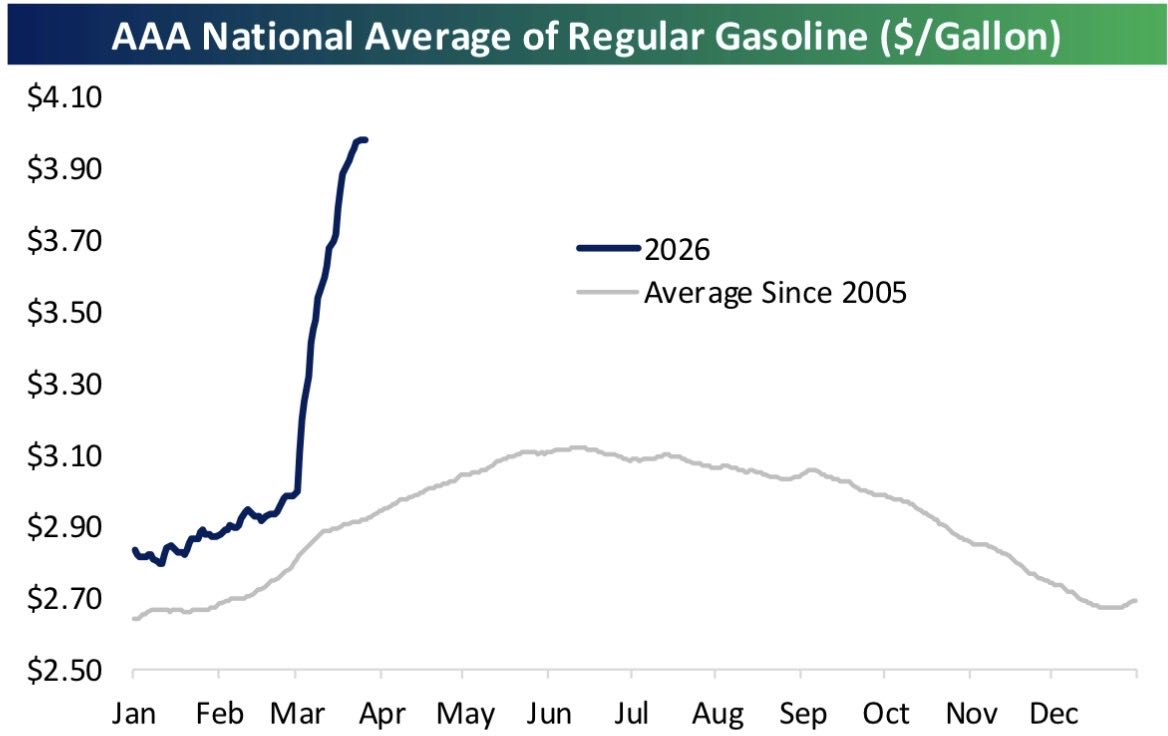
But if you own a gas-engined vehicle, get ready to spend more on fuel…
@bespokeinvest: The Iran war’s impact on US consumers in one chart:
Energy prices disproportionately affect low-income consumers…
“When gasoline prices jump, families—especially those with lower incomes who spend a larger share on essentials—have less money for everything else. The longer energy prices remain elevated, the more households will need to confront tradeoffs. Families who depend on petroleum products to commute to jobs and school and to heat their homes may need to pull back on more discretionary forms of spending. That could potentially result in lower spending at restaurants or retailers. It could also result in households carrying elevated levels of debt.” - Federal Reserve Vice Chair Philip Jefferson
As global aluminum goes into a shortage, the biggest buyers are turning to Russia. Wait, what?
The war in the Middle East has triggered “panic buying” of aluminium by some of the world’s biggest carmakers amid fears that supplies could run out within months if the conflict persists.
Gulf producers, including Aluminium Bahrain and Qatalum, have cut production, with disruption to power supplies and shipping bottlenecks hitting both raw material imports and exports. Aluminium is widely used in industries from carmaking to aerospace and construction.
Executives at car parts companies and aluminium producers said carmakers were trying to build up contingency stocks as the war enters its fourth week.
“If the situation continues, there will be more panic buying,” said an executive at an aluminium producer. “We have lived through crises in the past, but this one is very different.”…
Traders in Japan said the country’s carmakers and suppliers were also considering buying supplies from Russia, having chosen to boycott the country since its full-scale invasion of Ukraine in 2022.
“We don’t really want to take supplies from Russia but we have no choice but to,” said one Japanese trader.
Aluminum isn't the only input shortage for liquid containers…
Global brewers operating in India are warning of price increases and supply disruptions as a shortage of gas due to the Iran war drives up the cost of glass bottles and shipping delays hit imports of aluminium needed by can makers.
India is especially vulnerable to fuel availability as the world's fourth-largest importer of natural gas, relying heavily on the Middle East for shipments, sourcing about 40% of its supply from Qatar…
The Brewers Association of India, representing global brewers Heineken, Anheuser-Busch InBev and Carlsberg told Reuters that glass bottle prices have surged around 20%, paper carton rates have doubled as well as other packaging materials such as labels and tape…
Nitin Agarwal, CEO of Fine Art Glass Works in Firozabad, a glass-making hub in northern Uttar Pradesh state, said he has cut production by 40% at his glass bottle making factory due to gas shortages. His customers include many liquor companies as well as producers of juice and ketchup bottles.
"We've cut production and increased prices by 17-18%," Agarwal said.
The shortages have already affected India's $5 billion bottled water market with some producers increasing prices by 11% due to rising rates of plastic bottles and caps.
Petroleum based products like PVC and MDI are risks to future housing costs…
Polyvinyl chloride (PVC) is a widely used, durable, and cost-effective synthetic plastic, commonly found in construction (pipes, window frames). Methylene diphenyl diisocyanate (MDI) is a highly reactive, versatile aromatic diisocyanate essential for producing polyurethane foams, rigid insulation, adhesives, and sealants.
MDI and PVC present the clearest near-term inflation risks within housing inputs. MDI is a key input in mattresses, OSB and spray foam insulation and PVC is a key input in flooring and commercial roofing/siding. MDI prices are up approximately 40% in China and ~25% in the US spot market, with contractual pricing typically lagging by one to two quarters. PVC prices have increased 30–35% internationally, reflecting higher electricity driven Cl costs and elevated ethylene/methanol inputs. US contract pricing has lagged, but spot prices are moving higher, which could impact LVT flooring, pipes, siding, and commercial roofing. Polyethylene pricing has moved sharply higher in Asia despite weak demand, and although US producers remain cost advantaged, they are hiking prices too. That said, durability of these increases appears lower if geopolitical pressures ease. Coatings seem more manageable, and our chemicals team sees 5% inflation starting in 2H26 for the basket of commodities used in coatings (which includes TiO2).
BofA Global
H.B. Fuller is a global leader in the formulation and manufacturing of adhesives, sealants, and coatings and is needing to make many adjustments for the war…
“This conflict is already creating significant constraints on raw material availability with impacts that extend across feedstocks, intermediates, logistics lanes, and energy inputs. We have received over 40 force majeure letters from suppliers in recent weeks, clear evidence that this is a major disruption. Chemical production capacity has decreased significantly, and tanker routes have been disrupted and repositioned.” - H.B. Fuller CEO Celeste Mastin
Semiconductor and MRI machine manufacturers are going to also have to slow down their work…
Most Americans think of helium as the gas that holds balloons aloft, but, more important, it is an essential coolant in MRI machines and semiconductor manufacturing.
The U.S. produces the most helium, yet Qatar accounts for about 35% of world capacity. If its output remains offline for another four to eight weeks, supplies will be stretched and could cause problems for chip makers, said François Jackow, chief executive of industrial gas supplier Air Liquide.
“Any shortage of helium supply to this industry, which is probably one of the most critical, would definitely limit the production of those most advanced chips,” he said this week on the sidelines of S&P Global’s CERAWeek energy and mining conference in Houston. “Given what’s at stake today, that could be a major challenge for the world.”
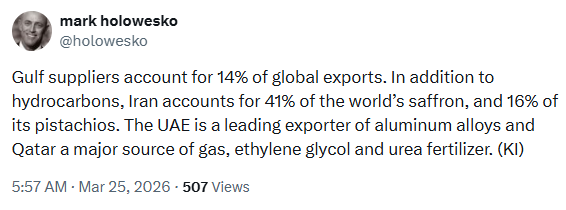
And if you are an Indian cuisine or Spanish paella foodie, you had better begin hoarding saffron…
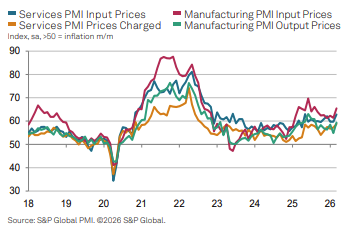
Last week's S&P Global PMI report showed surging input prices to their highest level since May 2025…
Prices paid for inputs meanwhile spiked higher, due principally to the energy price jump caused by the war. Overall average input costs rose to the fastest degree for ten months. Higher costs were passed on to customers to generate the largest rise in selling prices in over three-and-a-half years. Rates charged for services rose on average at a rate not seen since August 2022 while goods prices increased at the sharpest rate last August.
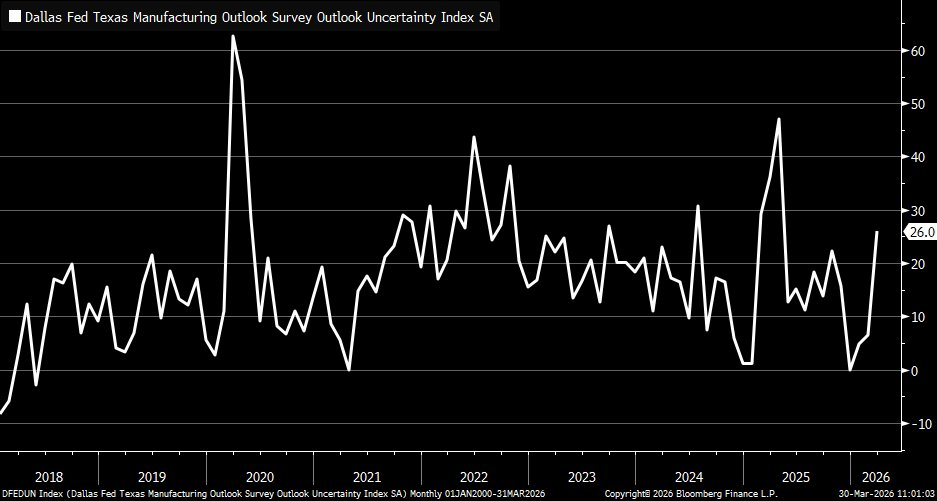
Fresh data from the Dallas Fed noted that manufacturer uncertainty spiked in March to the highest levels since the tariff ramp up last spring…
@KevRGordon
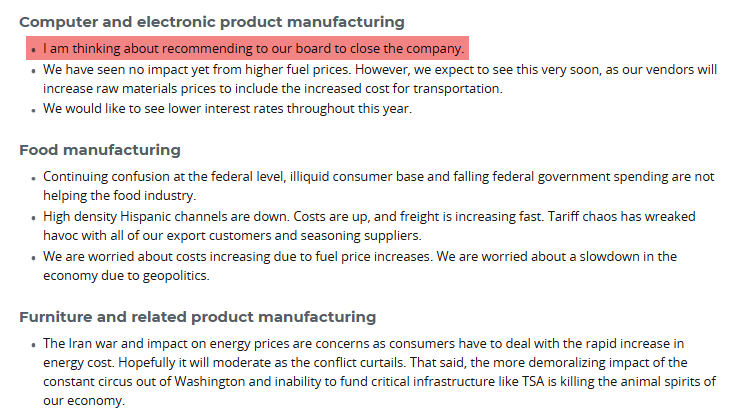
More concerning comments in today's Dallas Fed Survey, but the highlighted one gets the mic drop…
A brutal 8% price increase for any small business that ships packages via USPS…
The U.S. Postal Service is seeking a temporary 8% charge on certain popular products, including Priority Mail, to help blunt the impact of rising transportation costs.
USPS filed notice on Wednesday with the Postal Regulatory Commission seeking the price increase, which would take effect on April 26 and remain in place until Jan. 17, 2027, pending final approval.
“This temporary price adjustment will provide needed flexibility for the Postal Service by helping to ensure that the actual costs of doing business are covered, as required by Congress,” the agency said in a news release, noting that its competitors have reacted to rising fuel prices with “a number of surcharges.”
Some companies are preparing for a recession…
“Because, as you know, in a business like ours, we rise and fall with the state of the economy, and a sort of global recession would be, you know, a pretty ugly situation to be in, even though on a relative basis. In the U.S., we would stand to position ourselves better than most.” - Phillips 66 CFO Kevin Mitchell
Onto the micro, Meta Platforms' loss in the LA Courts last week will lead to platform changes…
The entire case was built around the design. Infinite scroll, autoplay, algorithmic feeds, notification systems. Those are not user posts. Those are the company's own engineering decisions, made in their labs, tested on their servers, optimized by their employees. CBS News put it plainly: this case centered around how the apps are designed, not the content itself. Section 230 does not protect you from your own product choices.
The jury answered yes to seven specific questions per defendant. Were they negligent in the design or operation of their platforms? Was that negligence a substantial factor in causing harm? Did they fail to adequately warn users? And did they act with malice, oppression, or fraud? That last finding triggered punitive damages.
The pipe (aka the Social Media platform), not what flows through it. That argument won and opened new legal ground that can change everything that comes next.
If the design is the defect, the remedy is redesign. Not a warning label. Not a terms of service update. The product itself has to change.
Even with the conflict in the Middle East accelerating, the M&A market activity continued to pick up…
$75 billion in volume across 14 M&A deals. 10 public company acquirers and 7 private company sellers.
- Sysco (SYY) said it would buy catering supplier Jetro Restaurant Depot in a $29 billion deal, including debt, expanding the top U.S. food distributor's reach among price-conscious independent restaurants. The companies said Restaurant Depot shareholders will receive $21.6 billion in cash and 91.5 million Sysco shares, which equate to about $7.5 billion as of Friday's close, giving them a roughly 16% stake in the combined company. Family owned Jetro Restaurant Depot operates a wholesale cash and carry model, where customers pay upfront for goods such as food, beverages and takeaway containers, complementing Sysco's delivery network serving restaurants, hospitals and hotels. The deal would help Sysco enter the higher-margin "cash-and-carry" business, where Restaurant Depot has about 166 warehouse locations across 35 U.S. states.
- US insurers Equitable Holdings Inc. (EQH) and Corebridge Financial Inc. (CRBG) are set to merge in an all-stock deal valuing that combined business at $22 billion. The retirement, asset and wealth management giant would be called Equitable and manage $1.5 trillion in assets, with more than 12 million customers. Corebridge had a market value of about $12 billion as of close on Wednesday, while Equitable had a capitalization of roughly $11 billion.
- Merck (MRK) has reached a nearly $6 billion cash deal to buy the cancer biotech Terns Pharmaceuticals (TERN) and its promising leukemia treatment. If it proves to work safely, the experimental drug would give Merck a boost as the company prepares for its top-selling drug, Keytruda, to lose patent protection. Under the terms, Merck would pay $53 a share for Terns a 6% premium to its closing price. The deal is worth $5.7 billion including the cash that Terns has on hand.
- Apollo Global Management has agreed to acquire Nippon Sheet Glass (5202.jp) marking its largest private-equity investment in Japan to date, totaling about $3.7 billion in enterprise value. The U.S. asset manager said that its funds would invest equity to support the Japanese company’s financial position and long-term growth. Apollo said that Nippon Sheet’s principal lenders would effectively swap a portion of their outstanding loans for equity to shore up its balance sheet. The U.S. asset manager expects the Japanese company to capture rising demand for architectural glass, automotive glazing and solar products thanks to its manufacturing capabilities and deep customer relationships.
- Brookfield Asset Management and Caisse de Depot et Placement du Quebec are teaming up to buy Boralex (BLX.ca) in a deal worth about 3.8 billion Canadian dollars, the equivalent of US$2.76 billion, that aims to accelerate the Canadian renewable energy company’s growth as a private company. Boralex’s shareholders will receive C$37.25 a share in cash, which marks a 32% premium to the closing price. Quebec pension fund Caisse, Boralex’s largest shareholder with a roughly 15% stake, will double its interest in the company, and Brookfield through its flagship infrastructure strategy will buy the remaining 70% of Boralex. The deal implies a total enterprise value of C$9 billion, including project and corporate-level debt.
- Private-equity giant KKR has struck a deal to acquire the U.S. bakery chain Nothing Bundt Cakes from Roark Capital for over $2 billion, including debt, according to people familiar with the matter. Nothing Bundt Cakes was started by two mothers in 1997. The business has since expanded to hundreds of locations around the country. Roark acquired the Dallas-based chain in 2021. The bakery chain is largely franchised, a business model that private-equity firms have been attracted to because it can offer predictable revenue streams.
- Gilead Sciences (GILD) plans to acquire Ouro Medicines, a developer of autoimmune-disease therapies, for up to about $2.18 billion and develop the assets from the deal in a collaboration with Galapagos. Under the terms of the deal, Gilead would buy all of the outstanding equity of Ouro for about $1.68 billion in cash upfront, which is payable at closing, and up to $500 million in contingent milestone payments. The acquisition adds OM336 (gamgertamig), a clinical stage BCMAxCD3 T cell engager, to Gilead’s growing inflammation portfolio.
- Swiss drugmaker Novartis (NVS) will buy California-based biotech company Excellergy in a deal worth up to $2 billion extending its anti-allergy range and in line with plans to increase its U.S. focus. Excellergy's food allergy drug candidate, Exl-111, would extend Novartis' existing anti-allergy franchise, which includes its blockbuster Xolair, used for allergic asthma and other conditions, that faces increased competition in some EU markets.
- Germany's Henkel (HNKG.de) agreed to buy Nasdaq-listed Olaplex (OLPX) in a $1.4 billion deal to strengthen its premium hair care business. The acquisition is equivalent to 3.3x EV/sales, 15x EV/EBITDA and 23x P/E. Olaplex is a premium haircare brand, with 50% of its sales in the US. The brand generated €370m in sales in FY25. The price paid is a premium of about 55% over Wednesday's closing price.
- Two Harbors Investment Corp. (TWO) has terminated its merger agreement with UWM Holdings Corp. (UWMC) and instead agreed to be acquired by rival CrossCountry Intermediate HoldCo in an all-cash deal valued at $10.80 per share. The revised offer from CrossCountry values the company at approximately $1.13 billion, up from its prior $10.70-per-share bid. The all-cash deal is lower than UWM’s earlier $1.3 billion proposal, which was structured as a stock transaction with a fixed exchange ratio of 2.3328 shares of UWMC Class A common stock for each share of TWO stock.
- Flex (FLEX) to acquire Electrical Power Products, Inc., a leading provider of engineered-to-order electrical power control and protection systems. The all-cash transaction is valued at approximately $1.1 billion. EP2 has more than 35 years of experience designing, integrating, and manufacturing highly engineered control and relay panels and modular, integrated control buildings for utility, power generation, and industrial customers. EP2 serves a diverse set of longstanding customers and operates a scaled manufacturing campus in Des Moines, Iowa. EP2 is expected to generate revenue of approximately $323 million in fiscal year ending March 31, 2026, with anticipated double digit organic growth and a mid to high-teens adjusted EBITDA margin profile.
- SRS Distribution Inc., a subsidiary of The Home Depot (HD), has entered into a definitive agreement to acquire Mingledorff's, Inc., a leading wholesale distributor of heating, ventilation and air conditioning (HVAC) equipment, parts and supplies, serving residential and commercial customers through 42 locations in five states across the southeastern U.S. Mingledorff's reportedly generated approximately $1 billion in revenue in 2024.
- Vertiv (VRT), a global leader in critical digital infrastructure, today announced it has entered into an agreement to acquire ThermoKey S.p.A., a leading provider of heat rejection and heat-exchange technologies with long-standing relationships across original equipment manufacturers (OEMs) and system integrators, as part of Vertiv's continued investment in advanced cooling solutions to support high-density AI data centers. Founded in 1991 and based in Italy, ThermoKey brings more than three decades of engineering and manufacturing experience in heat exchangers for data center cooling and other demanding applications.
- Uber Technologies Inc. (UBER) has agreed to buy the chauffeur booking app Blacklane, the company’s latest move to court a high-end clientele. The deal will expand Uber’s offerings targeting business executives and wealthy consumers, a fast-growing segment of the business. Financial terms were not disclosed. Berlin-based Blacklane, whose backers include Mercedes-Benz Mobility AG, operates in more 500 cities across more than 60 countries through a mobile app and web booking platform. The purchase is set to bolster Uber Elite, which the rideshare giant is so far offering to frequent Uber Black riders and corporate account customers in Los Angeles and San Francisco. Blacklane was founded in 2011 and was valued at more than €500 million ($574 million) after a 2024 funding round.
Various News Sources
This new Scout EV is going to kill it in the US…
Volkswagen has bet $7bn that it can finally crack the American market by reviving a retro American brand of farmyard trucks that kicked off the US obsession with sport utility vehicles…
In an interview with the FT, Scout’s chief executive and VW veteran Scott Keogh said Scout would establish itself as a separate brand in the US, with a view “potentially” to pursuing a public offering in the future.
“Scout was designed to meet this American moment,” said Keogh. “We are bringing back an iconic American brand that basically invented the SUV.”…
Keogh insisted that despite a recent EV sales slump in the US, more Americans could be convinced to go electric as long as their concerns over range were addressed.
He added that the new Scout models’ consciously “1950s and 1960s vibes” served as an acknowledgment that many EV makers had gone too far in removing familiar creature comforts in favour of futuristic touchscreens and electric door handles.
“Americans said, ‘yeah, I’m not into the whole spaceship thing. I’m just like, dude, where’s my truck?’,” Keogh said. “Dude, here is your truck.”

The kids napped me away from the dismal weekend news and took me to two good geek flicks this weekend...
The first is a fun science stuffed film made from the book by Andy Weir. (If you didn't like 'The Martian' then our Venn diagrams have little overlap.) The second is a very timely documentary about the current state and outlook for AI. If you have kids, parents, or friends who have questions or are concerned about AI, this film could help.

Learn more about the Hamilton Lane Strategies
DISCLOSURES
The author has current equity ownership in: Nvidia Corp.
The information presented here is for informational purposes only, and this document is not to be construed as an offer to sell, or the solicitation of an offer to buy, securities. Some investments are not suitable for all investors, and there can be no assurance that any investment strategy will be successful. The hyperlinks included in this message provide direct access to other Internet resources, including Web sites. While we believe this information to be from reliable sources, Hamilton Lane is not responsible for the accuracy or content of information contained in these sites. Although we make every effort to ensure these links are accurate, up to date and relevant, we cannot take responsibility for pages maintained by external providers. The views expressed by these external providers on their own Web pages or on external sites they link to are not necessarily those of Hamilton Lane.