
Weekly Research Briefing: Bring on the Heat

US outdoor temperatures won't be the only thing elevated this week. Q1 earnings reports continue to fuel higher forward earnings expectations. This has led to a surge in stock prices for the sectors and industries that have benefitted. While energy prices remain high, most investors are cool about the long-term effects, believing the dispute in Iran will settle and the Strait will reopen. Friday's non-farm payroll additions, which beat expectations for the second month in a row, helped ease nerves about energy's impact on the macro economy.
As you will see below, high energy prices are beginning to impact earnings commentary, especially regarding consumer sentiment and spending. This affects many companies that sell directly to customers, whether through small purchases (McDonald's) or big ones (Whirlpool). As expected, consumer-facing stocks are significantly underperforming the market right now. This could create opportunities for those investors wanting to build a return to normal oil price stock basket or even for a GP looking to acquire one of their most favorite brands. Big rotations like this can lead to potentially epic gains and wins in the future.
For now, the capital markets are lining up a solid list of private companies to go public. Expect to see many names in the news through month-end as IPO buyers scramble to get the shares they want. Any big gains will fuel the future mega-AI IPO listings expected later this summer and into year-end. It should be a busy summer of new filings and listings, which is tough news for any junior investment banker's summer holiday travel plans. Experience now, winter vacation later. Have a great week.
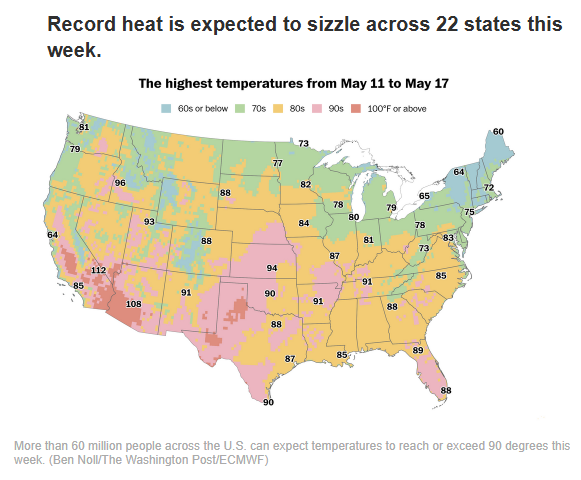
This is just an early warm up to the Super El Niño building in the Pacific Ocean which will scramble the earth's weather for the next 18 months…
Temperatures are forecast to top 90 degrees for 60 million people and 100 degrees for 13 million more. The heat will hit the West first then spread east. Use this week's heat as an early warning to clear all vegetation away from your living structures before the big heat hits later this summer.
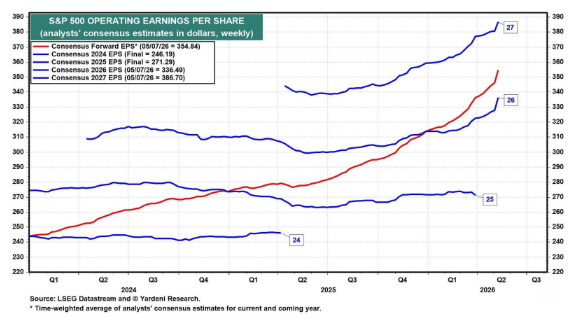
The most important thing in the market right now remains earnings outlooks which continue to move higher…
We reiterate that the upward revisions to consensus 2026 and 2027 earnings estimates have been impressive, as companies have been reporting stronger-than-expected earnings results. Consequently, S&P 500 forward earnings has been rising at an accelerating pace. By definition, it will converge with the consensus 2027 estimate at the end of the year. The latter is already at $386.70.
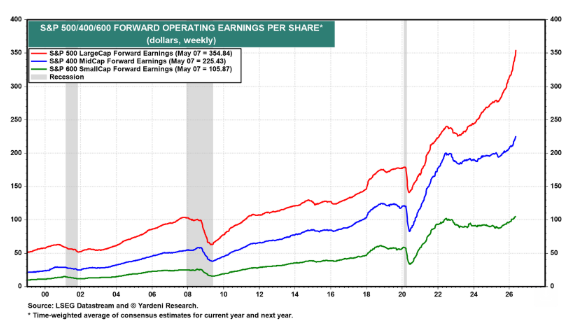
While the largest companies have dominated the news flow this earnings season, the smaller caps are also participating…
This chart shows the broadening out of rising earnings expectations into the middle and smaller cap companies in recent weeks.
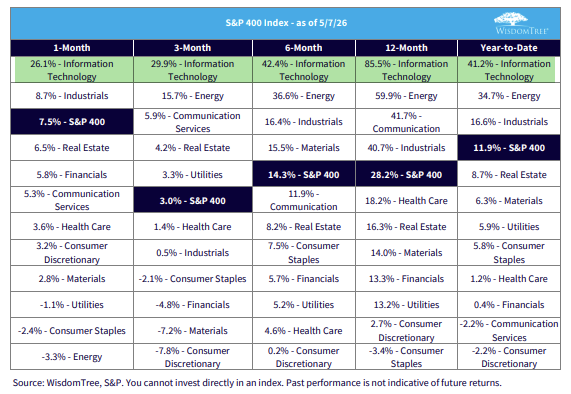
And don't think that it is only the biggest technology companies that are being rewarded…
Any owner of the midcap technology sector is probably also pleased with their portfolio right now.
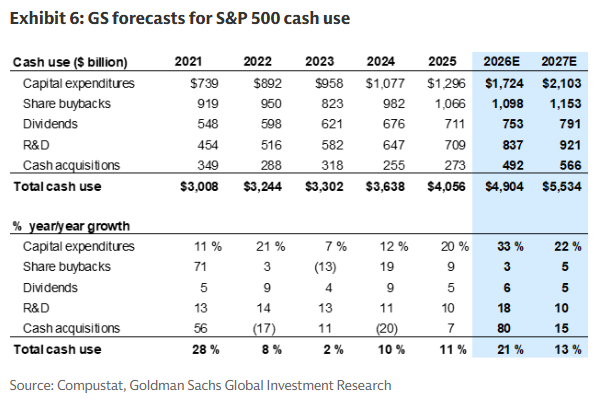
As corporate cash use shifts toward capex and acquisitions, it slides away from stock repurchases and dividends…
Our updated cash spending forecasts point to a continuation of the trend toward investing for growth. We forecast S&P 500 capex spending of $2 trillion in 2026 (+33% vs. 2025) alongside buybacks of $1 trillion (+3%). Our estimates show companies allocating roughly 55% of cash spending to capex and R&D and 35% to buybacks and dividends, compared with the 10-year averages of 43% and 46%. Cash M&A should grow by +80% in 2026. In 2027, we expect a slowing pace of hyperscaler capex growth to cause a deceleration in aggregate S&P 500 capex spending, while hyperscaler and broad S&P 500 buyback growth will likely remain minimal.
Goldman Sachs
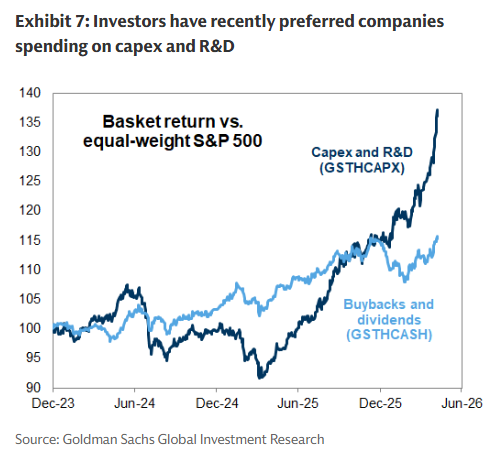
But investors are in a rewarding mood for those investing into new growth areas right now…
Goldman Sachs
I thought this was a helpful answer for those looking to size up total Tech capex spending…
Could you expand on your views around Tech CapEx and where we go from here?
Hyperscaler CapEx has been a core theme for the S&P 500 for the last two years. Now, CapEx is expected to grow 60-70% this year. This rapid expansion in CapEx spending over the next year is driving not only strong price momentum, but also economic and earnings growth.
S&P 500 companies that are tied to AI were spending roughly around $550 billion on R&D and CapEx in 2023, and is now expected to grow to $1.3-1.4T over the next year. This figure only includes US large-caps, and does not include private companies, non-US companies, and spending by sovereigns. If you include spending from all players including adjacent industries, the annual tech investments should be over $2 trillion. By 2027, we are going to get to a point where spending will likely approach levels comparable to global military spending, which is very large…
Roughly 20% of S&P 500 companies are tied to tech hardware and semis, which are benefiting from all of the spending, so they're monetizing this AI capex boom. The other 20% is hyperscalers and these companies plus a few private players are driving >80% of the CapEx spending. From everything we are seeing now, the market is short compute and these companies should earn a significant ROI when new compute capacity comes online.
Bhupinder Singh — Head of US Equity Strategy and Thematic Research, J.P. Morgan
But the market is really rewarding the makers of the picks and shovels right now…
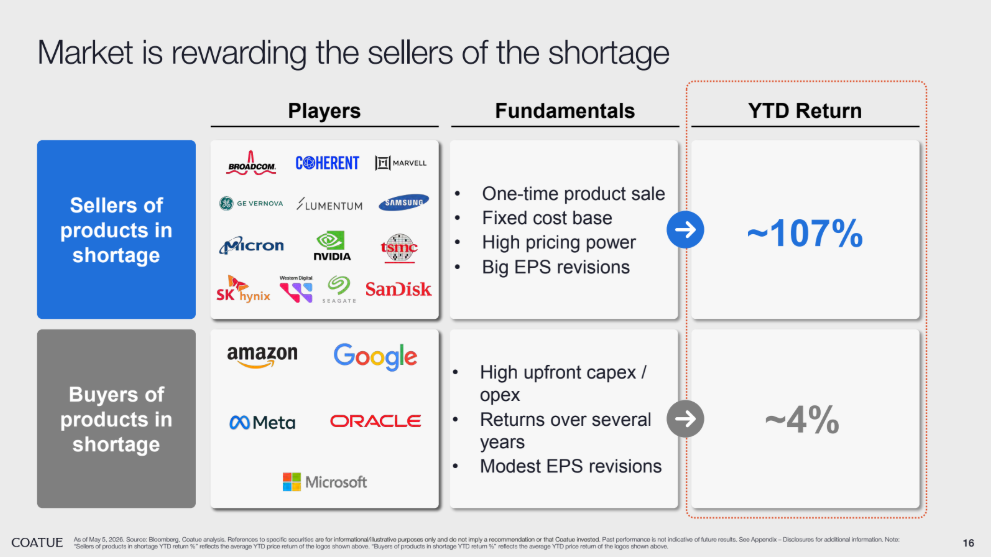
Speaking of shortages, Texas Instruments would like to pass along to you another price increase…
Analog IC leaders Texas Instruments and NXP both issued upbeat guidance for the current quarter, while market-circulated reports suggest the two are also moving in parallel on pricing actions. According to Sina and eTime, citing company notices, TI is set to launch its second round of price hikes this year, while NXP is reportedly preparing an increase as soon as June.
eTime reports that a market-circulated Texas Instruments notice dated May 7 signals another round of price increases. The letter cited indicates TI will adjust pricing across multiple product lines, with increases varying by materials and technologies. New pricing will apply to all orders and shipments from July 1, 2026, with the company attributing the move to market conditions and rising supply chain costs, the report adds.
While the latest notice does not disclose the scale of adjustments, Sina notes this marks TI’s second price hike this year, following an increase in April, when prices on select analog and embedded products were raised from April 1.
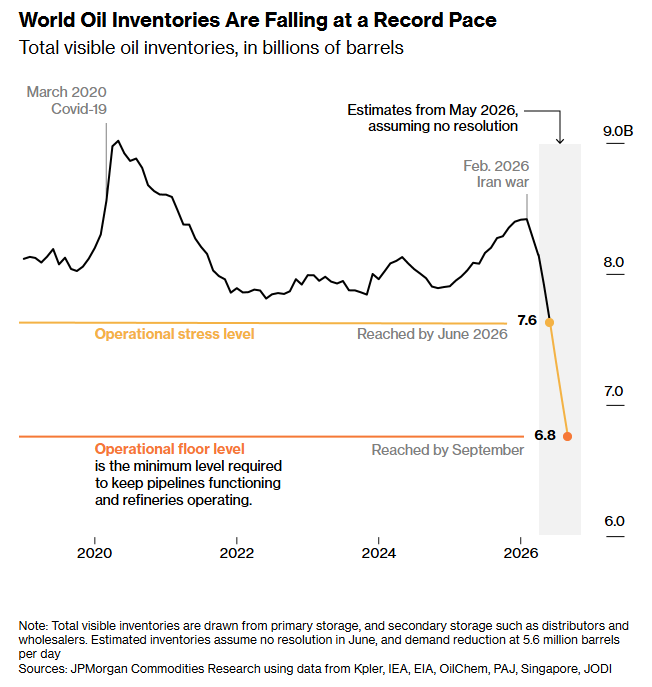
I have no idea if the oil storage tanks will run dry on the 4th of July, but the total energy supply chain gets more stressed with each passing week of idle supertankers…
The world has burned through oil inventories at a record speed as the Iran war throttles flows from the Persian Gulf, eating into the very buffer that protects against supply shocks.
The rapidly shrinking stockpiles mean that the risk of even more extreme price spikes and shortages is getting ever-closer, leaving governments and industries with fewer options to cushion the impact of the loss of more than a billion barrels of supply, two months into the near-closure of the Strait of Hormuz. The sharp depletion will also mean the market stays vulnerable for longer to future disruptions even after the conflict ends…
Crucially, the system also requires a minimum level of oil, which means that the “operational minimum” is reached long before the inventories actually hit zero, said Natasha Kaneva, JPMorgan Chase & Co.’s head of global commodities research.
“Inventories are acting as the shock absorber of the global oil system,” she said. But “not every barrel can be drawn.”…
JPMorgan’s Kaneva warns that inventories in the Organisation for Economic Co-operation and Development could reach “operational stress levels” early next month, if the strait doesn’t reopen, and then “operational minimum” floors by September. That’s the point when the world hits the bare minimum amounts of oil needed for pipelines, storage tanks and export terminals to function properly.
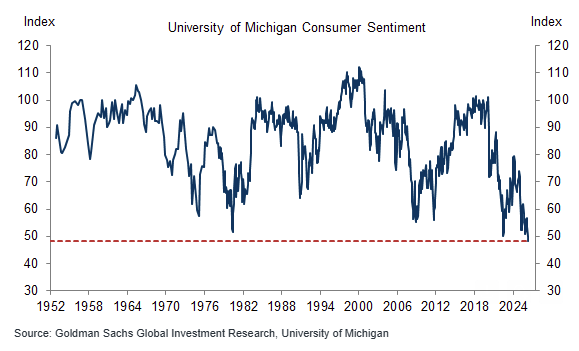
Higher energy prices continue to be felt in the recent consumer sentiment surveys…
The University of Michigan’s index of consumer sentiment declined by 1.6pt to 48.2 in the May preliminary report, somewhat below expectations and the lowest level in the survey’s history if it holds in the final report. The survey's current economic conditions component declined by 4.7pt to 47.8, which would also be the lowest level in the survey’s history if it holds in the final report, and the consumer expectations component edged up by 0.4pt to 48.5. The University of Michigan noted that “About one-third of consumers spontaneously mentioned gasoline prices and about 30% mentioned tariffs. Taken together, consumers continue to feel buffeted by cost pressures, led by soaring prices at the pump.” They added that “Middle East developments are unlikely to meaningfully boost sentiment until supply disruptions have been fully resolved and energy prices fall.”
Goldman Sachs
The restaurant industry began to note some customer stress which is likely due to higher gas prices…
“Overall foot traffic to restaurants remains challenged.. Per Black Box, traffic to restaurants was down approximately 1.9% in the quarter.” - Sysco CEO Kevin Hourican
McDonald's is in a better position than most, but they are still feeling the consumer stress…
McDonald's CEO Chris Kempczinski said on Thursday higher gas prices linked to the Iran war were disproportionately hurting low income consumers, as the burger chain warned of a weak start to its second quarter.
McDonald's, like several fast-food chains, relies heavily on low-income consumers and have been offering up value deals to lure more cash-strapped diners…
"Elevated gas prices are the core issue we're seeing right now," Kempczinski said on the earnings call. "I think probably it's fair to say ...(macro environment) is certainly not improving and it may be getting a little bit worse."
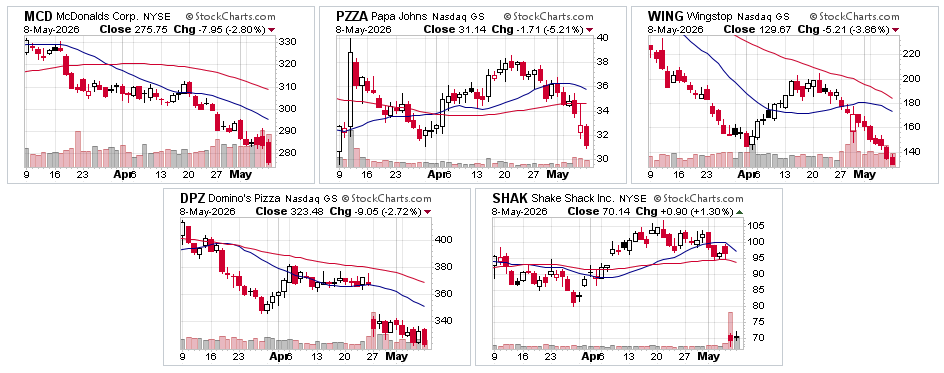
Several U.S. restaurant chains such as Shake Shack, Papa John's, Wingstop and Domino's have reported weaker quarterly sales growth, citing a fallout from the Iran war.
As these quick serve restaurant stocks show, it has been a challenging earnings month…
StockCharts
The weak housing market also had a hand in major negative earnings surprises at Installed Building Products and Whirlpool…
- IBP - Total residential sales fell 10% (single-family residential sales down 10% and multi-family down 11%). 1Q operating margins of 11.3%, down 130 bps y/y.
- WHR 1Q sales -10% y/y (North America sales -8% y/y). Op Mgin = 1.3% -460 bps y/y (N.Am Op Mgin = 0.3% -590 bps y/y).
IBP & WHR quarterly earnings releases
For Whirlpool, they feel like they are operating during a recession…
"The US appliance industry demand declined 7.4% in Q1, with March being down 10%. This level of industry decline is similar to what we have observed during the global financial crisis and even higher than during other recessionary periods."
“...we can see that consumer sentiment has dropped to its lowest level in 50 years. The consumer sentiment was already on a very low level by any historical standards, but the war in Iran amplified consumer concerns about the cost of living. As a direct result, the consumer sentiment index in the US plunged, reaching the lowest level on record in March. Now, while our view is that consumer sentiment is unsustainably low and should rebound from here, these events clearly pressured our industry and particularly discretionary demand.” - Whirlpool CEO Marc Bitzer
@TheTranscript_
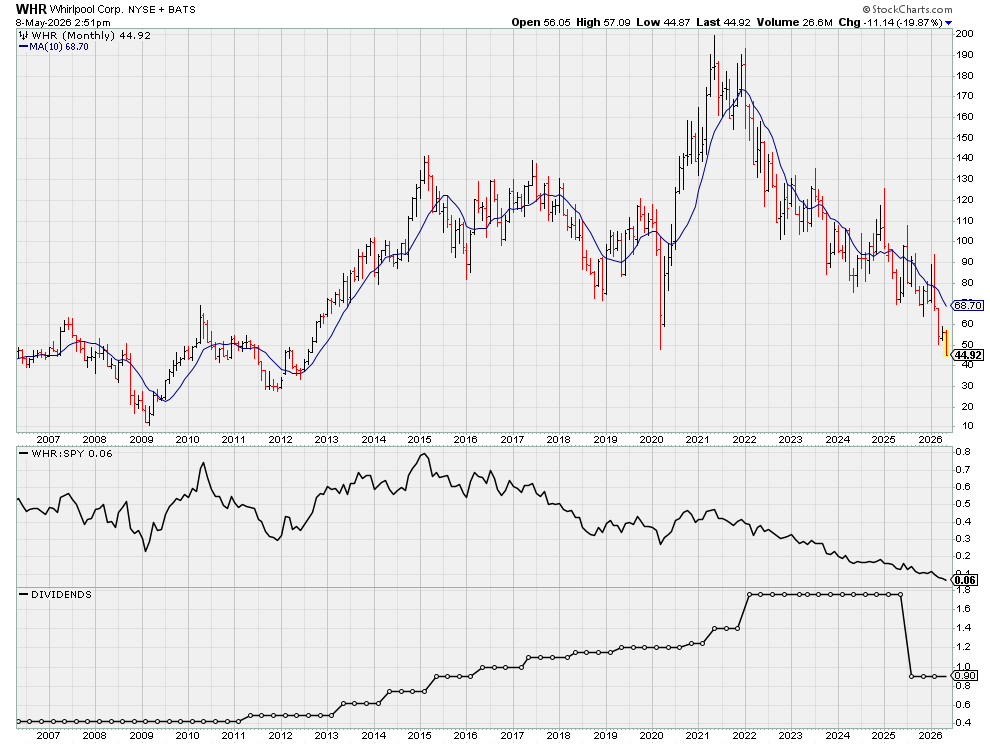
In fact, the wipeout of operating cash flow has forced Whirlpool to end its 55 years of paying a dividend…
Century-old Whirlpool has paid a dividend through 10 U.S. recessions and every global crisis since the 1950s. But the American manufacturer’s cash crunch has gotten so severe that it is suspending that payment until further notice.
The news sent shares plunging more than 20% before settling down 12% on Thursday as Wall Street analysts pressed executives for clarity on the appliance maker’s financial picture. The stock has dropped more than 80% over the past five years as the company’s cash flow has shrunk, leaving it without enough to both pay out investors and pay down its debts. Last year, Whirlpool slashed its dividend by nearly half…
Whirlpool blames the Iran war for driving U.S. consumer confidence to 50-year lows as higher oil prices add to ongoing concerns about the cost of living. The company’s organic net sales declined 6% year-over-year in the first quarter, and its adjusted earnings, which Wall Street had expected to be 38 cents a share, came in as a loss of 56 cents a share.
StockCharts
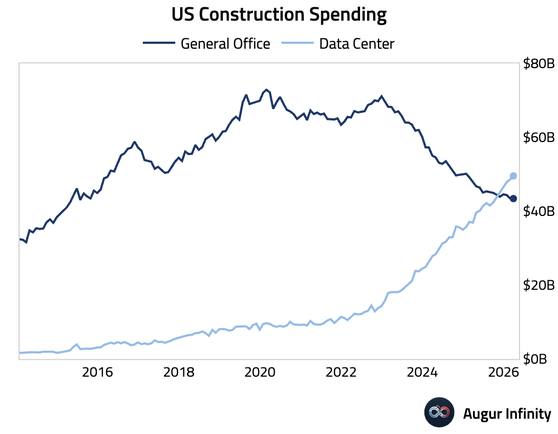
If only, Whirlpool would have also made IT equipment cabinets…
Data center construction spending remains strong, with the lead over general office construction widening.
Meanwhile the slowing of new Office builds is leading to a pickup in rent prices…
“On a relative basis, nobody started new construction. There was no new supply generated starting in 2020 because of the pandemic, and then following 2020 because of the rise in rates, and then following that because of work-from-home concerns. So we’ve now seen a recovery in demand that’s being matched by essentially 0 new supply in the market.. And in Tier 1 markets, we’re seeing the top come off rents. Rents legitimately 50%, 70%, 80% higher than they were 5 years ago and that’s beginning to flow through the numbers.” - Brookfield Asset Management CEO Connor David Teskey
The IPO calendar is heating up before summer arrives…
Some high profile offerings on deck for the next ten days across the power, AI, and semi sectors.
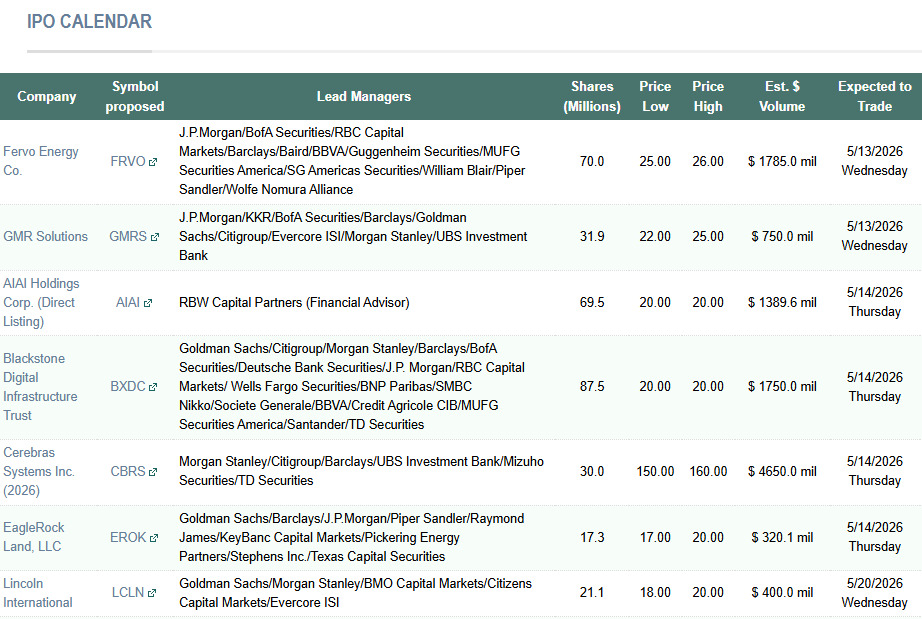
This AI chip company demand is so hot that its price range is melting upward…
Cerebras Systems is set to raise the size and price of its initial public offering as soon as Monday, as demand for the artificial intelligence chipmaker's shares continues to climb, two people familiar with the matter told Reuters on Sunday.
The company is considering a new IPO price range of $150-$160 a share, up from $115-$125 a share, and raising the number of shares marketed to 30 million from 28 million, said the sources, who asked not to be identified because the information isn't public yet.
At the top of the new range, Cerebras would raise roughly $4.8 billion, up from $3.5 billion under its original terms, though the figures remain subject to change before pricing, the people said.
The increase follows a broader surge in AI adoption that has driven sharp demand for high-performance chips and turned semiconductors into a key bottleneck in the technology supply chain. Cerebras' IPO has drawn orders for more than 20 times the number of shares available, the people said, as the chipmaker looks to manage surging interest ahead of its May 13 pricing.
Reuters
Last week saw a pure play MEMS foundry go public in Europe's most successful listing in over a decade…
311 Swedish kronor on Monday's close would put it +280% from its IPO price. Who said Europe was a cold place to do a high tech IPO?
Silex Microsystems AB surged in its first day of trading on Nasdaq Stockholm after an initial public offering that raised about 2 billion Swedish kronor ($220 million) for the specialist microchip-maker and its Chinese shareholder Sai MicroElectronics Inc.
The debut marked the best first day performance for a sizable European IPO in more than a decade. Cornerstone investors took the majority of the shares in the offering and the deal was heavily oversubscribed.
Shares closed at 225.55 kronor apiece, 178% higher than the IPO price of 81 kronor. It was the best first day performance since REC Solar ASA’s IPO in 2013, according to data compiled by Bloomberg.
Silex operates the world’s leading facility for manufacturing micro-electro-mechanical systems, or MEMS, components that combine mechanical elements with semiconductor-style circuitry, according to its prospectus. The chips are used in technology that powers mobile phone accelerometers, which enables motion tracking for fitness and screen orientation, and steers lasers for lidar systems in autonomous driving.
Another positive call comment about the current underlying conditions for M&A…
“Well, clearly, there are some factors that really exist that really have existed before, but they’re quite strong right now. Number one, CEO confidence is very sound and quite high. Number two, the economy despite the fact that there is a dislocation and there is some uncertainty geopolitically, the economy is quite resilient. Number three, the financing markets are not just open, but they’re really abundant. And so there’s real financing opportunity. And so there is a real can-do attitude. And I think finally, I think Boards are very comfortable that scale is good right now for lots of different reasons whether it has to do with how do you deal with AI? How do you deal with the world around you? How are you thinking about your supply chains and things? Scale is actually looked upon as a positive, not a negative. And so that’s another reason.” - Evercore CEO John Weinberg
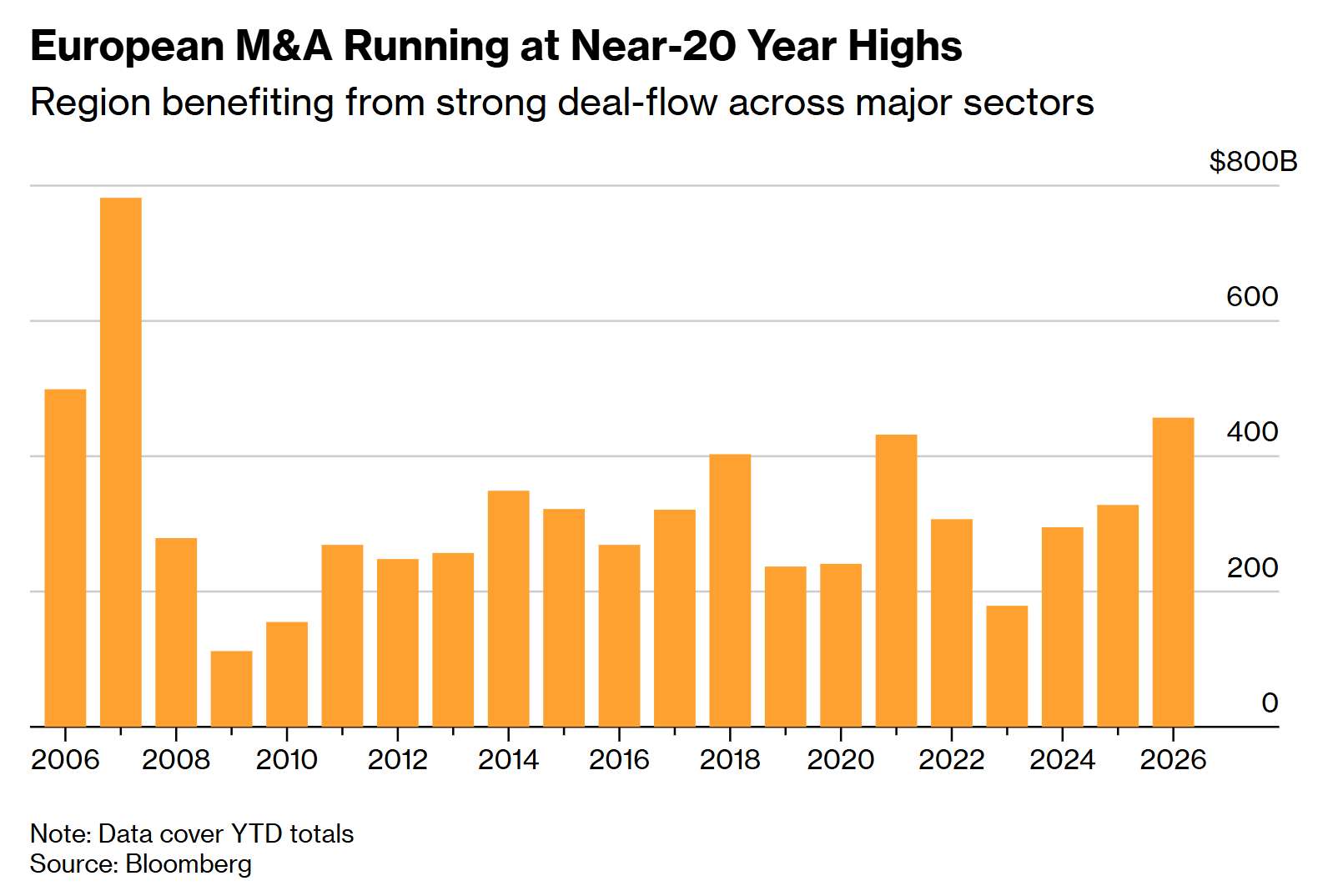
You don't have to tell Europe that M&A activity is strong as they are lining up for a two decade high in volumes…
…the M&A headlines have kept rolling in as Europe’s dealmakers plot their own path to the history books. Fittingly, you also have to go back around two decades for the last time deal volumes in the region were running this hot.
Let’s take a look at those numbers: the value of M&A involving European companies has risen 39% to more than $455 billion this year, data compiled by Bloomberg show. That really stands out when compared to other major regions. In the Americas, things are running at a far more modest (but still respectable when considering historical averages) 9% higher, and it’s a similar story in Asia Pacific.
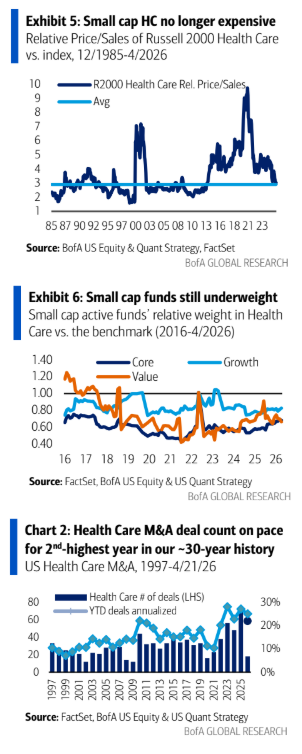
And while US Health Care valuations remain in the doldrums, M&A in the sector is lining up a record year…
Health Care M&A has picked up in in the years post-COVID, and year-to-date, we’ve seen 18 deals – on track for the second-best year in our data history (~60 deals if annualized, close to 2023 levels) after 2025’s record 70+ deals (Chart 6). Health Care’s share of total deals (25% YTD) has been tracking at record highs (between 20-30%) since 2023. Large cap Health Care continues to buy pipeline growth in SMID (most targets remain small caps), particularly with looming patent cliffs in large Pharma, though aggregate deal size has also begun to increase (on track for the highest since 2019 if YTD pace continues).
BofA Global
Another sore part of the market that is looking less sore is the Software space…
A new higher high to start the month of May.
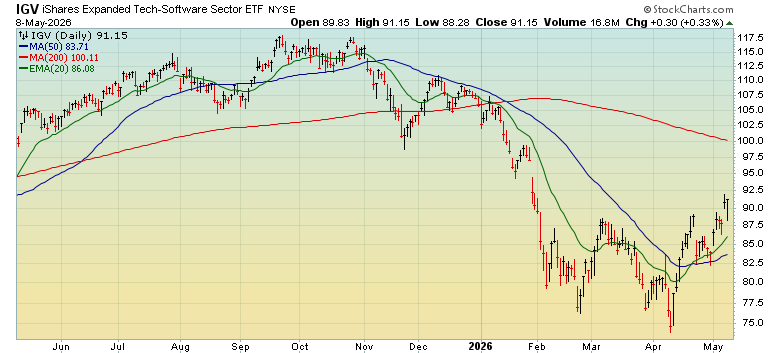
It doesn’t hurt that valuations for software companies are at record lows right now…
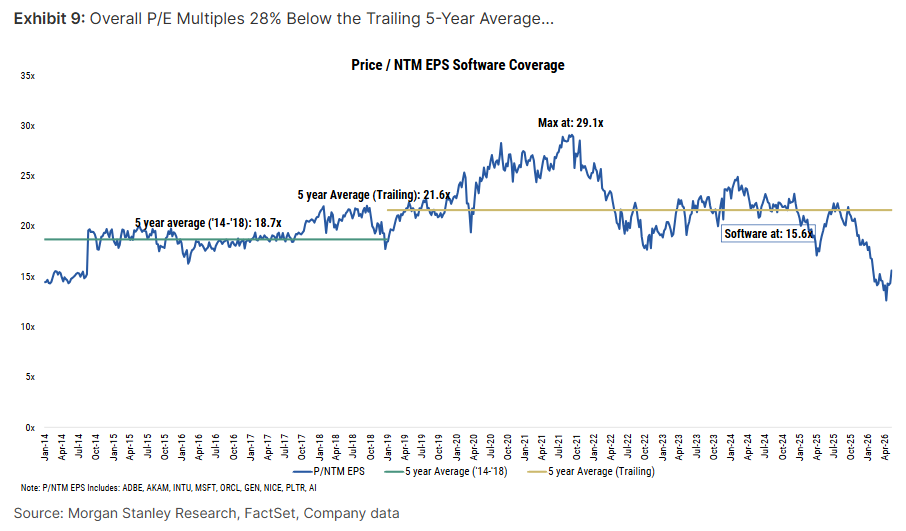
Morgan Stanley
Meanwhile, the rest of non-Software large cap Tech was making all-time new highs on Monday…
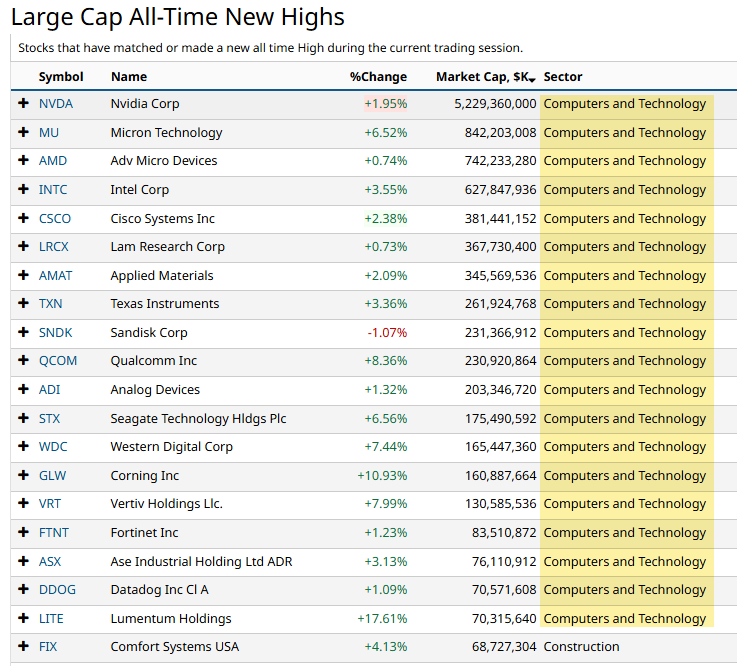
Barchart
Emerging Market equities are now eyeing their best 12 month run since after the GFC…
Overweight commodity and semiconductor exposures also helping EM to finally outperform the S&P 500.
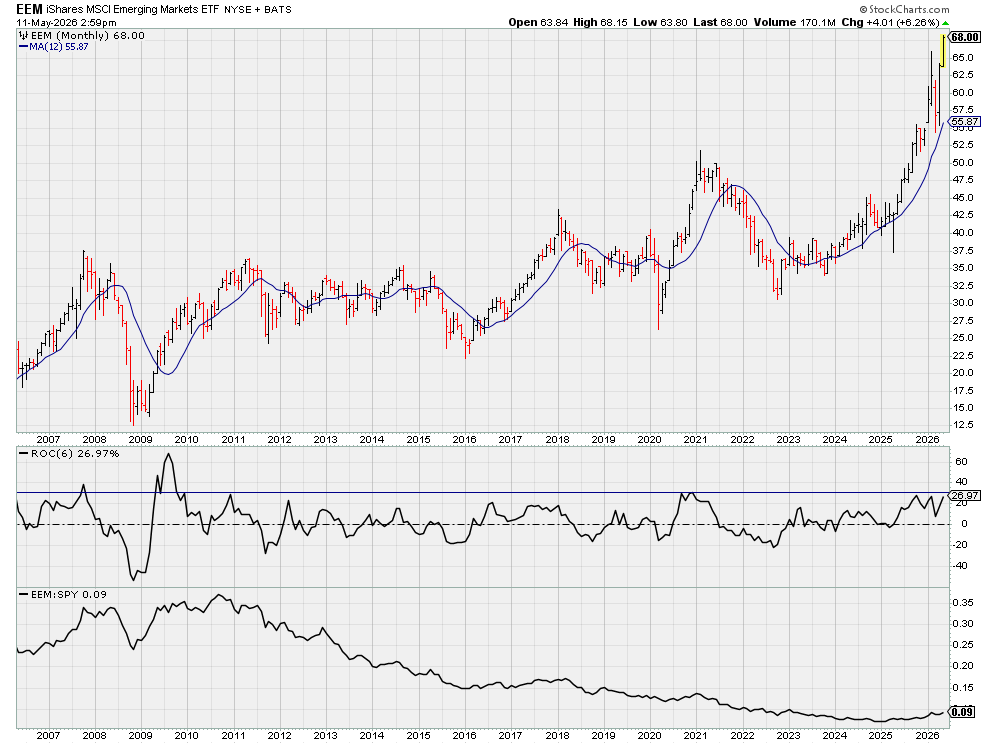
StockCharts
In addition to ramping outperformance, Emerging Market valuations remain cheap…
The EM P/E relative to DM is trading at a record discount at present, at 12x forward P/E versus approximately 20x for DM, this represents a 37% discount, significantly wider than the historical median discount. At an absolute 12x forward P/E, the space is far from demanding, particularly given the earnings growth trajectory of 51% for 2026 and 19% for 2027.
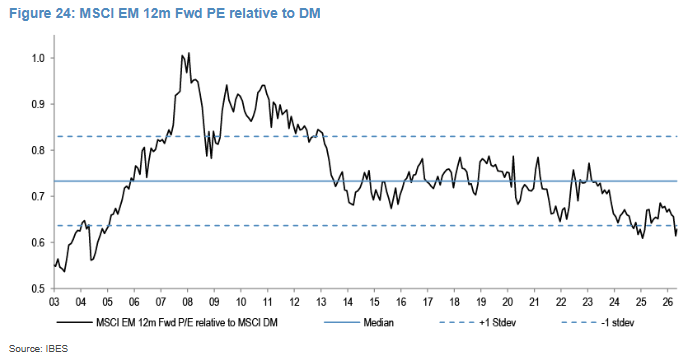
J.P. Morgan
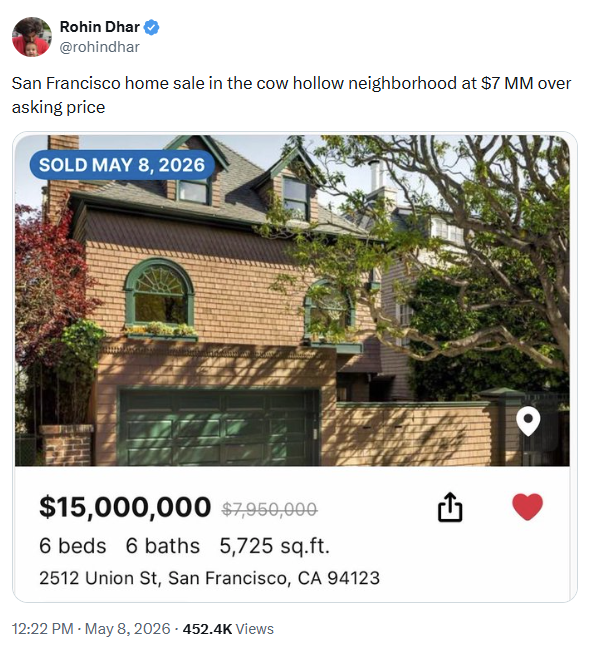
If you thought San Francisco was still having a difficult time, erase that thought…
Such a wild turn of events between Ukraine and Russia…
“Overall, it feels like an inflection point in the war,” says Sir Lawrence Freedman, an emeritus professor of war studies at King’s College London. “If the Russians have nothing to show for their efforts I would not be surprised if in some places things start crumbling.” Losses of soldiers, running at 35,000 a month, exceed the pace at which Russia can recruit replacements. And behind the raw numbers—nearly 1.4m killed and seriously wounded since Russia’s invasion—is a grimmer new development. Until last year, the ratio of killed to wounded Russian soldiers may have been between 1:2 and 1:3, poor by modern standards but roughly in line with past conflicts. In March Mr. Zelensky said that Russia was suffering almost two dead soldiers for every one wounded. “The stoicism and fatalism of Russian soldiers must be wearing thin,” says Sir Lawrence.
Finally, find a time at the end of July to see the greatest story ever told…
And Christopher Nolan made it in 100% IMAX cameras which is a first for the film industry.

Learn more about the Hamilton Lane Strategies
DISCLOSURES
The author has current equity ownership in: McDonald's Corp.
The information presented here is for informational purposes only, and this document is not to be construed as an offer to sell, or the solicitation of an offer to buy, securities. Some investments are not suitable for all investors, and there can be no assurance that any investment strategy will be successful. The hyperlinks included in this message provide direct access to other Internet resources, including Web sites. While we believe this information to be from reliable sources, Hamilton Lane is not responsible for the accuracy or content of information contained in these sites. Although we make every effort to ensure these links are accurate, up to date and relevant, we cannot take responsibility for pages maintained by external providers. The views expressed by these external providers on their own Web pages or on external sites they link to are not necessarily those of Hamilton Lane.